De Materie – Phia Ménard/Opera Ballet Vlaanderen/Bas Wiegers
Een schurend vooruitgangsdenken
Sébastien Hendrickx





‘Language: no broblem’, Marah Haj Hussein, © Giada Cicchetti
In Language: no broblem, dancer and theatremaker Marah Haj Hussein fries an egg on the stage and it feels like trying do away with the useless yet enraging chicken-and-egg question. Who was first? The Palestinians or the Israelis? Who invented the hummus and the falafel? Are these almost ridiculous questions important in the face of a bloody conflict? The play seems to descend into a definite no, a no that dances through framing language boundaries. Yet the conflict is still there and the tension between national and individual identity is spun tightly, weaving a postmodern collage of language and identity. Through intimate encounters, Hussein explores how Palestinian Arabic and Hebrew intertwine in the minds of those navigating oppressive realities.
‘Language and Ideology’ was a course I took as a third year bachelor’s student. We analysed how a language can be used as a status marker and thus gatekeep certain groups of people from participating in a social setting. The cold academic scalpel cut through these questions painlessly, there was a distance even with recognizable tensions. Hussein cleverly stages her play as a lecture, introducing relevant vocabulary so the audience could follow. I, being a good student, even wrote the terms down. Hussein establishes safety in the theatre room, giving an introduction to what we’re going to see and read. We’re going to hear multiple interviews in Arabic and read the translation on the stage. The translation is in different colours so we can separate the different speakers.
“Through intimate encounters, Hussein explores how Palestinian Arabic and Hebrew intertwine in the minds of those navigating oppressive realities.”
We start with an almost innocent example of a daily judgment passed on strangers. In Arabic there’s a saying: ‘calves chewed your trousers’. It means that the trousers haven’t been properly ironed. We hear a couple of ladies talk about this and giggle. But their lightness isn’t infectious, it clashes with the multicultural, interdisciplinary, polylinguistic mood of the show. I wonder who irons their clothes these days. I also notice that the judgment is passed on the wrinkles, folds, unevenness of the cloth – you might even say the lack of monoculture. However, monoculture is inherently impossible. One of the speakers describes their relationship with language as an uprooted tree that doesn’t have nurturing soil to grow in. The theme of language feeling like home is present in almost every snippet of dialogue. The speakers have sensitive and deep relationships with their mother tongue, it’s something they think about every day, not just a tool of communication. Some of them hate Hebrew, some of them focus on how similar these languages are, but almost all of them prefer one over the other.
© Oya Latifa
“It’s surprising and ingenious, it’s beautiful to see the few props on the stage change shape, expand, shrink or break apart in order to hold the words.”
The dialogue snippets are also interrupted by Hussein’s re-enactment of her eventful train travels. She’s compiling a story from the short episodes but we constantly get interrupted by the dialogues, Hussein changing her mind, train conductor announcement, or yet another language she encounters on the train. The postmodern collage she’s assembling makes sense as far as she’s able to hold the many often clashing stimuli she receives: she speaks Arabic but isn’t religious, she can’t tolerate the smell of durum because it gets in her clothes, she sits next to someone that eats beetroot hummus and speaks Hebrew, she has to move because she sits in someone’s chair, she wonders about who lives in Lokeren.
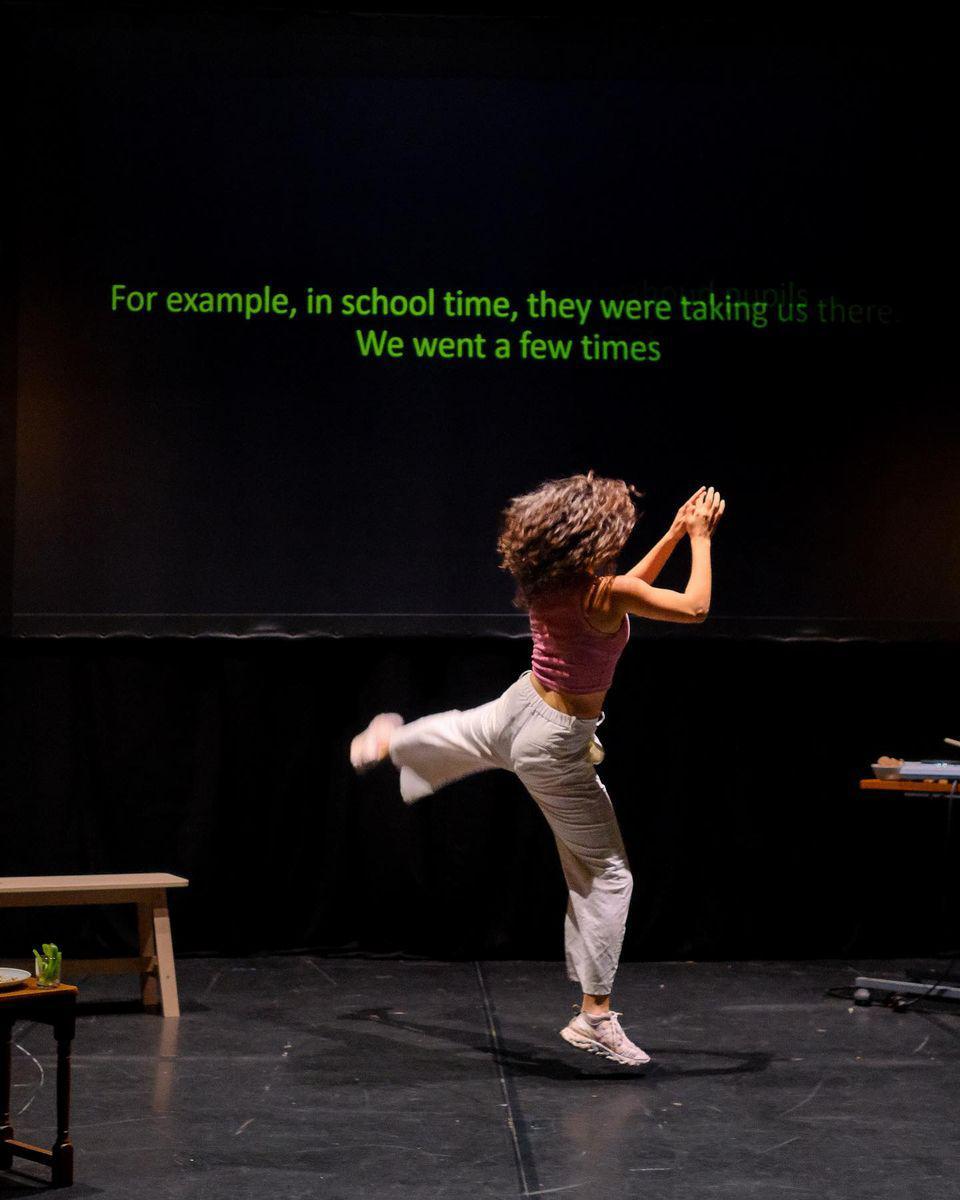
In the meantime Hussein prepares different surfaces on the stage so we can see the translation of what’s being said on yet another place: the lid of the box, a part of a bench, a stretched out cloth. It’s surprising and ingenious, it’s beautiful to see the few props on the stage change shape, expand, shrink or break apart in order to hold the words. More and more often we see Hussein herself holding the words, carrying their weight with her arms – and then interviewees start questioning her: why are you asking these questions, you’re a dancer, why do you care? At this point Hussein seems to be breaking from the tension of navigating these multiple languages and cultures in Belgium, where she’s well integrated, she repeats, but feels the pressure of a fold that’s supposed to be ironed.
“Set against a backdrop of everyday scenes – frying an egg, train rides, conversations – the play touches upon deeper questions: Who belongs? Whose language takes precedence? Its strength lies in maintaining tension even in release, leaving us to reflect on the unseen borders that divide us.”
The play spirals together with Hussein towards some kind of release, but not after Hussein lashes out against white people’s privilege, the pressure to be normal, the expectation to integrate. It touches on many themes and is layered to point where the only thing left to do is dance. The play isn’t afraid to be in your face, doesn’t shy away from harsh truths and isn’t trying to be politically correct. It has a lot of power and holds many perspectives which feels authentic to the performer at the heart of it all. Set against a backdrop of everyday scenes – frying an egg, train rides, conversations – the play touches upon deeper questions: Who belongs? Whose language takes precedence? Its strength lies in maintaining tension even in release, leaving us to reflect on the unseen borders that divide us.
KRIJG JE GRAAG ONS PAPIEREN MAGAZINE IN JOUW BRIEVENBUS? NEEM DAN EEN ABONNEMENT.
REGELMATIG ONZE NIEUWSTE ARTIKELS IN JOUW INBOX?
SCHRIJF JE IN OP ONZE NIEUWSBRIEF.
JE LEEST ONZE ARTIKELS GRATIS OMDAT WE GELOVEN IN VRIJE, KWALITATIEVE, INCLUSIEVE KUNSTKRITIEK. ALS WE DAT WILLEN BLIJVEN BIEDEN IN DE TOEKOMST, HEBBEN WE OOK JOUW STEUN NODIG! Steun Etcetera.
recensie
11.09.2024
Leestijd 5 — 8 minuten
05.09.2024
—
14.12.2024

Ugnė Noreikė is a Lithuanian writer, musician and artist. She works in spaces of not knowing, vulnerability and extreme feelings. She’s looking for meeting points between sounds and words.
Dit artikel maakt deel uit van: Dossier: Theater Aan Zee 2025
Sébastien Hendrickx
Mia Vaerman
recensie 11.09.2024
Sébastien Hendrickx
Mia Vaerman