Confessie – Raven Ruëll & Bruno Vanden Broucke
De kunstmarkt maakt de kunstenaar
Klaas Tindemans




© Asmaa Laajimi
A headless suit, disembodied legs, a floating apple: Ika Schwander brings Magritte’s uncanny imagery to life in this commissioned performance at KMSKA. Wading through his surrealist universe, Schwander stirs the waters of his founding trauma: the drowning of his mother. And in restaging that story, Schwander dismantles the myth of the lone genius: what if Magritte’s art equally belongs to his mother Régina, to his wife, to all of us?
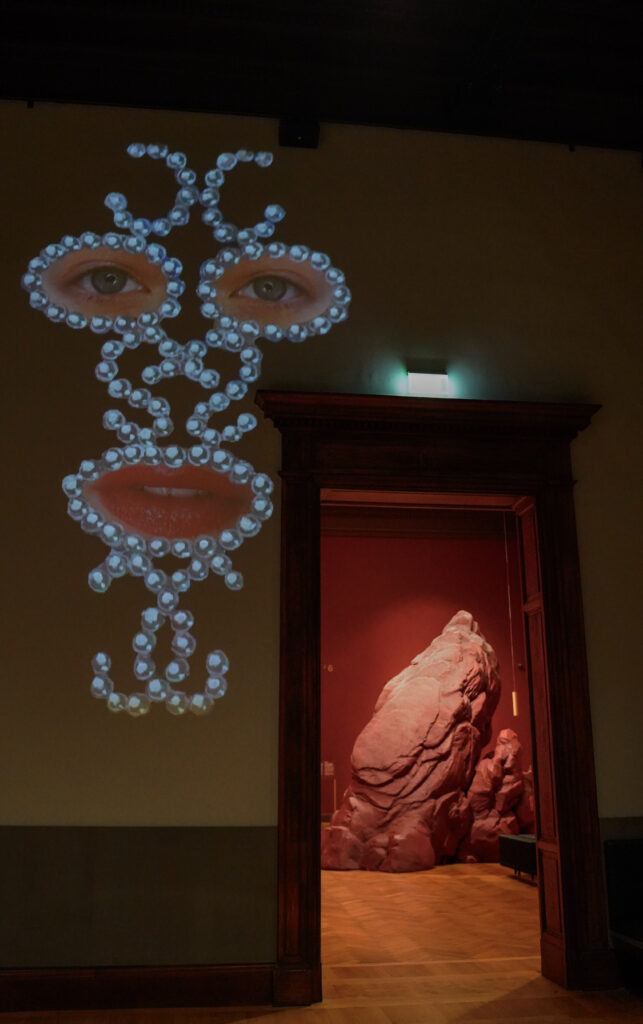
A headless man sits in the corner of a big room. I call this figure a man because it wears a black suit with a stiffened white collar underneath. A dress is lying on the ground, a pearl mask from Magritte’s Sheherazade is projected on the wall. Or is it a wall? The light beaming through its cracks makes me question the solidity of it. This looks like a still of one of Magritte’s paintings, an homage by Ika Schwander commissioned by KMSKA to celebrate the end of a three-month-long exhibition. She brings his ideas and figures to life, contextualizing them in the contemporary world.
Suddenly, I turn and see the suit standing. Its steps are echoing as if from underwater. Slowly, it reaches the wall that opens into a massive elevator. There lie two pairs of legs joined by the waist of Mitzi Beesemer struggling to find what is up and what is down. The legs wriggle, roll around but the body is left none the wiser, we don’t understand what it wanted, but did it want anything at all? The headless body closes the door. Could the suit see what it was showing?
After Magritte’s mother drowned herself in the river he started questioning the abilities of his vision. Seeing her body all pale, like that of a fish, her face covered by her nightgown, he didn’t recognise this body as that of his mother. We hear the voice of Magritte talking about how the latency of his vision affects reality. He comes to a conclusion that he can only trust still images even though these are mere representations of a delayed present. Aren’t we all walking headlessly, constantly confused about what is up and down, trying to figure out ourselves and failing?
“Aren’t we all walking headlessly, constantly confused about what is up and down, trying to figure out ourselves and failing?”
Something green rolls onto the stage. An old man next to me claps his hands. ‘Une pomme!’ he exlaims. It’s funny how charged these fruits are: from Adam and Eve to doctors and Magritte, who enters the room as the apple rolls in? Schwander walks in reverse tabletop position with a man’s head in between her legs. She crawls to the dress on the ground and puts it on. The man’s head is now at the top of the dress, the legs become his arms. Once again this collection of body parts is struggling to find its bearings. Each body seems to be missing something. We seem to all be searching for the answer to our creation myth. Why were we created, why do we die?
The action parts of the performance are separated by Magritte talking about his ideas, his world-view, the death of his mother. It’s often disjointed and hard to follow, but it seems to be pointing to the emptiness that a loss of a dear one leaves behind. It poses a need to re-invent – the mother who has drowned, the charged apple of our creation myth, the body that’s missing something while also being cast completely into its being.
© Asmaa Laajimi
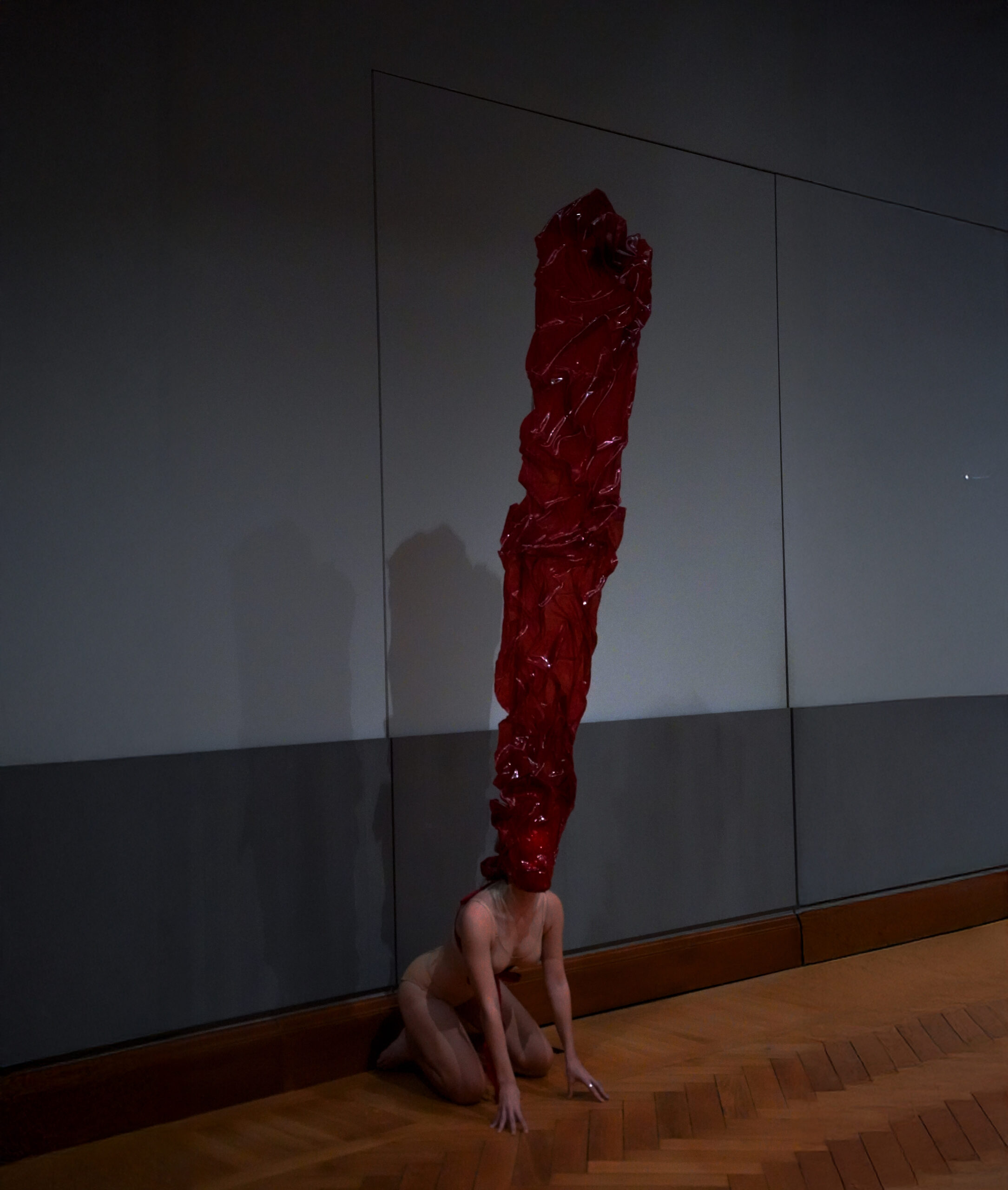
As Schwander wades through Magritte’s ideas so she stirs the waters of the river where his mother has drowned herself. Magritte had a bad relationship with water after the incident and has learned to stay on the shore, out of fear to be called in by his mother. In the end Schwander is sitting stark naked with a tall red mask-crown on her face. She’s emboyding Magritte’s mother with her nightgown standing erect: obscuring her face but also crowning her. And no wonder, her name was that of a queen: Régina. And Régina has come to claim her place in René’s art.
This reminded me of one of the last sketches by Magritte I saw in the exhibition downstairs. It made me sigh out loud and roll my eyes. It showed a naked woman with an erect penis instead of her head. I was appalled by it and jumped to conclusions – the same old story of men objectifying women, I concluded. However, with Schwander’s take, his drawing is transformed. In the play’s scenes depicting contorted disformed bodies I’m enabled to see it as an interchange, a renewed relationship. It’s just a head growing from genitalia, genitalia growing from a head. No one is anyone’s tool; it’s a reinvention of relationships, sexuality, the birthing of ideas.
“In the play’s scenes depicting contorted disformed bodies I’m enabled to see it as an interchange, a renewed relationship. It’s just a head growing from genitalia, genitalia growing from a head. It’s a reinvention of sexuality, the birthing of ideas.”
A big question today is how we reinterpret the works of masters in the light of half of the world’s population gaining visibility. Schwander’s nakedness makes the nakedness of all the other women in the halls next door much more apparent. As a feminist viewer I’m prone to make distinctions: Schwander chose to be naked, therefore she’s empowered, the women in the paintings are mere props. Time and time again I have to ‘forgive’ the great painters their blindness when it comes to women. And while it is true that the world of art has long been a big sausage party, it is equally true that women are capable of moving beyond victimisation. We can re-imagine the great classics as ideas about the world – as a mystery, and not a battle between sexes.
Schwander invites us to look beyond what one might dismiss as an outdated idea and see the relationship in everything that was ever created. So Magritte’s art is also that of his mother, of his wife, and of all of us today, he’s not a lone genius. We’re all interconnected, and this connection is beautiful as well as confusing. Collecting all of these experiences into a painting, and seeing it as a collection is where the creation myth begins.
KRIJG JE GRAAG ONS PAPIEREN MAGAZINE IN JOUW BRIEVENBUS? NEEM DAN EEN ABONNEMENT.
REGELMATIG ONZE NIEUWSTE ARTIKELS IN JOUW INBOX?
SCHRIJF JE IN OP ONZE NIEUWSBRIEF.
JE LEEST ONZE ARTIKELS GRATIS OMDAT WE GELOVEN IN VRIJE, KWALITATIEVE, INCLUSIEVE KUNSTKRITIEK. ALS WE DAT WILLEN BLIJVEN BIEDEN IN DE TOEKOMST, HEBBEN WE OOK JOUW STEUN NODIG! Steun Etcetera.
recensie
17.02.2026
Leestijd 5 — 8 minuten
15.12.2025
—
14.04.2026

Ugnė Noreikė is a Lithuanian writer, musician and artist. She works in spaces of not knowing, vulnerability and extreme feelings. She’s looking for meeting points between sounds and words.
Klaas Tindemans
Mia Vaerman
recensie 17.02.2026
Klaas Tindemans
Mia Vaerman