Lullabye – Anneleen Keppens
Wie zorgt er voor wie zorgt?
Tom Rummens





© kurt van der elst
‘Death is fast, doom moves slow’, writes Johanna Hedva in How to Tell When We Will Die. Macc(h)abées by theatre maker and performer Sophie Warnant functions like a physical capsule spilling these temporalities and a seven-year-long research on the end of life. How to unpack themes like euthanasia, burial practices and countless conversations with doctors and patients in a dance without words? And how could writing on a dance like that keep up with the bodily acuteness the performance is striving for?
The gym hall of the primary school Kroonlaan in Oostende is the hosting venue for Macc(h)abées during this year’s festival edition of Theater Aan Zee.
The pull of time into its multiple directions is palpable here: The hall is a century old, yet somewhat glowing from its noticeably neat restoration; the place usually inhabited by sporting children, now filled with spectators that appear to be predominantly in a later stage of their lives.
Sophie Warnant awaits us as we enter and must delay the start of her performance even further, since the bathrooms of the venue are located across the yard behind the gym hall. Those still needing to rush there exchange apologetic glances with her, acutely aware of causing a disruption in the agreed-upon protocol. Then, in the bathroom: A row of tiny toilets with doors so low that the occupants can be watched by their attending supervisors at all times. The vulnerability of being witnessed in an inconvenient bodily state– of being a body in need of care– are themes that will be re-evoked throughout Warnant’s performance.
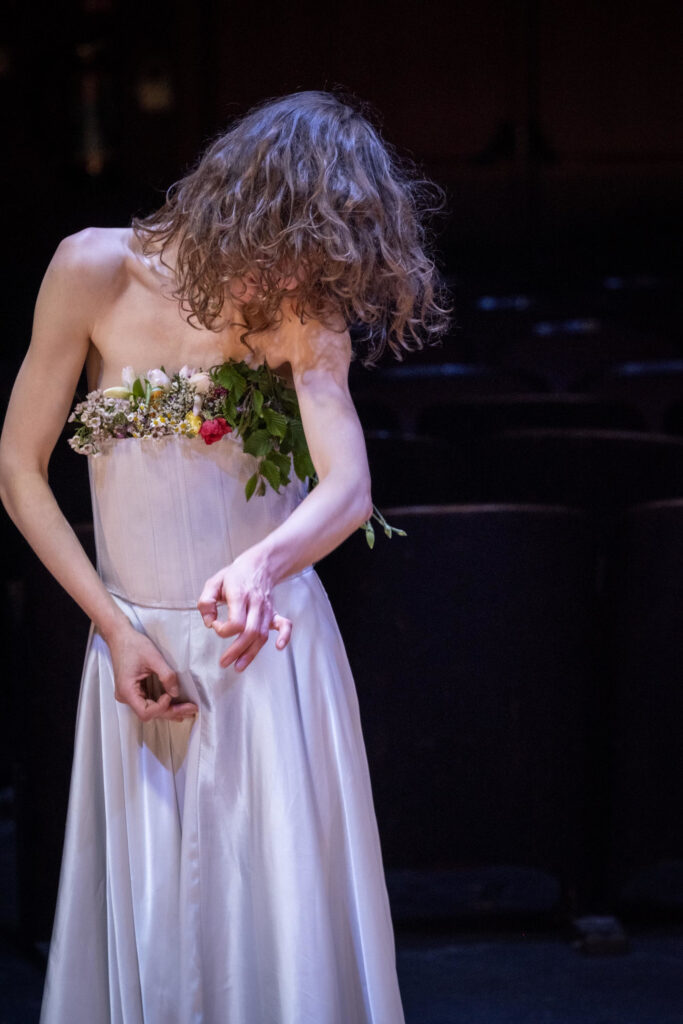
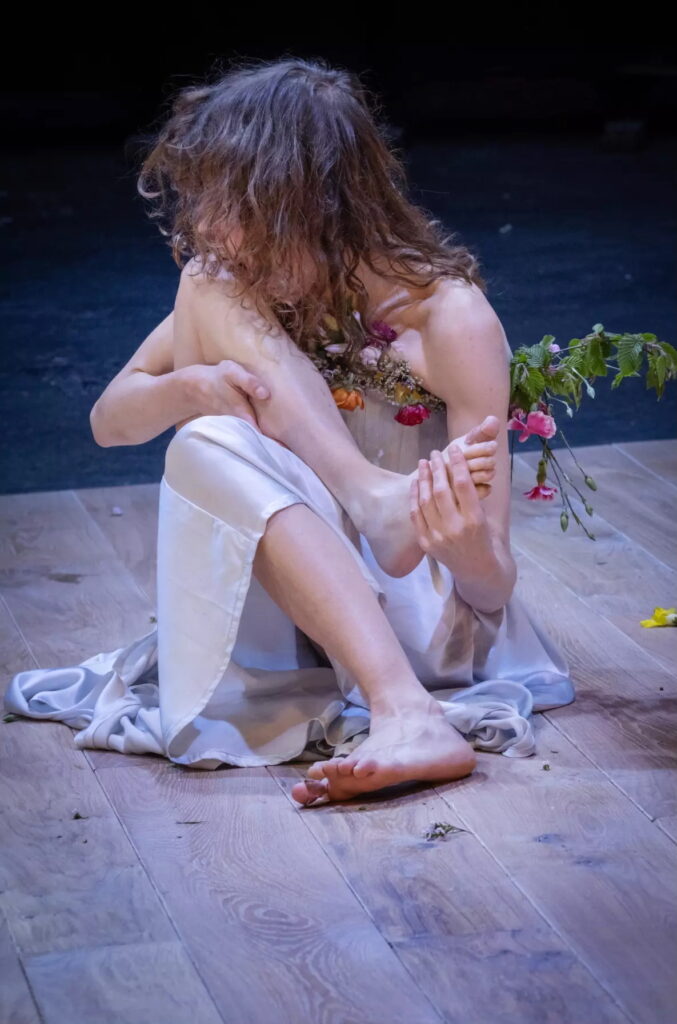
With everyone finally settled, Macc(h)abées takes off gradually and silently; Warnant’s accommodating smile still rests on us for a while. Dressed in all black garments, she wears a silky chemise and Adidas sweatpants: a little bit of priest on top, the contemporary performer’s working uniform on the bottom. Or rather the clothing of those who haven’t left their house, their bed or a hospital ground in a long time? Shedding layer after layer, Warnant changes into a light-coloured satin dress; a bouquet of flowers tucked into the corset opening, from now on decorating and lightly obscuring her bare chest.
A striking detail: A pair of kneepads loosely hanging on her shins, taken off before fulfilling their purpose, as if the measures to soften the crash no longer matter because the crash itself is unavoidable.
“Sophie Warnant appears young and lively to me, yet I am reminded that what I can see of other people’s bodily and mental condition might be very limited.”
Invisible under her now festive and ethereal appearance, a pair of thermal underwear remains for a moment. I have to think of Freddie Mercury in his last video shoot for These Are the Days of our Lives– how underneath his costume, an extraprotective layer needed to shield his body against its own build-down; how he performed so gracefully, so generously on the surface. Sophie Warnant appears young and lively to me, yet I am reminded that what I can see of other people’s bodily and mental condition might be very limited.
When Warnant withdraws her casual, friendly attention from the audience, the physical time capsule of her research is irreversibly spilled, pouring out a contourless current of gestures and behaviors: There she stands with her head hanging, her empty palms stretched out– the moment of a grip loosened, a hand over, suspended and frozen in time. A violent gasp disrupts the silence– a wheezing, a groaning; a death rattle? Her mouth, open for too long, gapes at us. Her hands as if pulling something out from within her; her arms moving somehow in delight, somehow too stiffly– shaped into claws, becoming bony branches. Her mouth snaps shut, then presses into her naked flesh to breathe warmth into it. Her mouth that bites into her own flesh to suffocate a scream.
Macc(h)abées’ death dance oscillates between self-stimulation and self-soothing, facelessness and exposure, giddy disorientation and delusional determination. As soon as Warnant’s movements become assertive, suggesting a sense of track, she lies down, gets lost in contemplation, forgets about the track. Poses linger for too long; I allow my mind to drift away. Anyone who has ever woken and dozed off next to someone’s hospital bed might recognize this temporality. Erratic outbreaks jolt me back– a sharp in-breath, laughter, arms flailing through the air. Still alive. When Warnant covers her face with her dress and throws herself upside down, her now naked lower body stares back at us, plumply demanding to be dealt with. Yes, it is exposing to be unwell, sick, and dying and Warnant exposes and imposes her body in all its oddness upon us.
“Yes, it is exposing to be unwell, sick, and dying and Warnant exposes and imposes her body in all its oddness upon us.”
With increasingly reckless gestures, Sophie Warnant destroys the flower bouquet on her décolleté. What I had come to accept as part of her body splatters onto the light brown tarp laid out on the dance floor. A last drastic move, a grand gesture in full consciousness: Warnant grinds the flowers between two cobblestones with one heavy smack. What is left of them she places back into a vase and leaves the room quietly. A sober exit, unspectacular, without fuss, shifting symbolism of death and bodily disaster from archaic to banal.
I read Macc(h)abées as a physical speculation on the very moment of death, whether violent or chosen, sudden or seeping. Still, I wonder: what of Sophie Warnant’s seven-year-long artistic research does not live on in her dance? Had I not known about this impressively thorough preparational period, perhaps I would have fewer questions. Now, my curiosity about the encounters with thanatopractors and euthanasia-advocates remains somewhat unsatisfied and I am left to search for hints within Warnant’s gestures. Despite the associative spaciousness this allows for, at times I have doubts about the performativity at display: Is what I am watching an effort to empathize, a re-enactment, or even mimicry?
© kurt van der elst
© kurt van der elst
I come to the conclusion that it doesn’t really matter, as Sophie Warnant’s phenomenal and signifying body interact with one another in eternal loops: When Warnant imitates a gasp for air, she nonetheless gasps; her breathing changes the amount of oxygen that rushes into her lungs, coloring her cheeks red. It is in these moments, that I experience Macc(h)abées like in a time lapse of doom, the slow and inevitable decay we all share as part of the human condition.
What is most powerful about Warnant’s performance, though, is not so much the register of images she offers of the body as a site of breakdown, which is already familiarly ingrained into our cultural memory. It is more, how she creates a space where the audience is tending patiently and attentively to the body in crisis in their middle. How we wait it out, until it’s over and our attendance is no longer needed. I am also reminded that, for some bodies, the end of their condition will never be reached within their lifetime.
Once more to Johanna Hedva, who proposes the definition of “the body” as anything that needs support. No matter how close or far away from death we might be– or if we subscribe to the idea that we are, in fact, constantly dying– this feels true to me.
KRIJG JE GRAAG ONS PAPIEREN MAGAZINE IN JOUW BRIEVENBUS? NEEM DAN EEN ABONNEMENT.
REGELMATIG ONZE NIEUWSTE ARTIKELS IN JOUW INBOX?
SCHRIJF JE IN OP ONZE NIEUWSBRIEF.
JE LEEST ONZE ARTIKELS GRATIS OMDAT WE GELOVEN IN VRIJE, KWALITATIEVE, INCLUSIEVE KUNSTKRITIEK. ALS WE DAT WILLEN BLIJVEN BIEDEN IN DE TOEKOMST, HEBBEN WE OOK JOUW STEUN NODIG! Steun Etcetera.
recensie
06.08.2025
Leestijd 6 — 9 minuten
01.03.2025
—
14.09.2025
Anne-Lene Nöldner works as a dance artist in Belgium and Germany. She is a member of the ensemble Elsa Artmann/SANFTE ARBEIT, with whom she creates performances and publishes texts between essay and anecdote on their online platform sanfte-arbeit.de. From September 2025 Anne-Lene will start as artistic researcher at the Royal Conservatory of Antwerp.
Dit artikel maakt deel uit van: Dossier: Theater Aan Zee 2025

Tom Rummens
Floris Baeke
recensie 06.08.2025
Tom Rummens
Floris Baeke