De Materie – Phia Ménard/Opera Ballet Vlaanderen/Bas Wiegers
Een schurend vooruitgangsdenken
Sébastien Hendrickx




© Keren Kraizer
In MadDoG, the Brussels-based Australian performance artist Lydia McGlinchey explores the fragmented realities of the hyperreal. Joined on stage by performers Mate Jonjić and Estefanía Álvarez Ramírez and musician Iris Therasse, McClinchey wades through a muddy march of meanings, mirrors and moulds.
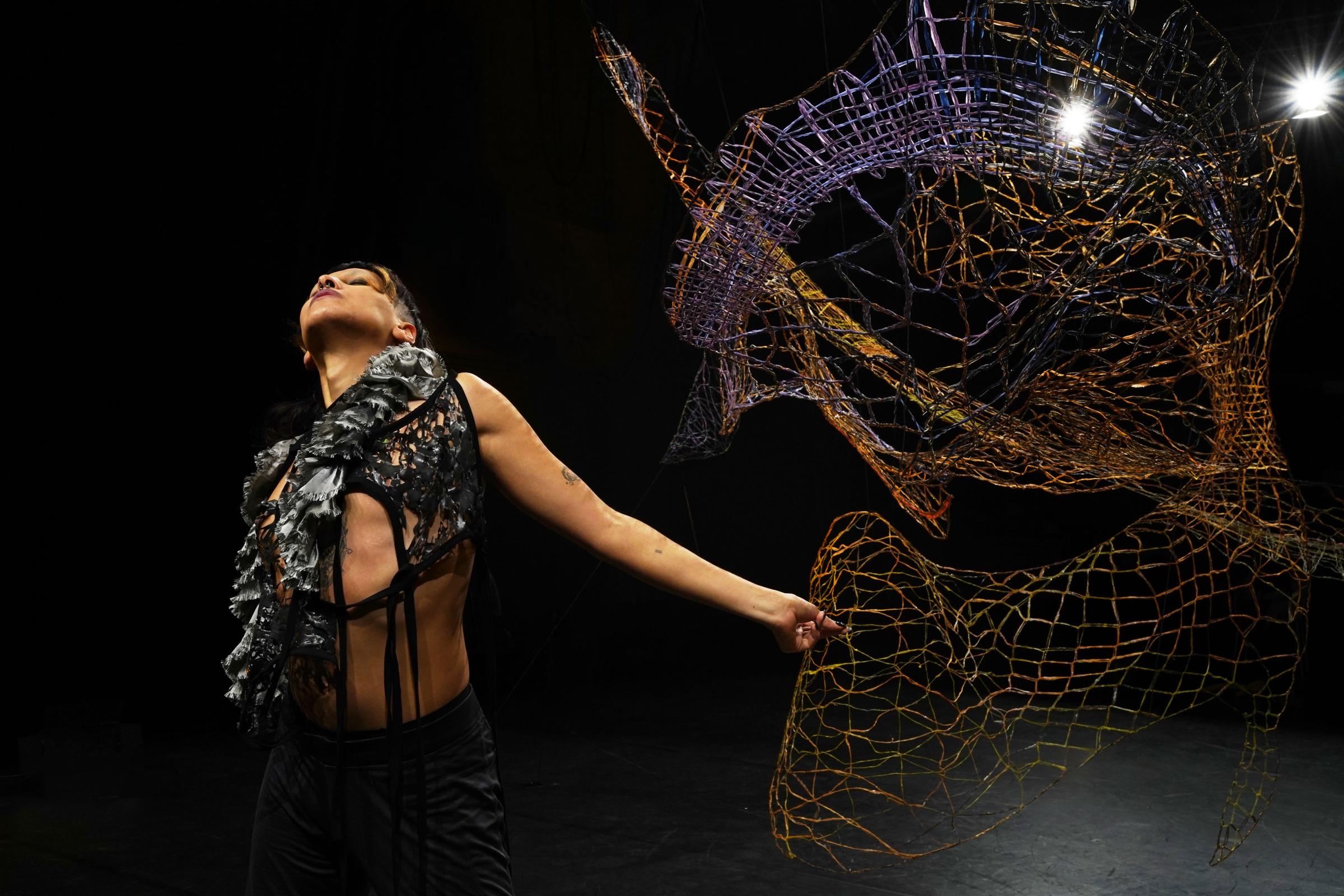
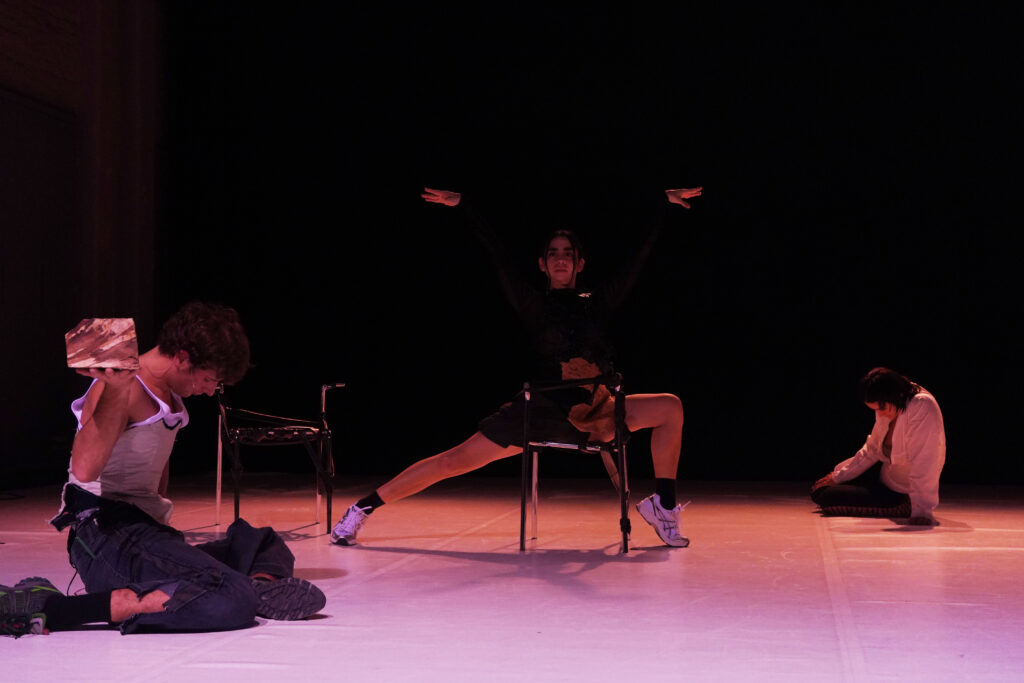
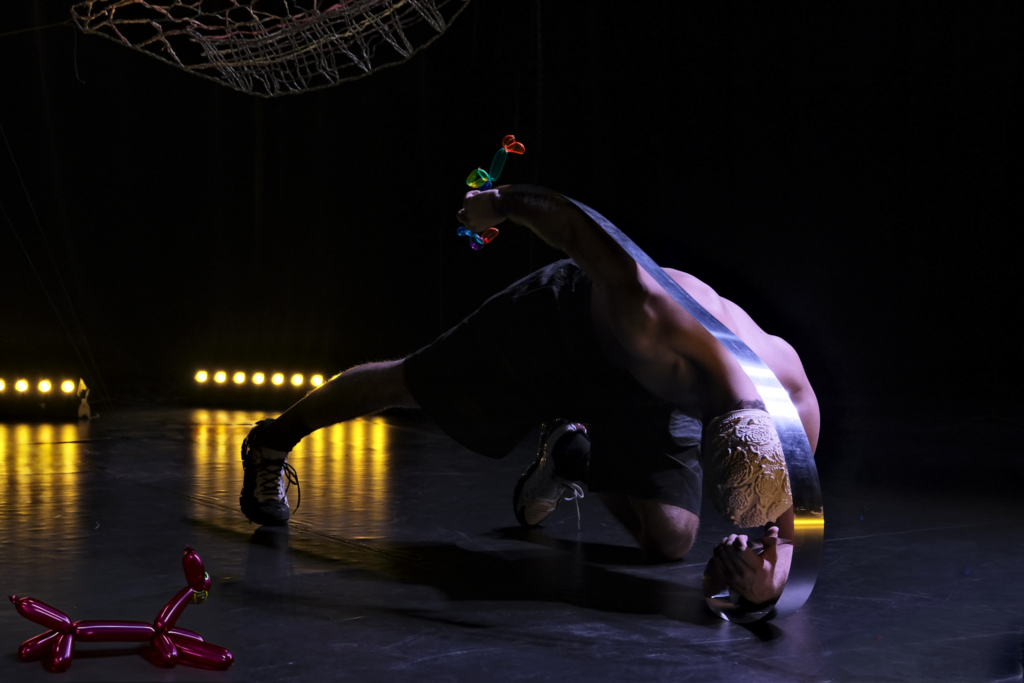
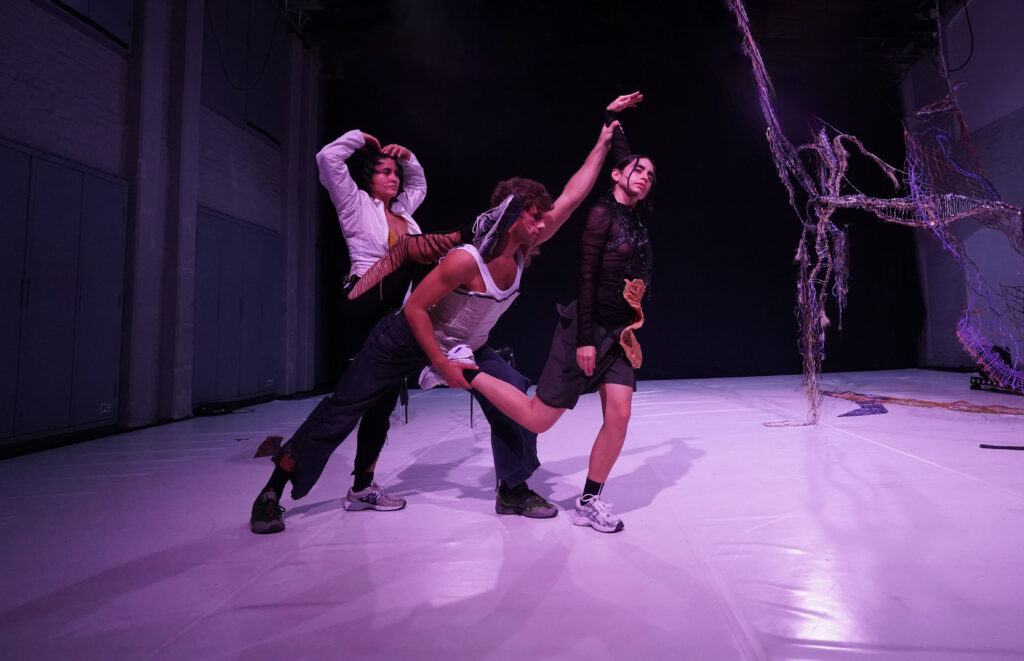
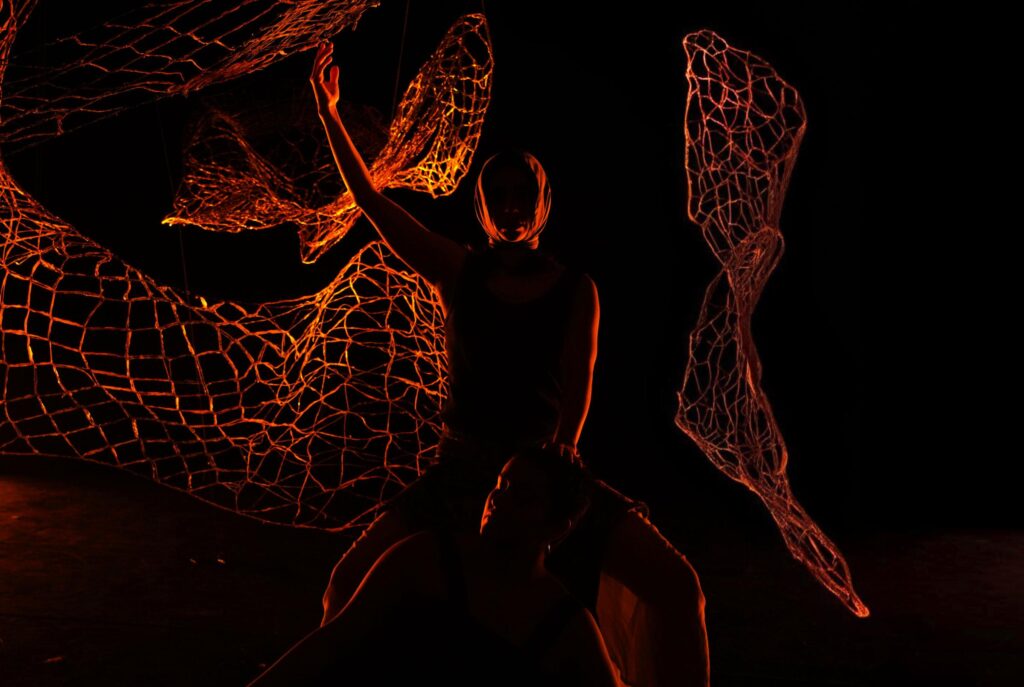
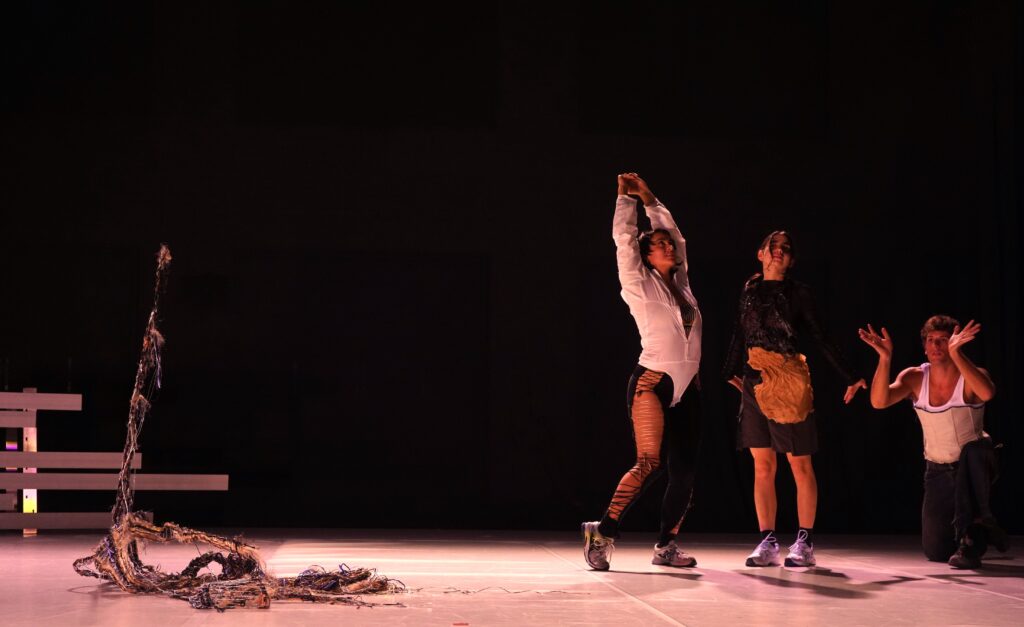
A dimmed light slowly illuminates the outlines of the four bodies on stage. To the sound of crashing waves, one body moans: ‘What on earth am I… meant to do… In this crowded place, there’s only you… I don’t feel like coming down…’ Slowly chewing the words, the voice glitches, falters, hoarsely stretching out the words, reducing them to an unintelligible noise. The light gets brighter, red. A number of ragged weavings, created by McGlinchey herself, together with textile designer Elena Vloeberghen and Texture Museum Kortrijk, hang like decaying organisms above the stage. The weavings are in sharp contrast with some shiny objects scattered across the scene; a pair of aluminum chairs, a structure that could be anything between a bike rack and an inconvenient table, some glistening balloons. The brightening light reveals the two other performers, slowly coming to life through calculated movements. The bodies eventually join in the song, trembling, shaking, further exploring the textures of their own voices: ahahahahaaarrrhhhhhgggg.
There’s not much time to figure out where exactly we ended up. We’re soon presented with an endless stream of fragmented movements, alternated by snippets of text. The underwater noises resemble what one would imagine being inside a womb would sound like. In a dreamy voice, one of the bodies shares: ‘When I was 8 years old, I ran into a river… I am drowning… My mum says: “I can’t come and save you, I just got my hair done.”’ Is this a fantasy land or a fever dream?
Slowly moving across the stage, the bodies seem to be acutely aware of the fact that they are being watched. Their measured movements resemble the ceremonious ending poses of gymnasts, concluding their exercise. They playfully pose in front of the audience — not entirely unlike the poses my sisters and I used to recreate in front of our digital cameras after watching another episode of Benelux Next Top Model online. In their cryptic and fragmented dialogues — or rather, simultaneous monologues — the bodies muse about their seemingly endless possibilities. ‘I want to get rid of my face and change it with Kim Kardashian’s’, one of them daydreams — simultaneously revealing that, while the possibilities may seem endless, they are always already determined by the desired mirror-image. Throughout the piece, the numerous formal as well as textual references to mirrors and surfaces seem to continuously reflect the obsession with constructing and maintaining this image: ‘All the vital organs are located on the outside’, they conclude.
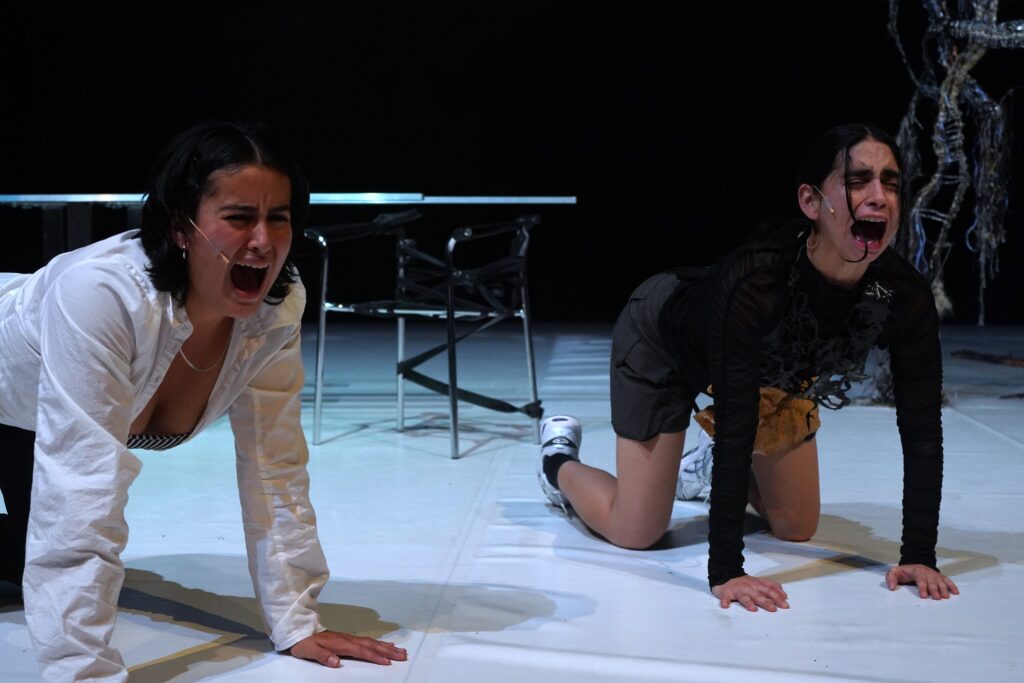
However, it soon becomes apparent that the rigid poses don’t remain feasible: the bodies start to itch, glitch, obtrude — in- and outside messily spilling into each other. The smoothness of the shiny surfaces is punctured by sharp cries, squirming bodies and the expression of pain and discomfort on their faces. With angular movements, close to the ground, the mutinous bodies rub against the carefully constructed dreamworlds. Transforming into a dog, one of them crawls across the stage, panting and growling. Incited by a screaming guitar solo, the rabid animal chases its toy. The performers undress down to their latex underwear. As the bodies continuously move between the pinup girl and the beast, becoming more and more tangled up in the inbetween, the knot of meanings becomes more complex: the dog is mad, the dog is the leader of the group, the dog is your therapist, the dog is cute, the dog is loved, the dog is domesticated.
The sequences of perfected poses thus mainly seem to serve as a reassurance to an abstract observer that their strange embodiment isn’t threatening to the complex rules of this hybrid reality. That they get it. ‘The best way to get someone to trust you is by copying their movements, mirroring them,’ they explain. Their bodily performances, then, seem to always be a reproduction of a reproduction, an impression of the same mould: to what extent has the production of self become a mass production?
“In their fragmented performances, there’s a casual promiscuity, a bored sensuality — always reaching, never touching.”
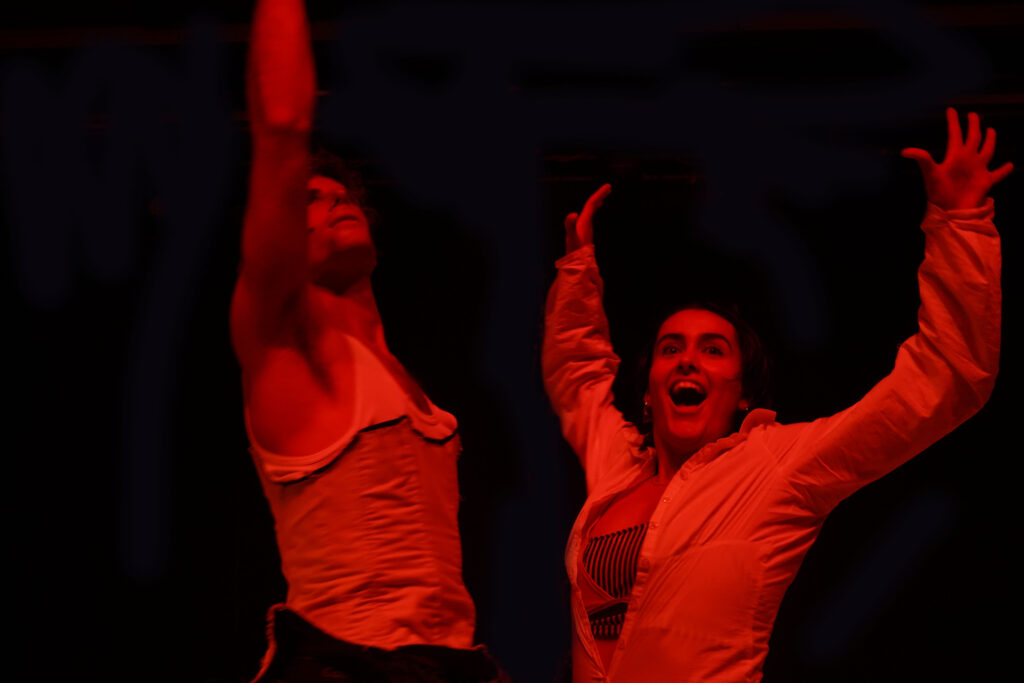
Regardless, the bodies on stage seem to approach their continuous (re)construction and simultaneous ‘to-be-looked-at-ness’ rather ironically, detached. A playful, almost mocking grin on their faces, they knowingly make the audience complicit in a tangle of looks, complicating an all too easy conclusion of who the gaze (and the pleasure attached to it) belongs to. In the fragmented performances of their bodies, there’s a casual promiscuity, a bored sensuality. Even with their fingers in each other’s mouths, there doesn’t seem to be a real connection. A burlesque performance in a red spotlight or a freely interpreted threesome on a rope ladder, never seem to reach a climax, always reaching, never touching. It’s all just one big performance, in which the bodies alternate between taking the form of ‘a woman, a knife, a consumer.’ One of them inflates some glossy silver balloons, twisting them into different shapes, before they eventually pop.
Inadvertently looking for a framework to enter into these dazzling worlds, Angela McRobbies’ The Aftermath of Feminism comes to mind while I’m watching the bodies perform themselves into being in the soft pink light. In the book, McRobbie outlines how, in post-feminist times, young women are not really visible, but just existing as a ‘flash, sparkle or shimmer’, and goes on to observe how ‘within this cloud of light, young women are taken to be actively engaged in the production of the self.’ McRobbie concludes that this particular production of the self is inherently tied up with a neoliberalist mode of consumption which ‘requires not only regular self-surveillance, but also self-regulation through the consumption of products that promise to correct whatever flaws.’ Like changing faces with Kim Kardashian. ‘Buy what you want, there is no afterlife,’ the bodies on stage reiterate, sarcastically equating their love for jewellery with their capacity to enjoy labour.
© Keren Kraizer
© Keren Kraizer
© Keren Kraizer
© Keren Kraizer
In this context, the contrast between the tactile weavings and the mass produced shiny objects on stage becomes even sharper. With McRobbie in mind it’s hard not to read this obvious juxtaposition as a reflection on the tension between histories of (feminised) reproductive labour and the similar reproduction of the self-image — or what McRobbie calls the ‘postfeminist masquerade’, in which sexist symbols are adopted and reproduced under the guise of irony and self-awareness. The new generation of young women is liberated anyway, right? On stage, the daughter reassures the anxious mother: ‘I am still your Barbie doll.’
Borrowing from the deeply ironic, self-referential vocabulary of online chat rooms, the bodies refer to each other as ‘girl’, ‘honey’, ‘kitten’, ‘baby’ or ‘bestie’. ‘I am claimed by my native language: English’, one of them states in a clear accent. Is it monoculture or a more complex assemblage? It’s hyperpop, my sister, sitting next to me, concludes: the shiny aesthetics juxtaposed with angsty lyrics, the inevitable glitches between a multitude of realities, the ‘late-capitalism-dystopia-vibe’; everything is as fake, as real, as confusing and cute as the multiple shiny balloons of pink dolphins on stage. As (inter)changeable as their chosen handles: ‘MadDoG’, ‘FatWhale’ or ‘DesolateStar’. ‘Dear besties, I feel vulnerable like a puppy… I feel like I am obedient but I don’t know what to obey’, one of the bodies shares, lost in the labyrinth of failing frameworks.
While MadDoG presents us with a clever pastiche of the hyperreal, the endless stream of out-of-context fragments sometimes risks becoming too self-referential, perhaps relying too much on ‘poppy’ references to render its indeterminacy meaningful. In doing so, the piece mostly presents a knot, rather than inviting us to take part in its active untangling. In the process of experiencing the cyclical narration and piecing together the loose threads, it’s never quite clear if something is an artistic choice or just a coincidence. And, while its open-endedness is also what makes it intriguing, the piece sometimes runs the risk of losing itself in its ambiguity, in a world where the mad dog only scratches the surface.
“While its open-endedness is also what makes it intriguing, the piece sometimes runs the risk of losing itself in its ambiguity.”
The occasional slump in the dramaturgical framing, however, is countered by the contrariness that is found in the more material realities of the piece, not least the tangible tension between the different registers of bodily movement. Or the ways in which MadDoG deals with sound: the introductory moaning of McGlinchey, the tactility in the diverse soundweavings of Therasse, the bodies exploring the textures of their voices as well as the scraping sounds of the shiny objects around them. The returning motive of texture, tactility, layers and weavings, which resonates in the costumes and the scenography too, seems to demonstrate a certain intention, a red thread, which eventually ties together the fragmented texts, objects and meanings.
© Keren Kraizer
© Keren Kraizer
© Keren Kraizer
After the performance, we curiously approach the weavings left on stage. They resemble these knots of seaweed and plastic fishing wire, washed up after a storm: the intertwining of different worlds and their mutual de(con)struction. In a similar way, there’s an accidental beauty to be found in the messy mishmash that is MadDoG. In the strange poetics of the implosion of different worlds — like the widespread meme of a lapdog photoshopped into a group of dolphins jumping out of the water. ‘Anatomy is no longer destiny’, Laura Mulvey echoes in my notes app. Or is the mad dog always already condemned to drown in a heavily polluted ocean?
Someone recently told me about his particular fear of only seeing the Instagram reels he watches flash before his eyes in his final moments. In its own strange way, MadDoG explores a similar anxiety, resulting from the increasingly hybrid worlds we navigate — leaving it up to the viewer if they are witnessing the utopia or the post-apocalypse. Both of them, probably, and everything in between.
KRIJG JE GRAAG ONS PAPIEREN MAGAZINE IN JOUW BRIEVENBUS? NEEM DAN EEN ABONNEMENT.
REGELMATIG ONZE NIEUWSTE ARTIKELS IN JOUW INBOX?
SCHRIJF JE IN OP ONZE NIEUWSBRIEF.
JE LEEST ONZE ARTIKELS GRATIS OMDAT WE GELOVEN IN VRIJE, KWALITATIEVE, INCLUSIEVE KUNSTKRITIEK. ALS WE DAT WILLEN BLIJVEN BIEDEN IN DE TOEKOMST, HEBBEN WE OOK JOUW STEUN NODIG! Steun Etcetera.
recensie
03.12.2024
Leestijd 8 — 11 minuten

Margot De Grave Loyson heeft een achtergrond in de beeldende kunsten (KASK, Gent), culturele studies (KU Leuven) en gender studies (Universiteit Utrecht). Via taal en beeld onderzoekt ze het potentieel van (feministische) artistieke praktijken en alternatieve vormen van kennisproductie in het verbeelden van verdrukte verhalen en het uitdagen van een dominant cultureel geheugen.
Sébastien Hendrickx
Mia Vaerman
recensie 03.12.2024
Sébastien Hendrickx
Mia Vaerman