Iphigenia – De Roovers
Geef mij maar het verzet van Klytamnestra
Mia Vaerman




© Michiel Devijver
Long Voyage Home is a play that’s caught in a web of loose meanings that both inspire and trouble. How do we tell a story about belonging and home, how do we find meaning? The play refuses to make sense or to give an answer, which is frustrating, but it’s also where its power lies.
If we start at the beginning we choose a point when something began and something else ended. And a good story needs a beginning and an end. It also needs a main character. Upon entering we’re greeted by Gerben Vaillant seated at the edge of the stage, wearing a knight’s armour boots. They’re silver and shining, mismatched with a tank top and a chain around his neck. He starts speaking, imitating Matthew McConaughey’s wild accent from True Detective. He’s telling a story about his prized possession – these eye-catching boots. The way he got these boots, that’s a good story, he concludes. “Let me tell you a bad story”, and we hear a shot. The True Detective a.k.a. Vaillant falls to the floor as if shot dead. And so it begins, a bad story, with an end so abrupt, the main character killed so suddenly that not only the author is dead, but the linear narrative itself is sent to meet its maker.
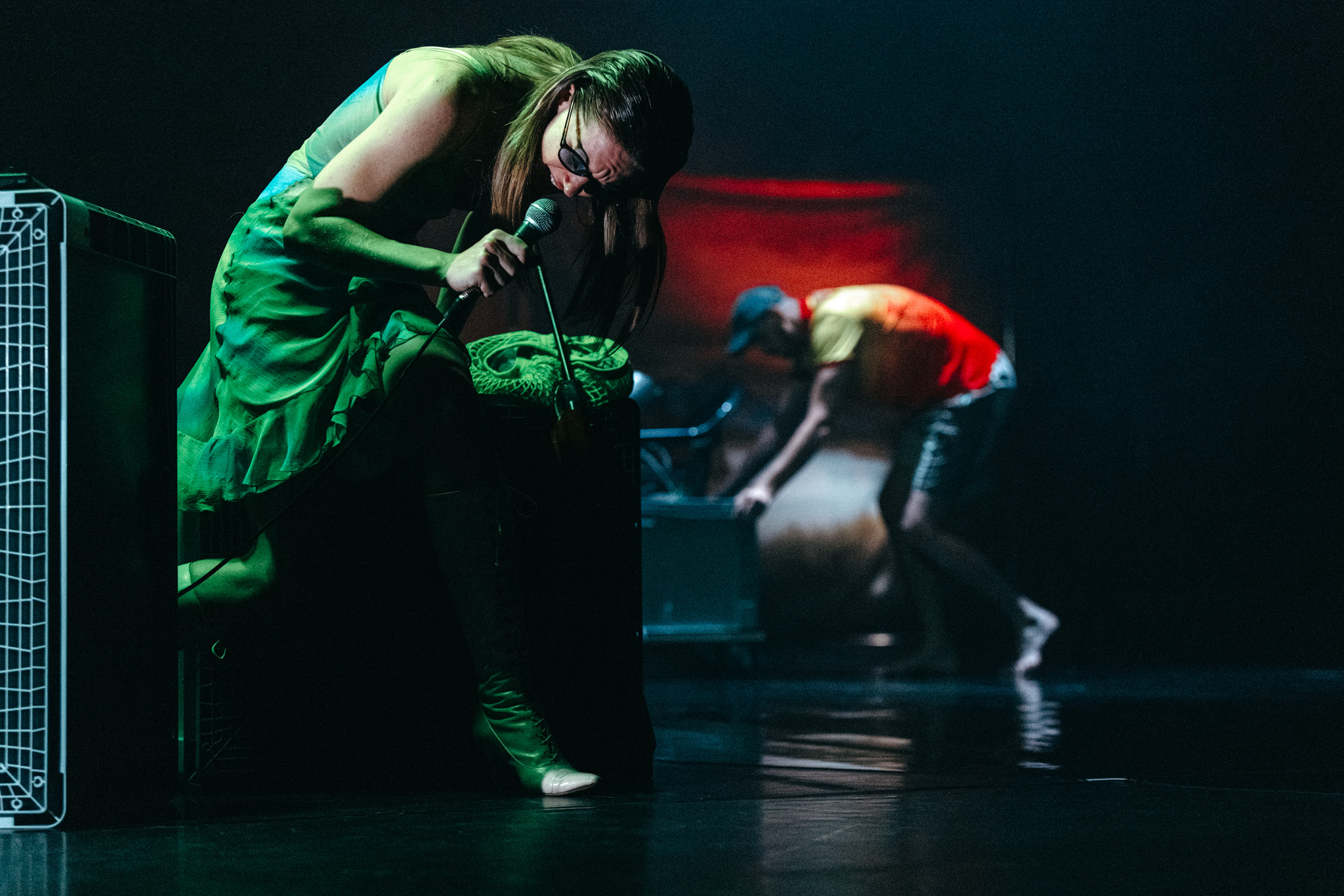
It seems that at the core of the play there’s the question on how we distil meaning. We, the audience, become the detectives who try to piece together the cause and effect of what we see. The stage curtain opens and Koning sings, her voice creating a magnificent soundscape. We lose ourselves in her journey, but just when we seem to get a sense of direction, the mood changes. There are funny sounds distracting us, there are lights going on and off, the song is storming out of control until we descend into full darkness and silence. For the second time the tension is built up to leave us empty-handed. What comes next, we ask, desperately hoping to find correlations between the pieces, to retrace the events that led us to this massacre.
“It seems that at the core of the play there’s the question on how we distil meaning. We, the audience, become the detectives who try to piece together the cause and effect of what we see.”
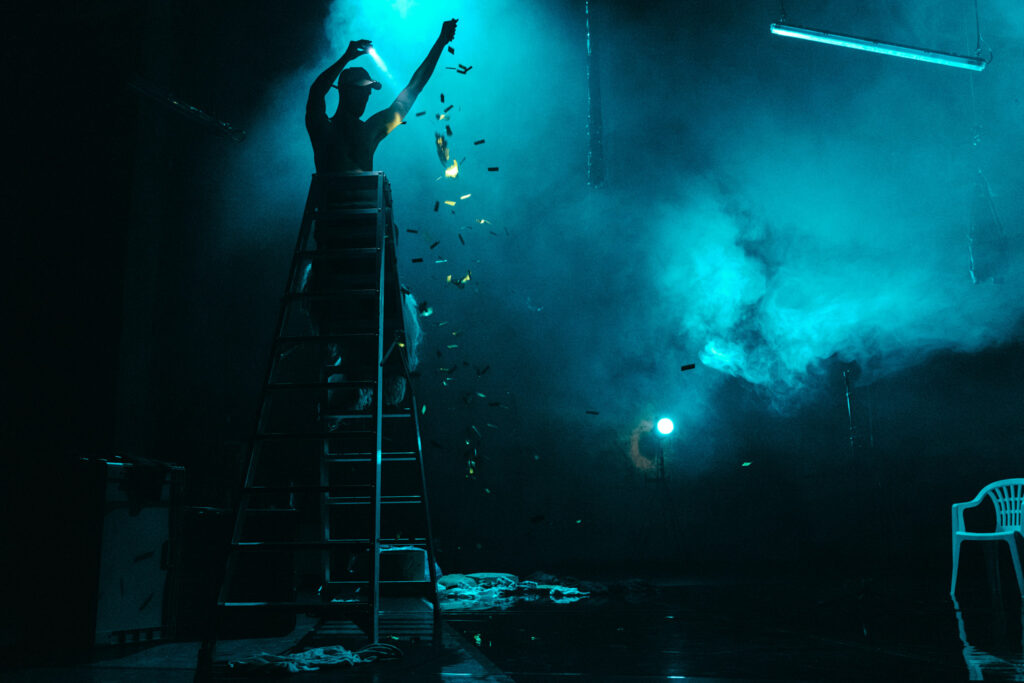
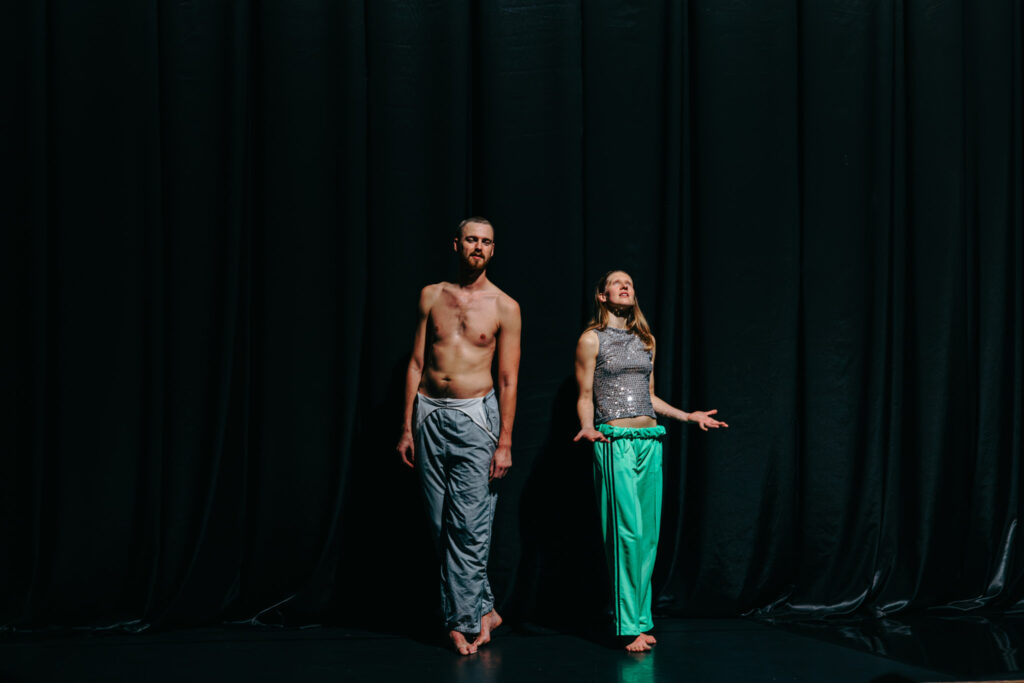
The next moment is powerful but not helpful with the task at hand. A flashlight spotlights Vaillant and Koning undressing at the corner of the stage. The scene takes a good 10 minutes and is done in absolute silence. All the heads are faithfully turned to follow every miniscule, excruciatingly slow movement. Who are these people we so patiently look at? This shows the power of the makers to hold our attention to something we don’t recognise or understand in an otherwise fast-paced, oversaturated play and attention-deficit society. Their unestablished characters will go on a journey of dressing and undressing for another dozen times on the stage. And even though the play is oversaturated, it doesn’t collapse under its own weight. Something else is caught in the flashlight, which is tied around the head of a crew member sitting in the audience, and we’re yet again engaged. Koning and Vaillant make us laugh, cover our mouths, tilt our heads, wonder: is this dress not too tight for him?

© Michiel Devijver
Around that time I ask myself: “If we’re the detectives, what is the crime?” It seems that the crime is the lack of a crime and we’re out of work. Things happen, we put them together and then they fall apart. Koning has found a gun after telling us that she’s a school shooter, referring to yet another film released just this year. I wonder if she has seen the movie, if it’s an accident, a coincidence? I’m still caught in a pursuit to get things right, running some kind of imaginary rat race in my head. I’m trying to find the most clever reference to open up the play. What is hard to admit is that the play is already open, hiding nothing from us, not trying to sell us anything.
“Nostalgia is very present in the play. Many things, including art, are designed to sell, to appeal to middle-aged people, most of whom have grown up with the same pop culture. So I wait for them to mention Kate Bush, instead they speak of Lana Del Rey – more recent but still a highly nostalgic singer.”
However, nostalgia is very present in the play. Many things, including art, are designed to sell, to appeal to middle-aged people, most of whom have grown up with the same pop culture. More often than not this is done through emotional manipulation. So I wait for them to mention Kate Bush, instead they speak of Lana Del Rey – more recent but still a highly nostalgic singer. Her music videos are filled with heartbroken women that look like 90s pop stars walking in smokey landscapes, mascara running down their faces. Towards the end Koning and Vaillant share a cigarette at the same corner they undressed, and I’m reminded that before the Covid pandemic smoking was going out of fashion.
But as much as these things, and the lack of correlation between them, irritate me, they too inform me of the world we live in. I slowly realise that the ambiguity of the play is done on purpose, trying to get us out of the habit of grasping things. At the same time the play is deconstructing these over-repeated narratives and images, as the stories they tell derail, their costumes are once again changed and happiness is found in the moments that make the least sense.
This play is about the 21st century, it’s made of it. As I watch it unfold and make little sense the question of distilling meaning comes back to me. We first hear the shot that kills the hero and only then we get to see the gun and question its presence. Is it just another object? Do we have no use of principles that direct our attention, that funnel the otherwise crazy world into beautiful stories? It’s not that simple, but Vaillant and Koning are questioning these principles we’re so used to. Maybe the goal is to broaden our perspectives, to stop asking for results and focus on the process, to stop looking for home and focus on the journey. Can we stay open when we don’t understand? Can we dare to meet ourselves in these unstable characters who are constantly being distracted by the world around them and can’t find stable footing?
“This play is about the 21st century, it’s made of it.”
I stand outside after the premiere and look at the street lights, smell the cigarette smoke and overhear snippets of strangers’ conversations. The otherwise drab and depressing cityscape gains meaning. I pay attention to being here, instead of constantly comparing it to all the places I’m not in – the forest, my home country, my dream house. The messy scenography and props of the play were beautiful, they sensitised me to beauty. As this city and this place right now is my voyage and not my home, maybe I can allow myself to be in a process of being here and building something that some day will feel like home? Dancing, getting lost in conversations that make no sense, sharing a moment and finding connection between people, isn’t that what home is all about?
© Michiel Devijver
© Michiel Devijver
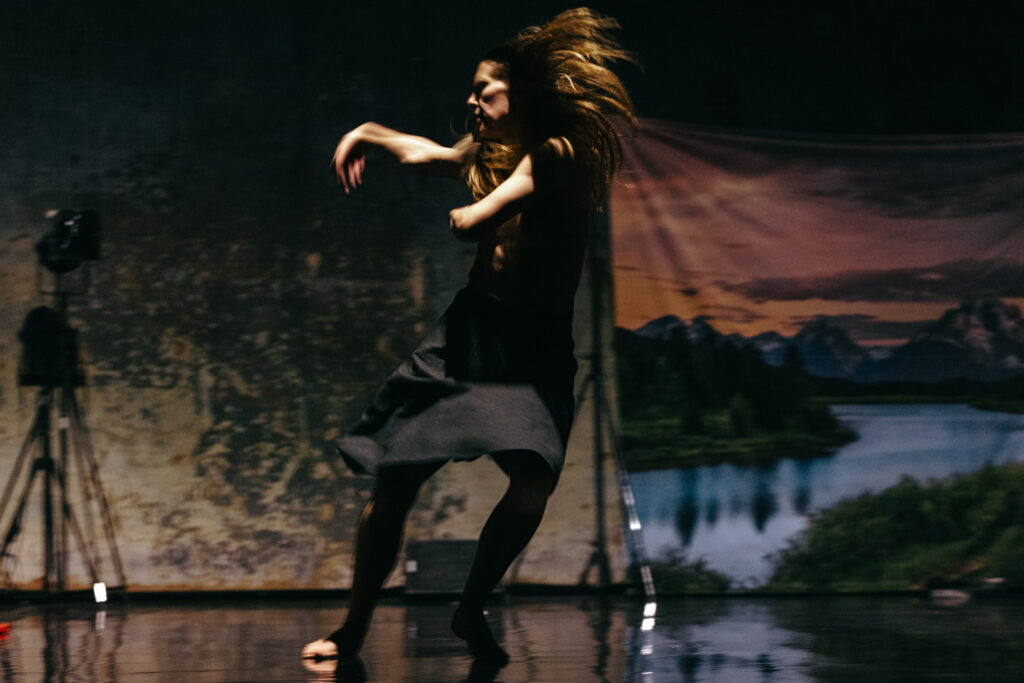
© Michiel Devijver
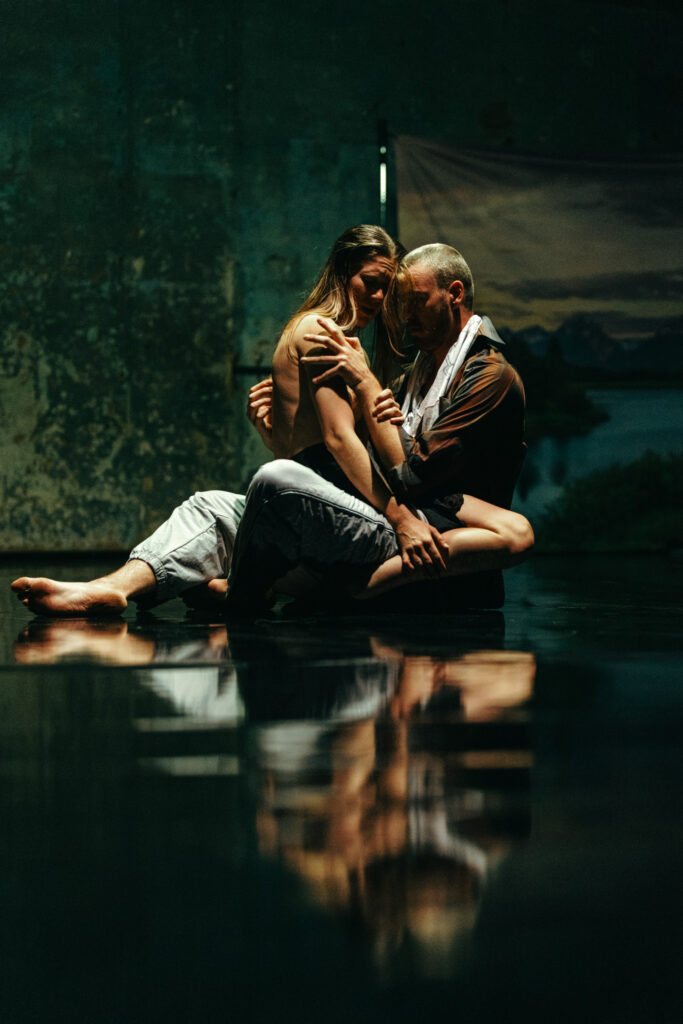
© Michiel Devijver
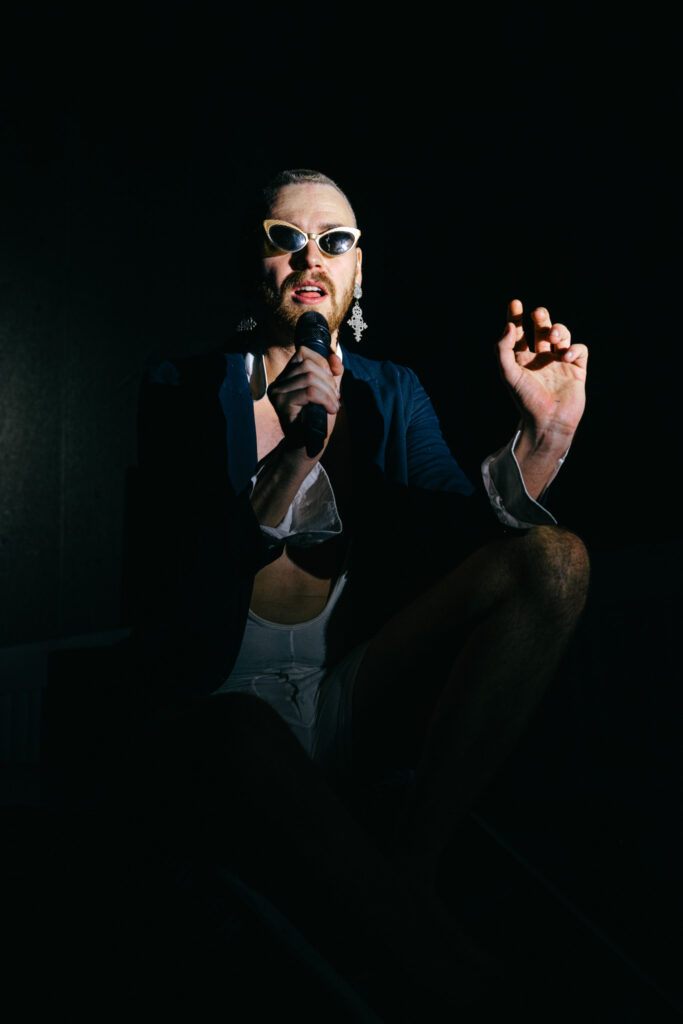
© Michiel Devijver
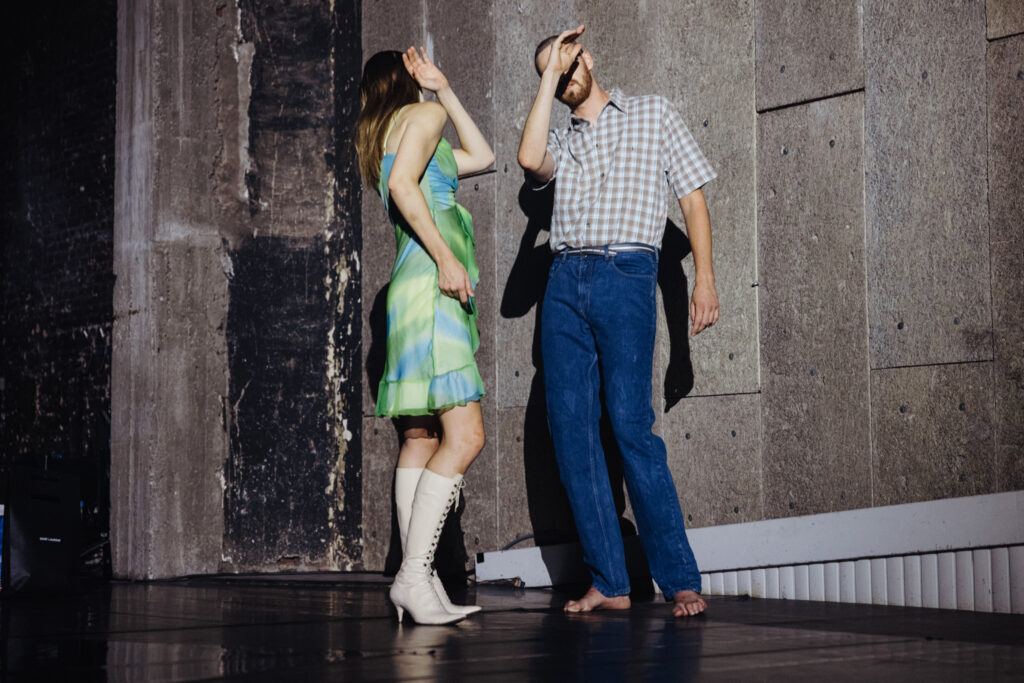
© Michiel Devijver
You can find the tour dates for this performance here.
KRIJG JE GRAAG ONS PAPIEREN MAGAZINE IN JOUW BRIEVENBUS? NEEM DAN EEN ABONNEMENT.
REGELMATIG ONZE NIEUWSTE ARTIKELS IN JOUW INBOX?
SCHRIJF JE IN OP ONZE NIEUWSBRIEF.
JE LEEST ONZE ARTIKELS GRATIS OMDAT WE GELOVEN IN VRIJE, KWALITATIEVE, INCLUSIEVE KUNSTKRITIEK. ALS WE DAT WILLEN BLIJVEN BIEDEN IN DE TOEKOMST, HEBBEN WE OOK JOUW STEUN NODIG! Steun Etcetera.
recensie
29.09.2026
Leestijd 6 — 9 minuten
08.09.2026
—
14.01.2027

Ugnė Noreikė is a Lithuanian writer, musician and artist. She works in spaces of not knowing, vulnerability and extreme feelings. She’s looking for meeting points between sounds and words.

Mia Vaerman
Tom Rummens
recensie 29.09.2026
Mia Vaerman
Tom Rummens