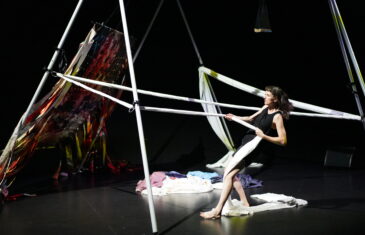
Lullabye – Anneleen Keppens
Wie zorgt er voor wie zorgt?
Tom Rummens





© Mariona Puig
DARK premiered in the 13th edition of Trouble, a performance festival whose central theme this year revolves around invocations, evocations, magical or shamanic rituals, political actions in public spaces, and dialogues with the unseen. Kris Verdonck continues his exploration between the oppositions of being and non-existence in this three-part performance. The first one deals with unseen entities behind screens; the second is a Beckett recital in memory of Johan Leysen, a Flemish actor who passed away two years ago; the third and last part is a short musical act, with sounds coming from three sousaphones hanging on the ceiling while no one seems to be playing them.
In all these acts we can sense the presence of artificial intelligence. We’re guided by a guide, Jeroen Van der Ven, hidden behind a mask, who calls himself a ‘guided guide’ as he doesn’t speak himself. His guidance comes from a sound box he controls. The box asks us to turn off our phones, but then glitches and repeats a useless piece of information. The audience gets confused and laughs. Silly AI, right? While Jeroen Van der Ven is gesticulating as if he himself were speaking, his movements are somewhat delayed. He looks surprised every time he has to imitate yet another phrase. As he’s somewhat reluctant to follow the voice, I’m becoming somewhat reluctant to listen to it. I find it tiring to listen to commands from a box, but I want to see the show, and so I follow.
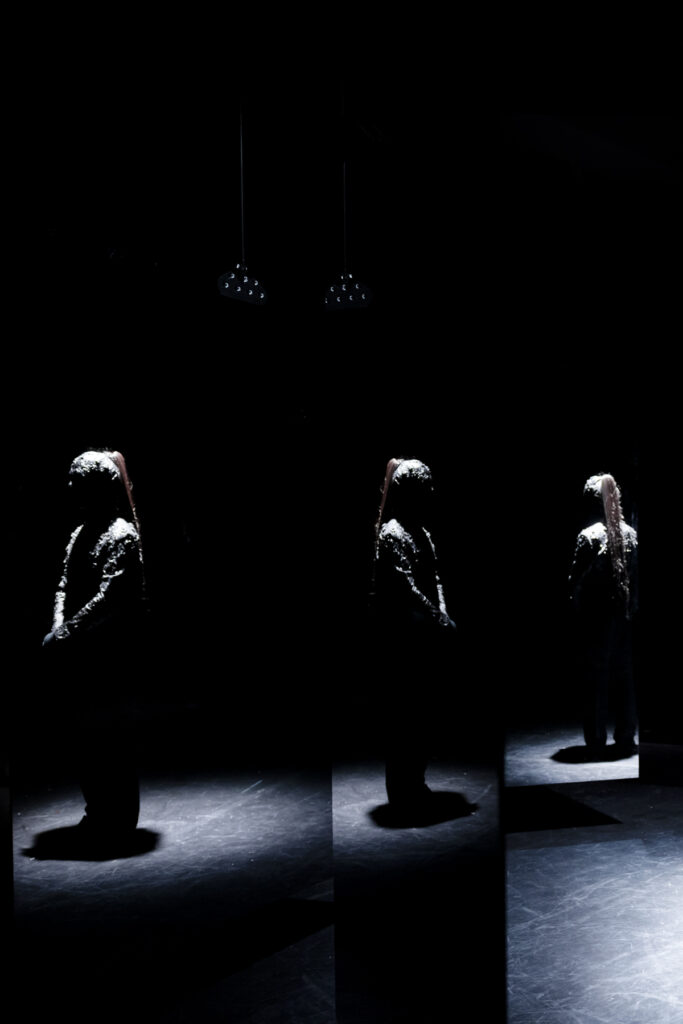
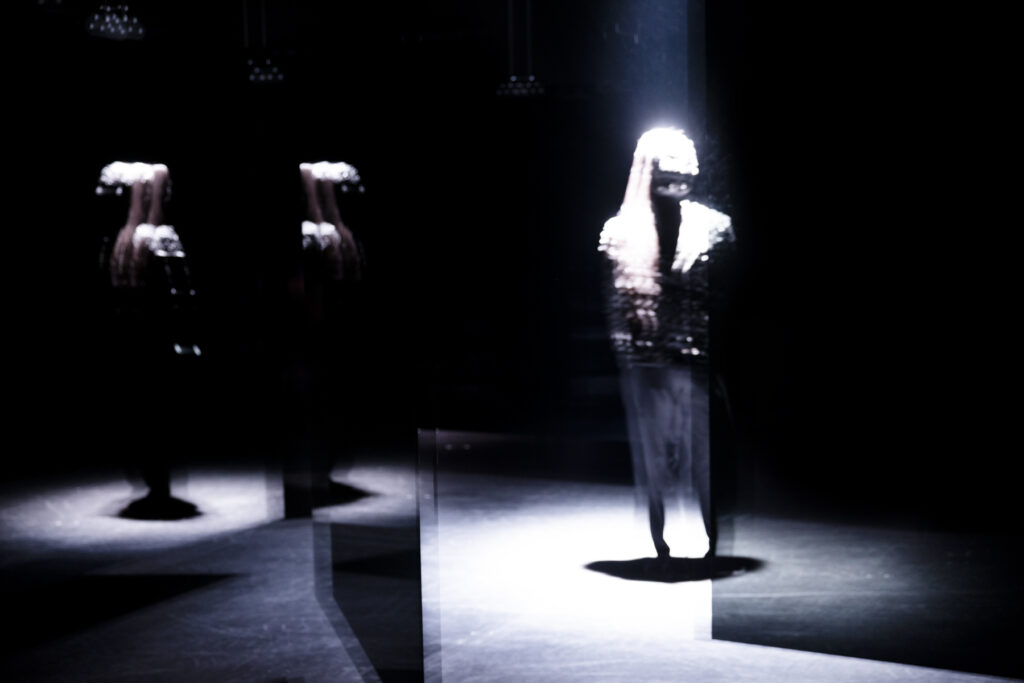
In the first room we’re seated in front of a circle of black screens. At first, we see our own reflection, then the lights go out and we see nothing. Then an entity appears. Mustaf Ahmeti wearing a stiff black and silver suit invokes the same chills as the alien from Ridley Scott’s movie by the same name. He’s moving the screens just by looking at them, his movements make them spin and tremble. Only a moment ago we were instructed to think about who’s behind the apps and programs we use. I guess by seeing Mustaf we have to come to the conclusion that whatever it is, it’s something scary and undefinable. The worst thing the entity can do, however, is make us retract our legs so it can walk past. I make myself small and see Mustaf hit someone’s leg, they look slightly annoyed. Similarly to when an app doesn’t work properly and we release a frustrated sigh. Are we supposed to be scared of this entity or reflect on our own relationship with it? I don’t know.
“We turn to technology to answer all of our prayers, to bring the dead back, to punctuate Beckett so we understand him. I wonder how the Irish existentialist would feel being so forcefully brought out of human existence.”
We’re led to another room where blankets are floating like ghosts. We hear a voice reading the unbelievably dense final part of Beckett’s Texts for Nothing. This seems to be a eulogy to Johan Leysen, but it feels impersonal as the text is read by a computerized voice. Maybe it is a sort of séance, spirituality performed by technology, a testimony to what our religion has become? We turn to technology to answer all of our prayers, to bring the dead back, to punctuate Beckett so we understand him. I wonder how the Irish existentialist would feel being so forcefully brought out of human existence. To deal with this unpleasant thought I keep reminding myself that AI doesn’t say ‘I don’t know’ while Beckett does. If you ask AI a question to which it doesn’t know the answer, it will make one up. I desperately cling to this idea to feel curiosity as I am absolutely uninterested in a patriarchal all-knowing machine that takes away my agency.
“DARK might have the same aversion to AI as me, but it is not radical enough. It avoids its responsibility to be a clairvoyant.”
The problem with such ephemeral and ghostly invocations is that they don’t correspond to the real-world consequences of AI. It feels as if we’re resorting to childish monster stories to portray something we don’t yet understand. AI as a scary alien, AI as Beckett’s genius, and lastly, AI as the air that blows the sousaphones, how spirited. The truth is that AI already has immense global consequences. Even though we blindly poke fun at it when it makes apparent logical errors (as if to console ourselves), it is also clever and has the same prejudices as us. AI makes racist, colonial and misogynist judgements. The information it provides is biased, because the information it’s fed on is also biased. It strengthens existing colonial structures as, naturally, all the resources it needs don’t exactly deserve a Fair Trade logo. AI insatiably consumes Humanity’s and Earth’s resources. We’re caught in a vicious cycle – we feed it more and more energy under the pretext that it will solve our energy crisis. According to a UC Riverside study, an average ChatGPT search uses about 100 ml of water. Ten searches correspond to a liter of water. And so it goes.

© Koen Broos
© Koen Broos
© Koen Broos
Is it the place of art to call such notions into question? Can this reality be a part of a ritual in another, dark world that we don’t yet understand? The prompt that the performance festival gives as a guidance to its theme is ‘Performance as clairvoyance?’ Yet we aren’t in the dark when it comes to the consequences of our interactions with screens. There aren’t any cyber alien entities there to get us. For me, it felt that DARK might have the same aversion to AI as me, but it is not radical enough. It avoids its responsibility to be a clairvoyant. It feels like a weak cautionary tale that mocks, through irony, the sheeplike people that keep watching their smartphones all the time. Imagine instead that this performance was done in harsh white light. It might have been a true clairvoyance of what we know but choose to ignore.
KRIJG JE GRAAG ONS PAPIEREN MAGAZINE IN JOUW BRIEVENBUS? NEEM DAN EEN ABONNEMENT.
REGELMATIG ONZE NIEUWSTE ARTIKELS IN JOUW INBOX?
SCHRIJF JE IN OP ONZE NIEUWSBRIEF.
JE LEEST ONZE ARTIKELS GRATIS OMDAT WE GELOVEN IN VRIJE, KWALITATIEVE, INCLUSIEVE KUNSTKRITIEK. ALS WE DAT WILLEN BLIJVEN BIEDEN IN DE TOEKOMST, HEBBEN WE OOK JOUW STEUN NODIG! Steun Etcetera.
recensie
24.04.2025
Leestijd 5 — 8 minuten
01.03.2025
—
14.09.2025

Ugnė Noreikė is a Lithuanian writer, musician and artist. She works in spaces of not knowing, vulnerability and extreme feelings. She’s looking for meeting points between sounds and words.
Tom Rummens
Floris Baeke
recensie 24.04.2025
Tom Rummens
Floris Baeke