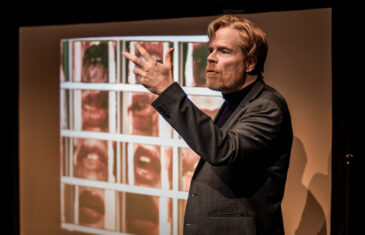
Confessie – Raven Ruëll & Bruno Vanden Broucke
De kunstmarkt maakt de kunstenaar
Klaas Tindemans





© Katrien Van Breedam
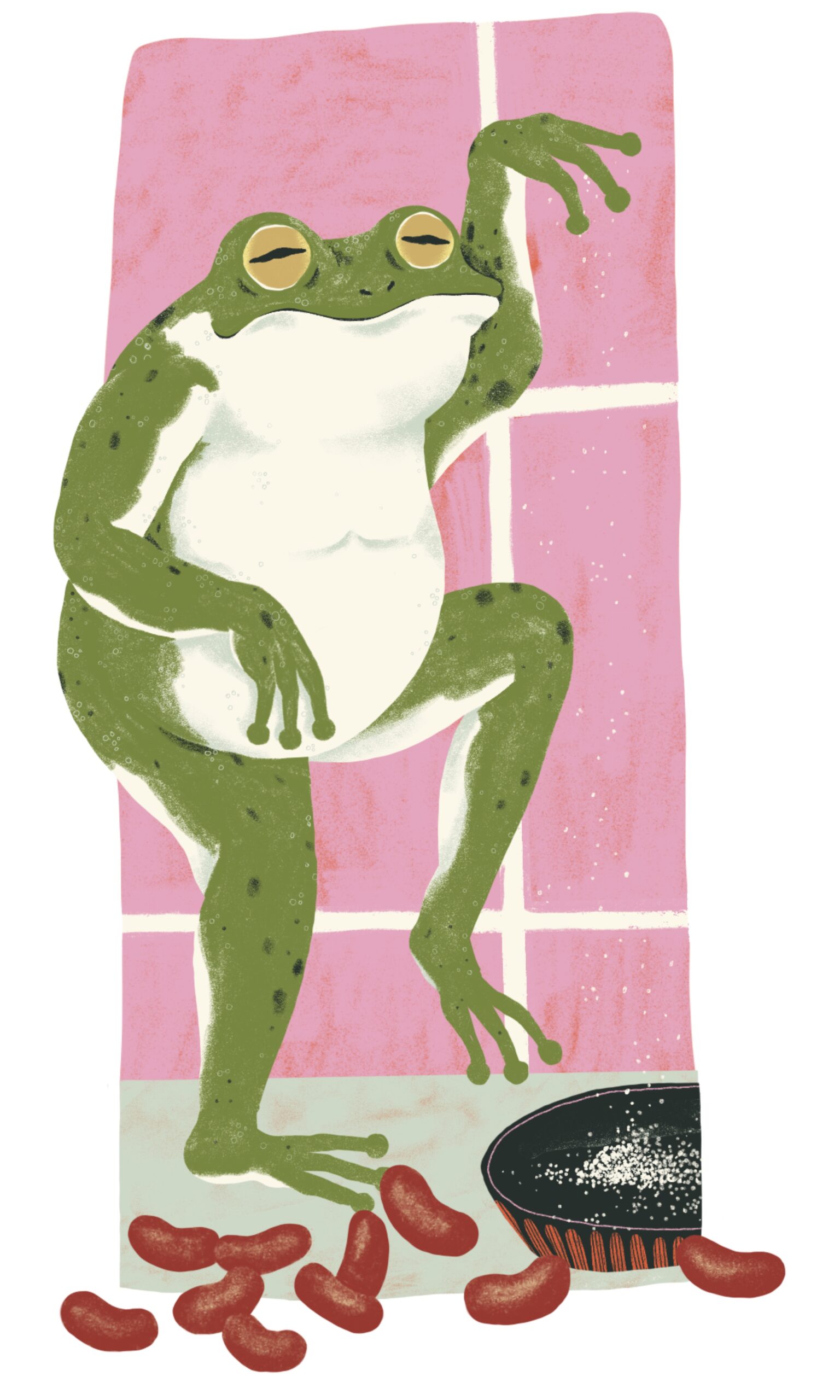
My mom likes explaining how to cook things. For a long time, her life revolved around food. She’s retired now, but she had a Japanese restaurant in the suburbs of Vancouver for twenty-two years. Although she wasn’t officially a chef, she stepped in to cook whenever they were short-staffed. Her explanations are usually to illustrate how easy a recipe is, by which she means I should try making it. There’s often a lot of stirring involved, which she describes as guruguru, a Japanese onomatopoeia. She’ll say, ‘You have to let it simmer on low heat, add the sugar, and stir it guruguru, guruguru.’ She’s talking about how to make anko, a sauce made of red beans used in Japanese desserts. The onomatopoeia conveys the duration and patience required, until the sauce first says pukupuku and then bukubuku as a delicious scent rises from the pot.
My mom has a musical way of talking, and her use of onomatopoeia adds to the rhythm. She’ll say the table is guragura and put a piece of cardboard under one leg. Or how she sat on the muffin, and now it’s pettanko. Or that she was too busy to drink anything, so her throat is karakara. She often sang around the house when we were growing up, mostly Japanese pop songs, and I thought she had a lovely voice, even though she always said, ‘I’m a terrible singer!’ I worked at the restaurant, and she sang there too, along with a CD or the TV. There was a five-disc CD player, impressive at the time for the number of songs you could shuffle at once. And there was a Japanese channel on TV — she would sit on a stool behind the bar and watch concerts when the restaurant was slow.
But once, when she was singing particularly loudly, her business partner laughed and said, ‘You might be singing your heart out, but you’re off-key.’
I didn’t think she was, and I told her so. But my mom was insulted and swore never to sing again. I remember a sinking feeling because I knew she was serious. She was stubborn, unforgiving, and always kept her word.
© Katrien Van Breedam
They both worked long hours to make ends meet. For years they worked seven days a week because they couldn’t afford to hire extra staff or close the restaurant. My mom was always the last to eat lunch and dinner because she waited for all the customers to finish. She didn’t have time to go out for a meal or shop at her favourite stores. And now she wasn’t going to sing either.
Sometimes her partner would walk around and sing the first line of ‘Rudolph the Red-Nosed Reindeer’ as ‘Ta-ra-ra-ra-ra- ra-ra’. My mom told me he was feeling lonely when he did that. ‘Really?’ I asked. “How do you know?” It was still many months until Christmas.
She gave an unsatisfying answer: ‘That’s what he always does.’ I was in my early twenties, and I knew I was supposed to be an adult, but adulthood felt like an uncomfortable new suit. I tried to imagine what made him lonely. He was surrounded by staff, a family he went home to every night, and friends he golfed with. He loved to talk, and got to do as much of it as he wanted because he was the boss. He was a chef and I was a server, so we didn’t often speak, but I heard snippets of stories about the local salmon run, the Hubble Space Telescope, the roots of Christianity. Mostly, I saw him work steadily, stoically, day in and day out. It had never occurred to me that he had a private inner life. A part of him I had never imagined opened up.
Japanese onomatopoeia not only imitate sounds; they also make inner feelings and sensations perceptible. Consider how in English many words beginning with gl- — such as glance, glare, glint, and glow — evoke a visual quality. Hinyari, for example, depicts the feeling of cold: like on an evening after the last days of a dwindling summer, when you suddenly realise you need a jacket. You’ve felt autumn coming — the shorter days, the cooler winds — and now it has arrived. The glimmer of a new beginning. A quietness, like sediment settling at the bottom of a pond, the impression of coming to rest.
The restaurant had glass walls, and the entrance faced west. Sometimes, on early summer evenings, a blinding golden light spilled in through the front. In the lull before the dinner rush, leaning against the counter, the light washed away my view, and in the emptiness appeared the feeling of an ending. Of the day, of my time at the restaurant — the knowledge that some things are for the last time and you don’t know it.
© Katrien Van Breedam
Ufufu, a mischievous laugh.
Wakuwaku, a feeling of excitement.
Nikoniko, your beaming face.
Kirakira, your sparkling eyes.
Patapata, my shirt in the wind.
Parapara, the first drops of rain.
Sappari, feeling refreshed.
Tatatatata, running feet.
Puri, a small fart.
Buri, a big fart.
Geragera, uncontrollable laughter.
Gorogoro, a grumbling stomach.
Gosogoso, rummaging around.
Paka, a lid opening.
Pakupaku, eating quickly.
Ponpon, a full stomach.
Then the bell over the door would tinkle, chiririn, the first customers would walk in, and we would swing into action. Ice would clink, the hot plate would sizzle, and we would be too busy to notice the setting sun, the darkening sky, daylight replaced by the lights of the city.
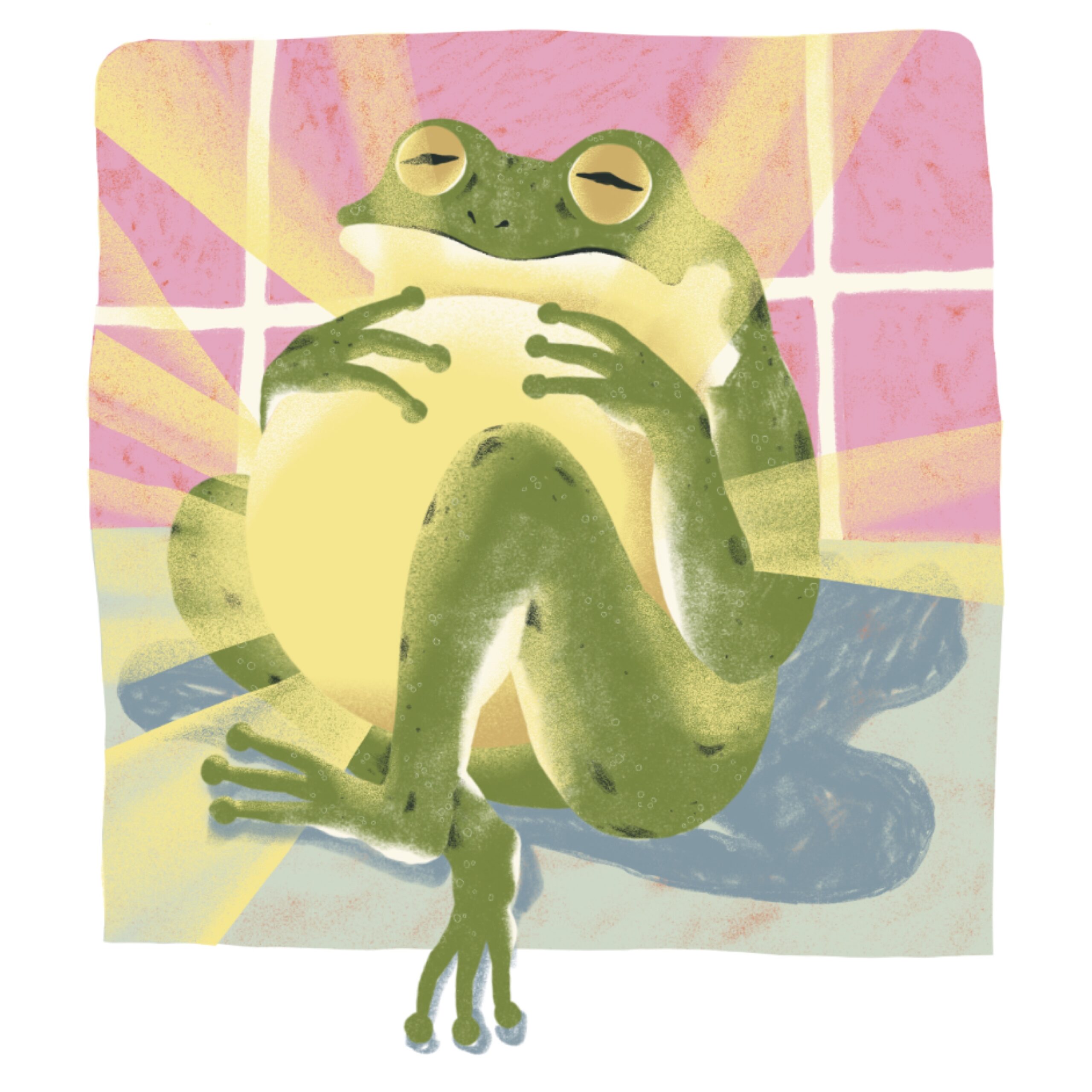
I hadn’t heard my mom sing in more than a decade when she started singing again for my son. Funnily enough, she’s sometimes off-key.
Kaeru no uta ga
Kikoete kuru yo
Gwa gwa gwa gwa
Gero gero gero gero
gwa gwa gwa
— Kaeru no uta
I can hear
The frog’s song.
Croak, croak, croak, croak,
Ribbit, ribbit, ribbit, ribbit,
croak, croak, croak.
— The Frog Song
KRIJG JE GRAAG ONS PAPIEREN MAGAZINE IN JOUW BRIEVENBUS? NEEM DAN EEN ABONNEMENT.
REGELMATIG ONZE NIEUWSTE ARTIKELS IN JOUW INBOX?
SCHRIJF JE IN OP ONZE NIEUWSBRIEF.
JE LEEST ONZE ARTIKELS GRATIS OMDAT WE GELOVEN IN VRIJE, KWALITATIEVE, INCLUSIEVE KUNSTKRITIEK. ALS WE DAT WILLEN BLIJVEN BIEDEN IN DE TOEKOMST, HEBBEN WE OOK JOUW STEUN NODIG! Steun Etcetera.
kunstenaarsbijdrage
15.12.2025
Leestijd 5 — 8 minuten
15.12.2025
—
14.04.2026
Emi Kodama is a Japanese-Canadian artist from Vancouver. She has been living and working in Ghent since 2008, when she started the post-graduate programme at the Higher Institute for Fine Arts (HISK). Through a multidisciplinary practice that includes writing, performance, and installation, Emi layers elements of daily life with dreams and memories to create stories that you can explore and expand. Her work has appeared in Ricepaper Magazine and The Malahat Review. Her collection of short stories and drawings “If I Were You” was published by MER. Paper Kunsthalle in 2012.

Klaas Tindemans
Mia Vaerman
kunstenaarsbijdrage 15.12.2025
Klaas Tindemans
Mia Vaerman