Atlantis/The Sea – Radouan Mriziga
Luisteren naar choreografie
Natalie Gielen


© Binta Kopp
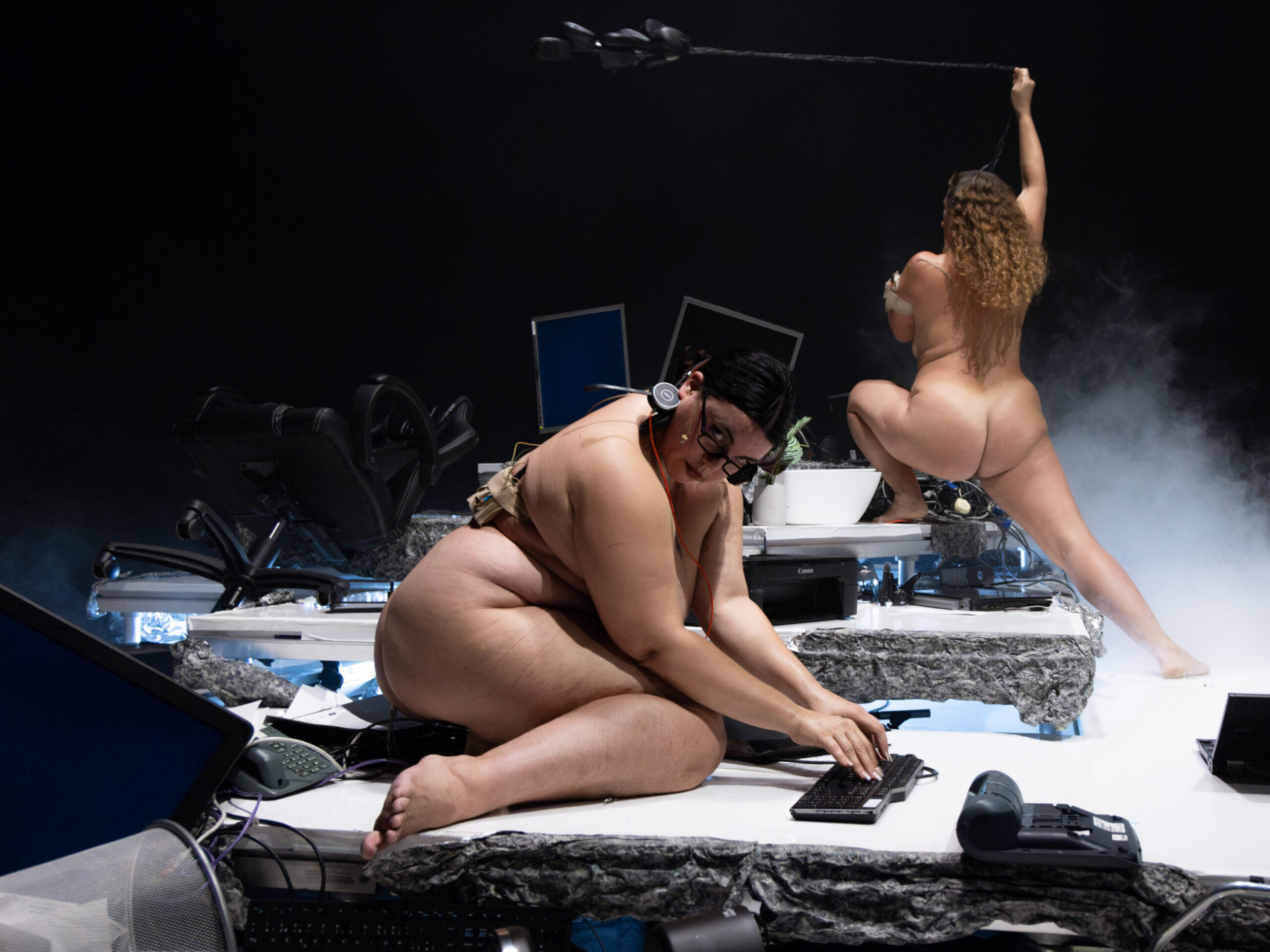
Naked amidst a graveyard of 90s office junk, Sophia Rodríguez and Teresa Vittucci seduce screens, force printers into a kiss, and try to reclaim raw human intimacy in a touch-starved world.
Do we touch our office supplies more often than we touch our loved ones or ourselves? While my fingertips softly tap out this sentence on the keyboard, I observe the bruise marks on some keys from frequent use. I repeatedly push space after each word, again and again and again… I gently rest my hands on the slightly warmed-up smooth surface… something adjacent to life, but most definitely dead… or? With Anger angels, Rodríguez and Vittucci play with our ability to make dead things alive, to personify objects. To what extent can we have a relationship with our keyboard? Should we even want that? On the stage behind them, we see a pile of discarded garbage: printers, screens, computer mice, wires, coffee makers. Can one imagine a more unsuitable and barren ground for two Boticcelian angels?
“Rodríguez and Vittucci play with our ability to make dead things alive, to personify objects. To what extent can we have a relationship with our keyboard?”
What does touch have to offer us in the world of plastic? Rodríguez and Vittucci descended onto the stage in all their naked glory. Amusingly, they start to imitate Baroque sculptures freezing into uncomfortable ballerina poses, awkwardly imitating grace. They eye each other but never touch – that moment explodes later, in a Michelangelian encounter of two fingers on toppled office chairs. The music is epic, human touched human! But now we’re further, right? Now human will touch the Silicon Valley! It looks like these two cherubs mean business, they’re here on Earth to lose their innocence. They’re here on Earth to be touched by what really matters! And that, obviously, is office supplies.
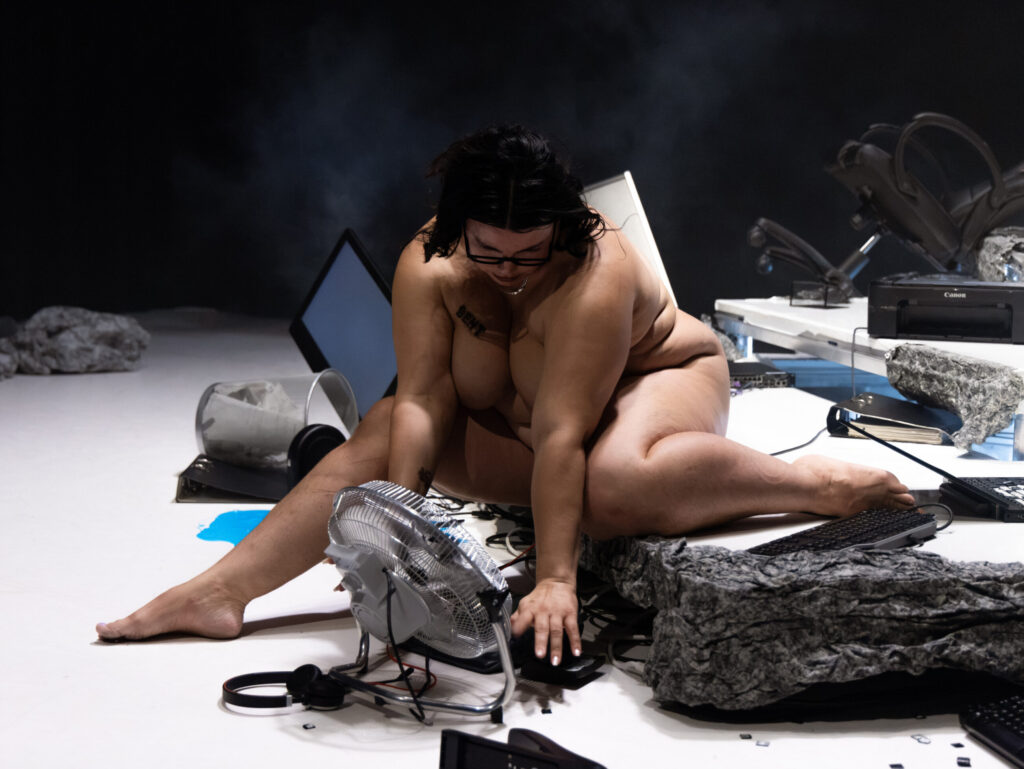
Many moments on the stage are new, even though the objects with which the artists interact are part of our daily landscape. At one point Rodríguez is riding a computer screen while Vittucci puts on glasses, her sexy assistant look is complete. The artists are openly toying with the erotic, but it never becomes pornographic. We don’t get aroused; at any moment the mood can change. They grab things with force, break them apart, make their insides leak on them – something blue from the coffee maker covers Vittucci’s hands, Rodríguez is chewing plastic. There’s a wish for intimacy: how do we make these things touch us back? Vittucci and Rodríguez can’t seduce them, so they slam their faces into printers. Can they force them into a kiss? The audience gasps, that (realization) must’ve hurt.
“I wonder why Vittucci and Rodríguez are attempting intimacy with the objects on the stage. Is it a commentary on our touch-poor society?”
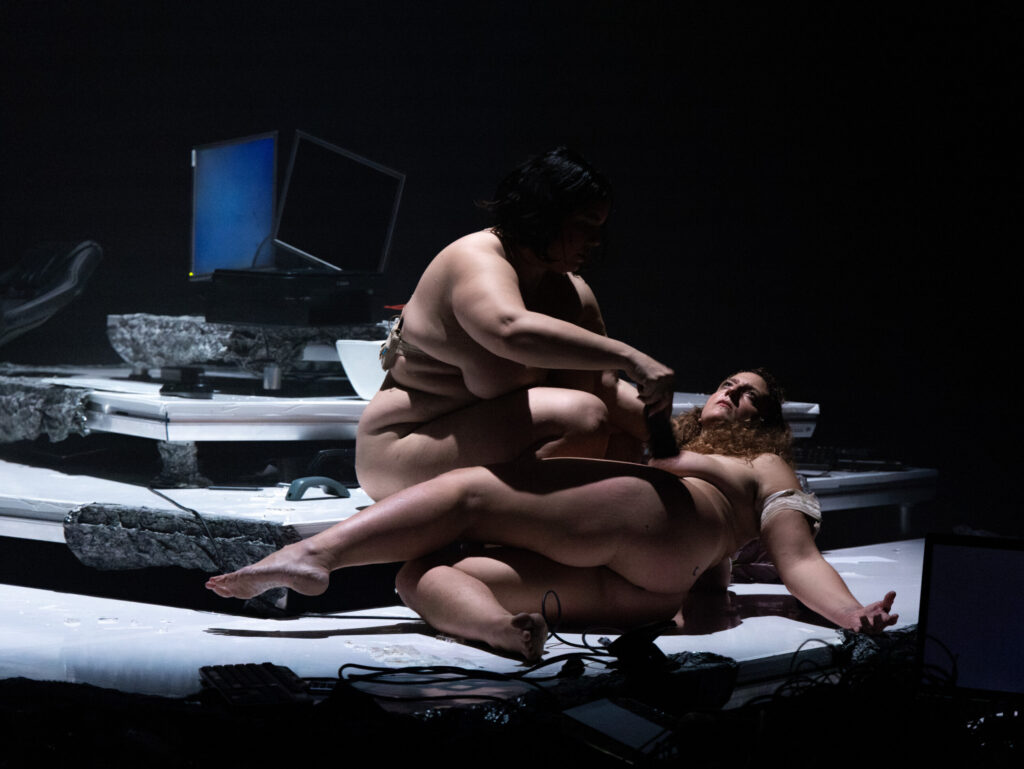
I wonder why Vittucci and Rodríguez are attempting intimacy with the objects on the stage. Is it a commentary on our touch-poor society? Even though the answer to this question is left open, I feel a strong eagerness when the women finally embrace each other. They engage in a wild tug of war, roll around the stage, kick, scream, punch, and slap. Rodríguez bites Vittucci’s butt cheek, and Vittucci gets startled. There’s an answer on many levels – an ‘ouch’, a taste of sweat on Rodríguez’s tongue, a red bite-mark. Rodríguez rolls on the feet of the people in the first row and surprisingly none of them recoil. There’s something about touch that is reclaimed, rediscovered by the artists. We simply want to be touched, and it’s not as simple as physical nearness.
I leave the hall wondering how we change this unbalanced relationship between humans and technology. The play doesn’t engage with this question that I feel it poses. It gets somewhat stuck in a dual relationship, women versus technology, human versus non-human, and even Rodríguez versus Vittucci. Vittucci’s boundless adoration for Rodríguez is apparent throughout the whole play. It’s endearing but it also strongly colours what happens on the stage. This leakage of personal relationships uncovers something profoundly human about us. We want to lose ourselves in something that is more powerful than us – our work, love, drama or, unfortunately, technology.
“It gets somewhat stuck in a dual relationship, women versus technology, human versus non-human, and even Rodríguez versus Vittucci.”
At this point in time, technology is controlling us much more than we’re controlling it. So, as angels, we have to lose not only our innocence but also our naivety. It’s funny as well as insightful to play with office supplies from the 90s and then giddily roll around with someone you adore. But technology has changed a lot since then. Humanness is diminished with every picture that gets generated online. What would happen to our angelic selves at a data center? Can we destroy those and rediscover intimacy, please? Is there any humanness left to interact with in the offices where job interviews are performed by robots? The artists’ point about reclaiming touch and intimacy still stands, but I am left wondering how I can do this today.
© Binta Kopp
© Binta Kopp
De speeldata van deze voorstelling vind je hier.
KRIJG JE GRAAG ONS PAPIEREN MAGAZINE IN JOUW BRIEVENBUS? NEEM DAN EEN ABONNEMENT.
REGELMATIG ONZE NIEUWSTE ARTIKELS IN JOUW INBOX?
SCHRIJF JE IN OP ONZE NIEUWSBRIEF.
JE LEEST ONZE ARTIKELS GRATIS OMDAT WE GELOVEN IN VRIJE, KWALITATIEVE, INCLUSIEVE KUNSTKRITIEK. ALS WE DAT WILLEN BLIJVEN BIEDEN IN DE TOEKOMST, HEBBEN WE OOK JOUW STEUN NODIG! Steun Etcetera.
recensie
25.11.2026
Leestijd 5 — 8 minuten
08.09.2026
—
14.01.2027

Ugnė Noreikė is a Lithuanian writer, musician and artist. She works in spaces of not knowing, vulnerability and extreme feelings. She’s looking for meeting points between sounds and words.
Natalie Gielen
Kristof van Baarle
recensie 25.11.2026
Natalie Gielen
Kristof van Baarle