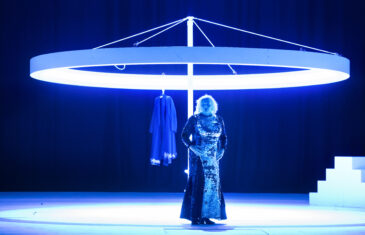
De Materie – Phia Ménard/Opera Ballet Vlaanderen/Bas Wiegers
Een schurend vooruitgangsdenken
Sébastien Hendrickx





© Simon Baetens
Exhausted from witnessing how life (human and not) is reduced to a mere techno-element of the neo-liberal machine, in the silence of my room, I cultivated limoni for the future. Somewhere between potting soil and fiction, these little green dreams snuck into the interstices of my confined life and together we began to imagine a garden, dispersed yet interconnected.
Ai limoni del futuro is an on-going practice-based artistic research project, which imagines its own publication in the form of a garden. It is a performative writing project that unfolds through multiple mediums (mail, web, contracts, video, sculptures, soil, pots,…) and partners (human, non-human, institutional and non-institutional), which takes as its stage, the urban space, the intimate space and potentially the planet.
It is a science-fiction story, set and written in the present at the crossroads of health, economic, ecological, energetic and human crises. The protagonists are plants. Particularly one fruit, recalling lineages, of Mediterranean travels spoke to my senses and became the cultural keystone species of a future expansive garden: Limoni. Mestizos, hybrids, promiscuous, bastards. Throughout centuries they were involved in an intergenerational orgy which included insects, wind, human fingers, tongues, stomachs, intestines of several not identified animal species. The lemon exists as techno-fruit, a hybrid co-domesticated with humans for joy of the senses, trade and consumption
(reluctant to taxonomy)Seeds coming from hybrids are said to be sterile, unproductive, unable to produce fruit, or producing monstrous inedible ones. As the market/industry sets the norms of what is accepted and civilized, offspring of hybrids are called – by opposition – Wild.
Too South to feel fully domesticated, lazy, un-productive, intense, eager of erotic connections, not knowing what to do with my-self in a locked-down city not mine, with growing language confusion. Hybrid limone with its queerish chimeric migrant techno nature made me feel protected in the expression of my own uncertain, multiple, peripheral (half rural half townie) yet passionate sexuality.
Its fragrant attractive smell, that flavor that shocks the tongue and awakens all the senses up and down the spine.
Moreover, a generative mis-understanding intervened to strengthen the bond: in Italian slang, limoni doesn’t only mean lemons, but also long lasting tongue kisses.
Unproductive, un-useful Wild limoni would have produced long lasting tongue kisses, by collapsing language and reactivating the mouth as non normative erogenous spot.
We were both ready to graft another story on each other.
The first exchanges of lemon seeds happened through the postal service, a practice called love spell. The delivered seeds, wrapped in wet toilet paper during their 10 days rest, started to dream their future and transform, to sprout, becoming for the receiver of the envelopes a hybridum between small aliens and characters of some sort. An unknown logogram language, while the toilet paper on which they lay, looked like an ancient un-rolled papyrus or parchment used for unknown writing.
I was inspired by Stefano Mancuso, founder of the department of Neurobiology of the Plants, who makes an important point by saying that we are mislead to consider the task of agriculture being to produce food, while instead every farmer is/or should be the true protector of the land. Agreeing with that, I invited people, reached by the love spell, to become guardians of a slice of this emergent garden, protecting the dream of sensual encounters in the form of limoni.
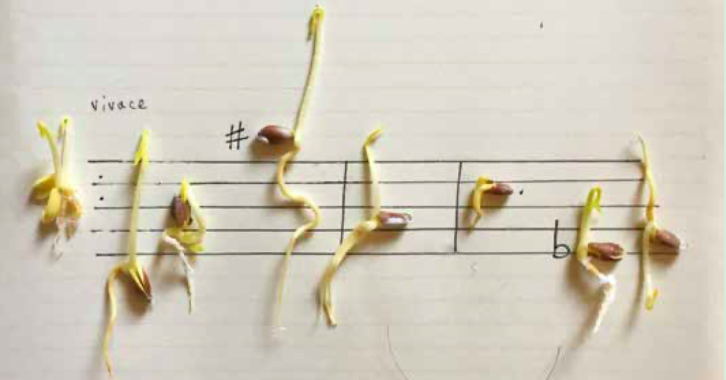
© Matteo De Blasio
Unable to take care of the growing multitude of plants on my own, I began to look for partners who would take care of one or more plants. Recyclart has been the first inviting me to open an adoption office in their courtyard and for the occasion I designed a consensual form to be filled in and signed by the future adopters, asking to imagine a commit with an experimental ritual choreography of care. The garden spread and sprouted new friends.
Adoptions of slices of gardens by artistic institutions didn’t always work that well.
limoni were often left to the care of migrant workers/cleaners/maintainers, if not completely forgotten, while programmers, directors – often very busy with a re-growing amount of work cannot fit the regular care of a few pots in their schedule.
It seems that growing a few plants, not even a garden, is inappropriate for work time.
It makes me wonder: What if while promoting green and decolonial programs for the public, each working space should include one hour per day of gardening? Even with the worst results, wouldn’t an hour less of production – on a planet that suffers from overproduction – be a notable gain for the health of everybody?
Cultivating a garden as an artistic outcome means to challenge the idea that my own artistic work would produce objects, or even events, something to be transferred into the market machine. Indeed you cannot (and neither can I) experience the garden in its whole. It is an alive multi-organism that exists through the endurance activity of mutual attention of a multiplicity of partners and contributors. You might catch a glimpse, it could appear in the story of someone else, you could encounter a tentacle of it, its fragrant smell could reach you. Its unfinished nature is constitutive of a work that grows in time. Incompleteness is the space left for others to join the co imagination of it.
Borders of gardens are ephemeral. Private property surely doesn’t work to speak about gardens, while it can do big damages; walls might be part of a garden and impede certain entities to access, but still there are so many others joining in and moving out: insects, wind, sun, etc. which make the garden possible and meaningful. Could you ever consider them ‘yours’? Caring for a garden would make you care for them too. It is exactly the overflowing generosity and receptiveness that make a garden what it is, it is only in this way that gardens will become rich and care back for you.
KRIJG JE GRAAG ONS PAPIEREN MAGAZINE IN JOUW BRIEVENBUS? NEEM DAN EEN ABONNEMENT.
REGELMATIG ONZE NIEUWSTE ARTIKELS IN JOUW INBOX?
SCHRIJF JE IN OP ONZE NIEUWSBRIEF.
JE LEEST ONZE ARTIKELS GRATIS OMDAT WE GELOVEN IN VRIJE, KWALITATIEVE, INCLUSIEVE KUNSTKRITIEK. ALS WE DAT WILLEN BLIJVEN BIEDEN IN DE TOEKOMST, HEBBEN WE OOK JOUW STEUN NODIG! Steun Etcetera.
essay
12.01.2023
Leestijd 5 — 8 minuten
15.12.2022
—
14.03.2023
Matteo De Blasio is an Italian artist and researcher based in Brussels. Graduated in philosophy at the University of Milan, he obtained a Master in choreography and performance at the Academie Royale des Beaux Arts (Isac-espace urbain).
Sébastien Hendrickx

Mia Vaerman
essay 12.01.2023
Sébastien Hendrickx
Mia Vaerman