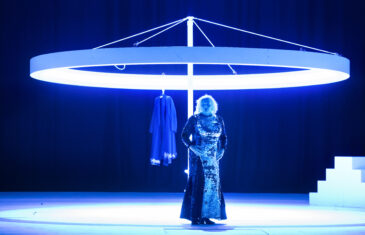
De Materie – Phia Ménard/Opera Ballet Vlaanderen/Bas Wiegers
Een schurend vooruitgangsdenken
Sébastien Hendrickx




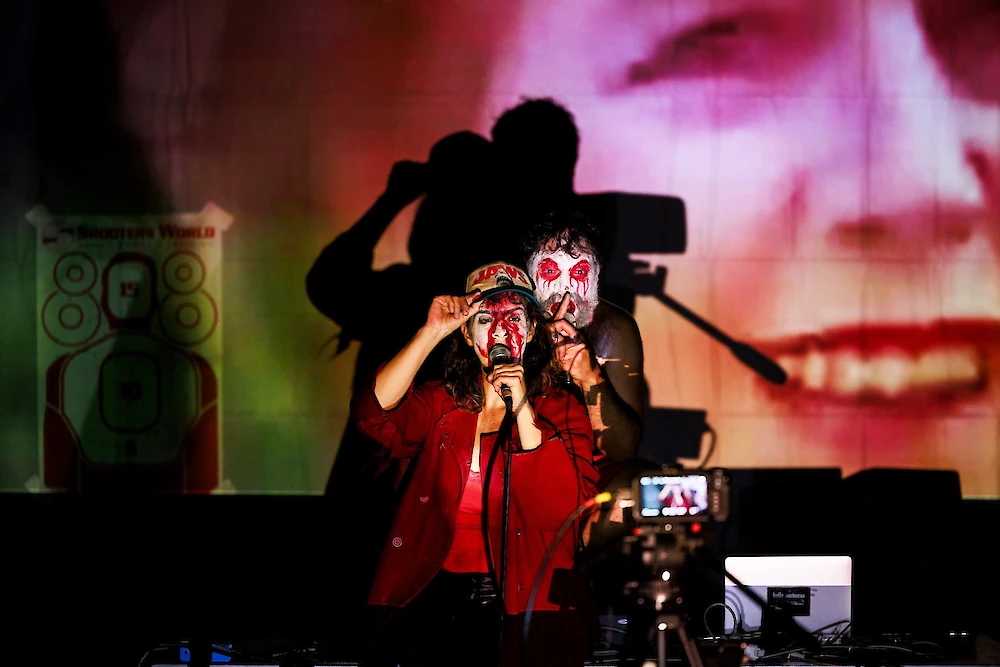
© Victoriano Moreno
Kidnapped unfolds at a time when, as the opening tells us, ‘the earth was tired’. Although the subtitle promises ‘A Training Ground for the Brutality that is Coming’, any distinction between a looming future and the present moment quickly collapses. What emerges instead is a sense of inescapable urgency.
The quick wit and dark humour of Rodrigo Batista and Mariana Senne are revealed early on, beginning with the performance’s description, followed by an unusually elaborate trigger warning. Instead of the standard caveats about flashing lights, this warning lists the political, emotional, and ethical intensities the audience is about to face: ‘This performance kidnaps you. The scene contains climate anxiety, fascism, contemporary corpses, critical speech, colonial and capitalist ruins, and ongoing violence. The audience may be exposed to participation, loud sounds, strong imagery, and political discomfort.’ More than a disclaimer, this statement serves as a declaration that what follows will refuse safety, comfort, or neutrality.
When the audience enters, the performers are running playfully across a room saturated in white. Dressed in colourful, pattern-heavy and mismatched clothes, their faces masked in clown paint, they command attention yet still appear strangely small against the vast, empty backdrop. The space is simple but precisely framed: a wall closes it off to the left and a white screen with a long table in front to the right. Throughout the performance, the two clowns named Terror (Rodrigo Batista) and Compassion (Mariana Senne) make inventive use of a live camera on stage. Combined with pre-recorded video collages, it creates layered perspectives within what might otherwise feel like a one-dimensional space.
The room is filled with the sound of a laugh track, the canned laughter of a television sitcom, that is eerily detached from the action. This forced cheer sets the tone for what follows: a distorted variety show, a horror of our own making, introduced by none other than Shelley Duvall. The American actress and producer was known for beginning each episode of her Faerie Tale Theatre with the same line: ‘Hello, I’m Shelley Duvall.’ When heard on repeat, the greeting takes on a mechanical quality, a rhythm that Mariana Senne mimics in the performance’s opening video. Duvall later tried, and failed, to recreate her formula for an older audience with Nightmare Classics a brief foray into televised horror stories. In a sense, this performance gently pays tribute to Duvall’s experiment by continuing it not with fictional horror, but with the horrors of the present day.
The performance interweaves a variety of discourses without resorting to jargon or elaborate theories. It demonstrates that intersectionality should be rather enacted than declared. Structured like a step-by-step guide, it leads the audience, cast symbolically as children, through successive scales of violence: from the kidnapped planet to the kidnapped body. By connecting environmental, territorial, and corporeal oppression, Terror and Compassion ultimately reveal how the abduction of the Earth under colonial capitalism mirrors the ongoing captivity of our bodies.
“What begins as a harmless assertion soon reveals its darker side: the same logic of individual pleasure can destroy communities and can drive systemic injustices.”
Throughout the performance, Terror and Compassion are haunted by déjà-vus: an eclectic collage of video fragments, ranging from interviews and speeches to news clips and pop culture moments, which are assembled to deliver a pointed message. Some sequences linger longer than necessary, but these moments do little to disrupt the work’s precision. Emerging from this layered media landscape, the clown balances absurdity with concise language. Keeping the tone humorous but never careless, the clowns provoke laughter as well as silence, feelings of complicity, shame, solidarity, and grief. Compassion and Terror’s exchanges cut to moments of striking clarity, such as a clip showing Pier Paolo Pasolini standing by the sea and reflecting on fascism. Terror distils his thoughts to their core: ‘Fascism is a bunch of criminals taking power.’ He then applies this logic to consumer society, a system of homogenisation that is seamlessly embedded within democracy. Then the performance reaches a critical revelation: our desires, relationships, and realities are being kidnapped by the very structures that claim to sustain us.
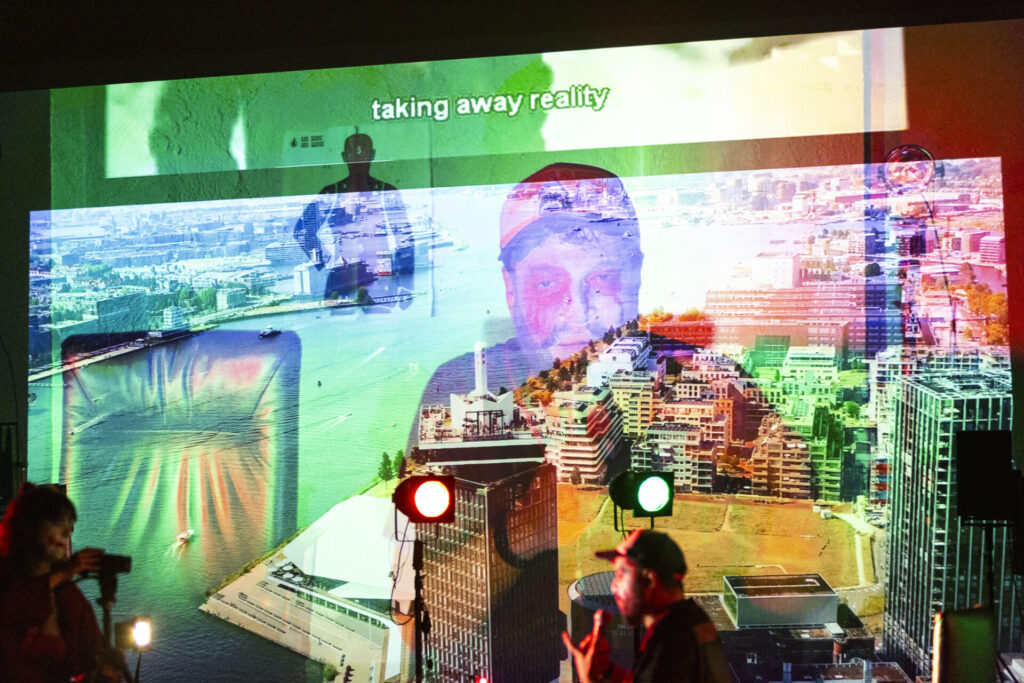
© Elodie Vreeburg
Early in the performance, the clowns declare that everyone should have the right to fun. What begins as a harmless assertion soon reveals its darker side: the same logic of individual pleasure can destroy communities and can drive systemic injustices. Despite the critique, individualism will persist until the end according to Terror who proclaims that, ‘You will be so traumatised that you will write your autobiography.’ Everyone will write their story, and no one will read them. The self becomes both refuge and prison, and attempts to soothe collective pain appear hollow, merely distracting us from our deeper desire for revolution.
Batista and Senne’s vision translates into a brutal, funny, honest, and alarming show. It refuses to escape the dystopia, choosing instead to stay within it, to strip away any illusion of distance. What we see on stage is not a vision of what might come, it is what already is. ‘The world is a casino that revolves around the sun, and we are the losers in that casino.’

© Victoriano Moreno
KRIJG JE GRAAG ONS PAPIEREN MAGAZINE IN JOUW BRIEVENBUS? NEEM DAN EEN ABONNEMENT.
REGELMATIG ONZE NIEUWSTE ARTIKELS IN JOUW INBOX?
SCHRIJF JE IN OP ONZE NIEUWSBRIEF.
JE LEEST ONZE ARTIKELS GRATIS OMDAT WE GELOVEN IN VRIJE, KWALITATIEVE, INCLUSIEVE KUNSTKRITIEK. ALS WE DAT WILLEN BLIJVEN BIEDEN IN DE TOEKOMST, HEBBEN WE OOK JOUW STEUN NODIG! Steun Etcetera.
recensie
13.10.2025
Leestijd 4 — 7 minuten
15.09.2025
—
14.12.2025
Lynn Gommes beweegt zich tussen het podium en de pagina, ze is werkzaam in de podiumkunsten en het publiceren. Aangetrokken door de raakvlakken tussen poëzie en politiek, zocht ze eerst haar toevlucht in het geschreven woord door opleidingen in de vergelijkende literatuur en politieke wetenschappen. Dit leidde haar naar cultural analysis, waarbinnen ze zich richtte op theater en het verkennen van het performende lichaam en diens plaats in de samenleving.
Sébastien Hendrickx
Mia Vaerman
recensie 13.10.2025
Sébastien Hendrickx
Mia Vaerman