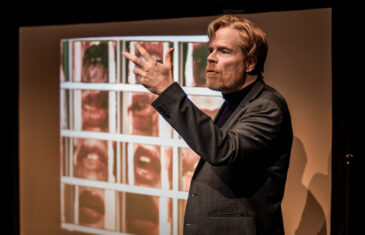
Confessie – Raven Ruëll & Bruno Vanden Broucke
De kunstmarkt maakt de kunstenaar
Klaas Tindemans





© Maryan Sayd
To call something holy is to give it a preciousness, to make it worth our uninterrupted attention. A morning routine can be non-negotiable, a dessert after dinner habitual, an afternoon with dear ones invaluable. But something holy seizes your whole being with force, with undeniable meaning, and it’s never self-inflicted. Experiencing holiness makes you forget yourself, and moves you from the individual to something greater, more united. How often do we experience this throughout the day? Not that often, I’d say. And yet, every waking moment on this earth is sacred and whole. This is not religious preaching, but a simple truth. If you ever just take a minute to realise all that needed to happen for you to be this combination of molecules, that’s simply miraculous. This is also true if we zoom out and see our being in the world as intertwined instead of individualistic. In Holy, Martha Canga Antonio guides us into sensing this sacredness by asking what it means to hold space for it.
I like to see plays that I’ll have to review alone because my attention is sharper. Since I’m in my own company, the audience becomes a part of the performance as well. While I was waiting to enter a sold-out premiere I observed a few other singletons but most of the spectators had someone to talk to. The crowd was naturally dividing itself in small couplets, quartets, rarely a sextet. It made me think of the difficulty of being in a crowd that doesn’t have a common goal. We’re standing around waiting for something to happen, but we lack direction and focus. And so we easily fall into our habits, we divide into the groups we came with. Even though the combinations are comfortable and recognizable, the simple truth is that we’re also constantly separating ourselves. By choosing comfort and recognition we might miss something greater.
Upon entering the Theatre Studio of De Singel we encountered some more walls. The whole theatre hall was occupied by a construction – high black walls behind which we heard something moving. For some time we were again waiting there, some people hung their jackets, looked for a place to leave their backpacks. After a moment the crowd started moving. I was following them and then I saw Martha Canga Antonio beaming at a narrow entrance. She was lit by a spotlight, happy to welcome us to her music theatre directing debut. After starring in the critically acclaimed film Black, she seems to be looking for closer contact with the audience.
Inside we saw Lazara Rosell Albear at the drums situated on a low platform. She was sitting against a wall facing the entrance and was unmissable. Her Cruella-de-Vil hairstyle pointing to different sides gave her an edgy look. Her clothes were ragged, but she looked festive, like a shaman ready to perform a ritual. The enclosed space soon became crowded and some couples had to stand further apart, friend groups split. Something became more interesting than our own comfort. Albear started drumming louder and louder with music blasting from the speakers. She was out of rhythm and then in it again, expressing pure energy, getting us hyped. The spotlight changed and illuminated Martha Canga Antonio behind us, who started singing. Her voice was similar to that of Martina Topley-Bird; the music style reminding me of her own album released in 2023 under the name of Martha da’ro called Philophobia; disorienting, fearless, groovy, was setting the dream-like mood of the space.

© Maryan Sayd

© Maryan Sayd

© Maryan Sayd
After their musical performance the wall in front of us moved, opening up a narrow gateway on the right to yet another dark space. We all eagerly but calmly went through the passage and got situated in half a circle in front of another platform. There Magdelaine Hodebourg was dancing like a conjurer to Jazz Sanusi’s bossa-nova improvisations accompanied by Ashley Morgan on guitar. It was sweet and tender, lulling us into a state of care. The need to reconfigure our positions so that everyone can see became self-evident and to me, this was the strongest part of the performance. In lack of a clear system that aligned us in and through the shifting spaces, we had to find our way around each other. Making what was happening visible for everyone became a common goal. Because of that, we also saw each other, the taller people scooched for the shorter ones. There were no firsts or lasts, people simply made room.
“Jazz Sanusi was weeping for a loved one, modulating into her whistle tones, showing off her voice. It made me wonder: what relationship with ego does holiness have?”
One last time, the wall with the drums moved and altered the setting of the rooms. It started turning around, and this carousel invoked the feeling of the world being contained in this shapeshifting space. On different sides of the wall we saw different still lives by performers; they were apart, then slowly got together, closer to each other, moving from the individual to the whole. Once it stopped moving we started walking around with the performers, in search of what’s next. It seemed like they, like us, were searching for something, maybe attempting to express holiness – having a personality crisis in the case of Ashley Morgan, dancing in a frenzy in the case of Magdelaine Hodebourg. When we encountered Jhaya Caupenne – bending backwards, spinning her floor-length hair – my neighbour almost got hit in the face, exclaimed “oh damn” and moved away with a smile. It was all happening right in front of our noses.
The space and moving focal points loosened up the crowd, but we were still walking around in silence, aware that the performance is ongoing. Yet I noticed that I’m more interested in looking at other spectators than at what the performers are doing. Jazz Sanusi was weeping for a loved one, modulating into her whistle tones, showing off her voice. I saw some people nod in admiration of her skill and talent, undeniable, indeed. But seeing this made me wonder: what relationship with ego does holiness have?
“In the end, I felt that this performance was more about crowd control than about what is actually performed.”
Our drive to do, to achieve, to be the best, to shine, that’s all beautiful. But in this day and age we rarely shine in service of holiness or something greater than ourselves. It’s us shining for us, empowering our individualistic self. The performance doesn’t seem to be inquisitive about this relationship of individual talent and holiness. It seems to take for granted that a full-blown expression of emotion is the key to sacred being. While it might be cathartic and a good way to prove the performers’ right to the stage, it falls flat without a greater message. If living everyday reality as holy means nothing more than the right to full expression, then it clashes with what the performance is asking us to do: to see each other, feel unity with strangers, forget ourselves and feel whole.
Some parts of it were awe-inducing, others were out of tune or rhythm, falling apart as they were performed. With art, you never know what’s supposed to happen, you only observe what happens in the moment. And for a very short time we were walking this shapeshifting chamber as a holy temple of curiosity. What’s next, and where will it occur? We lost our historical context: the memory of coming from somewhere and with someone was less interesting than the present. Maybe just for a split second we were allowed into the temple of being whole and together.
More shows: 26-28/3 in Viernulvier (Ghent) and 2-4/6 in AB (Brussels).
KRIJG JE GRAAG ONS PAPIEREN MAGAZINE IN JOUW BRIEVENBUS? NEEM DAN EEN ABONNEMENT.
REGELMATIG ONZE NIEUWSTE ARTIKELS IN JOUW INBOX?
SCHRIJF JE IN OP ONZE NIEUWSBRIEF.
JE LEEST ONZE ARTIKELS GRATIS OMDAT WE GELOVEN IN VRIJE, KWALITATIEVE, INCLUSIEVE KUNSTKRITIEK. ALS WE DAT WILLEN BLIJVEN BIEDEN IN DE TOEKOMST, HEBBEN WE OOK JOUW STEUN NODIG! Steun Etcetera.
recensie
01.02.2026
Leestijd 6 — 9 minuten
15.12.2025
—
14.04.2026

Ugnė Noreikė is a Lithuanian writer, musician and artist. She works in spaces of not knowing, vulnerability and extreme feelings. She’s looking for meeting points between sounds and words.

Klaas Tindemans
Mia Vaerman
recensie 01.02.2026
Klaas Tindemans
Mia Vaerman