De Materie – Phia Ménard/Opera Ballet Vlaanderen/Bas Wiegers
Een schurend vooruitgangsdenken
Sébastien Hendrickx




© Ilse Ghekiere
For those who are on stage, surrender usually counts as a high good. But when does surrender become submission, when are boundaries not only tested but crossed, and what ambiguous role does a term like ‘consent’ play in this? Using pioneering female performance artists from the past, Ilse Ghekiere dissects pain and empowerment in contemporary performing arts.
“Would I have attended such an event at the time?” This is the first question in a long list that the American writer Maggie Nelson asks in her book The Art Of Cruelty1 as she contemplates the 1971 performance Shoot by Chris Burden. Like many artists of his generation, Burden explored, through a series of controversial performances, the limits of the body by intentionally putting that body in situations of danger. Shoot made Burden famous for his simple request to be shot in the arm. An action that surely must have hurt, but for all it is worth: the bullet wasn’t fatal and the performance made history.
Nelson continues: “Why do I still feel morally uncomfortable about watching this now? What are the differences––ethical, sensory, aesthetic––between being present for such a thing and watching a recording of it? What about between watching and listening.”
“Feminist Martha Nussbaum argues that in some contexts, being treated like an object is not necessarily harmful and can be even an important part of how we enjoy and desire.”
Reading or writing about transgressive art is not the same as watching or performing it. A book can be put down. Words create distance and a sense of autonomy. Performance art of the 1960’s and 1970’s is full of legendary examples of artists experimenting with self-harm, pain, violence, danger––you name it. Rather than representing these themes, these artists wanted to show us ‘the real thing’, to confront us with the vulnerability of bodies and the shock that comes with witnessing such violent actions. Maybe it’s a relief to know we no longer have to attend, that we no longer have to be their audience, that some other people have done the job for us. At the same time, maybe that’s just blasé. It is easy to lean back and say: We’ve seen this trick before. Art history provides us with what is left: Descriptions, maybe audience testimonies, a picture, a relic, and when we are lucky, a recording. Reading about these iconic performances, many of which were, not surprisingly, made by women artists (the medium of performance art was new and, not unimportantly, also cheap), I feel both excited and overwhelmed by the conceptual possibilities and the stories created around these works. They haunt me, like ghosts.
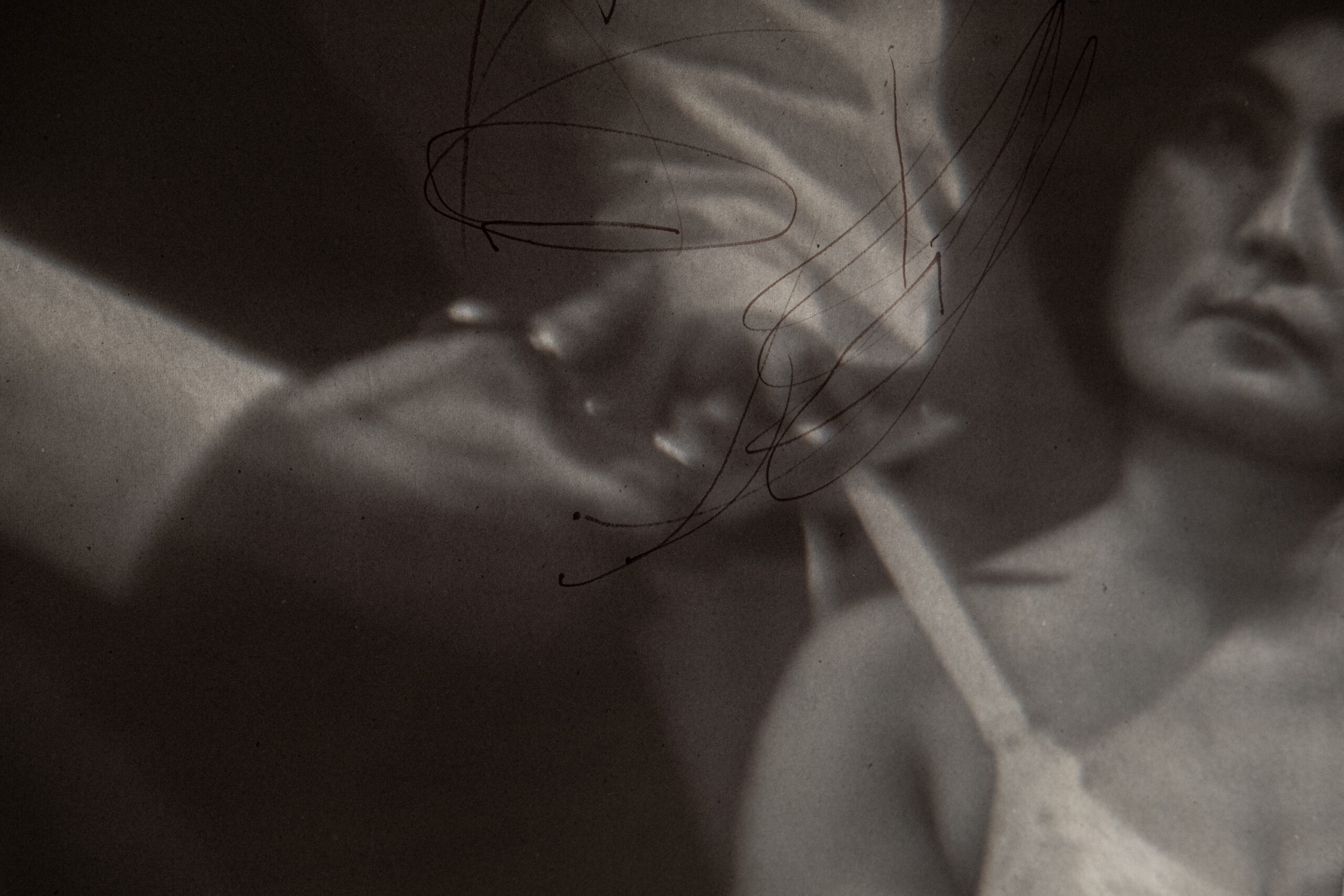
An image of a woman sitting on a stage while her dress is slowly cut to pieces by members of the audience, eagerly picking up the pair of scissors lying next to her (Cut Piece, Yoko Ono, 1964). An image of a headless woman lying on a kitchen table, her underwear pulled down, strokes of blood tracing her naked legs and buttocks (Untitled (Rape Scene), Ana Mendieta, 1973). An image of a woman with a box with a curtain around the torso, roaming the streets of Vienna, inviting passengers to touch her breasts hidden behind the curtain. She’s smiling. (Tap and Touch Cinema, VALIE EXPORT, 1968). A long table filled with objects insinuating the possibility of both pain and pleasure. Next to it, a woman ready to undergo whatever the audience would like to do with her (Rhythm 0, Marina Abramović, 1974).
Contrary to Burden, whose work has been described as an example of ‘classic masculine hubris’, the above-mentioned artists, and many other pioneering women artist among them, explored not just the topic of violence, but more specifically sexual violence. These canonized references have been part of my imagination since my early dance education. As both a dancer and a person inhabiting a woman’s body, these performances spoke to me as portraits of ‘strong women’, the kind who cold-bloodedly staged danger and violence by soliciting it themselves. Over the years, I have outgrown the air of emancipation these performances once held – somehow, their potential, or promise, let me down. ‘Sexual violence as artistic sacrifice’, comes across as a somewhat meek proposal compared to the plentiful of depictions of cruelty and suffering available to us these days – a blast of images and stories for us to peruse and consume, and be troubled or entertained by, in high definition, at any time. The fact that the importance of these works, to a large degree, builds on the idea of the singular artist as myth – Abramović, for example, has literally turned herself into an institute (MAI) – also leaves me reluctant to defend their early radicalism. Collective efforts by other feminist artists of the time, and their importance to the movement as a whole, is often overlooked. Instead we continue producing around the ‘artist-myths’.

© Ilse Ghekiere
Still, their performative strategies continue to intrigue me, being relevant to questions about the role of the performer, even today. There is something peculiar about the tension in actively pursuing self-objectification and passivity, while all the while inviting possible harm. Philosophical theories on objectification have been around since Kant and have played a central role in feminist critique. Aside from discussing what ‘objectification’ exactly means, much has been written on how it affects men and women differently. When academics talk about self-objectification in society at large, it most often concerns the pressing demands on women to conform to beauty standards and how this demand is to some degree internalised and self-regulated. Therefore it comes as no surprise that a majority of feminists see objectification and self-objectfication as a morally problematic phenomenon. Although I mostly agree with this critique (I am one of those feminists), I also follow other voices, the feminist Marta Nussbaum among them, who approach objectification as something not exclusively negative. Nussbaum argues that in some contexts, being treated like an object is not necessarily harmful and can be even an important part of how we enjoy and desire.2 In short, objectification can also be something positive and rewarding.
“Instead of meditating and sensing, you end up trying to be the ‘good student’, hoping you look right to the outside.”
In an interview with MoMA, Yoko Ono reflects on her experience of performing Cut Piece by comparing it to going into a trance: “Don’t fight. Let it happen. By not fighting we show them that there’s a whole world that could exist by being peaceful.”3 While Ono’s intention was most likely to give a spiritual spin on her experience, for me the comment reads as naive. At least at first. It reminded me of what the late Tibetan teacher Chogyam Trungpa Rinpoche coined as “idiot compassion” or rather the confusion between showing compassion to others and letting them walk over you, while continuing ‘your smile and be kind-mantra’. An avid Vipassana meditation practitioner myself, I feel strongly about this ambiguous line. Even though sitting still for hours on end has been helpful in terms of life management (stillness can be very painful), it has also shown itself to be an excellent technique for enduring pain as ‘mere sensation’––a tool for feeling less, and a potential trap into indifference.
“What forms or contexts of inflicting harm, on oneself or others, should be allowed (S/M, suicide or assisted suicide, performance art, or any other consensual scenario, and so on), and which should be discouraged or prohibited?”, Nelson wonders.4
© Ilse Ghekiere
Reading one of the many stories about student initiations at Flemish universities, published in the wake of Sanda Dia’s death, I found myself visited by the ghost of Cut Piece. One student described how she was ‘sold’ to an older male student, someone higher up the ranks. He told her to put on a t-shirt and then asked passengers on the street to cut holes in it, gradually making her more and more naked. Eventually, and just like one can see in the film recording of Cut Piece, someone cut away her bra. Reading the story, and watching Ono’s reaction when the bra was being cut, I first felt – and still feel, on behalf of any person wearing a bra – deep humiliation. Then shock, directed at the audience and the passers by, and their willingness to participate. I wonder if this is one of these instances where I might think of myself as morally superior – someone who would never accept such an invitation. And maybe this is one of those cases where I am relieved that I don’t have to see the performance live and for the first time. If I am honest, I am unsure of what I would have said or done. What if I wrongfully assumed consent? What if I wrongfully assumed the absence of it? Or, as Nelson continues her inventory: “Who has the power, authority, right, duty, and/or audacity, to intervene on behalf of another’s body, especially a body that is doing what it says it wants to do? When and how (if ever) is it anyone’s business to mandate what we do with our bodies in our lifetime?”
“Many dancers describe how their work and education has conditioned them to, at least to some degree, desensitize and objectify their bodies.”
“I think I actually hurt myself through meditation”, a friend and dance colleague confided to me when I mentioned the subject of this text. I knew precisely what they meant. Although I wouldn’t go as far as blaming meditation outright (even if I believe it can be taught in ways that are questionable, even harmful) there is always the possibility it might reveal something about one’s relationship to commitment, discipline, endurance and pain, in ways one might not be prepared to face. Instead of meditating and sensing, you end up trying to be the ‘good student’, hoping you look right to the outside. You end up in pure rigidness, while flagellating yourself: “Sit still!”. It took me years to accept that my internalised rigour to submit to a task or endure a challenge, especially when driven by external motives such as having an audience, was not a trait to be proud of. Instead it was something that weakened me, something to unlearn. A painfully slow unlearning to understand that if pain isn’t opening my senses in a pleasurable way, it should not be worth my time.
Over the years, and thanks to the work of Engagement Arts5, I have engaged in countless conversations about transgression and negotiating boundaries in dance. Inevitably, the topic of pain and one’s relation to it, comes up. Many dancers describe how their work and education has conditioned them to, at least to some degree, desensitize and objectify their bodies; a strategy directly linked to the demands of pushing both physical and mental boundaries, and the constant promise of becoming ‘a better dancer.’ These experiences are not necessarily negative. One can enjoy the muscle pain and missing it when it is not there, or enjoy the endorphins that come with extreme physical exertion, or have a high threshold for pain (something that might come in handy, for example when giving birth). Through this lens, Ono’s reflection about going into a ‘trance’ appears not so naive after all, but rather accurately describing a form of emotional dislocation and a strategy of objectification which I believe many performers, myself included, have mastered to be able to stage all kinds of actions, not only ‘transgressive’ ones.
“In a very understandable way, what it means to give ‘full permission’ – freely given, reversible, informed, enthusiastic and specific – feminists in sexual ethics point out that consent remains a legal term and so is embedded in a contractual logic.”
Art historically, I am curious about the relation between the body art of the 1960’s and 1970’s and European continental contemporary dance as we know it today. Language serves up ‘performance art’ as something different than ‘performing arts’, making an artificial split between work created in the tradition of visual art (often centering on ‘the object’) and disciplines such as dance, theater or music (more centering on ‘the body’). That said, there are many conceptual and aesthetic overlaps between the two – cross-pollinations that are sometimes visible in the event, but not always easy to track after the fact. Still, most would agree that continental European contemporary dance has greatly benefitted from the thematic and aesthetic explorations of performance art of the 60’s and 70’s. However, one major difference that continues to pull my attention is the question of authorship: while the performance artist almost always holds the signature, the dancer (or actor) traditionally does not. Furthermore, while the previously mentioned examples of performance art might make overt statements by displaying harm and expressing transgression (making it visible), in the performing arts pain, suffering, sacrifice often functions as hidden engines behind creative processes. For example: We don’t exalt the bleeding toes hidden in the point shoes of the ballerina as we do the blood dripping from the flesh of the transgressive performance artist, simply because we are not supposed to do so. While the latter might be thought of as radical, the former almost borders the perverse.
What does risk-taking mean in relation to authorship? Or in relation to visible vs. invisible harm? The art historian Jane Blocker uses the term ‘risk transfer’ to describe the work of artists who became famous for being “fearless risk-takers by transferring the risk to those around him or her.”6 Person A (paid or not) is taking a physical risk that person B, who is not bodily involved, profits from, financially or culturally. The term itself originates from the world of corporate finance, and as much as this kind of inequality is inherent to capitalism (I think for instance of the unknown number of people who died while building the stadiums of the 2022 World Cup), it’s interesting to realise how intrinsic this logic is to the dynamic between the author (composer, director, choreographer) who creates the work, and the performer, who executes it, and therefore also takes the physical and often psychological risk involved.
“Who defines harm? On whose behalf?” I have quoted Nelson many times. When I see a performer doing something dangerous, harmful or transgressive on stage, I often lazily assume they must have consented to these actions. As we know, the real harm and abuse in the performing arts happens where we cannot see it, and as an audience you are somewhat (metaphorically as well as actually) left in the dark and can only make assumptions about a performer’s agency or lack thereof. Add to this the hidden engines of creation––pain, suffering, and sacrifice––and you’re lost in murky territory. What to do, for example, with a dancer who appreciates being scolded or humiliated by a director, believing it enhances their performance and pushes them to places they would otherwise not go?
In negotiating boundaries in dance, the notion of consent has been introduced as a magical word that will dissolve all problems. Despite my enthusiasm for the discourse, consent theory has its limitations, especially when entering the stage and rehearsal space. As much as it lays out, in a very understandable way, what it means to give ‘full permission’ – freely given, reversible, informed, enthusiastic and specific – feminists in sexual ethics point out that consent remains a legal term and so is embedded in a contractual logic. The critique goes on saying that consent theory reestablishes patriarchal and heterosexual dynamics: consent as being an exchange between two parties where one gives the consent (‘the woman’) and the other receives it (‘the man’). Furthermore, consent theory seems to filter out the ambiguity that many sexual and, I believe, artistic encounters have. It is also based on the assumption that people, at any stage in their lives, possess high levels of self-knowledge, or to add Nelson’s final question: “In what sense, under what conditions, can we say that a body knows what it wants?”
© Ilse Ghekiere
I don’t know if my body knows what it wants, but I do have a feeling it knows what it does not want. Maybe this explains why these canonized performances haunt me. What I see under their skin, is a message that confuses me, namely that being the author of one’s own inflicted, sexualized pain, changes the game. While the only thing I really see is an idea of the strong woman in charge of her self-invited harm. That’s maybe a harsh statement or a simplified way of looking at these works, but I wonder if staging violence against women by reperforming the self-objectification becomes a default position, while at the same time blinding us to the new narratives of female pleasure, agency and collectivity. Erotic art films made by women and queers have surely given interesting answers to this tension (see for example the queer pornographic art by A. L. Steiner and A.K. Burns). Strangely, it makes me wish for more ‘deceptive’ or ‘vengeful’ objects: the object-turned-subject that suddenly acts back. Like a performative version of the famous painting Judith Slaying Holofernes, breaking with the narratives of violence against women through the use of sisterhood and vice. Breaking the agreement, breaking the status quo, breaking the spell.
The original sources of the images used by Ilse Ghekiere are as follows:
Cut Piece, Yoko Ono
Tap and Touch Cinema, Valie Export
Rhythm 0, Marina Abramović
KRIJG JE GRAAG ONS PAPIEREN MAGAZINE IN JOUW BRIEVENBUS? NEEM DAN EEN ABONNEMENT.
REGELMATIG ONZE NIEUWSTE ARTIKELS IN JOUW INBOX?
SCHRIJF JE IN OP ONZE NIEUWSBRIEF.
JE LEEST ONZE ARTIKELS GRATIS OMDAT WE GELOVEN IN VRIJE, KWALITATIEVE, INCLUSIEVE KUNSTKRITIEK. ALS WE DAT WILLEN BLIJVEN BIEDEN IN DE TOEKOMST, HEBBEN WE OOK JOUW STEUN NODIG! Steun Etcetera.
essay
06.04.2023
Leestijd 14 — 17 minuten
15.03.2023
—
31.05.2023
Sébastien Hendrickx
Mia Vaerman
essay 06.04.2023
Sébastien Hendrickx
Mia Vaerman