
HUNTER – Liesa Van der Aa / B O D I E S
Let’s play!
Evelyne Coussens






Némo Camus – Dona Lourdès © Valeriia Shcherbina
Dona Lourdès (2024) by artist Némo Camus, co-created with Robson Ledesma, is a performance about his relationship with his grandmother Lourdès de Oliveira and her family heritage. Born in Brazil to a white American father and a Brazilian black mother, Lourdès is known for her supporting role as Mira in Black Orpheus (1959) a movie directed by French director Marcel Camus, grandfather of Némo Camus. Furkan Ak untangles how the piece narrates the hidden story of Brazil’s racial whitening policy of the colonial era that continues to haunt Camus’ family and Brazilian culture.
According to Giralda Seyferth, The theory of racial whitening, inspired by the ideas developed in Europe about racial determinism, was developed in Brazil in the period between the end of the Empire of Brazil (1889) and World War I (1914). The chief characteristic of this theory is its ambiguity: it thought of miscegenation (the mixing of people from different racial backgrounds, for example through marriage and childbirth) at one and the same time as both an evil to be extirpated and a solution for the racial question in Brazil.
The preoccupation with various types and degrees of colour mixing and their conse quences for the formation of the Brazilian nation was a constant in the work of various writers — historians, sociologists, anthropologists, etc. — all in some degree influenced by theories that today we would label racist but which, at the time, had the status of authentic science. The concept of whitening implies a series of presuppositions and some even contradictory opinions on the meanings of the concept of race: the authors believed in the inequality of human races, in the incapacity of the black to become civilised, in the genetic inferiority of the non-white races, including in this the majority of mestizos, and, principally, in a natural and social selection that would lead to a whiter Brazilian people in the not very distant future. Using the then popular term “eugenics”, the Brazilian authors who developed this theory suggested the possibility of ‘cleansing the mixed-blood population of its African characteristics after a few generations.’1
“Dona Lourdès lets us listen to mixed-race people’s stories from different eras and the Brazilian diaspora in Europe. These ghost stories confront us with the realities of post colonialism and its hidden traces in social structures.”
Through the framework of hauntology, I argue that Dona Lourdès consists of spectral traces and ghost stories of mixed-race people. Each appearance2 of such ghosts makes us think not only about injustice in the present, but also justice for the future. Ghosts manifest themselves as traces and continue to haunt until their presence is acknowledged. ‘Haunting, above all, has the force to put the familiar social and political structures into crisis through the processes or the mediations it actively creates’3, writes Nermin Saybaşılı. In this context, Robson Ledesma, a Brazilian dancer, makes the traces visible with his presence on stage. Dona Lourdès, co-directed by Némo Camus, Robson Ledesma and Nathalia Kloos, lets us listen to mixed-race people’s stories from different eras and the Brazilian diaspora in Europe that are still haunting today. These ghost stories confront us with the realities of post-colonialism and its hidden traces in social structures.
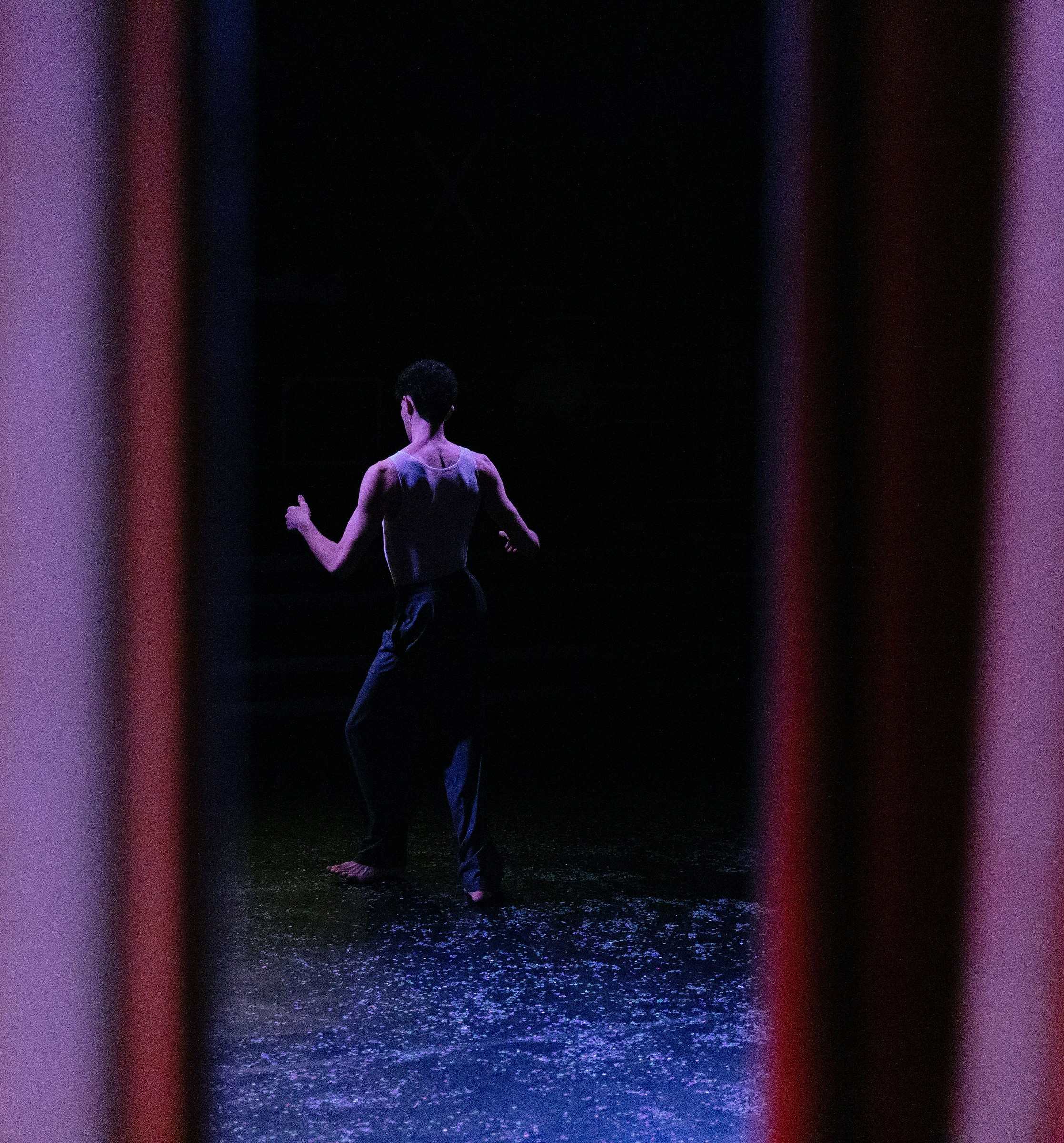
There is a curtain of white, beige and pastel colours stretching across the entire playing area behind the stage. While the audience waits for the performance to start, dancer Robson Dona Lourdès Ledesma enters with confetti in a small bag from the left. Ledesma wears black trousers, a blue shirt with an Ancient Greek himation in black and green colours on top. It is almost identical to the colours and costume on the poster of the film Black Orpheus (Marcel Camus, 1959), an adaptation of the ancient Greek myth of Orpheus and Eurydice set during the carnival of Rio de Janeiro. Starting from the front of the stage, Ledesma walks slowly, scattering confetti to cover the whole playground. It is like a kind of preparation for something, in an almost ritualistic atmosphere. Gradually, a humming sound grows louder and louder from backstage. The black floor of the theatre stage slowly fills with confetti. At first the curtains resemble an interior space or a room in a home, but with the addition of the confetti, the space evokes an outside setting, like we’re at a carnival.
“Through the confetti, the place transforms into an uncanny place with a fuzzy quality where identities slip between each other.”
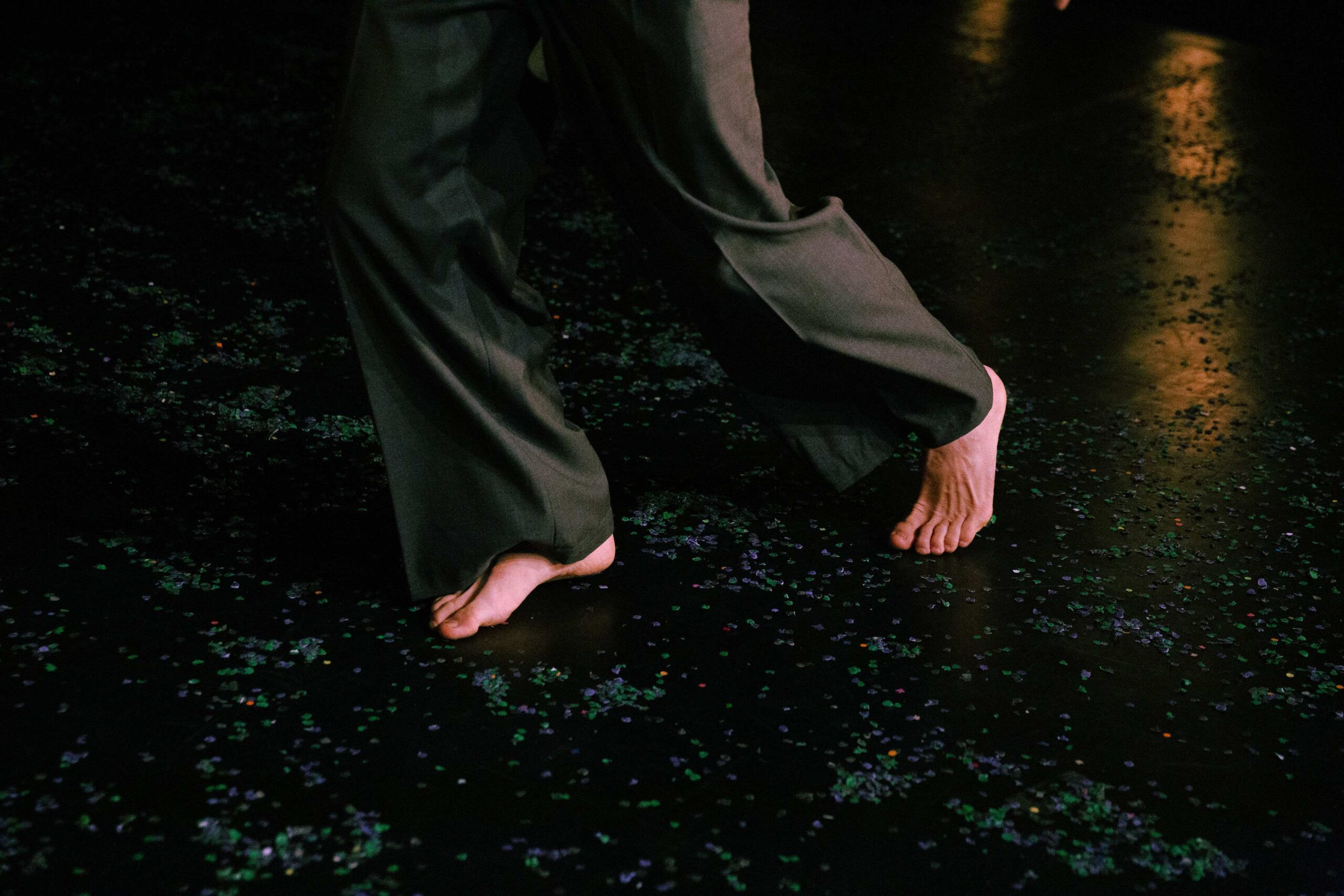
This tension of inside and outside creates a kind of uncanny feeling. Through the confetti, the place transforms into an uncanny place with a fuzzy quality where identities slip between each other. While Ledesma dances to the music, we hear Dona Lourdès start to sing along to the song of a mixed-race girl with an old samba rhythm. It is in this moment that both the musical manifestations of the racial whitening appear in the performance for the first time and a ghost appears, by blurring the meaning of the spaces, to haunt, thus forcing the viewer to look beyond the visible. Ledesma spins round, waving his arms up and down with enthusiasm and takes samba steps back and forth on his tiptoes. In the carnival scene in Black Orpheus, Mira performs the same movements in a crowded environment by turning around her fiancé. Ledesma’s steps make the confetti on the stage move, marking his trajectory on the black floor. These sharp, fast and at the same time enthusiastic movements contain a certain aggression. The simultaneous combination of aggression and joy recalls the inversion of roles and the roots of carnival tradition that ‘reflects the paradoxes of Brazil for Carnival is both a celebration and a denial of Brazil’s Black roots.’4
The paradox of carnival tradition emerges through Ledesma’s dance and lets his body trace the present by Lourdès’ ghost story. Derrida, who coined the term ‘hauntology’, writes: ‘The “ghost” introduces knowledge of a “supernatural and paradoxical phenomenality, the furtive and ungraspable visibility of the invisible”5 There are steps forward and backward with enthusiasm. The smiles all around are identical to the dance of Lourdès playing the role of Mira in Black Orpheus, seen in the first scenes of the film. Ledesma’s movements not only synchronise with Dona Lourdès’ character in the film, but with her narration in the present as well.
It is through these parallels and synchronisation that Ledesma appears as a trace of Dona Lourdès. She slips away through his body, by creating traces as if to attract attention, as if to mark the present with her absence before hearing her ghost story. We don’t see the movie, nor her physical body nor voice recording. ‘The dialectics of visibility and invisibility in the act of haunting involve a constant negotiation between what we can see and what we cannot.’6
© Valeriia Shcherbina
Lourdès haunts Ledesma’s body and lets him embody her story rather than translating the movements and rhythms of life. In this way, Lourdès’ haunting of Ledesma deconstructs the visuality through a Brazilian dancer living in Europe, creating an ambiguous moment to let spectators think about the diaspora in Europe with Lourdès’ voice and Ledesma’s body. The light dims slightly and traces of confetti on the black background of the stage remain. The dancer disappears in the darkness. Lourdès’ interview with her grandson starts to play. Camus begins by emphasising that it is important to start the interview in Lourdès’ native language, even though he is not a master of Portuguese himself. The conversation continues in Portuguese as Lourdès corrects her grandson’s mistakes. We learn that Lourdès’ mother worked in the house of a rich white American family, and had a relationship with one of the sons of the family. From this relationship, Lourdès was born. Lourdès says that because she is mixed-race and her mother is black, people on the streets of Rio think of them as child and babysitter, not as mother and daughter. She grows up with her mother, who encourages her to go to samba school. Her passion for dance has been above everything else since her childhood. She goes to samba school but meanwhile is interested in classical ballet. In her twenties she auditions for the film Black Orpheus, directed by French director Marcel Camus, which is shot in Brazil. She ends up landing the role of Mira and the film becomes a worldwide success.
“The tension between the public and private spheres, fuelled by the tension between the visible and the invisible, turns the stage once again into a haunted place.”
Besides telling of her audition for the movie and shooting days, she talks about her passion for samba and ballet, and her teenage years in Brazil. She talks about the country’s wealthy white population, the great demand for samba schools and her dreams of moving out of the country and studying modern ballet in France. During filming, Camus and Lourdès have a relationship and they move to Paris together. On Camus’ advice, she becomes interested in classical ballet and gymnastics respectively in Paris. Lourdès’ ghost story as a social figure forces us to look at traces of racial whitening policy in the socio-political structure of Brazil and diaspora life in Europe.
Following Lourdès’ personal life story, a recording of Camus’ voice is heard, describing a family portrait he encountered during a visit to the National Museum of Fine Arts in Rio de Janeiro. Ledesma reappears like a ghost with heavy steps from behind the white transparent curtain in a new costume with a white top and trousers in shades of grey. ‘The “ghost” is always the “uncanny” guest. It never simply occupies the space but elusively haunts it.’ 7 While the dancer walks to the front, the traces of confetti appear once more on the black ground and spectators continue to listen to Camus’ description of Ham’s Redemption (A Redenção de Cam), by painter Modesto Brocos from 1895. In the painting, a black woman is in the left corner, a Mestiço woman sitting with a white baby in her arms in the middle and a white man sitting on the right. The black grandmother looks to the sky, thanking God for making her grandchild white. The portrait shows how a family whitens, reflecting the Embranquecimento (whitening) debates in Brazil in the nineteenth century.
© Valeriia Shcherbina
‘Holding a ripe orange in his left hand, the child represents a prosperous future, while the mother points to her African mother who represents the genetic or cultural past.’8 This family portrait is among the most symbolic examples of the racial whitening policies and scientific racism carried out in Brazil at that time. While the traces of the life story of Lourdès are already on the stage, the traces of a family in 1895 intertwines with it. The dancer traces the stage with his costume which is similar to what the father is wearing in the painting. When Ledesma arrives at the centre of the stage, he starts to take steps forward and backward, as if he is oscillating between leaving and staying in place. There is a feeling that the movements are slower and heavier variations of the samba steps in the first scene. The fact that all of this is right in the centre of the painting associates it with the white baby representing the future. Dancing with heavy movements to suddenly dark music and an ominous soundscape makes it seem like something is approaching. A sound reminiscent of a motorway is heard followed by the sound of a crowded square in Brazil. Although there is a direct resemblance between the colours of the house in the painting and the pastel tones of the colours used in the set, the stage is almost like a crowded public space due to the soundscape. This tension between the public and private spheres, fuelled by the tension between the visible and the invisible, turns the stage once again into a haunted place.
The haunting by the colonial past takes place through a reenactment of this iconic painting and from Lourdès’ interview. In this nineteenth-century painting, the traces of the family and the Lourdès’ traces intertwine, and in this haunted stage, concepts such as history, borders and the body are blurred. Only traces of ghost stories from different periods remain. Ghost stories may have taken place in the past, but they still haunt us today. The increasing anti-immigrant discourse and the rise of the far right in the world are working with all media organs to render ghost stories invisible.

© Valeriia Shcherbina
Today, there are many ghosts of the diaspora over Europe seeking justice. Telling the stories of ghosts — migrants, the displaced, and the diaspora — against all discourses will contribute to seeking justice. Dona Lourdès presents its contribution of seeking justice by telling this story in the capital of the European Union.
KRIJG JE GRAAG ONS PAPIEREN MAGAZINE IN JOUW BRIEVENBUS? NEEM DAN EEN ABONNEMENT.
REGELMATIG ONZE NIEUWSTE ARTIKELS IN JOUW INBOX?
SCHRIJF JE IN OP ONZE NIEUWSBRIEF.
JE LEEST ONZE ARTIKELS GRATIS OMDAT WE GELOVEN IN VRIJE, KWALITATIEVE, INCLUSIEVE KUNSTKRITIEK. ALS WE DAT WILLEN BLIJVEN BIEDEN IN DE TOEKOMST, HEBBEN WE OOK JOUW STEUN NODIG! Steun Etcetera.
essay
05.09.2024
Leestijd 10 — 13 minuten
05.09.2024
—
14.12.2024

Furkan Ak is a theatre maker who graduated from RITCS (Brussels) and Yeditepe University (Istanbul). Through practice as research (PaR), Ak mainly focuses on transnational theatre, migration and hauntological dramaturgies in his works.


Evelyne Coussens
Timeau De Keyser
essay 05.09.2024
Evelyne Coussens
Timeau De Keyser