Confessie – Raven Ruëll & Bruno Vanden Broucke
De kunstmarkt maakt de kunstenaar
Klaas Tindemans




U.F.O., Jule Flierl © Anja Weber
What if the voice is not just a carrier of meaning but a choreographic force, a movement in itself? What if the act of listening is not passive reception but an embodied, political, and relational practice? Jule Flierl traces a path through contemporary voice performance, dance, protest, and interdependent artistic practices to explore how voice and listening co-constitute each other, both on stage and in the world.
I am a contemporary dancer. Instead of following the voice of the teacher or obeying the tact of the music, I produce sound with my body while I move. I have followed my voice’s desire through overtones, noisy experiments with vocal reflexes, beatboxing, bel canto, screams, and public speaking. I insist that voice is a form of movement. I explore voice as a tool for choreographing the relation between the eye and the ear. I listen to how my inspiring art colleagues’ articulations have infused my ears and how their sound has shifted my vocal imaginary. My voice does not sound independently; it is strongly interdependent with my environment, the atmosphere in the audience, and the emotional tone in the public sphere. If my voice is not only an instrument but also a sensory organ, then how does what goes on in the political sphere affect my voice somatically? How do institutional and governmental tactics like silencing, gaslighting, and defunding—for example, in relation to demands for human rights for Palestinians in the German art field—create an environment of suffocation for artists’ voices in these times?
“While voice practice is essential for artistic and political self-empowerment, the responsibility for being heard doesn’t lie with the voicing person alone.”
The role of voice in the dance field is not resolved, rather, the question of how vocalization shifts the experience and perception of a dancer’s body remains an open field of exploration. In this text, I will give examples of experimental voicing that ask the listener to question how they relate to others’ voices. New voice-bodies are proposed through practices in the public sphere, the performing arts, and in the private body. These voice-bodies can in themselves be a message that asks the listener to recalibrate their mode of listening.
TO MAKE YOURSELF HEARD OFFLINE
The offline voice carries the burden of the biographical body and its relation to enduring its own sound. To have a voice. To own your voice. To unleash your voice. To gather voices. Voice has become a prominent analogy for agency, potency, and responsibility within social, cultural, political, and public life. Speech-acts, public discourse, elections, and chanting at demonstrations are voice-based tools for participation within self-defining democracies. Voicing is practiced in diverse ways in protests—proclaiming strong sloganslike ‘Jin, Jîyan, Azadî’ (Woman, Life, Freedom) in Kurdistan and Iran, or ‘El violador eres tú’ (The rapist is you) in Argentina and Chile. Silence, too, is used as a disruptive voice-act, as in the standing man protest in Istanbul or the recent protests in Serbia.
‘Sometimes you have to shout because you are not heard. If you have to shout to be heard, you are heard as shouting.’1
In preparation for the abortion rights demonstrations during the right-wing PiS government in Poland, sound and performance artist Edka Jarząb trained female-socialised people in screaming, getting loud, and making themselves heard. This practice broke through the hard layers of cultural voice embodiment for feminised voices, that are conditioned to be patient, humble, and calm. This practice offered a way to break out of habitual voice patterns, disturb social norms through raising the volume, and regulate the demonstrators’ nervous systems while chanting on the streets together. The current global polycrisis puts a huge weight on voices to articulate themselves loudly, correctly, and self-confidently. While voice practice is essential for artistic and political self-empowerment, the responsibility for being heard doesn’t lie with the voicing person alone. Listening to voices, stories, and narratives that don’t correspond to one’s own agenda—listening in a non-competitive and non-instrumental mode—is a task for anyone who is part of the public. Next to voice training, can there be an education of the ear, an exercise in listening?
“I wanted my body to become a divine riddle, an opaque technological innovation, a virtuoso player that prompts viewers to ask questions about the body as a source of vocalisation.”
In their 2022 book Sounding Bodies: Identity, Injustice and the Voice, Ann J. Cahill and Christine Hamel focus on voicing as an event that is mutually shaped by the listener and the vocaliser. They call this shared responsibility ‘inter-vocality’: ‘Voice is a fundamentally interactive event. Vocal emanations do not exist as self-contained, self-defined phenomena, but always vibrate between and among entities (human bodies, built and found infrastructure, etc.).’2
Voicing creates relations that are multi-directional. When I performed my 2015 solo Operation Orpheus, I sang while turning around my axis and sculpted the reflection and resonance of diverse surfaces my voice met in the architectural space. When I held a speech against the Kulturkampf and budget cuts in the arts in 2024, I experienced two types of listening: the crowd resonated and amplified my voice, while the politicians present were more like molton curtains, absorbing the sound and content of the protest. When decision-makers don’t have listening as part of the job description, how should discoursein a democracy work—where everyone speaks and no-one is listening?
‘The meanings and evaluations of those vocal emanations—whether they are viewed as disruptive, or impressive, or shrill, or beautiful—are never inherent to the emanations themselves, but are the products of power and value discourses masquerading as natural or given. An ethics of envoicing thus entails a recognition of responsibility for how both individual and collective practices produce certain kinds of voices and receiving practices.’3
How do we listen to the emotional charge of loudly screaming feminised voices at abortion rights protests—voices that do not perform rational speech acts but shout for a rational cause and embody their urgency? How can our ears postpone their listening expectations and work as hard as the speaker does?

Störlaut, Jule Flierl © Dieter Hartwig
‘Where previous philosophical approaches to the human voice have frequently focused on its mine-ness, its irreducible association with the unique individual, here we are emphasizing the ways in which voiced human beings are responsible for each other’s voices, individually and collectively, sonorously and politically.’4
Cahill and Hamel describe how voice-acts are shaped by the ways they are received. Thus, it is not a one-way relation in which a voice shapes the listener; voices depend on how they are listened to as well. In art and society, how can we take care of each other’s voices, despite being embedded in an economy designed around competition and exclusion? In the current crisis of listening, we need new formats and practices for approaching ears and minds. What can choreography contribute to this desire?
This summer I witnessed Angela Schubot-Vitec’s performance YA!, performed by three able-bodied dancers and five performers from the Thikwa Theater—a group of artists with different abilities. If I had known the voice of a plant was the topic of the performance, I might not have entered into the state it offered, which touched me so deeply. It was the practice itself—witnessing the listening and relating among performers and beyond human ears—that moved me.
On 7 July 2025, I wrote: ‘Instead of being crowded by stage action, the space was inhabited by bodies that inter-related calmly through simple gestures, as well as charming and witty sounds. All were humming, one person snored, melodies appeared and words of a particular fantasy language were uttered. One person spoke to themselves, one person repeatedly proclaimed an unknown word with great oral intensity. The space was covered in raw wool, with a hood towards one side from within which a body yearned, while the voices in the space around hissed and hummed. The audience was later invited to enter this crib, and it felt like entering a body. While hearing a melodic soundscape from the outside, a spontaneous chain reaction of voicing by the diverse bodies in the hood was initiated by the snoring performer. This performance left me touched, unable to understand what had just happened. YA! was a tender encounter between audience and performers that fulfilled my post-pandemic desire for a curious and soft community.’
“I like to think of voice-acts that happened in other moments as being eternally present and resonant. They echo into other historical contexts, with other discourses around them.”
This performance located virtuosity not in the physical or musical form but in the ability to create relations—to a herb and between the mixed-ability group of performers, and the audience. As an audience member whose senses are already overstimulated before entering the theatre, this performance offered me access to a gentle, careful state of togetherness that was at the centre of the movement, voice, and performance practice. The performance allowed me to receive a message through unexplored sensory pathways.
In 2020, I witnessed Joana Tischkau’s Play B(l)ack at Tanzplattform München. The piece is based on lip-synching by a group of performers, who embody diverse characters from German Schlager history with precarious and mostly racist relationships to Blackness. The bodies of the live dancers are staged as vessels for prerecorded voices. The choreographic principle relates to the historic pop band Milli Vanilli (1988-1990), for which two Black male dancers were cast as performers, while the white producer recoded his own singing voice, and put it into their appealing bodies. The utilitarian mindset of pop culture toward bodies and identity is painfully exemplified by how the dancers’ bodies were hollowed out, to be stuffed with the voice of the author, who desired to be represented by Black bodies. In both Milli Vanilli and in Tischkau’s TV-show-like live performance, the labour of the dancers—who contribute the (sexy) images that illustrate the physical realness of the voice-givers—is not reflected in the sound of the prerecorded voices. Here, voice is not a sign of performative authenticity, but a seductive tool that demands submission from the body whose task it is to embody that voice. In Play B(l)ack, Tischkau uses drag to offer insights into the creation of commodified bodies, the racist dynamics of listening, and how what we see of a body informs the filter in the ear.
I am reminded of Nina Sun Eidsheim, who proposes a practice of critically listening to listening. She writes about the racialising practices of listening to vocal timbre in classical singing and demands that we put pressure on the positionality of the listener in her 2019 book The Race of Sound: ‘Keeping in mind that listening is always already political, listeners would examine any interpretation or judgment, acknowledge that it is the process of listening and interpreting that willed that particular meaning into being, and interrogate why it was projected onto a particular vocal timbre. In other words, through such a process, listeners would know that any meaning that arises is based on their own meaning derivation.’5
She describes how listening is not a neutral or passive act, but seems to be about identifying who a person is. In a talk about her book6, she mentions that, because she was adopted from Korea by a Norwegian family and grew up fully Norwegian but looking Asian, her surroundings often interpreted her voice as sounding Asian or not fully Norwegian. Her appearance shaped the expectations of listeners and produced what they could hear in and from her.
Die Hörposaune, Antonia Baehr & Jule Flierl © Anja Weber
After many rejections and comments that the question of voice wasn’t relevant for dance, I decided to work on the genealogy of the question of how voice inhabits a dancer’s body. Not to confirm the authority of canon over the lived practices of makers, but to intervene in the writing of dance history as an artist. I was searching for a way to describe something that existed in practice, but didn’t yet have a graspable context: the practice of voice in dance. I had seen many outstanding works by colleagues and was on my own path of exploring how my voice could mess with my bodyimage. Then I discovered the concept of TonTanz: ‘Can one not also dance with tones? When you feel like dancing, you enter into a state of drunkenness, that can transform originally naturalistic tones into dancing tones.’7
In 2016, I went to the dance archive in Berlin and found articles, manifests and a sound reel by Valeska Gert, a Jewish genre-breaking grotesque dancer from the Weimar Republic, whose art was later classified as degenerate, forcing her to flee Nazi Germany. She claimed to be the first dancer who danced with her voice!
In her writings, Valeska Gert made connections between cinematic effects and her performative use of speed and slow motion. She also described her innovation of TonTanz in relation to the newly developed TonFilm (sound film). While most practitioners of modern dance searched for a ‘natural’ way to move, she categorised her dance within the field of media and its newest developments. When I worked on a speculative re-interpretation of her Tontänze for my 2018 solo Störlaut, I asked myself, what my body’s answer to the latest medial development was. I came up with the method of dissociation, in which I dissociate the tonal activity of the larynx from my facial articulation. I sing the melody of Wagner’s Liebestod and dance with my face independently. It is a refusal to lip-sync my own voice, separating image and sound imprints that stem from my live performing body. I wanted my body to become a divine riddle, an opaque technological innovation, a virtuoso player that prompts viewers to ask questions about the body as a source of vocalisation. With TonTanz I excavated the name of an artistic field, for which I had had no name until then. TonTanz became the fictional starting point for my cocky genealogical project.
I realised that I wanted to learn from contemporary artists of the TonTanz genre and set out on a quest to meet and host other artists’ voices.
“From childhood on, I observed that a person whose speech is not decodable is given the status of an object that must be clinically administered within our speech-centered society.”
For my 2017 lecture performance I Intend to Sing, I learned Simone Forti’s Throat Dance from a written score that is accompanied by a drawing. I learned the voice score from My Dog Is My Piano by Antonia Baehr from the score and her feedback, and Myriam Van Imschoot taught me her Scrambled Speech in live meetings. To map out the voice performance landscape that already existed and bring together artists with similar interests in Berlin, I founded, together with Alessio Castellacci, the series From Breath to Matter8 in 2016, where we hosted voice performances by artists from dance, new music, and visual arts. From 2018 through 2021, I continued the series with Mika Hayashi Ebbesen, with whom I transformed it into the Aerosol Lab during the pandemic, featuring online performancesand a series of podcast interviews9 with artists like Edka Jarząb, Siegmar Zacharias and Myriam Van Imschoot.
I realised that my perspective toward the heirs of TonTanz was tied to my environment in Berlin. While the dance field is international, its historical focus is clearly on Western countries, despite one part of Berlin having belonged to the Eastern Bloc. When my friend and inspiration Irena Z. Tomažin invited me in 2019 to research and improvise in Ljubljana, the 1970s Yugoslav performance artist Katalin Ladik was pointed out to us as an artistic relative after our improvisation evening.
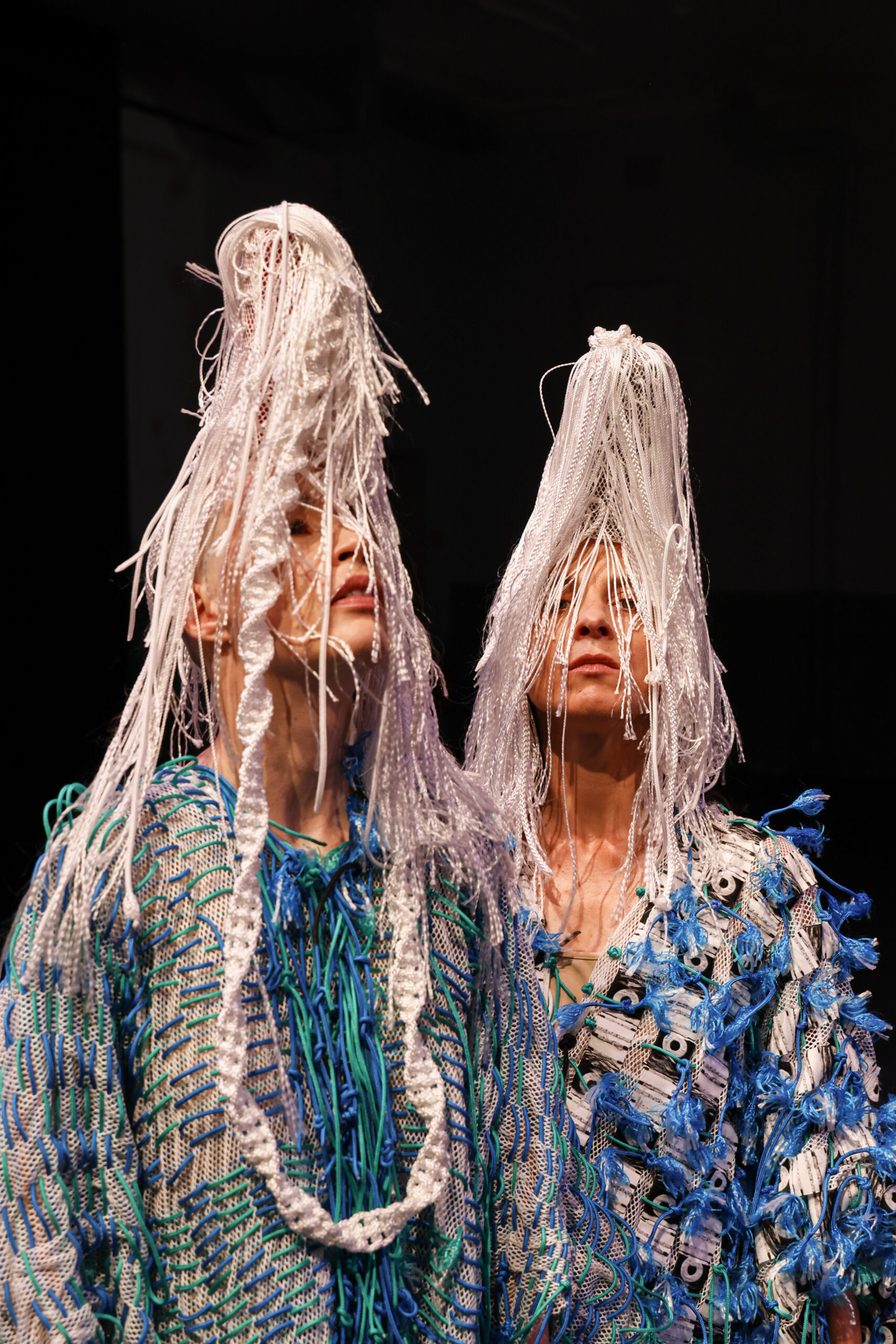
Irena and I began researching her work in 2020, but due to the pandemic we couldn’t meet her personally. We created the duet U.F.O.—Hommage to Katalin Ladik, whose title references Ladik’s most famous work, UFO Party. Most of her contemporary critics commented only on her naked body, her look, and her actions, while we thought that her work with voice and breath was quite outstanding. For us, the ‘Unknown Flying Object’ from the title also became an analogy for the voice-body, which doesn’t relate to gravity and remains an unruly physical function. In this duet, we developed a voice-body that is like a UFO or like the famous Lacanian objet petit a, which signifies an object of desire that one can never fully grasp or control.
In 2024, we published the LP U.F.O. and invited Ladik to see our show in Berlin, join a panel discussion, and teach a masterclass. Forty artists wrote motivation letters and came to meet her. Alongside her voice teaching and scores, she offered stories about producing her work in a socialist country, as a single mother, as part of the Hungarian language minority in Vojvodina and as an artist who created pioneering work alongside breadwinning jobs. How had her context shaped her voice-body relationship? Why was she compared to Yoko Ono and Hannah Wilke, when these artists worked in the USA under completely different conditions? Why is the context often made invisible when discussing her aesthetics, and how could the reception of her work in Western countries include its mode of production?
I like to think of voice-acts that happened in other moments as being eternally present and resonant. They echo into other historical contexts, with other discourses around them. I like to interrogate and listen to past voices, asking how the past performative act enables and feeds into my live performance, and how my present attention and perspective can feed back and alter the past in return. If I can rewrite the past, can I also find a way to carve out figures of the future?
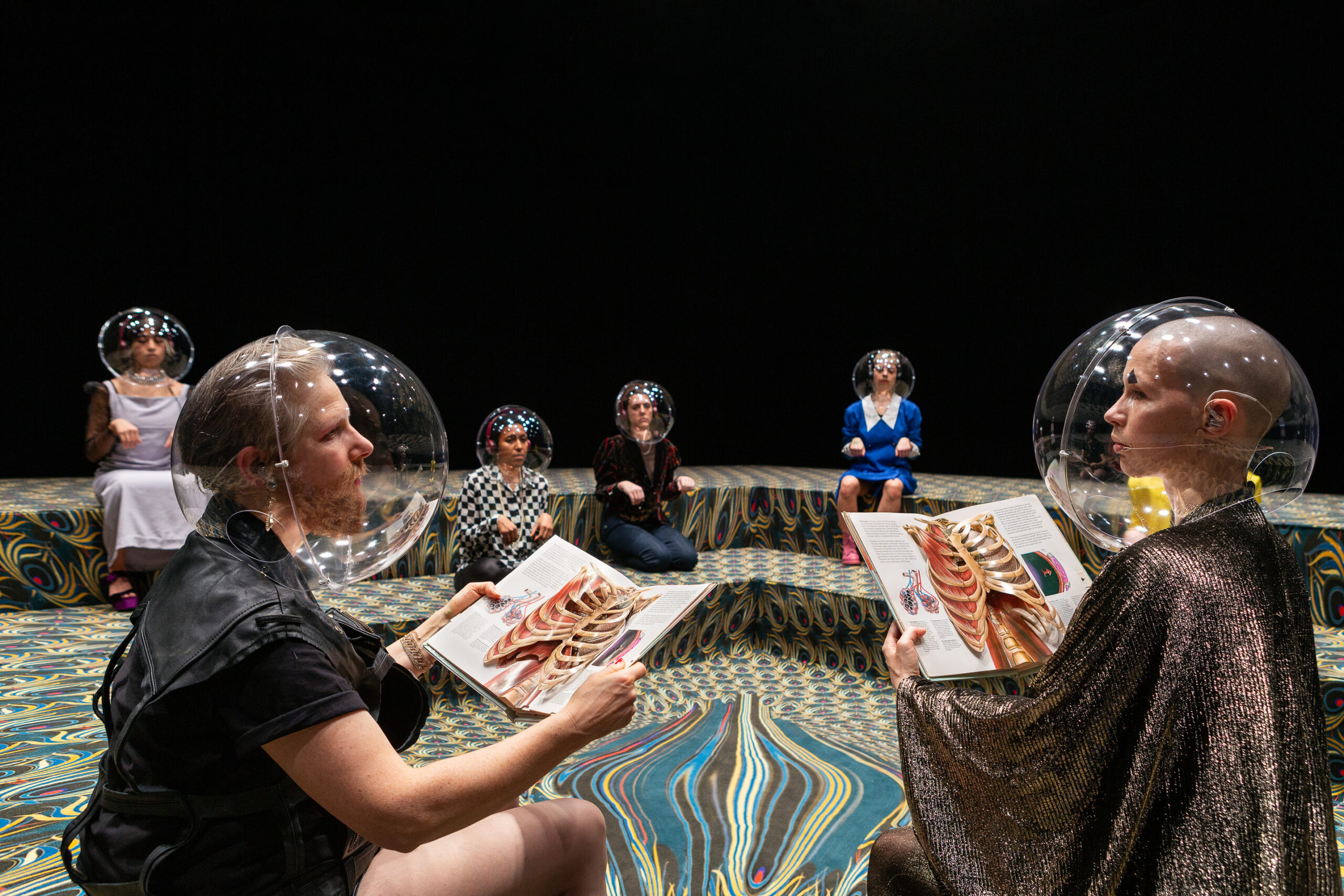
During the pandemic, I worked with Antonia Baehr on Die Hörposaune, which first took the shape of a film10, in which we wore transparent helmets by plastique fantastique, reminiscent of those worn by the Jetsons in the 1950s animated series. We imagined a voice performance in a distant future, reading and touching three-dimensional scores while vocally interpreting their content: human anatomy and flower blossoms, relics of an organic past. Our voices were closely recorded, emitting noisy, smacking, and airy sounds. When Die Hörposaune could finally be performed live in 2022, we performed without helmets and the audience received our microphoned voices through headphones. There was a strong intimacy between the subtle mouth articulations and the audience’s ears. Weadded another layer by placing small microphones into our genitals before the eyes of the surrounding audience. Our stomachs’ digestive voices became audible through the walls of our genitals and travelled into the earphones, tickling the aural cavities. The ASMR (Autonomous Sensory Meridian Response) performance directly bridged the feeling of isolation and alienation through the distance and no-touch rules of the pandemic. We explored new modes of listening and what they do to the nervous system–where sound isn’t about cultural reproduction, but about stimulation and wonder.
In the course of writing this text, my father suddenly passed away, and I reflected again on how his presence shaped my demand for listening to bodies with an experimental ear. After a car accident in the period between the fall of the Berlin Wall and German reunification, a severe brain injury left holes in both of his speech centres, and he lost his ability to articulate thoughts, wishes, or questions. Despite the absence of linguistic information, there was speech—a speech mixed with breath, automatised speech-like movement, and digestive oral articulation. From childhood on, I observed that a person whose speech is not decodable is given the status of an object that must be clinically administered within our speech- centered society. How can we listen to a body with the intention of learning something about that voice-body and about one’s own listening? Reflecting on my artistic work in relation to my father’s vocal presence, I realised that the training of a sensorial ear is deeply political.
How to do things with voice during the global authoritarian turn?
What we live through politically imprints itself in artists’ bodies, voices and practices. It seems to be a crisis of voicing. I would argue that it is, in reality, a crisis of listening. The collective nervous system is targeted by politics of shock and escalation that lead to a constant fight-or-flight mode. Letting go of the physical grasp of this defensive state requires hard labour. This state reduces listening to a mere scanning for decodable information, affirming what we already know and deciphering only sounds we can categorise. Experimental voice performance and choreography propose transformative listening practices, challenge normative conceptions of body, identity, and communication, and leave us in a state of wonder.
BIBLIOGRAPHY
Ahmed, S. (2024). Feminist Ears. In Revell, I. & Shin, S. (Eds). Bodies of Sound. Silver Press.
Cahill, A.J. & Hamel, C. (2022). Sounding Bodies: Identity, Injustice and the Voice. Bloomsbury Publishing.
Edsheim, N.S. (2019). The Race of Sound: Listening, Timbre and Vocality in African American Music. Duke University Press.
KRIJG JE GRAAG ONS PAPIEREN MAGAZINE IN JOUW BRIEVENBUS? NEEM DAN EEN ABONNEMENT.
REGELMATIG ONZE NIEUWSTE ARTIKELS IN JOUW INBOX?
SCHRIJF JE IN OP ONZE NIEUWSBRIEF.
JE LEEST ONZE ARTIKELS GRATIS OMDAT WE GELOVEN IN VRIJE, KWALITATIEVE, INCLUSIEVE KUNSTKRITIEK. ALS WE DAT WILLEN BLIJVEN BIEDEN IN DE TOEKOMST, HEBBEN WE OOK JOUW STEUN NODIG! Steun Etcetera.
essay
15.12.2025
Leestijd 17 — 20 minuten
15.12.2025
—
14.04.2026

Jule Flierl is a choreographer who explores the interconnection of voice and dance through the lens of somatic and expanded voice techniques, voice philosophy, contemporary dance, and historical examples of dance-makers who have voiced their movements.

Klaas Tindemans
Mia Vaerman
essay 15.12.2025
Klaas Tindemans
Mia Vaerman