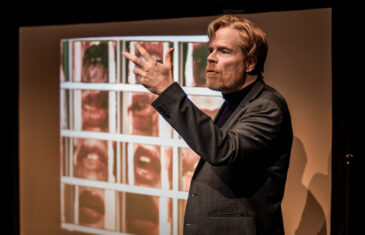
Confessie – Raven Ruëll & Bruno Vanden Broucke
De kunstmarkt maakt de kunstenaar
Klaas Tindemans




© Kurt Van der Elst
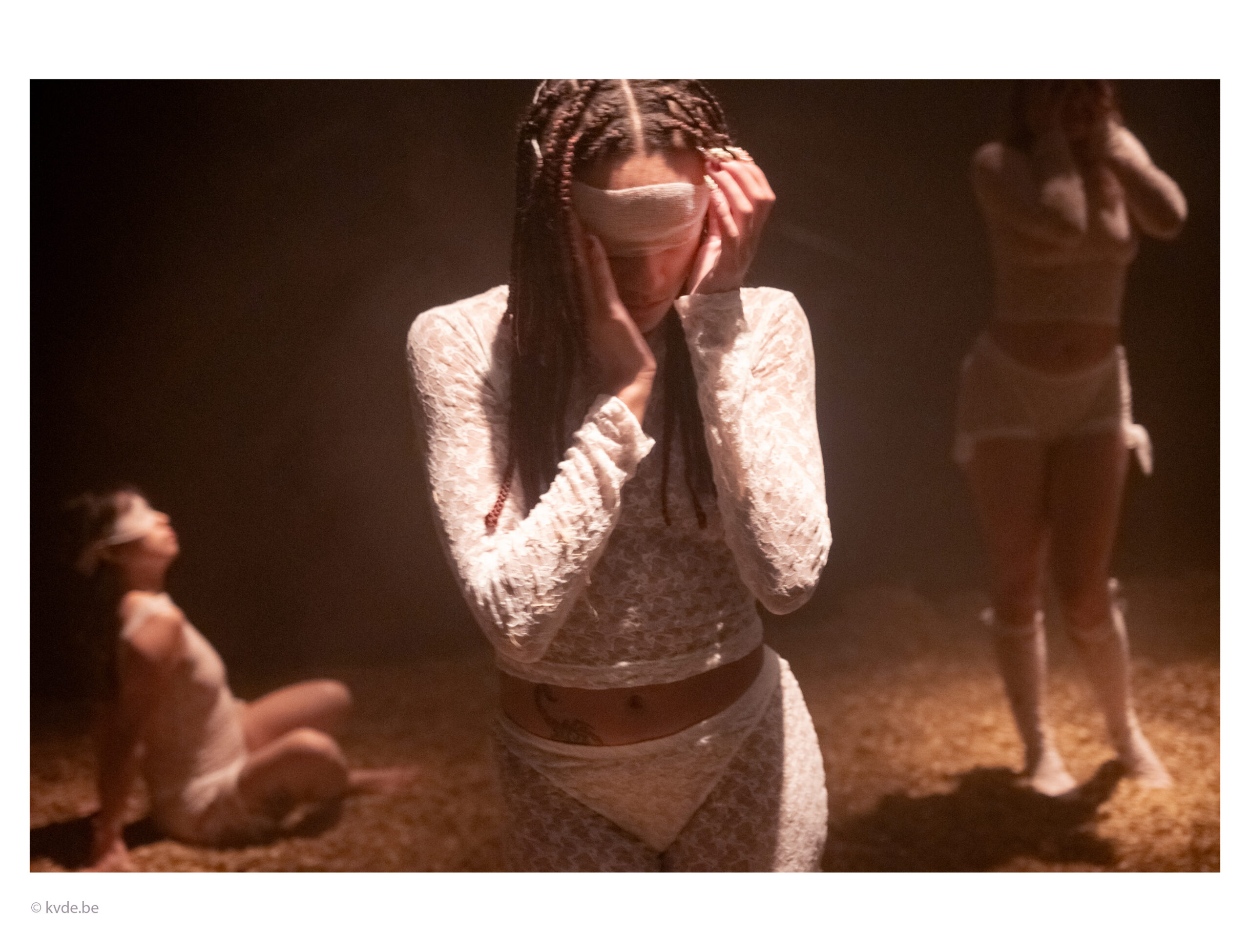
In Gaze, choreographer Laura Neyskens and dramaturg Raphaël Vandeweyer explore how patriarchal dominant narratives control female bodies. Three dancers find themselves caged in a big terrarium which they themselves are unfamiliar with. Lacking agency, these women start to exercise the most recognisable movements that have been mostly performed by female bodies – moving like a doll, rocking a baby, dancing seductively, etc. However, the performance lacks a reflective moment, the agency is never given back to the dancers who after an hour long female-trope exorcism leave their confinement none the wiser.
We see something moving, being born behind a see-through wall, in a big terrarium. Slowly we recognize that something to be two bodies intertwined, finding the end of their own limbs, forming into a human shape. A third body appears just a bit further, but there’s no doubt they all belong together, mirroring each other’s movements, finding their way upright. The very last feature of these bodies that can be identified is that they seem to be female. They’re barely dressed and the parts that are dressed are covered in lace, it makes me laugh. I wear my most comfortable grandma underwear for an hour-long dance performance and I’m sitting in the audience. But of course, this is a premiere of a performance about voyeurism on the female body, no one would pass up on the opportunity to flesh it out.
The performance seems to be walking a tightrope between exposing the female body because the women are re-claiming it, or because the patriarchy desires women to do so. It shouldn’t be a tightrope, and yet there’s nothing empowering about the lace strangling the dancers’ bodies. Not that they look uncomfortable, but they were born in it, it wasn’t a choice. However, there’s no clear audience they dance to. It sounds paradoxical because we’re there, and yet we all are somewhat unaware of each other. Blindfolded, these women move like dolls around the territory allocated to them that’s inaccessible to us. Who has put them in there, what are these walls keeping in and what are they keeping out?
“They’re barely dressed and the parts that are dressed are covered in lace, it makes me laugh. I wear my most comfortable grandma underwear for an hour-long dance performance.”
Audrey Apers is the first one to lose her blindfold. It seems to be her first conscious choice – a choice to see. This, however, changes very little. Even after Izah Hankammer and Zoë Chungong gain vision they continue dancing like dolls. We see a man, Pascal Buyse, come on the stage. He cleans the windows of the terrarium, paying no attention to the women inside. The three of them curiously follow his microfiber mop as an object yet unseen. Knowing this world, that’s very unrealistic. Another male figure breaks in, it’s the male voice that greeted us when we entered the hall. It’s asking us about emancipation and no one in the audience answers. Instead, we hear the women inside answer in bird calls.

© Emma Ostyn

© Kurt Van der Elst
Henrik Ibsen’s A Doll’s House comes to mind, a classic when it comes to portraying caged women, as sweet as little birds, as docile and pretty as dolls. To break out of this role the main character Nora has to dance her freedom dance, a wild Tarantella that unleashes her power. Apers, Hankammer and Chungong are following Nora’s dance steps and break out of the doll movements. Apples spawn as if out of nowhere, they bite them, throw them, kick them, Eve is on a rampage. As more and more objects appear on the stage their dance goes postmodern. An image is formed and destroyed the next moment, they’re nuns and sluts, they’re twerking as if they could shake this image-saturated world off of them. Koben Sprengers’ music is beating loud and the women go wild, it’s wonderful and crazy. But I do wonder, these women who don’t know what a microfiber mop is, where from do they get the stories of the world’s Madonna’s?
“Henrik Ibsen’s A Doll’s House comes to mind, a classic when it comes to portraying caged women, as sweet as little birds, as docile and pretty as dolls.”
Gaze seems to ask: if we as women recreate the sexist images that the patriarchy enforces on us, can we really be emancipated even though we’re able to dance the wildest of dances? In the end, when they find a way out of the cage, Hankammer undresses and shows her pussy to the audience. This feels like a middle finger to the patriarchy as it is the most explicit and chosen nakedness. The audience releases a careful chuckle when Chungong frames it.
However, if this is the only nakedness that’s consciously chosen then it implies that these women were born with lace as skin, they weren’t born naked. This cage doesn’t allow for emancipating actions, because the women born in it have only learned to recreate specific ideas about what it means to be a woman. In that case, why is it us and not the cage who get to see the framed pussy? Ultimately, I don’t understand the role of us as spectators. Should we have helped them escape or should we have left because we don’t endorse this kind of imagery? Or is it a parable that teaches us: if you want to stop women from embodying toxic narratives, stop watching them?
Pascal Buyse comes back, fixes the broken wall, again pays no attention to the three dancers on the stage. He’s just there to do his job, I guess, and whether someone is in the cage or not matters less than the existence of it. The cage seems to be a rite of passage that we as women undergo and escape. As soon as we escape it we’re not interesting any more, the performance has reached its end. 95 percent of its runtime shows women performing or exorcising patriarchal values out of their bodies, and while that’s well executed, it’s also uninspiring. Where do these women come from, why weren’t they trying to flee right away, why were they born in lace? Must we all go through it?
“The only thing we learn is what we already knew – women are caged victims of society’s standards. But does this self-pity give us any insight?”
Ibsen’s Nora escaped this cage 146 years ago. She went out of the frame and so we never see her actually reclaiming her own life. Gaze seems to be interested in that same escape, but this one happens by accident, while trying to perform all the imaginable female roles. Differently from Nora, the dancers didn’t open a door out, it happened by accident. Even so, what’s next, what follows this epiphany? What is there to be said about women being themselves, out of the cage? What forms, shapes, role models, do we find there? Do we follow the boys and emancipate ourselves by obsessing about our own genitalia?
At the end it feels like this performance is manifesting only those ideas that it is against. A big question to be asked is how we talk about dominant toxic narratives without giving them even more space, without giving them even more power. It’s how the old saying goes, there’s no such thing as bad publicity. In the dance performance the coolest, most wild parts are those where the dancers are recreating the clichés of what a female body is supposed to do. Without reflection, the only thing we learn is what we already knew – women are caged victims of society’s standards. But does this self-pity give us any insight?
The description of the performance tells us that it’s supposed to research “how dominant stories shape us <…> in a world where, we want to be seen and loved”. I’m left a bit confused as of who these women want to be seen by, who’s supposed to love them? Buyse doesn’t see them, and how can an audience offer love to a cynical carnival of the worst ideas about women? I can look at it, nod to myself and think, it was very good how Hankammer twerked, but that’s also bad because the patriarchy wants it and I’m against that. If this show is about the gaze, why are we gazing on the things we’ve already gazed on for such a long time? Why aren’t we turning our gaze on women less know, on behaviours that are breaking the tropes instead of recreating them?
De speellijst van de voorstelling vind je hier.
KRIJG JE GRAAG ONS PAPIEREN MAGAZINE IN JOUW BRIEVENBUS? NEEM DAN EEN ABONNEMENT.
REGELMATIG ONZE NIEUWSTE ARTIKELS IN JOUW INBOX?
SCHRIJF JE IN OP ONZE NIEUWSBRIEF.
JE LEEST ONZE ARTIKELS GRATIS OMDAT WE GELOVEN IN VRIJE, KWALITATIEVE, INCLUSIEVE KUNSTKRITIEK. ALS WE DAT WILLEN BLIJVEN BIEDEN IN DE TOEKOMST, HEBBEN WE OOK JOUW STEUN NODIG! Steun Etcetera.
recensie
07.12.2025
Leestijd 7 — 10 minuten
15.09.2025
—
14.12.2025

Ugnė Noreikė is a Lithuanian writer, musician and artist. She works in spaces of not knowing, vulnerability and extreme feelings. She’s looking for meeting points between sounds and words.

Klaas Tindemans
Mia Vaerman
recensie 07.12.2025
Klaas Tindemans
Mia Vaerman