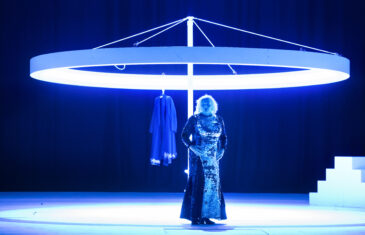
De Materie – Phia Ménard/Opera Ballet Vlaanderen/Bas Wiegers
Een schurend vooruitgangsdenken
Sébastien Hendrickx





© Dewi Mik
While watching my Everything brings us back to the body by Ehsan Hemat, my body relaxed. The heated room loosened the muscles, the light was never too bright. Seeing him carrying the weight of an 18-kilogram brass sheet gave a physical release, as if I was the one covered with a heavy blanket, and my hand just scribbled on to the page. What did it write? It turned to myths of Icarus and Sisyphus, people whose non-human counterparts – wings and a boulder – have extended and thus completed their physical form. And now Ehsan and his sheet are here before me, merging and fighting, inseparable in their opposition.
In the brochure I read that Ehsan Hemat just happened to find an old brass plate somewhere. It wouldn’t be the first time that great discoveries are meetings left to chance, divine intervention. There’s something supernatural in the performance, in the way the shiny plate mirrors the human body. Its colour captures something innate to human skin, a pink bronze hue, bewitching. We see Ehsan and us reflected on it, at one point it’s transformed into a wall that separates us and Ehsan. He walks, hidden behind the brass, and wails while we see reflections – our own emotion played with. Our faces are stretched and elongated by the brass sheet, as if we were weeping together.
Because of the respect that he shows to the sheet and because he’s absolutely naked with it, they feel like equals on the stage. There’s something profoundly truthful in this nakedness. He creates an ecology in which the brass sheet and his body are all that matters, and they supply each other with meaning. Like in many sci-fi productions, this play explores the relationship between human and non-human bodies. This relationship, however, isn’t based on information extraction or crossing the boundaries of bodily limits. Quite the opposite, it brings us back to the body that we have at our disposal. By doing so it takes a radical but loving acceptance of all bodies as equal. These concepts Ehsan researched reading Rumi, a 13th-century Persian poet, and Achille Mbembe, a philosopher from Cameroon.

© Julie De Clercq
What’s magical about Ehsan’s ability to form a relationship with the sheet is that this non-human body doesn’t have a clear application in the normal world. It’s something that most of us never interact with, not a big chunk like this. Yet at the end when Ehsan is bowing to us the sheet is imbued with life and even gets its own flower bouquet. This reminds me of Dutch primatologist Frans de Waal and his book, Are We Smart Enough to Know How Smart Animals Are? In the book he gives many examples of people being ignorant of the intelligence showcased by animals. I feel like this question is furthered by Ehsan. Are we attentive enough to recognise magic in all things on this planet? Sadly no, but many of us are trying.

© Jullie De Clercq
Even though Ehsan’s performance deals with difficult themes, it manages to remain childlike at its core. His attention to the unresponsive sheet allows the imagination to run wild. I call it the magic of the lack, the best everyday example of which is cats who never want to play with fancy bought toys and instead go for a ripped-off shoelace. Because this sheet was not made to be something, it can become anything. Often Ehsan seems to play with the sheet, see how far it can bend, how fast he can run with it, what crazy noises it can make. All his actions captivate and make us laugh and gasp. Many times I feared that the sheet was going to fall, crash into the audience or rip the black vinyl floor. I was made aware that I know nothing about the body of this brass sheet, but Ehsan has befriended it. And this friendship is of the best kind – through it both of them have transformed.
KRIJG JE GRAAG ONS PAPIEREN MAGAZINE IN JOUW BRIEVENBUS? NEEM DAN EEN ABONNEMENT.
REGELMATIG ONZE NIEUWSTE ARTIKELS IN JOUW INBOX?
SCHRIJF JE IN OP ONZE NIEUWSBRIEF.
JE LEEST ONZE ARTIKELS GRATIS OMDAT WE GELOVEN IN VRIJE, KWALITATIEVE, INCLUSIEVE KUNSTKRITIEK. ALS WE DAT WILLEN BLIJVEN BIEDEN IN DE TOEKOMST, HEBBEN WE OOK JOUW STEUN NODIG! Steun Etcetera.
recensie
24.03.2025
Leestijd 4 — 7 minuten
01.03.2025
—
14.09.2025

Ugnė Noreikė is a Lithuanian writer, musician and artist. She works in spaces of not knowing, vulnerability and extreme feelings. She’s looking for meeting points between sounds and words.
Sébastien Hendrickx
Mia Vaerman
recensie 24.03.2025
Sébastien Hendrickx
Mia Vaerman