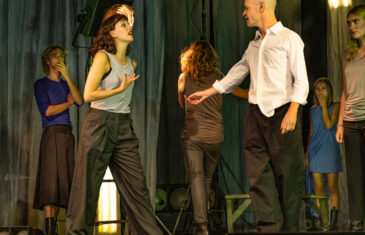
Iphigenia – De Roovers
Geef mij maar het verzet van Klytamnestra
Mia Vaerman





Who wants © Kurt Van der Elst
Art knows no borders, but artists all the more so. Physical territories, nationalities, laws, rules: they are increasingly restraining the cultural mobility of non-European artists wishing to travel to the Schengen Area. Why is it that visa procedures have become so complex, burdensome and uncertain? And how does this undermine the much-needed international exchanges on our stages? Charlotte De Somviele raised these questions with Iranian-Belgian choreographer Ehsan Hemat and artistic director of laGeste Hildegard De Vuyst, who as a dramaturge has been working closely with theatre-makers from Congo and Palestine for twenty years.
October 2023. Iranian theatre-maker Naghmeh Manavi is denied a visa to attend the Moussem Stages festival in Belgium. Her performance Will I Remember? at Monty is cancelled at the last minute.
May 2023. Director Keyvan Sarreshteh, who lives and works in Tehran, is invited to the Wiener Festwochen. He is allowed to come, his dramaturge and technician are not. Behind the scenes, they learn that the authorities believed that the chance that these young artists would want to stay in Europe was too high.
Summer 2023. Kenyan writer and theatre-maker Ogutu Muraya is denied boarding on an Egyptair flight to Paris at Nairobi airport because he does not have a return flight on the same airline and they cannot guarantee his return.
Spring 2023. South African soprano Nobulumko Mngxekeza-Nziramasanga is singing in Gorges Ocloo’s The Golden Stool at music theatre LOD. Her tourist visa allows her to stay for three months, but rehearsals take longer. The procedure for a new long-stay visa takes weeks. Only three weeks before the premiere is she given the green light.
May 2023. For De stem van vingers, a performance about the history of immigration policy and border violence around Fortress Europe, theatre-maker Thomas Bellinck collaborates with Afghan journalist Said Reza Adib. As a refugee who ended up in Finland after a terrible exodus, Reza is not allowed to travel. Actors Musia Mwankumi and Jeroen Van der Ven become his mouthpiece.
February 2019. At NTGent, the premiere of Histoire(s) du théâtre II by Congolese choreographer Faustin Linyekula is cancelled. Neither can Sept Mouvements Congo by his compatriot Michael Disanka go ahead. The reason? The closure of the Schengen House in Kinshasa, where Belgium issues visas for eighteen European countries. With that sanction, then-President Joseph Kabila wanted to show that he disagreed with the Belgian government’s decision to allocate part of its development aid to Congolese civil society and critical human rights organizations. For its part, Belgium had taken that measure because Kabila had postponed the elections time and again.
Hildegard De Vuyst and Ehsan Hemat sigh as I go over the stories. They sound all too familiar. As an Iranian-Belgian choreographer who has lived in Brussels since 2007, Hemat says that he submits visa applications almost monthly for family, friends or fellow artists. As a dramaturge at les ballets C de la B (now renamed laGeste) and the Marseille Festival, De Vuyst has been working closely with artists from Palestine, Congo and South Africa for more than twenty years.
The week before our conversation, De Vuyst’s handbag happened to be stolen. While waiting for a new identity card, she has to use her passport. ‘Not white or black, not rich or poor, this is the real privilege for me’, says De Vuyst as she taps the purple booklet on the table.
Are the above stories the rule or rather the exception?
De Vuyst: That’s hard to say because, in my opinion, a lot remains under the radar. The problem only becomes visible when a performance is cancelled, or when a well-known figure like Cynthia Bolingo is denied a visa for an important competition in the United States (the Belgian 400 m record holder missed the Diamond League final in September as a result, ed.). What is certain is that the situation has changed dramatically in twenty years. When we used to apply at les ballets C de la B for a visa for a non-European performer, we were pretty sure they could come. Now it has become much more of a lottery.
Ehsan, your performance A in the role of B when C didn’t make it (2023), a collaboration with three Iranian theatre artists including your uncle, fell through in part due to visa problems.
Hemat: That’s right, we lost two weeks of rehearsal time. The play was part of the Moussem Cities festival, dedicated to Tehran. More than twenty Iranian artists needed visas, as a result of which several applications were submitted too late. But perhaps more important was the impact of the political context. As soon as a diplomatic problem arises between Belgium and Iran, as now in the wake of the Olivier Vandecasteele case, Belgium closes its doors.
“So we end up in the absurd situation where products can travel freely today, but bodies can’t.” (Hildegard De Vuyst)
Ordinary citizens are indeed the victims of what happens on the political stage. As recently as September, France suspended all visa applications from artists and students from Burkina Faso, Mali and Niger ‘for security reasons’. The coup leaders in those countries were highly critical of the former colonizer, France.
De Vuyst: That political influence is a big problem, including in the opposite direction. Travelling from Belgium to Congo is difficult these days. The Congolese are like: If we can’t travel freely to the Schengen Area, why should we receive you? You can hardly blame them.
More and more countries in the Schengen Area are closing their foreign embassies for financial reasons and outsourcing their visa applications to external organizations such as VFS Global (Visa for Schengen) and VisaMetric. Research by network platform On the Move shows that this has complicated things enormously for artists and cultural organizations.
Hemat: In Tehran, VFS is really corrupt. Getting an appointment is almost impossible, so the only options you have are to pay or to turn to the black market. And those are not the only extra costs. In theory, you pay 125 euros for a visa application, but my parents have to fly from Shiraz to Tehran every time to apply in person. VFS also charges extra fees for all sorts of paperwork you didn’t know you needed. Normally, the procedure takes about four weeks, but it quickly exceeds that. And if a document is missing, your application is cancelled and you have to start over.
De Vuyst: Since 9/11, that has indeed been the trend. You used to have a personal contact at an embassy, someone who usually showed good will towards artists. If an application came in late, they thought: Okay, not clever, but we’ll see what we can do. Now the whole procedure has been digitized and outsourced. Everyone has become a number. It is an administrative maze that no one can navigate anymore.
Since Covid, Europe has looked even more strictly at who is allowed to cross its borders. This has dealt an irreparable blow to international exchanges. How have you experienced this in practice?
De Vuyst: Yes, Europe has simply had enough of it all. Full stop. Let me give you one concrete example. It hardly gets worse than this. In July 2021 we invited Michael Disanka and his wife Christiana Tabaro to bring Sept Mouvements Congo to the Marseille Festival. At the Schengen House in Kinshasa, however, the couple was told that they would be well advised not to apply for a visa for their six-month-old baby. In other words, only if they left their child behind would they be allowed to travel. During their quarantine in Marseille, they completely reworked the show, as their three dancers and musicians were not allowed to come either.
Is this happening on the perverse assumption that Disanka and co. would otherwise not return to Congo?
De Vuyst: Indeed, it is assumed that every non-European is a potential migrant. Schengen officials have only one mission: to keep people out. And all those who the officials are not sure will return – because they don’t have a baby, say, or don’t have a house in their own name or don’t have enough money in their bank account to survive in Europe – well, they just don’t get a visa.
Hemat: That bias particularly affects young artists. My uncle, who is in his 70s, had no problem coming to Brussels. Because they know that at his age, he already has a life in Iran and won’t just leave it behind. That is also why my parents never got permission to visit me in Belgium until 2016. Only when they decided to come separately were they allowed to.
“My parents never got permission to visit me in Belgium until 2016. Only when they decided to come separately were they allowed to.” (Ehsan Hemat)
That’s heartbreaking.
Hemat: Yes, but I can’t talk about those problems with anyone here because no one understands. Meanwhile, my father has decided he is no longer going to visit his children anymore, all of whom live abroad. He doesn’t want to beg for visas anymore, it’s too humiliating.
For several years now the application process has largely happened online. The pandemic only intensified this wave of digitization, but in your opinion there is nothing innocent about this.
De Vuyst: Governments have been leveraging digitization to gain control over citizens. Covid was just an excuse, an experiment that is now being made permanent. Certain regimes find that very convenient.
Conditions have also become stricter and more opaque for those who invite foreign artists.
De Vuyst: Aha, now we’re talking about the pledge of financial support or the famous prise en charge. (Hemat and De Vuyst both start chuckling) It used to be that an organization, such as les ballets C de la B or KVS, could stand surety for a foreign artist. Today, that is only possible as an individual citizen for a short-stay visa. And watch out, this is no laughing matter. Not only do I have to be able to prove that I have enough income, I also have to pay for all accommodation and medical expenses in the event of a repatriation. The mayor of the municipality where I live also has to legalize that prise en charge. Where is this leading us?
Hemat: In my case, my in-laws even have to stand surety because I work with temporary employment contracts as an artist. The whole procedure has been digitized but at the same time VFS and the Belgian government usually only accept original documents. You have no idea how many times an application is refused because you submitted a copy, or how many times you have to send in your passport for one or other stamp. You just hope you don’t have to travel in the meantime. It’s too absurd for words.
And we haven’t even talked about the work permits …
De Vuyst: Yes, the visas are one thing. Anyone who wants to rehearse in Belgium for more than a month needs a work permit. These are not issued at federal level, but at Flemish level. You can see where this is going already. (laughs) There, too, conditions are complex. A work permit requires a contract, and with that contract comes a Belgian bank account. So the Congolese musicians from Requiem pour L. (2018) had to open an account here so they could receive their Belgian wages and pay social security contributions. But then they had to reclaim those taxes because they are not Belgian. It’s enough to drive you crazy. And we’re not even talking about international tours.
Hemat: I had always hoped to keep the relationship with my native country alive, but it’s just too difficult. I don’t think I’ll be working with Iranian actors anytime soon.
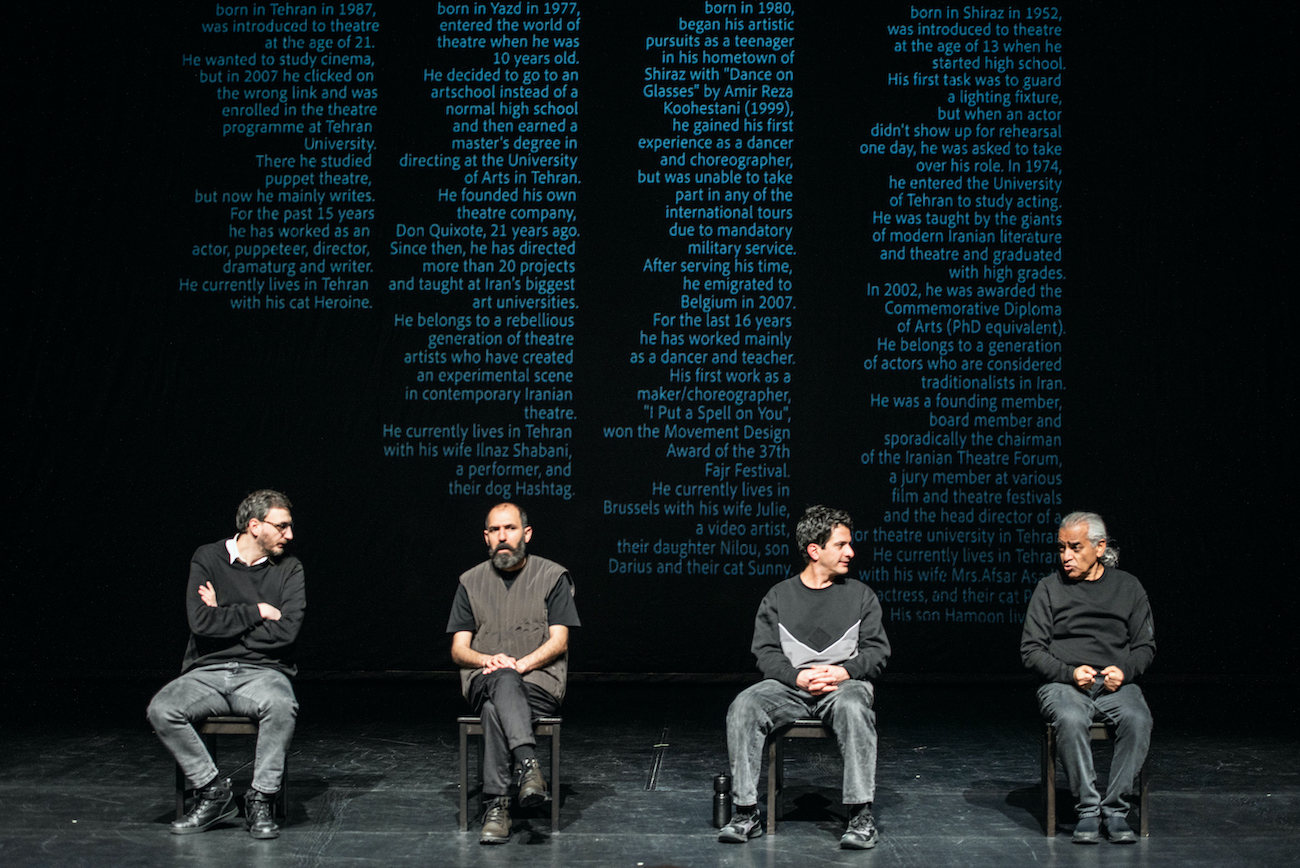
A in the role of B, when C didn’t make it, Ehsan Hemat © Michiel Devijver
The opaque procedures, the lack of expertise and meetings at the external agencies that have to approve the visas, the Kafkaesque bureaucracy, the absurd reasons for refusal (i.e. ‘insufficient financial resources for living expenses’ or ‘insufficient proof of commitment to return’) … They also apply to ordinary travellers.
But artists and cultural workers are particularly targeted, argues the network organization On the Move, which surveyed more than 130 artists and organizations on this subject (2023). Often, festival invitations or grant approvals only come at the last minute, so artists can’t start working on visa applications in time. Moreover, as freelancers, they generally have an irregular income and it is not always easy to prove that they are artists …
Live performing arts are even more affected by this than other disciplines.
De Vuyst: Absolutely. Physical proximity is at the heart of our work. Cinema can travel without a director, as can visual art. But we simply have to travel. So we end up in the absurd situation where products can travel freely today, but bodies can’t. Europe just doesn’t want the people, full stop.
Hemat: This is one of the reasons why many renowned non-European artists settle in the Schengen Area. With a second passport, they can get around that exhausting visa procedure. That is why you see the same names popping up all the time on the posters of international festivals, while the new generation remains underexposed. For instance, how do young artists deal with the Women, Life, Freedom movement in Iran? We don’t know.
De Vuyst: Many of the Congolese with whom we worked at les ballets at the time have built a new life in Europe. The same goes for the Palestinians. This has led to a total brain drain locally. Those who can leave. I would like for those people to feed the new generation of artists in their own country with the know-how they have acquired here. But surely it is not for me to say that anyone should go back to Ramallah or Kinshasa.
The problem is also that not everyone has equal access to even applying for a visa.
De Vuyst: No, the Belgian consulate in Israel, for example, is in East Jerusalem. Palestinians from the West Bank are not allowed to go there. So they have to give their application to someone who does have access to Jerusalem, but not that many people do.
“Governments have been leveraging digitization to gain control over citizens. Covid was just an excuse, an experiment that is now being made permanent. Certain regimes find that very convenient.” (Hildegard De Vuyst)
How much pressure does this put on international exchanges?
De Vuyst: Huge pressure. I’ll be very blunt … We no longer use Flemish money to make our productions these days, but the Belgian tax shelter. Costs of Belgian employees are tax deductible for 70 per cent, European ones for 20 per cent and non-European ones for only 10 per cent. So even on the financing side, international cooperation is totally being undermined.
Hemat: Indeed, there are hardly any subsidies left for intercultural exchanges. A travel grant only covers the cost of the people on stage, but not the dramaturge or technician. In 2025 we have the chance to play a dozen shows in Europe with A in the role of B … But financially, it is a very difficult exercise. It’s frustrating, because a tour like that is a boost to your career. And even if you get a visa, it is strictly for the work period. You have to return immediately the day after your performance, so networking is out of the question. I wonder how it is that so many top athletes can travel so easily …
In France, things are somewhat different. Artists can get a four-year ‘Passeport Talent – Artiste’, an exception that doesn’t exist elsewhere in Europe.
De Vuyst: Yes, this is how many African artists entered Europe. The advantage is that you can acquire French nationality in five years, if you can string together enough employment contracts.
Hemat: In Finland too, where my brothers live, I see that the procedure can be much more humane. I have the impression that the government there wants you to keep in touch with your family. Not so in Belgium.
Why are artists so quiet about this invisible boycott?
Hemat: Because they think they don’t have a voice and aren’t going to make a difference. And because, in the case of Iran, even with a foreign visa, you can still be stopped at the border at any time, whether because your profile is suspicious or you have criticized the regime.
Whether I see any prospects? Very occasionally. Keyvan Sarreshteh used his cancelled production at the Wiener Festwochen to open the debate. After that, there was apparently a bit more willingness to give Iranian artists visas. So perhaps making some noise can help to achieve something after all …
On the Move. (2023). Schengen Visa Code and Cultural Mobility: Latest insights with a focus on artists and culture professionals from the African continent.
On the Move. (2012). Artists’ Mobility and Visas: A step forward. Final report of On the Move’s workshop on artists’ mobility and Schengen visas.
KRIJG JE GRAAG ONS PAPIEREN MAGAZINE IN JOUW BRIEVENBUS? NEEM DAN EEN ABONNEMENT.
REGELMATIG ONZE NIEUWSTE ARTIKELS IN JOUW INBOX?
SCHRIJF JE IN OP ONZE NIEUWSBRIEF.
JE LEEST ONZE ARTIKELS GRATIS OMDAT WE GELOVEN IN VRIJE, KWALITATIEVE, INCLUSIEVE KUNSTKRITIEK. ALS WE DAT WILLEN BLIJVEN BIEDEN IN DE TOEKOMST, HEBBEN WE OOK JOUW STEUN NODIG! Steun Etcetera.
essay
05.02.2024
Leestijd 13 — 16 minuten
15.12.2023
—
14.03.2024

Charlotte De Somviele schrijft over podiumkunst voor De Standaard en is co-hoofdredacteur van Etcetera. Daarnaast werkt ze als klinisch psycholoog in een psychiatrisch ziekenhuis.
Mia Vaerman
Tom Rummens
essay 05.02.2024
Mia Vaerman
Tom Rummens