Lullabye – Anneleen Keppens
Wie zorgt er voor wie zorgt?
Tom Rummens





© Phillippe Goyens
Pablo Neruda once described Central America as the “soft waist of America”, a fertile region that has always been defined and dominated by the north. With Centroamérica, the Mexican collective Lagartijas Tiradas al Sol attempts to capture the pain of this exploited region with their distinctive documentary style. They once believed fervently in the power of theatre, but after a journey through seven countries plagued by moral murkiness, they are no longer so sure. Can theatre save the world?
Luisa Pardo and Lázaro Rodríguez founded Lagartijas Tiradas al Sol (lizards stretched out in the sun) twenty-three years ago when they were studying together in Mexico City. Their group has since grown into an arts collective that, in addition to theatre, produces publications, radio programmes and films, always in their own documentary style in which they interweave (auto)biography, fiction and socio-historical research.
In Centroamérica, they take us on a journey through the region south of their country, about which they know little and with which they have little to do. Mexicans prefer to look upwards, towards the United States, the great, rich, promised land. Central America is nothing more than a transit country, a narrow land bridge between North and South.
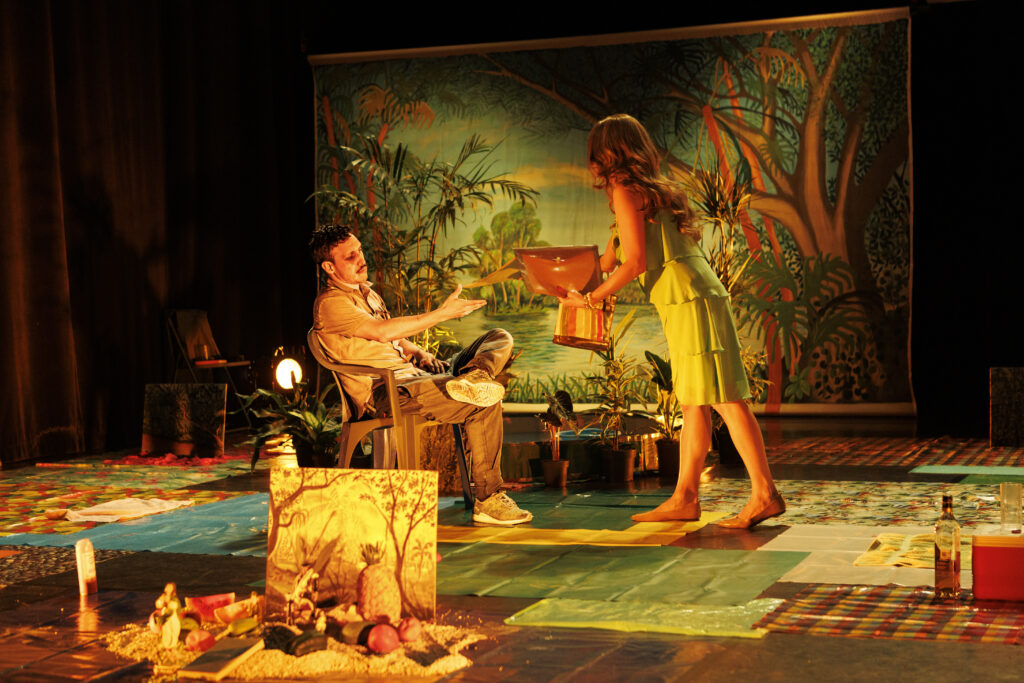
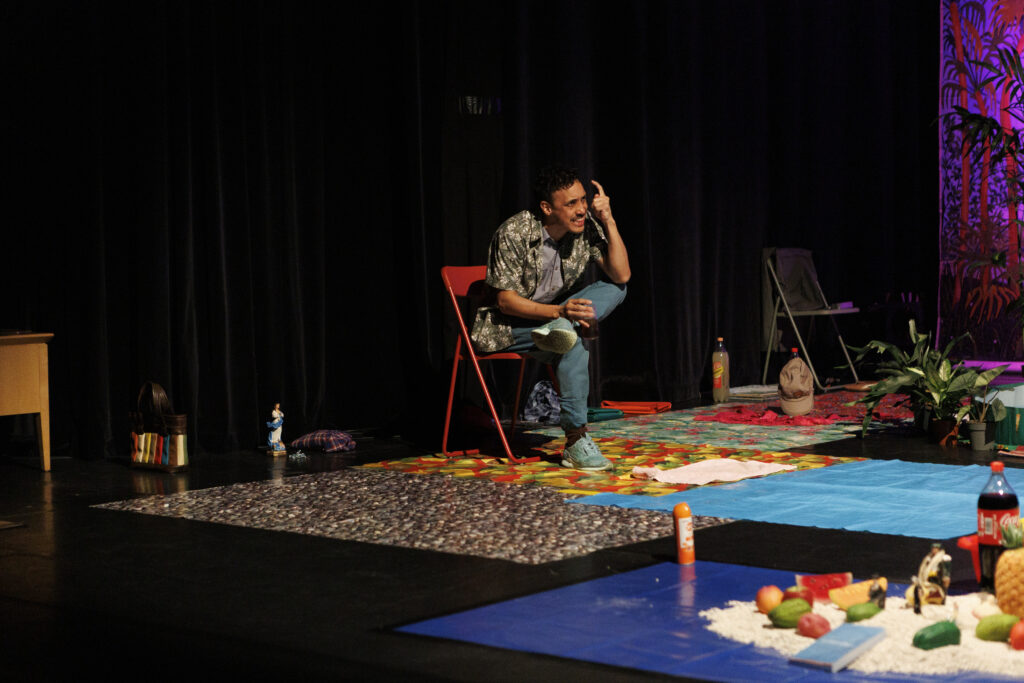
Perched on a white monobloc or sunbathing on plastic sheets amidst houseplants, tropical fruit, bottles of neon-coloured soft drinks and a paddling pool, Pardo and Rodríguez speak about their trip. In Guatemala, Belize, El Salvador, Honduras, Nicaragua, Costa Rica and Panama, it turns out that they themselves are now the rich, the privileged, the northerners. “Complaining here about our misery in Mexico is like complaining about not having shoes to someone with no feet,” says Rodríguez.
It is clear that a systematic politics of North Atlantic colonial exploitation has destabilised the narrow Central American strip of land to this very day. Following the initial Spanish colonisation in the 16th century came the Monroe Doctrine of 1823; the President of the United States claiming the right to intervene anywhere in Latin America, ‘his backyard’, alledgedly to protect the continent from European colonisation. (That doctrine may never have truly gone away, but with the abduction of Venezuelan President Nicolas Maduro by the Trump regime in January 2026, it is certainly back in full force).
For centuries, the region has been treated by reckless rulers as nothing more than a free-for-all reserve for cheap labour and financial gain, resulting in ruthless violence, corruption and poverty. Rodríguez later mentions somewhere that he would like to tell that story of Central America’s colonial history, of the Monroe Doctrine, of William Walker1 or of the United Fruit Company, but that it would make for very dull theatre.
Yet a little more context (certainly for me as a European who is too unfamiliar with that specific history of colonisation) provides a backdrop for situating the stories and images in Centroamérica, for example regarding the United Fruit Company. (For the juicy fruits and colourful soft drinks are not merely coincidentally groaning under the bright red glow and sweltering heat on stage). The Chilean poet Pablo Neruda wrote a poem about that American company in 1950:
“When the trumpet sounded, it was
all prepared on the earth,
the Jehovah parcelled out the earth
to Coca Cola, Inc., Anaconda,
Ford Motors, and other entities:
The Fruit Company, Inc.
reserved for itself the most succulent,
the central coast of my own land,
the soft waist of America.”2
For decades, the United Fruit Company – now Chiquita – was more powerful than any state in Central America, and was therefore known as ‘El Pulpo’, the octopus. We also owe the derisive term ‘banana republic’ to the company: a country so dependent on a single company’s export product (bananas) that that foreign company (United Fruit) effectively runs the country. When the democratically elected Guatemalan president Jacobo Árbenz sought to redistribute United Fruit’s fallow land to poor farmers in 1952, the CIA organised a coup at the company’s behest. Using a fake radio station (called Voice of Liberation), they spread false reports of mass uprisings and military defeats, until Árbenz’s own generals abandoned him. The result was a bloody civil war lasting 36 years, and a country that remains plagued by violence to this day. Todos mienten, everyone lies, we can read in a brief flash, spray-painted on a car, captured in shaky footage by Pardo and Rodriguez during their journey through Guatemala.
“In Centroamérica, the two do not explicitly discuss macro-history or colonial, North Atlantic imperialism, but instead use anecdotes and video clips to focus on the small, concrete, everyday life in the region, which is, of course, shaped by it in all sorts of ways.”
In Centroamérica, the two do not explicitly discuss that macro-history or colonial, North Atlantic imperialism, but instead use anecdotes and video clips to focus on the small, concrete, everyday life in the region, which is, of course, shaped by it in all sorts of ways. Rodriguez, for example, makes a fine observation about masculinity: he admits that when he walks around in Central America, he feels more like a man; he is looked at and treated differently there than in Mexico. “Being a man is being afraid of not being one,” he says, “of not being able to prove it.” Has arrogant American imperialism also led to greater mistrust, a desire to assert oneself, and thus machismo in Central American culture?
Rodríguez and Pardo also re-enact snippets of conversations they had – or might have had – with locals during their trip. You don’t know whether the conversations ever actually took place. The question Centroamérica poses is whether that matters: whether fiction can sometimes tell a truer and more pressingly real story about reality than the facts themselves. When Rodríguez, as a socially critical tourist, complains about the large-scale green energy projects funded by Dutch and Finnish money on Honduran soil, at the expense of the environment and with a whiff of neo-colonialism, a determined Pardo, as a weary local, reproaches him for his facile indignation and moral superiority. For her and all the poor families in Honduras, those European projects mean, above all, money and employment, and the chance to make something of their lives.
It is also this dilemma between pragmatism and principles over which the two argue when they are later in El Salvador. For what are we to make of President Nayib Bukele, the head of state with the most TikTok followers in the world and also known as the ‘coolest dictator in the world’? El Salvador was once the most violent country in the world and under the complete control of ruthless gangs; now, according to murder statistics, it is safer than Belgium. Bukele declared a state of emergency and locked up everyone with a tattoo, without exception. More than 100,000 people – roughly the population of Leuven – are being held without a fair trial. The trendy tyrant was re-elected in 2024 with a staggering 85 per cent of the vote.
In a video, we see him – wearing a smart Ralph Lauren polo shirt, a white cap, a fitness watch and a carefully trimmed beard – lashing out at a BBC journalist who is asking critical questions about his controversial actions. “Your solutions, the solutions of the EU, the UN and the US, haven’t worked. And now you’re angry that we’re making it safe here? We don’t criticise your monarchy either. This is the safest country in the world. Don’t tell us how to run our country!” Once again, the two re-enact a street argument: a slightly tipsy Rodriguez praises the courageous Bukele, who put a stop to the “barbarism of the gangs”, saved them and gave them back the streets. Pardo, in turn, assures him that there is “more to life than just security”, that there is also such a thing as freedom, that Bukele isn’t tackling the root causes – on the contrary, that the showman is more concerned with attention and viral TikToks than with structural solutions – why else would you introduce Bitcoin as the national currency?
“Pardo and Rodriguez’s journey through the soft waist of America brought them nothing but confusion. They have lost their way, worn down by political contradictions and moral murkiness.”
Does the region sometimes need a decisive dictator to restore order and put an end to the cycle of violence? Pardo and Rodriguez’s journey through the soft waist of America brought them nothing but confusion. They have lost their way, worn down by political contradictions and moral murkiness. They always believed so fervently that theatre could save the world, but now wonder what on earth they are doing. “Art is useless in the face of reality,” Pardo shares from her diary. “Lo intenté!” she cries out in despair a few times, “I tried!”.

© Phillippe Goyens
© Phillippe Goyens
© Phillippe Goyens

© Phillippe Goyens
What is the point of (documentary) theatre, really? What does fiction add to a reality full of injustice and crying out for action? Isn’t a documentary simply disaster tourism disguised as empathy, safely observing other people’s misery from a distance whilst even profiting from it? If you want to address social or political issues, why would you ever create art in the first place?
“What is the point of (documentary) theatre, really? Isn’t a documentary just disaster tourism disguised as empathy? If you want to address social or political issues, why would you ever create art in the first place?”
A way out presents itself to the duo in the form of María, a woman they meet after she has fled Nicaragua. It is the poorest country in Central America, and under the leadership of Daniel Ortega and Rosario Murillo, it has descended into a ruthless totalitarian dictatorship. There are thousands of political prisoners, hardly any universities, no independent media, filming in public can cost you your life, and nearly 15 per cent of the population has fled.
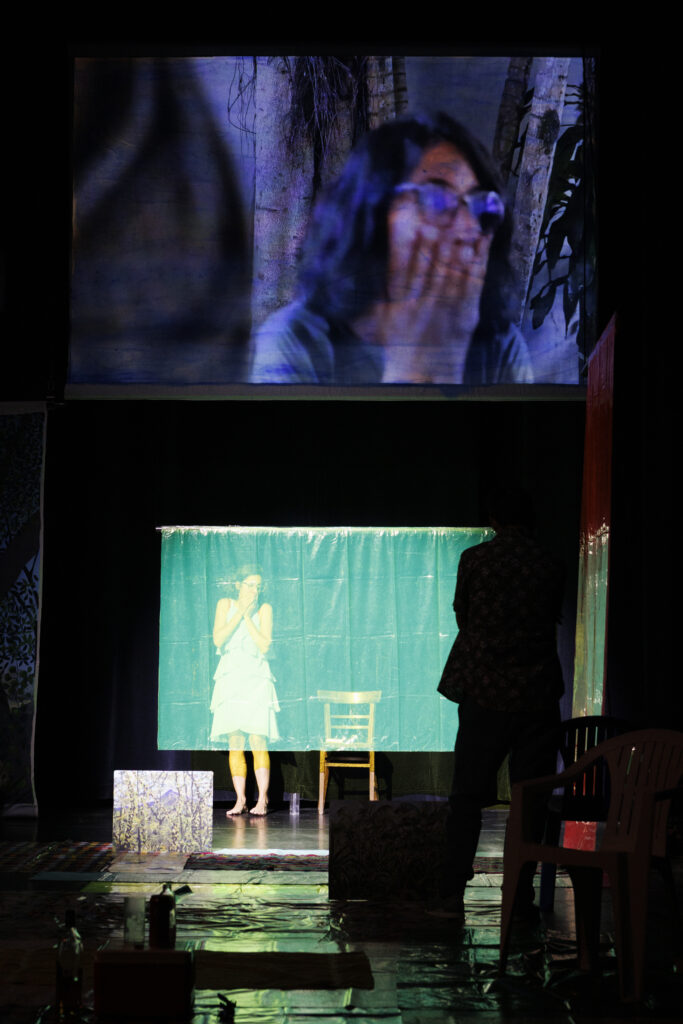
We see María telling the theatre makers on a screen that her brother died of Covid a few years ago and was thrown into a mass grave. She now wants to have him reburied alongside her mother in the family grave, but she herself can no longer enter Nicaragua. She asks Pardo, who looks like her, for a favour: she must cross the border using her Mexican passport and pose as María to the authorities in order to move her brother’s body to the family grave.
This request puts their role as documentary filmmakers in jeopardy: do they wish to merely observe the region’s misery from a safe distance, or do they choose to actually intervene? Rodriguez lacks the courage and is opposed, but Pardo sees this as an opportunity to allay her doubts about the powerlessness of theatre. She does not want to disappoint María, and above all, she can finally take concrete action, make a difference in reality, even at the risk of life and limb. At last, she can create a fiction in which something very real is at stake. The whole operation would provide the ultimate proof that theatre does not merely passively depict reality, but that creating fictions can also save the world, just as she once believed.
“Centroamérica turns out to be a poetic thriller, a spy documentary with the power of theatre at stake.”
Centroamérica thus turns out to be a poetic thriller, a spy documentary with the power of theatre at stake. We see how Pardo prepares for the infiltration, how she chooses the perfect clothes and wig, and practises the right accent. The operation, which was supposed to last just one day, goes – naturally – awry, but Pardo keeps going. As it progresses, the performance increasingly brings to mind the theatre mockumentary The Making of Berlin by Berlin, because by now you find yourself wondering whether the whole operation is real, or rather just a clever dramaturgical device. Or does that not matter?
When, after much bureaucratic acrobatics, it becomes clear that Pardo cannot achieve what she came for, she changes her plan. She lays flowers at the family grave, has the soil turned over, takes photos of the earth, and sends them to María, who thinks the task has been completed. Meanwhile, we see how Pardo, now disguised as María, builds a small altar on stage.

© Phillippe Goyens
© Phillippe Goyens

© Phillippe Goyens
Why does Pardo lie to María about something as significant as her brother’s corpse? Out of good intentions, so as not to disappoint María, because otherwise it would all have been for nothing? Or for the sake of the theatre, for the sake of a beautiful, well-rounded (good?) story? Does Pardo lie because she is a good person or a good storyteller? The successive pieces and fragments that are only loosely touched upon at the start of Centroamérica gradually fall into place: Pardo and Rodriguez are gifted storytellers, and ultimately manage to weave their extensive research into a moral nail-biter.
Todos mienten, everyone lies, was spray-painted on that car in Guatemala. Everything is, in a sense, a lie, theatre, fiction; a multinational is a fiction, bitcoins are a fiction, slavery is based on a racist fiction, a passport is a fiction, a certificate of exhumation is a fiction, even the CIA topples regimes with fabrications. The question posed by Centroamérica seems to be: which fictions do we wish to create? When must we use a very good lie to destroy something bad in order to replace it with something better?
Read the Dutch review here.
KRIJG JE GRAAG ONS PAPIEREN MAGAZINE IN JOUW BRIEVENBUS? NEEM DAN EEN ABONNEMENT.
REGELMATIG ONZE NIEUWSTE ARTIKELS IN JOUW INBOX?
SCHRIJF JE IN OP ONZE NIEUWSBRIEF.
JE LEEST ONZE ARTIKELS GRATIS OMDAT WE GELOVEN IN VRIJE, KWALITATIEVE, INCLUSIEVE KUNSTKRITIEK. ALS WE DAT WILLEN BLIJVEN BIEDEN IN DE TOEKOMST, HEBBEN WE OOK JOUW STEUN NODIG! Steun Etcetera.
recensie
12.05.2026
Leestijd 11 — 14 minuten
15.04.2026
—
07.09.2026

Floris Baeke (he/him) is a philosopher and critic. He writes for De Standaard and is co-editor-in-chief of Etcetera.
Tom Rummens
Floris Baeke
recensie 12.05.2026
Tom Rummens
Floris Baeke