The Forest School – Thomas Janssens
De misvatting die normaliteit heet
Tilde De Vylder


© Sander Lambert
The title presents a challenge. Are we meant to take it as an imperative (“you must burn a/the glass gate”) or as a statement (“a/the glass gate is burning”)? Is the gate made of glass, or is it a euphemism, like the glass ceiling? The refusal to evade clear-cut interpretations is a running device in Carly Rae Heathcote’s BURN GLASS GATE, whose metaphorical text was declaimed across a historical barn at Paalsteenhoeve in Oostende.
Three female performers joined her in the slightly damp environment, enveloped by a Susanne Kennedy-esque soundscape of a muted drone that separates them from the realism of the external world. The storyline is no less jagged than the syntax of the title: two women (portrayed by Anna Franziska Jäger and Jana De Kockere), wait for one woman’s younger sister Ena (portrayed by Estefanía Álvarez Ramírez) in front of a supermarket. The scene is interrupted by scenes of De Kockere’s character and Ena as children, the younger sister enraptured by a story of a great fire that destroyed a city, as well as scenes from their recent pasts that hint at the three women’s increasing loss of faith in their lives. The two women eventually give up waiting for Ena, and a theatrical conflagration engulfs the entire stage. Ena appears a few days after the arson with soot over her body but, when questioned about her whereabouts, remains evasive. The three women then go on a picnic where, surrounded by sounds of bird songs open air, Miro, Jäger’s character, announces that the two others will play forest and fire while she watches. The lights go out, but the performance, the artists seem to imply, will run in a closed loop ad infinitum.
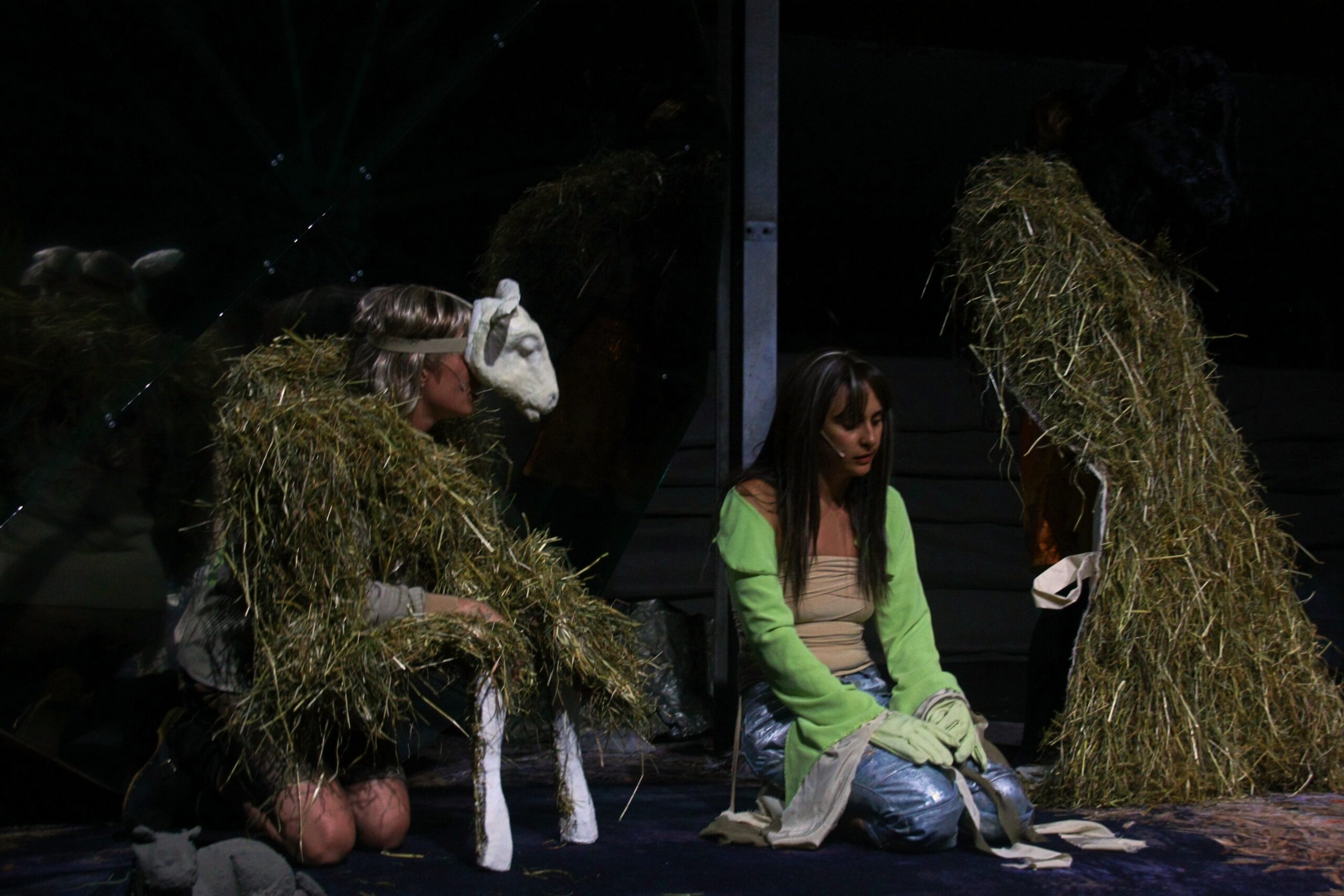
What strikes one immediately in the performance is in fact the visual element which mirrors the barren jumble referred to throughout the text. Manuela Vilanova creates an almost palpable scenography out of beige whose diversity of texture seems to come alive with the performers’ interaction. After the fog from the fire clears, the two main platforms are transformed into large upright mirrors, reflecting the gaze of the audience back at them; the enclosure of the audience, in turn, foreshadows the closed circuit of the eventual play-within-a-play. The costumes are no less multilayered, fabric upon fabric wrapped and crunched and folded on the performers’ bodies like a second sculptural element. At times the visuals feel like an installation, but that is not a bad thing: it grounds the performance against the destructive bewilderment of the characters.
The characters themselves are as if the figures by Samuel Beckett were possessed by the Millennial spirit—and perhaps it is no accident that the performance begins with Jäger and De Kockere waiting for Ramírez in a manner of Waiting for Godot. Miro longs for closeness with Life, hoping that the answers to existential questions could be found by her efforts. Her dwindling sense of self and purpose is countered by the detached, pragmatic “cruelty” of De Kockere’s character, who does not have the patience for angsty tomfooleries. Ena, on the other hand, sees through the surface (as evidenced by her hobby of cutting up dead birds open) and represents for Miro a penetrative insight into life that she lacks.
The world which drives the characters insane is only hinted at behind Jäger’s and De Kockere’s disjointed chant (“neoliberalism/ecology/discrimination/blockchain”), as if the complexities of the contemporary society, with the interlocking Big Tech and late capitalism and ecological disaster, have gotten out of control and ceased to make sense. Miro herself is discombobulated by the logic of the corporate world she works in while Ena regularly encounters death in a hospice. The young women believe that there is no possibility of a sane existence when breathing in “the fume of the insane world” and wonder if the destruction of the world through fire will produce clarity. The Biblical restoration of the good appears to take place in the final scene with an idyllic picnic, but the illusion is undercut by the theatrical conceit of the final line, trapping the characters who cannot, like Didi and Gogo, truly move beyond their predicament even though their “Godot” has arrived.
Whereas the ambitions of the piece run high, at times I was unsure if they were matched by the performance style and the final metatheatrical conceit. Distant and static, the portrayal of the three characters does not quite give life to the artifice that they are in process of creating, and the attitude distances the audience further from the text that is admittedly dense and not always comprehensible (however intentional it may have been). The piece is replete with metaphors that range from gruesome to humorous—at one point, Miro discusses the purpose of life with a goat and a cow à la A Midsummer Night’s Dream—but the ending does not convince the audience of the urgency behind the figurative language, that is, the human lot to suffer a flawed world and destruction of reality as the last resort.
In questioning the possibility of coherence—linguistically, in life, and elsewhere—BURN GLASS GATE knocks the idea of a conclusion off its pedestal. But, just as Milo’s unfulfilled quest is balanced by Ena’s penchant for ripping up an animal and searching inside, the play as a whole does not abandon all potential for significance in its metaphors. This time, however, it might have just missed the messy, bloody, corporeal guts encased in its own words.
© Sander Lambert
KRIJG JE GRAAG ONS PAPIEREN MAGAZINE IN JOUW BRIEVENBUS? NEEM DAN EEN ABONNEMENT.
REGELMATIG ONZE NIEUWSTE ARTIKELS IN JOUW INBOX?
SCHRIJF JE IN OP ONZE NIEUWSBRIEF.
JE LEEST ONZE ARTIKELS GRATIS OMDAT WE GELOVEN IN VRIJE, KWALITATIEVE, INCLUSIEVE KUNSTKRITIEK. ALS WE DAT WILLEN BLIJVEN BIEDEN IN DE TOEKOMST, HEBBEN WE OOK JOUW STEUN NODIG! Steun Etcetera.
recensie
05.08.2024
Leestijd 5 — 8 minuten
01.06.2024
—
04.09.2024
Caroline Lee-Jeong does dramaturgy and writes on different occasions. She has a background in literary and theater studies.
Dit artikel maakt deel uit van: Dossier: Theater Aan Zee 2024
Tilde De Vylder
Jonas Istace
recensie 05.08.2024
Tilde De Vylder
Jonas Istace