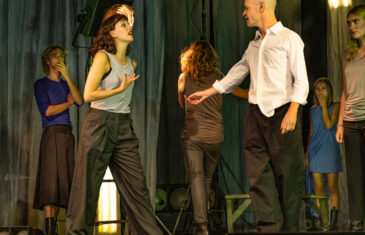
Iphigenia – De Roovers
Geef mij maar het verzet van Klytamnestra
Mia Vaerman





Bojan Dordjev is a performance artist from Belgrade educated in theatre and art theory. He’s the co-founder and editor of the platform TkH (Walking Theory) and the Journal for Performing Arts Theory (2001–2017). For his performance Politics of Colours / Chromopolitika he collaborated with Georgian artists. It is the opening act of the Belgian arts festival Europalia, dedicated this year to the Georgian art scene. In the introduction, he perfectly describes what it is about by saying something along the lines of ‘if you get lost don’t worry and let it take you somewhere, you’ll get the script at the end.’
The most popular toy in my kindergarten wasn’t a car or a doll. It was a carpet. A carpet with roads, crossings, traffic lights and houses. Riding toy cars or just wandering on it, pretending that my index and middle finger are a person, was the most engaging activity. This was our introduction to civilization, and simultaneously it gave us the pleasure of navigating an imaginary world. This kind of world is also explored by the performers Vladislava Djordjević, Luka Gergedava and Nino Namitcheishvili. Like children, they follow the lines of traditional Georgian carpets on the stage with their fingers, point at spots, draw flowers, but they look very serious. Their exploration is supposedly innocent but at the same it’s performed in silence and quite slowly. I saw a bored little girl sitting on my right side, and I wished that she would become a part of their act and intrude on their play that seemed to lack joy and curiosity.
“Politics of Colours / Chromopolitika breaks with dualisms and a linear understanding of time and opposition.”
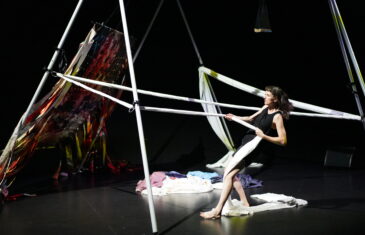
Apart from the silence and lack of inertia, there was something else unchildlike in the actors’ behaviour. At times, it seemed that instead of exploring and playing with the carpets, like children would, they were trying to break this knit of imagination, interrupt the tightly weaved civilization. By using their nails, beating and scratching the carpets, they make dry noises, a welcome relief to the deafening silence of the play. They pick up the carpets which transform into different things; a luxurious skirt, a cape to hide under, a lion’s mane. In the end these carpets, as well as the paper layers that previously hid them from the spectators, are cast aside. The actors move on to the next thing and Vladislava Djordjević begins her monologue.
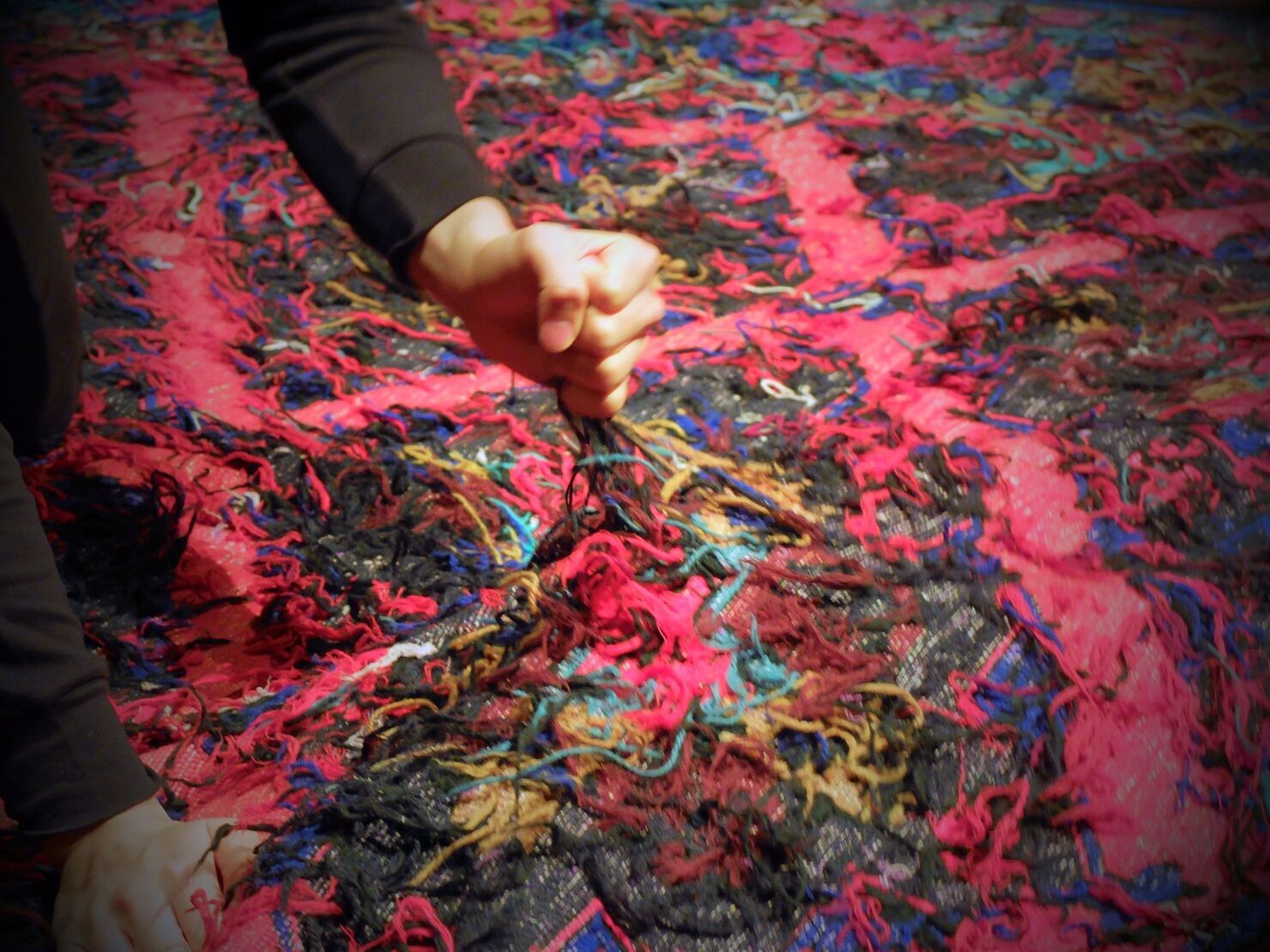
The monologue doesn’t follow a clear narrative, it meanders, it’s intuitive rather than logical. As if imitating the layered carpets and textiles on the floor, the story superimposes ideas, figures, stories and plays with the tension between tradition and innovation. It alludes to Georgian history and mythology and tells a story of a mural that was supposed to portray Lenin but instead became an abstraction of fire. This meanders to a myth of Amiran, a Prometheus in Georgian mythology, and distribution of knowledge. Indirectly Vladislava tells a story about resistance to the Soviet regime, where people chose to make up their own minds, follow the bright colours, passion, fire. However, later on she tells about modern resistance to vivid, bright colours as if they were something for children and unintelligent only. In such a way the play breaks with dualisms and a linear understanding of time and opposition. It’s anchored by real events and doesn’t become a postmodern mush proclaiming that everything is relative and everything matters. The hotchpotch of visuals and words is woven into its own carpet where contrasting ideas are a part of the world’s matrix. It’s summed up by Vladislava: ‘As if realism yearned for abstraction. But abstraction also yearned for realism…’
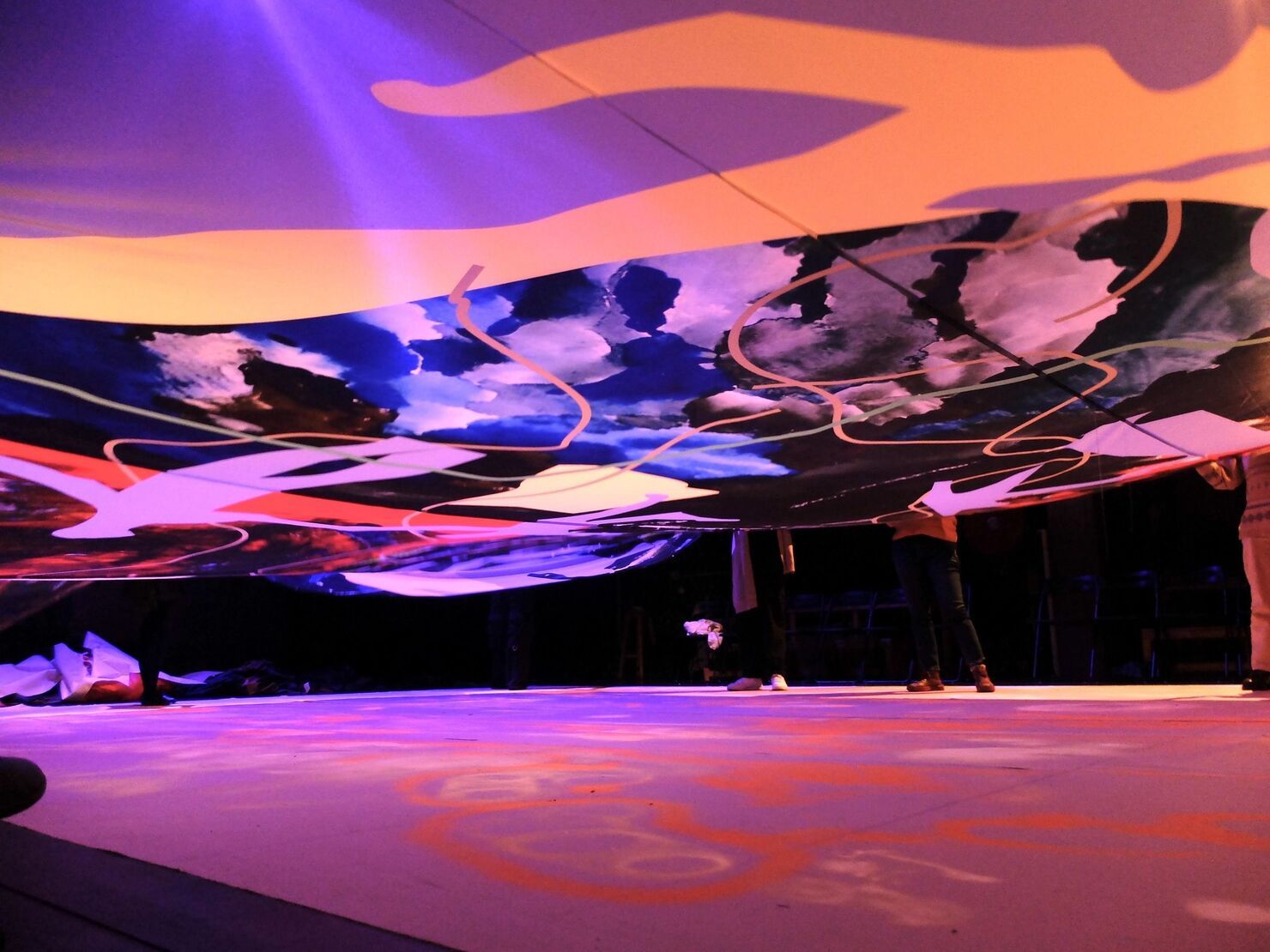
At the end of the play, the spectators have to lift up the last, most colourful and most abstract layer. They are encouraged to play with and under it, explore the freedom, the unapologetic beauty of bright neon and expressive squiggles. At this point my head is too full with impressions, I’m nervous about missing the point of it all. Like the spectators holding the colourful fabric I want to hold the matrix of the play without folds, to see and interpret the images. What do I do, I ask my friend, do I focus or relax? I heard her answer as feelax. It’s so perfect that I don’t double-check. People are invited to explore the space by going under the colourful fabric and dance to the music that just started to play. Some people are moved a lot of us giggle. But then the colourful sheet is taken away and the audience is supposed to break into a naked dance. Few of us do while others sit down and watch. The spectators unfortunately can’t peel off their own layers just yet, maybe at least in winter it’s better to leave them be under the sheets.
Politics of Colours / Chromopolitika will be performed in KAAP (Brugge) on 02/12/2023 and Bozar (Brussels) on 03/12/2023. More info on the website of Europalia.
KRIJG JE GRAAG ONS PAPIEREN MAGAZINE IN JOUW BRIEVENBUS? NEEM DAN EEN ABONNEMENT.
REGELMATIG ONZE NIEUWSTE ARTIKELS IN JOUW INBOX?
SCHRIJF JE IN OP ONZE NIEUWSBRIEF.
JE LEEST ONZE ARTIKELS GRATIS OMDAT WE GELOVEN IN VRIJE, KWALITATIEVE, INCLUSIEVE KUNSTKRITIEK. ALS WE DAT WILLEN BLIJVEN BIEDEN IN DE TOEKOMST, HEBBEN WE OOK JOUW STEUN NODIG! Steun Etcetera.
recensie
02.12.2023
Leestijd 4 — 7 minuten
15.09.2023
—
14.12.2023

Ugnė Noreikė is a Lithuanian writer, musician and artist. She works in spaces of not knowing, vulnerability and extreme feelings. She’s looking for meeting points between sounds and words.

Mia Vaerman
Tom Rummens
recensie 02.12.2023
Mia Vaerman
Tom Rummens