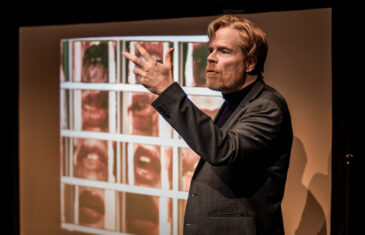
Confessie – Raven Ruëll & Bruno Vanden Broucke
De kunstmarkt maakt de kunstenaar
Klaas Tindemans





© Maryan Sayd
In Artists’ Entrance, we ask (international) performing artists questions about their lives and work. Each of these interviews is a unique portrait that provides insight into the artistic practice and life of creators and performers. We re-introduce the format with Mario Barrantes Espinoza as our first guest. Mario is a Costa Rican-Nicaraguan artist based in Brussels. Their piece FLESH CAN’T CAN’ T NOT’T ‘TIS FLESH H… was selected for het TheaterFestival 2025.
What was your first encounter with the performing arts?
Performing arts arrived kinda late in life, almost by accident. I was preparing for university, and had planned to get into architecture, the logical choice after studying architectural drawing for three years. At the same time, I applied for drama as my second career choice, I really don’t even know why, probably I thought it would be funny to try. That audition was the first time I was on a stage. In the end, I got accepted into both. But I loved drama so much, more than making technical drawings for eight hours, that I dropped architecture. Drama eventually led me to dance, since the schools were next to each other. And eventually dance took me to Belgium, where I feel I’m coming back to theatre, lol. But! I could say my real, real first experience was in church. I was raised in a very catholic family, which led me to be an altar boy at six. At the time, I didn’t understand it, but when I look back at it… the coloured robes, the readings in front of people, the processions drama, the fire, the incense, the ornaments… Catholicism in Latin America is for sure lived with a lot of theatricality. And I enjoyed it so much. Those were definitely my first shows.
When you were a child, what did you want to be when you grew up?
A magician. I remember it well cause, you know when they ask you that in primary school? I can still see the look of my teacher’s face after hearing ‘dentist’, ‘fireman’, ‘astronaut’ over and over again. When I said mago, she smiled and was like… is that even a profession? Jokes on her. It is.
When did you know that you wanted to work in the performing arts?
In Costa Rica, while studying dance. I was lucky enough to already be working with well-known Costa Rican choreographers and creating my own work. Producing there is not as well supported as it is in Belgium. It mostly comes down to self-funded initiatives, which require a lot of dedication. I mean, when you find yourself working in a field that can sometimes be so precarious and cruel… well, you realize you must really want to be in it, because I can’t think of any other explanation.
Which performance has kept you awake recently?
I’m between Carolina Bianchi’s The brotherhood, and Alberto Cortés’ Analphabet.
Which performance is unforgettable?

What is your favorite place to be?
Bed. Unpopular opinion? Underwhelming statement? A very Taurus answer? But it is. For me bed is not just a place to sleep and rest. It’s dreams, long nights of anxious thoughts, fears. A place for sex, pleasure, vulgarity, for the most fragile and vulnerable moments. A place for home, sickness, to forget and feel safe… for sharing intimacy with oneself and others. I could go on how much bed is such an overlooked place. But never for eating, food at least, I hate crumbs in bed.
Where would you like to show your work?
I definitely want to bring my stage work back home. That’s where the inspiration comes from. Tho lately I’ve been thinking a lot about how to make performance exist out of institutional frameworks. Clubbing and nightlife feel like exciting places to search for that answer. Of course, most clubs don’t have the technical equipment for full-length performances, but rather than seeing that as a limitation, I see it as an opportunity for something new to emerge. That’s how Apolemia was created: four artists and friends based in Brussels wanting to reimage performance practices within the club. Working on it.
Who taught you the most in your life?
Not a who, but a what: migrating. It taught me to embrace change, to not be afraid of the “other,” and to stay curious. My mother’s family migrated from Nicaragua after the civil war, a community that often faces xenophobic hate in Costa Rica. My father’s family, on the other hand, migrated internally from the countryside to San José, which at the time was an eight-hour bus trip. I grew up with the idea of traveling and not fully belonging to places. Later, when I moved to Brussels, within the EU’s context of mobility, I got in contact with such an eclectic city. I made friends who, by constantly sharing their backgrounds, continue to challenge my preconceived ideas about life. All of this gives shape to two forces—displacement and gathering—that continue to guide how I imagine performance.
How does your workplace or atelier look like?
I don’t have a studio. As an independent artist, workplace is where I can find it. I mostly get creative by travelling and going out at night. Life out there.
What do you to relax?
I recently got into Olympic weightlifting. Life is reduced to a one repetition at a time. You put your whole mental and physical effort in one movement. Very meditative. It’s refreshing especially coming from a background so rooted in release techniques and somatic work.
What music do you have on repeat at the moment?
Cumbia. At the moment, I’m in the research phase for my next work, which will complete the triptych of performances based on Latin American music that began with El cantar del playo or… a song is a rose is a thorn (plancha music) and FLESH CAN’T CAN’ T NOT’T ‘TIS FLESH H… (reggaeton). Last week I went to see Los Mirlos and Damas Gratis live at La Madeleine, on the same night, two of the most iconic cumbia bands, they marked generations. Therapeutic.
Do you have a ritual before you go on stage?
Don’t know if it counts as a ritual, but I tell myself to enjoy and avoid (work through) self-judgment.
What is the best thing about your job?
Working from desire. Collaborating with so many artists. Inhabiting so many different contexts. When I create, I try to work with materials that don’t force my attention, but rather give me the feeling they already carry me. Usually, these are themes or materials that give me so much vitality that I could talk about them for ages and performing them doesn’t drain me, but instead revitalizes both myself and my work. This often leads me to different places, to work with local artists, and to connect with people who don’t necessarily work in the arts.
Do you have a daily practice?
No. And I’m very ok with that.
Do your parents like your work?
My parents have never seen me perform live, mainly because of the distance and the financial effort it would take to bring them to Belgium. They only know my work through social media or the videos I send in our WhatsApp group. I think they still find it hard to fully make sense of what I do ha! One day I’m half-naked playing with a band, the next I’m hanging in a theatre play, then I’m in a monastery singing Gregorian chants, or suddenly teaching as a professor at an art school. As long as they see that I’m happy doing it, they’re happy too, or so they say. Still, I definitely hope to perform in front of them one day.
Does theatre have an impact?
This question fucks me up. I think I take it personal cause it’s at the root of a lot of my dissatisfaction and anxiety. It comes up quite often in therapy. I don’t always know how to answer it and to be honest I sometimes avoid asking it to myself. In these times, faced with the violence and problems that directly affect the place I come from, also faced with the broader genocidal, fascistic, and ecocidal forces shaping life globally. I’m not very optimistic about the kind of impact theatre is having, at least not in its current form. We keep making works about migration, queerness, environmental harm, racism, feminisms… but it too often feels like pouring glasses of water into a burning house. If theatre has any transformative impact, I doubt it happens inside theatre houses. This frustration gets worse when I witness institutions play the “performative support” card while failing to take a clear stand or direct actions. Politics become safe only when treated as content, not as commitment. And then another blow: artists who have been publicly denounced for abusive behaviour still receiving major awards, to me, this sends a clear message to the field: accountability doesn’t matter.
With whom would you like to collaborate once? Are there certain artists you feel related to and why?
I love the way Alberto Cortés crafts texts, written and staged. It soothes the soul and arouses the ear. I want more of that.
Have you ever had a special encounter with an audience member?
Yes. During the Culo Shaking Night. This is an event I co-organize with theatres where my work is presented. The night is inspired by family celebrations in Latin America: we have food, drinks, music, a short act, and kitschness… just an excuse to stay longer together sharing. I was performing El Cantar when an older woman came up to thank me. She told me she usually doesn’t go to the theatre, but that she went inside this time because the music and food were very inviting. She mentioned she sang all the songs of the show and how much she related to the idea of grieving from afar; family deaths, friends left behind, a place you can’t visit as often as you’d wish. All this while a salsa band was playing live. For a moment, it felt as if we were transported into someone’s quinceaños: people dancing, eating, sharing music and personal stories. For me, that’s the spirit of Culo Shaking Night: to invite people to experience theatre differently, to bring warmth and heat back into it. It reassures me, because even if my work sometimes feels directed at a very specific crowd, I’m always trying to reach beyond the traditional theatre space.
Do you care about reviews?
I do. The good and the bad ones.
What is the most recent note you made?
It was some notes about leyendas, they are oral tales, like traditional horror stories with supernatural characters, very common in Central America. I’ve been trying to connect this genre to local history, in my case the past of Costa Rica during the banana enclave period: what would it mean to continue building such oral traditions in the present? Could we imagine contemporary ‘bestiaries’ that are shaped by history, spirits, and memory? Transmitting them through embodied and oral storytelling?”
If you would get the chance to start again and choose a new career, what would you do?
A magician.
Do you think theatre will survive in the future?
Depends on what theatre we are talking about. Theatre as its most elemental, by that I mean the act of gathering, a human impulse: the need to enact, to embody, to tell, to show, to be witnessed… That I’m sure will survive and continue to thrive. It doesn’t require a stage or even a building. It happens around a fire, in a procession, at a ritual, in a living room, on a street corner. But if we’re talking about theatre as an apparatus, with its conventions, its politics of access, its institutions, its aesthetics, its building-mausoleums… then I hope people will find other ways to imagine it.
KRIJG JE GRAAG ONS PAPIEREN MAGAZINE IN JOUW BRIEVENBUS? NEEM DAN EEN ABONNEMENT.
REGELMATIG ONZE NIEUWSTE ARTIKELS IN JOUW INBOX?
SCHRIJF JE IN OP ONZE NIEUWSBRIEF.
JE LEEST ONZE ARTIKELS GRATIS OMDAT WE GELOVEN IN VRIJE, KWALITATIEVE, INCLUSIEVE KUNSTKRITIEK. ALS WE DAT WILLEN BLIJVEN BIEDEN IN DE TOEKOMST, HEBBEN WE OOK JOUW STEUN NODIG! Steun Etcetera.
interview
02.09.2025
Leestijd 10 — 13 minuten
01.03.2025
—
14.09.2025

Mario Barrantes Espinoza is a Costa Rican-Nicaraguan artist based in Brussels. They studied theatre and dance at the National University of Costa Rica, before moving to Belgium, where they graduated from the Training Cycle (2016) and the Research Studios (2018) at P.A.R.T.S. They have collaborated in works by François Chaignaud, Théo Mercier, Benjamin Abel Meirhaeghe, Michiel Vandevelde and Eszter Salamon, and performed as guest artist for the bands Peaches and The Subs.
Dit artikel maakt deel uit van: Artiesteningang

Klaas Tindemans
Mia Vaerman
interview 02.09.2025
Klaas Tindemans
Mia Vaerman