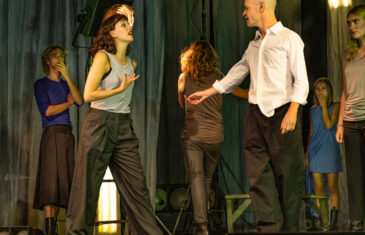
Iphigenia – De Roovers
Geef mij maar het verzet van Klytamnestra
Mia Vaerman





Liebestodt © Raynaud De Lage
In Artists’ Entrance, we ask artists about their life and work. Today: Angélica Liddell. Born in Figueres, Spain, she is a playwright, director, and performer, known for works like La casa de la fuerza (2009), El año de Ricardo (2005), Liebestod (2021), Vudú (2023), and Dämon. El funeral de Bergman (2024). From May 25 to 27, she can be seen at Kunstenfestivaldesarts with Seppuku. El funeral de Mishima o el placer de morir.
What was your first encounter with the performing arts?
I started putting on plays with other children when I was seven or eight, using our parents’ pornographic magazines. I directed the whole thing. Acting out those scenes was a fantastic introduction to sex and eroticism. So, in my childhood, my first encounter was with erotic theatre, and in my adult life it was Tadeusz Kantor who made me understand what art is.
When you were a kid, what life did you dream of?
I always replied that I wanted to be an “artist”, and that was that. From a very early age, I devoted all my energy to creating.
When did you know that you wanted to work in the performing arts?
When I was 18, I sat my first entrance exams for the Madrid School of Dramatic Art and failed. I didn’t get in. So I joined a theatre company at a cultural centre in a suburb, where people started dying of AIDS. That tragedy really left its mark on me.
Which performance has kept you awake recently?
I haven’t been to the theatre recently. But I was really moved by a performance by Abel Azcona, a Spanish performer.
Which performance will you never forget?
Jan Fabre’s Mount Olympus. Without a doubt. No other production has ever made me feel that emotion, that catharsis. It was incredible. Einstein on the Beach by Philip Glass and Bob Wilson will also remain etched in my memory.
What do you never want to see on stage again?
Costume design, especially if it’s ‘haute couture’. I hate it. I detest the world of fashion on stage. On stage, you have to turn shit into gold. Not the other way round. I detest the design of the set.
“I never want to see ‘haute couture’ on stage again. I detest the world of fashion on stage. On stage, you have to turn shit into gold. Not the other way round.”
What is your favourite place to be?
I like standing in front of a painting, a work of art. It’s my paradise.
Where would you like to show your work?
I think I’ve already worked in all the places I ever dreamed of. I’d like to reach audiences who aren’t familiar with my work, though. But unfortunately, due to various forms of censorship, I can’t show it in places like China, for example. Only decorative works with censored nudity and censored texts are allowed into China. There’s far more censorship in the art world than people realise. Real punk is over. Starting with the fact that you can’t smoke on stage. Just imagine where that leaves Valie Export.
Who have you learnt the most from?
From the masters of 20th-century cinema. Tarkovsky, Bresson, Kurosawa, Godard, Oshima, Bergman, etc…
“There’s far more censorship in the art world than people realise. Real punk is over. Starting with the fact that you can’t smoke on stage. Just imagine where that leaves Valie Export.”
Are you into astrology?
I’m obsessed with the creation of the universe. I went to the particle accelerator in Switzerland to try and make sense of it all. I look at everything from a perspective of millions of years. It’s the best way to put vanity in its place.
What does your workspace or atelier look like?
I don’t have one. I work in cafés.
How do you relax?
Walking, walking. But resting makes me anxious. I don’t know how to rest. Peace and quiet make me uneasy. All I know how to do is work.
What music are you currently listening to on repeat?
I listen obsessively to the music from the pieces I’m currently rehearsing. At the moment, it’s Marin Marais’s viola pieces.
Do you like gadgets?
What’s that?
Do you have a ritual before going on stage?
I’m too scared to do a ritual. I get into a state of paralysing anxiety.
What is the most beautiful thing about being an artist?
Trying to solve the problem of beauty. And above all, as Tracey Emin says: art has saved my life.
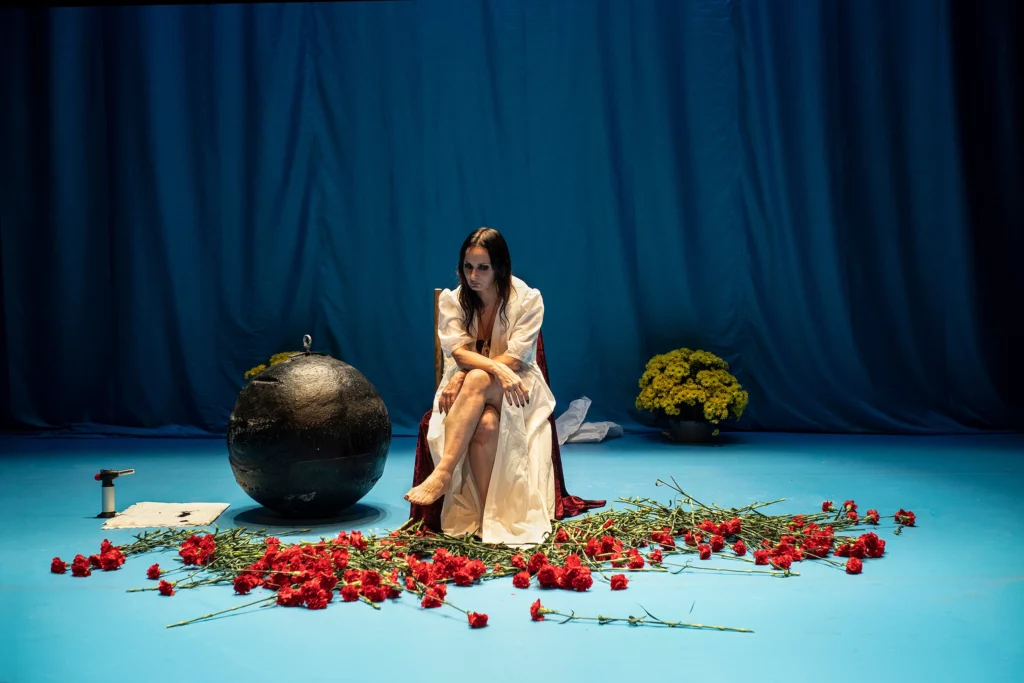
Vudu © Luca del Pia
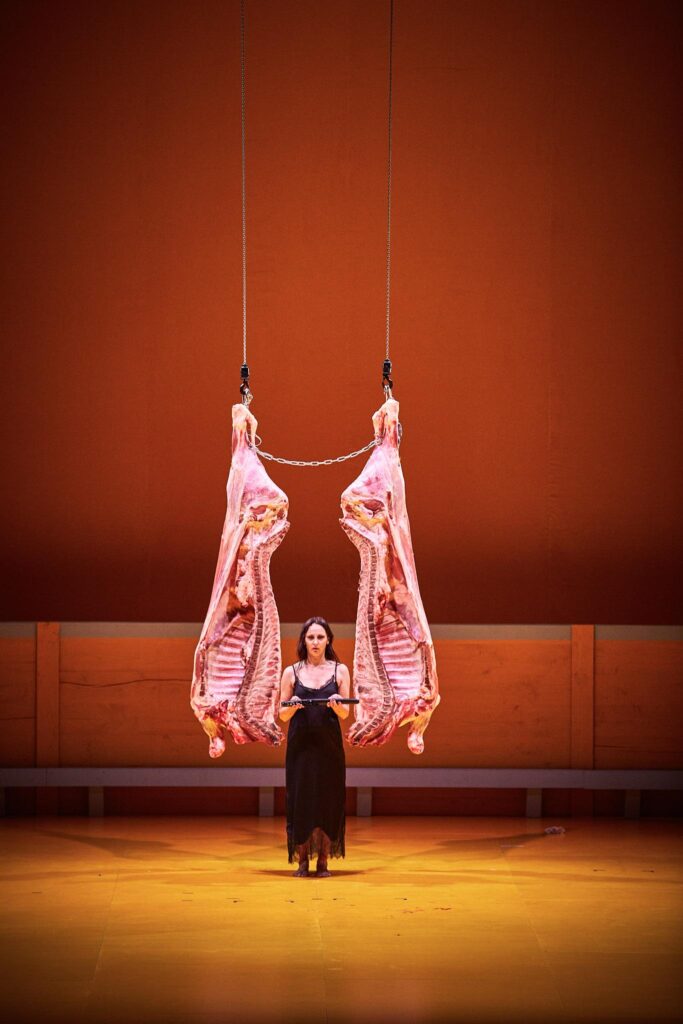
Liebestodt © Raynaud De Lage
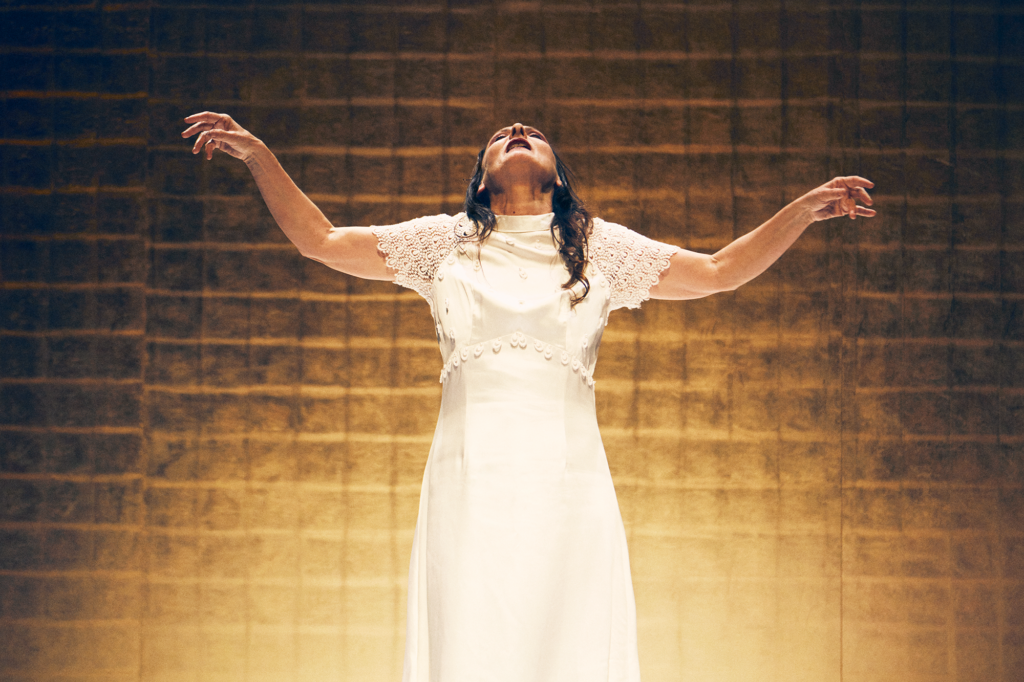
Sepukku © Ximena y Sergio
Do you need chaos or order to work?
My job is to bring order to chaos.
What do you like to work with?
I like to work with the immoral. My imagination is immoral. That is the world I like to surround myself with: evil, perversion, instincts, sex, the abominable – but not to judge it. No, I’m interested in everything that happens in the hidden realm and makes us whole as human beings.
What does your ideal dressing room look like?
Empty, completely empty. I love emptiness.
Do you have a daily routine?
I get up at 6.30 in the morning. I leave the house to go to the café and write for three hours. Then I go to the gym for an hour and a half. After lunch I write for another two hours. And after that I go to the cinema or for a walk, always in the same place, the same route, and I go to bed very early at 10.30 pm. That’s my daily routine, except when I have to go on tour or rehearse.
“I like to work with the immoral. My imagination is immoral. That is the world I like to surround myself with: evil, perversion, instincts, sex, the abominable – but not to judge it.”
How long before the premiere is your performance ‘finished’?
I finish the pieces in my head long before that. I need to have them mentally finished six months beforehand; text, images. I work as if in cinema; there’s no rehearsal process. When I arrive at the rehearsal space, I stage the structure I’ve brought with me and start making corrections. Things happen at that point, of course; I also attach importance to chance.
Do you enjoy performing, or does it mainly make you nervous?
Before I go on stage, I’m scared to death. Once on stage, I let myself be carried away by the trance; I unleash the madness, the crime, the hatred and the love. I become a sort of medium.
What habit would you like to unlearn?
Assertiveness. It causes me a lot of problems. People take advantage of me. They abuse me. I’m such a naive idiot, fuck.
Are your parents fans of your work?
My parents have passed away. I staged a funeral for each of them. I think my mother would have really liked the funeral I staged for her. When they were alive, even though they didn’t understand the plays, they enjoyed seeing their daughter on stage.
Does theatre have an impact?
Sometimes I miss the days when people would storm out of theatres shouting and booing, outraged, as in Stravinsky’s The Rite of Spring. We need a work like that. Right now, the impact can only come from the spirit; it is a spiritual impact. I still believe in emotion and catharsis.
“Before I go on stage, I’m scared to death. Once on stage, I let myself be carried away by the trance; I unleash the madness, the crime, the hatred and the love. I become a sort of medium.”
Who would you like to collaborate with one day?
I think I love artists I’ll never be able to collaborate with; artists who are impossible to reach. I wouldn’t be able to. I’d be overwhelmed by respect. I’d love to work with Araki, for example, or Paul McCarthy, or Larry Clark, or Arvo Pärt, but it seems impossible to me, to be honest. They’re true artists. I’d work with them as a slave. I’d offer myself as a slave. I’d also really like to work with people from the underground – I don’t know where the hell that is right now – I’d love to work with the younger ones, with young people who’d be willing to die with me. I’d love to work with people who think of nothing but dying for beauty, strange people, outside the real world.
Are there certain artists you feel a connection with, and why?
I feel a close connection to the Japanese underground scene of the 60s and 70s. I relate to that revolution, to that liberation through violence and eroticism. It was a time of wild experimentation in Japan. It was the post-atomic era. And the underground scene was right up to the task of that explosion. I’m always inspired by that period in art. And of course, when will the punks come back to flash their arses in Cannes? I’m really looking forward to it, for someone to come in and shit on the whole lot of it, like Godard, for fuck’s sake.
I also try to look among young people, to see where the rage is right now – the anti-social rage, the aesthetic rage. I want young people to influence me.
Which misconception about yourself would you like to dispel here and now?
None. Everyone is entitled to think whatever they like about my work.
Have you ever had a memorable encounter with an audience member?
I loved it when Park Chan-wook came to see Liebestod in Seoul. His Vengeance Trilogy is one of the best things to happen to cinema in recent times. He’s a genius. He invited us to dinner at a very popular place; it was a lovely evening. He’s a legend to me. I only dared to talk nonsense.
Do you care about reviews?
Not at the moment. Ingmar Bergman made me do it!!!!!!! I swear!!! It was all Bergman’s fault!!!!!!
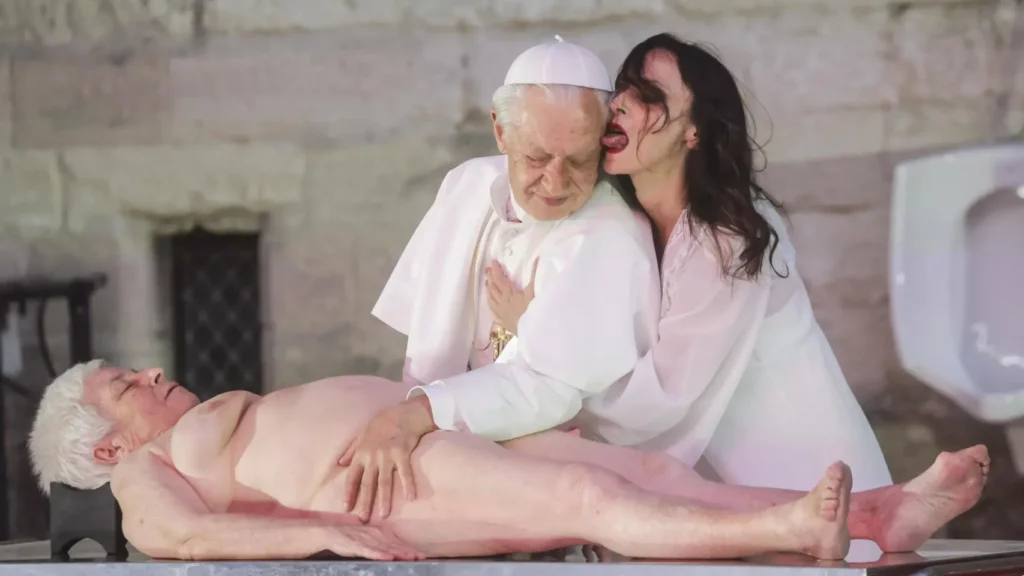
Dämon. El funeral de Bergman © Teresa Suárez
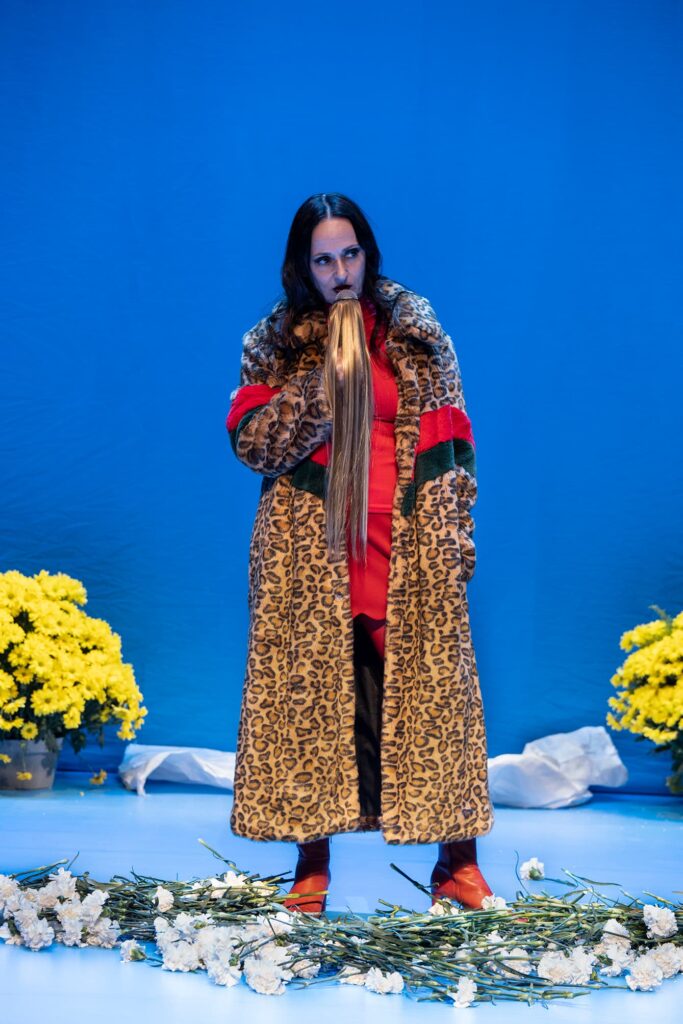
Vudu © Luca del Pia
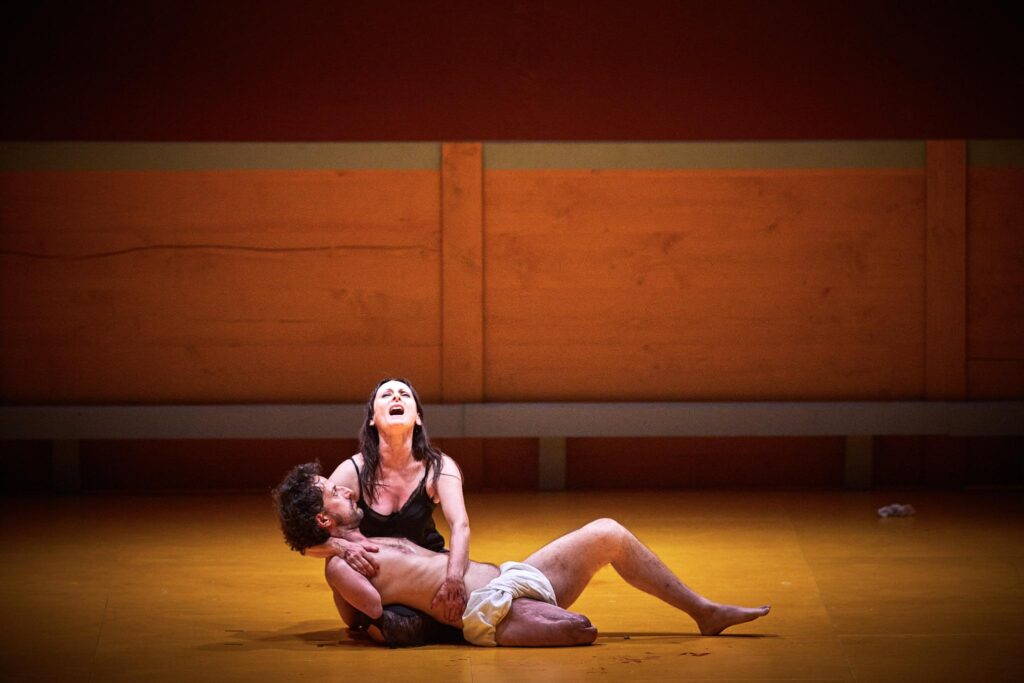
Liebestodt © Raynaud De Lage
What is the last note you made?
At the Odéon Theatre in Paris, a month ago, during the play Vudú (3318) Blixen. I said to one of my actors: “When you go on stage, pull your trousers down and let me grab your cock”. He’s my favourite actor, Yuri Ananiev, an 80-year-old Georgian pianist.
“I believe the 30th century will once again be a glorious century. The 21st century is a mannerist century, one of transition, of imitation, of commentary, and that’s logical; it’s an era in the making, like a foetus; the 21st century is merely an embryo of something.”
What question do you wish you’d been asked in an interview, but never were?
What do you think about when you masturbate?
If you could start over, what career would you choose?
I would devote myself entirely to writing. Above all else, I consider myself a writer. Theatre stops me from shooting myself. But writing gives meaning to every single one of my mornings. At least the mornings.
Do you think theatre will survive in the future?
Theatre will survive. Decorative plays will continue to be produced, of course. But art itself will disappear because genuine transgression and genuine experimentation will disappear. Art will be nothing more than a memory of art. The 20th century will never return. I believe the 30th century will once again be a glorious century. The 21st century is a mannerist century, one of transition, of imitation, of commentary, and that’s logical; it’s an era in the making, like a foetus; the 21st century is merely an embryo of something. But the 20th century is unsurpassable. Just look at the rubbish of a cinema that’s being made nowadays.
KRIJG JE GRAAG ONS PAPIEREN MAGAZINE IN JOUW BRIEVENBUS? NEEM DAN EEN ABONNEMENT.
REGELMATIG ONZE NIEUWSTE ARTIKELS IN JOUW INBOX?
SCHRIJF JE IN OP ONZE NIEUWSBRIEF.
JE LEEST ONZE ARTIKELS GRATIS OMDAT WE GELOVEN IN VRIJE, KWALITATIEVE, INCLUSIEVE KUNSTKRITIEK. ALS WE DAT WILLEN BLIJVEN BIEDEN IN DE TOEKOMST, HEBBEN WE OOK JOUW STEUN NODIG! Steun Etcetera.
interview
23.05.2026
Leestijd 10 — 13 minuten
15.04.2026
—
07.09.2026

Angélica Liddell (°1966, Figueres, Girona) founded ATRA BILIS TEATRO in 1993. Her groundbreaking work has been staged worldwide and translated into multiple languages, including French, English, German, Japanese, and Italian. Her recent productions, including Dämon—which opened the Festival d’Avignon 2024, La casa de la fuerza, Liebestod, The Scarlet Letter, and Qué haré yo con esta espada, have been presented at major theatres across Europe, America, and Asia, receiving critical acclaim.
Dit artikel maakt deel uit van: Artiesteningang
Mia Vaerman
Tom Rummens
interview 23.05.2026
Mia Vaerman
Tom Rummens