De Materie – Phia Ménard/Opera Ballet Vlaanderen/Bas Wiegers
Een schurend vooruitgangsdenken
Sébastien Hendrickx




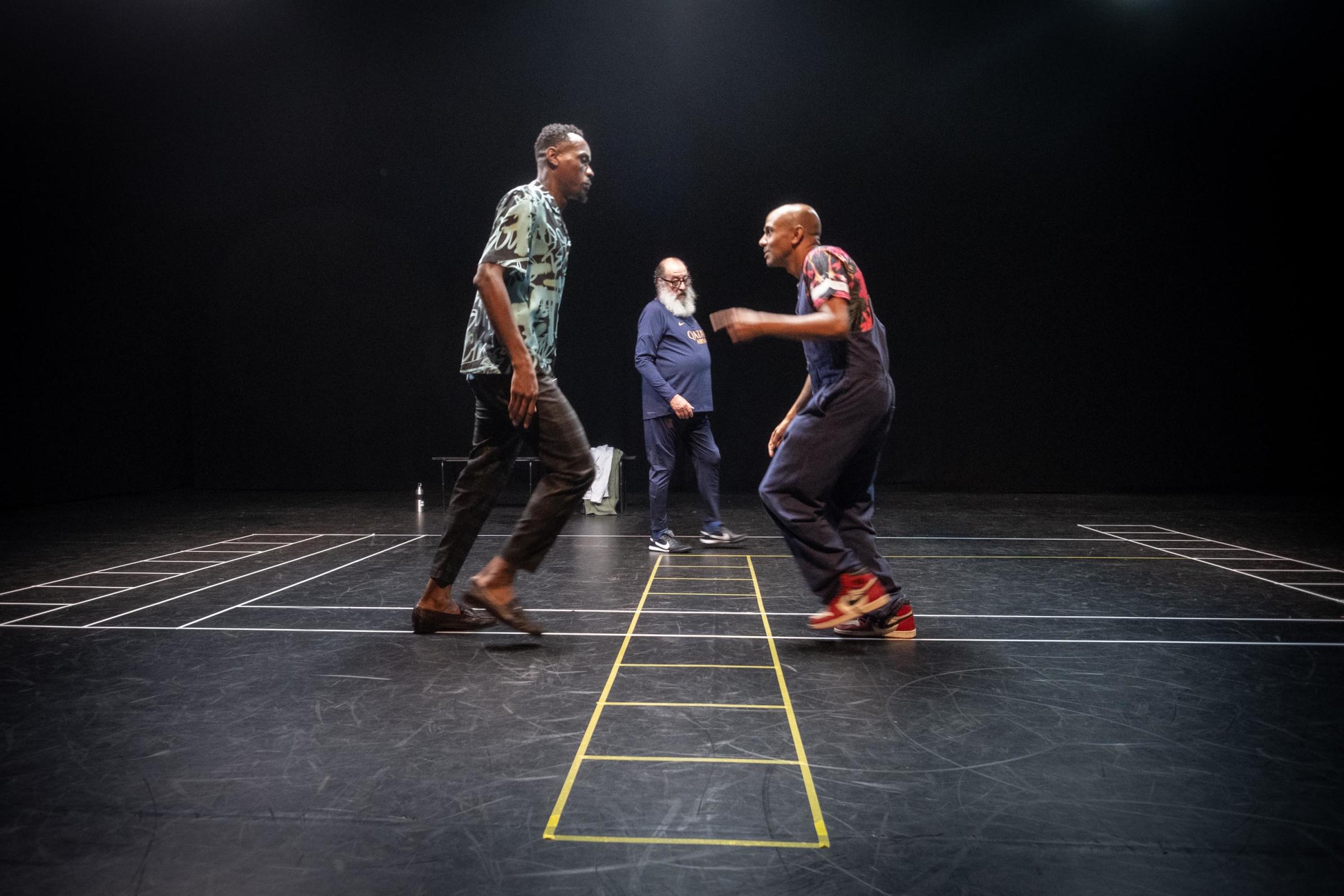
Ahilan Ratnamohan – Josse Jnr. © kurt van der elst
I must confess to the considerable consternation caused by the title. Many alternatives were on my list: a white public, abandoned with grudging forgiveness the desire to move beyond racial terminology; a Belgian public, quickly thrown away due to the ambiguity over who may safely claim such an identity; a European public, dismissed yet again, in fear of contributing to the construction of its apparently inevitable reality. In the end, I settled for anderstalig, or, if I may be allowed some etymological facetiousness, a barbaric public.
The 169th edition of Etcetera was devoted to the topic of multilingualism in Flemish theater—at schools, on stage, during the creative process, and more. Writers from different branches of the sector examined ways of respecting the local linguistic specificities, be they particular Flemish dialects or English-French-Dutch pidgin, and all advocated for more openness and linguistic diversity. Still, more questions remain to be asked on the concept of foreignness itself in relation to language: who is the anderstalige? Who is this othered (ver-ander-d) entity? And who judges the other’s anderstaligheid—the on-anders-talige—the same-talige (samen-talige?)?
An artist enters a space. Spaces, as Marianne Van Kerkhoven once said, “are made of skin, they have pores, they breathe,” but which breaths are entering through which pores in this space, the artist is not yet aware.1 They compose a story and, reasonably convinced of its relevance, its complexity, and its beauty (or their ego), they tell the story, in hopes that the public whose breath they can only vaguely sense in the darkness will grasp their gestures with sympathy (be-grijpen?) and recognize the spirit behind them (her-kennen?)—in short, that kinship will be born (ken-nis maken?), in which the space and the artist and the public breathe the same air together (samen?).
“Who is the anderstalige? Who is this othered (ver-ander-d) entity? And who judges the other’s anderstaligheid—the on-anders-talige—the same-talige (samen-talige?)?”
This certainly is not the sole model for the relationship between the public and the artist. But if the andertaligheid of the other (artist) presupposes a unity (within the public), we must admit to ourselves that the kinship between the two is based on the artist’s recognizability in the public’s eyes (her-ken-baarheid)—and that the artist’s attempts to bridge the gulf between the two have failed/are failing/will fail because of the public’s own sense of togetherness. Little does the public know that, from the artist’s point of view, it is the public that is anderstalig; the public that is barbaric; the public that imposes its own incomprehension, its suffocating sense of togetherness upon the artist. 2Thus the artist must take on the double-edged task of “knowing their public,” while the naïve public is bewildered by the artist’s barbarism.
The subject of anderstaligheid began to take root in my head last October, when I found myself on a tram up and down Rogierlaan after witnessing Ahilan Ratnamohan, Etuwe Bright Junior and Josse De Pauw perform in Josse Jnr. at De Kriekelaar. In his usual frank persona, Ratnamohan announces early on the motivations behind the show: after several collaborations with Bright Junior, he wants to depart from their humble origins in “immigrant football theater” and launch Bright Junior’s career into the world of Josse De Pauw, whose mastery of language, as well as his position in the Flemish cultural scene, have come to represent for them the ultimate stardom or the Belgian Dream.
I laughed. It took me several seconds to realize that I was the only one laughing. Ratnamohan turned towards me in sitting in the dark and said, “yes, exactly.” For what might have been the next quarter of an hour, it felt as though the lines from Ratnamohan and Bright Junior were directly addressed towards me; their attention, however, simultaneously heightened my awareness of the rest of the audience who were not involved in this dialogue. Everyone in the theater understood the mix of English and Dutch used onstage. I would like to believe that we all understood the premise of the show, which was to have performers with different connections to Flemish recite each other’s texts to see if this appropriation changed the performers’ cultural legitimacy. And yet, the kinship I felt between myself and the performers did not appear to develop among the other theatergoers. Although the show’s premise explicitly questioned the distinction between anderstalig and samen-talig (samen-levende?), it was as if the gulf between the artists doing “immigrant football theater” and the public could never close.
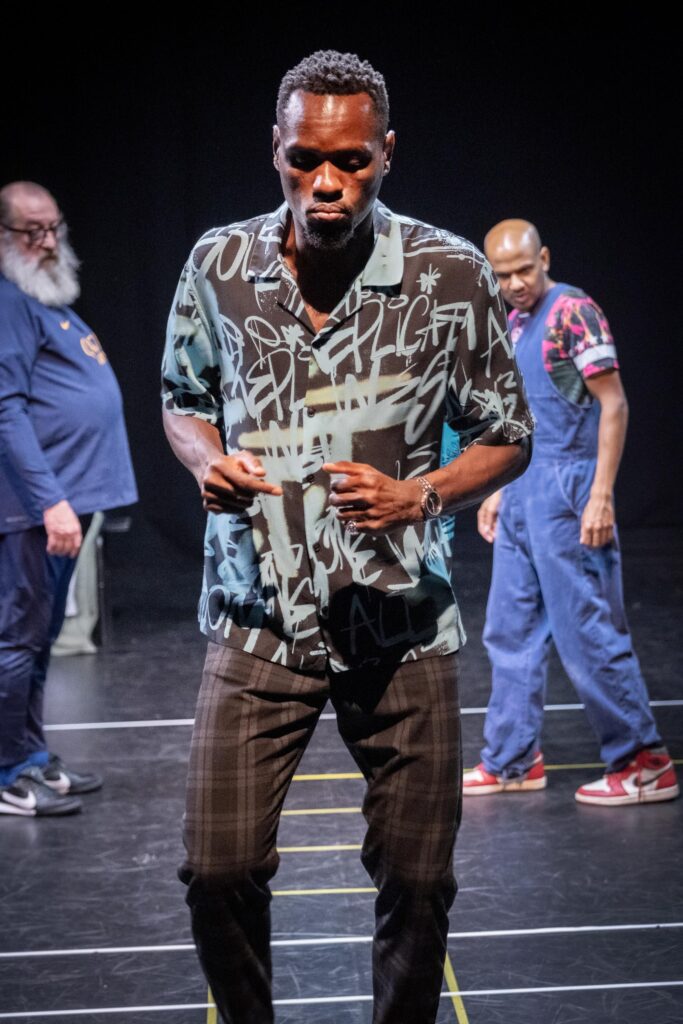
Ahilan Ratnamohan - Josse Jnr. © kurt van der elst
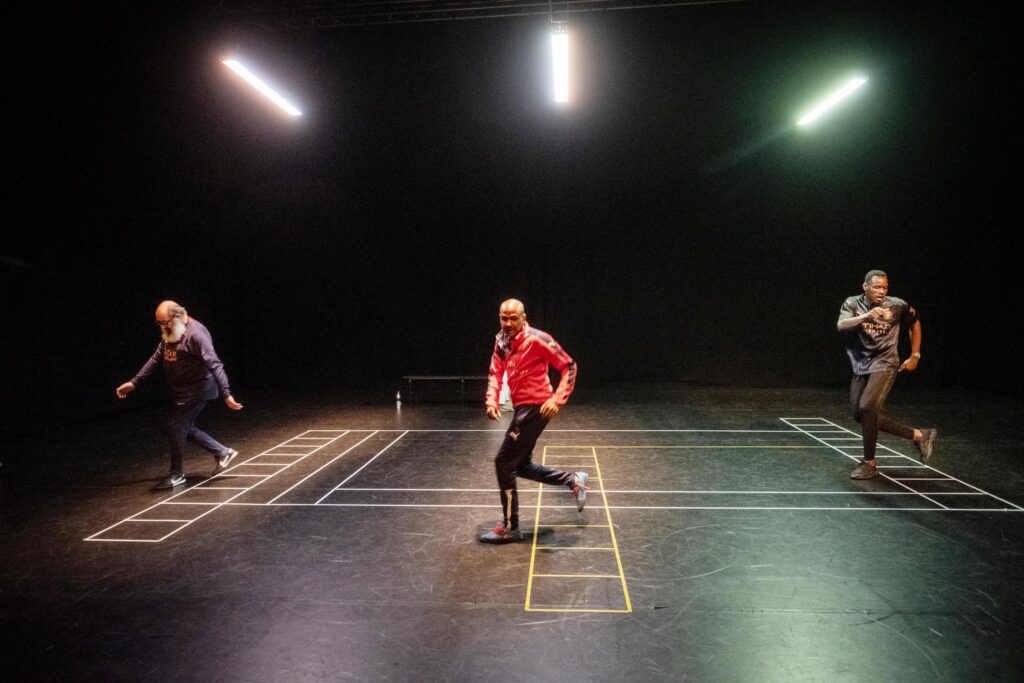
Ahilan Ratnamohan - Josse Jnr. © kurt van der elst
This sense of complicity between myself and the performers may well have been illusionary; to misquote Stefan Zweig, “to understand someone alone is to understand them twice as much.”3 But I do not think there were any inside jokes in Josse Jnr. that precluded a specific audience from grasping its central question. The text was clear and plain, occasionally embellished by the flourish of De Pauw’s writings, and the performers for the most part directly spoke to the public. Despite the absence of tricks that artists sometimes use to pull the rug from under the public’s unsuspecting feet, it seemed to me that the people in the room were not hearing the same thing, that a mal-entendu was brewing between us.
Let us return to the figure of the artist. In face of an anderstalig public and the ever-present potential for malentendu, the artist begins a long process of translation. By translation I do not mean that they translate their works into Dutch, although that may occur as well. By the term I am referring to a process of imagining a(nother) public.4 Of course, this translation is not something that takes place exclusively on stage. Most likely they were confronted with its necessity as soon as they realized their experiences are incomprehensible to others. For some, translation poses a challenge that pushes their artistic boundaries. For others, it implies an irrecoverable upheaval of their sense of groundedness. I am tempted to believe that most oscillate ambivalently between the two.
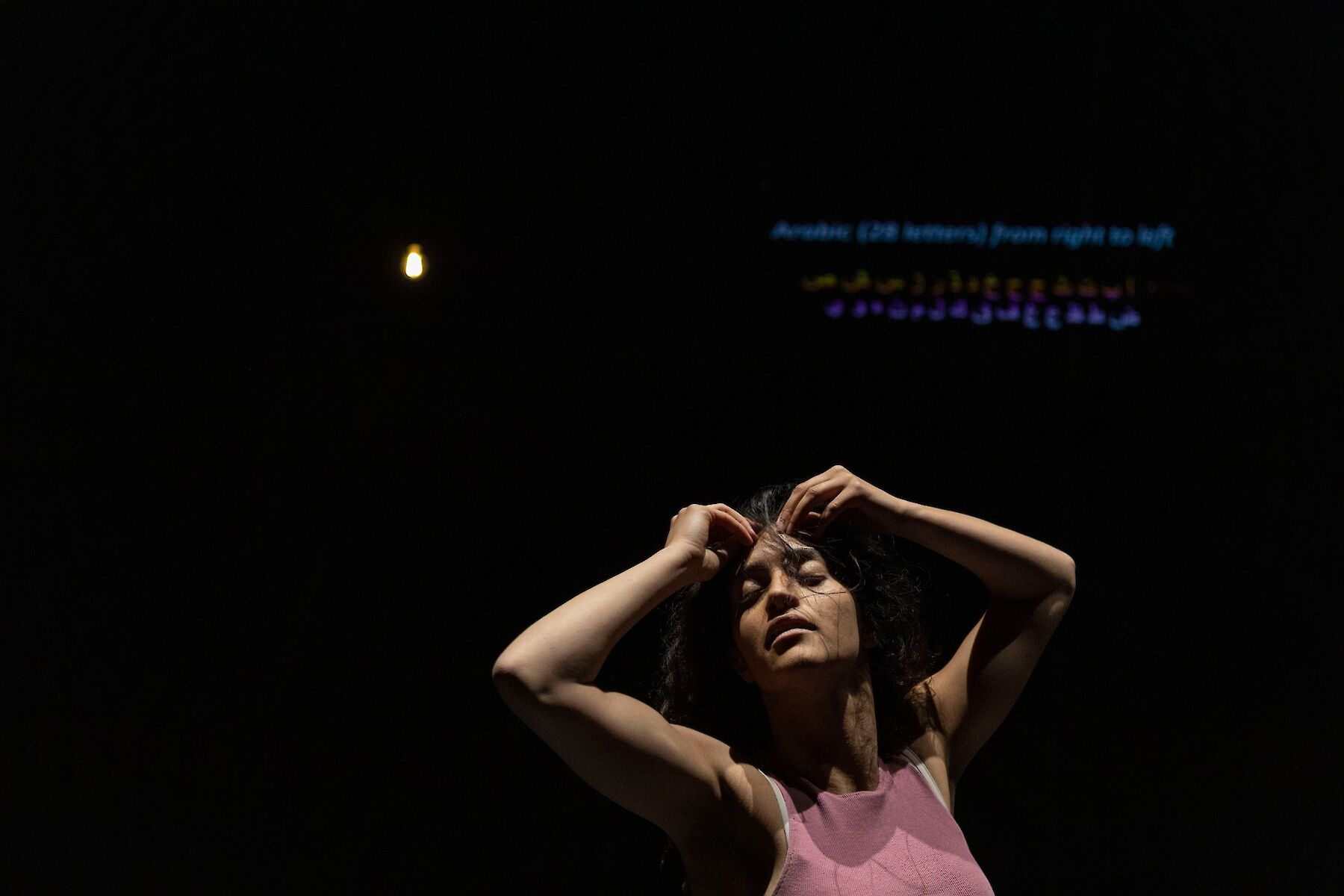
Marah Haj Hussein – Language: no broblem
With this new public in mind, the artist sets to molding their concoction of ideas and forms to suit its taste—or rather, as soon as an anderstalig public enters the artist’s imagination, their artistic practice cannot but be informed and influenced by this public. This unavoidable yet underestimated aspect of creation, I call the dramaturgy of translation. This is not to say that it is the sole dramaturgy present in a work—let us not fall into a reductionist trap—but when the artist and their public are not in tune, whispers traverse the porous fourth wall to reach the artist and guide their dramaturgy. In spite of this arduous process—the recognition of the public’s foreignness, the ensuing changes to the self, the invention of a new dramaturgy—however, the gulf between the artist and their public persists as long as the public perceives them as anderstalig.
In an interview with Het TheaterFestival after receiving the Roel Verniers Prize, Marah Haj Hussein describes a similar conundrum in her work Language: no broblem:
“When I create, one of the first questions that I ask myself is: which audience is there in the theater and to whom and I playing?… And when I think of the context in Belgium… I need to imagine a specific type of an audience that for example in Palestine does not exist. So I feel that how I created the piece is very much connected to the context of Belgium and, if I want to perform it anywhere else, I do need to do a lot of adaptations, because there are a lot of social codes within the piece that someone who does not understand Nederlands will not actually get.”5
“The gulf between the artist and their public persists as long as the public perceives them as anderstalig.“
The performance, riffing off on the language of accessibility used by cultural institutions to indicate potential language barriers, shows to what extent language in fact can and does cause problems in Palestinian political reality where the presence of Hebrew permeates every aspect of people’s life. But Haj Hussein adds another layer to the performance; the audio recordings of her family’s conversations in Palestinian Arabic are framed by a story of her journey on a train from Ghent, explicitly put in place to pull the Belgian audience in for the ride. Through this framing, Language: no broblem responds to the specificity of its public instead of treating it as a nameless neutral entity. Whether this public recognized the implications of this specificity in addition to the relevance of the story itself, on the other hand, I am uncertain.
In December 2023 I was able to meet with Ratnahmohan, who had just come back from an appointment at the Australian embassy near parc Royal. The year had been a particularly opportune time to see his repertoire, all playing with to a certain degree his own position as an outsider; talking in Flemish (as in Alle woorden die ik nog niet kende), Tamil/English (Should Have Been My Mother Tongue), or French (Une traduction infidèle), he bares before the audience his linguistic facility as well as shortcomings and plays, with occasional self-derision, the role of a model migrant. I recalled the moment in Une traduction infidèle in which he repeats French nasal vowel exercises, and how this embodiment of the all-consuming pressure to integrate oneself linguistically elicited no small amount of laughter. The dramaturgy of translation, it appeared to me, was completely lost on the public.
Here I must caution the readers that the following paragraph is a translation of the conversation including Ratnamohan’s subsequent feedback and my interpretations. To my question about his relationship to his public, he grinned and said, “I sometimes say I’m seducing them.” At times, this seduction works too well, and his work provides an entertaining end to a nice night out; other times, he does not seduce them enough and senses the tension in the room. In contrast to my frustration, Ratnamohan appeared to be fueled by the different levels of comprehension in his public; the differences in reaction, he believes, reveal the complexity of a work. To seduce does not only mean to resolve possible malentendus but to obscure, to deliberately create new malentendus at the right moment.
We may later explore the specific details of how linguistic translation commonly runs through Haj Hussein’s Language: no broblem and Ratnamohan’s series Should Have Been My Mother Tongue. 6 As stated, translation occurs beyond language whenever there is a gap between the artist and the public, and while language may signal its existence, it by no means is its sole cause. At the same time, artists can use language to demarcate and play with this gap, wielding it as a tool in creating their dramaturgy of translation.
Yousra Dahry & Mohamed Ouachen - Kheir Inch’allah © Anne-Flore Mary
Yousra Dahry & Mohamed Ouachen - Kheir Inch’allah © Anne-Flore Mary
Yousra Dahry & Mohamed Ouachen - Kheir Inch’allah © Anne-Flore Mary
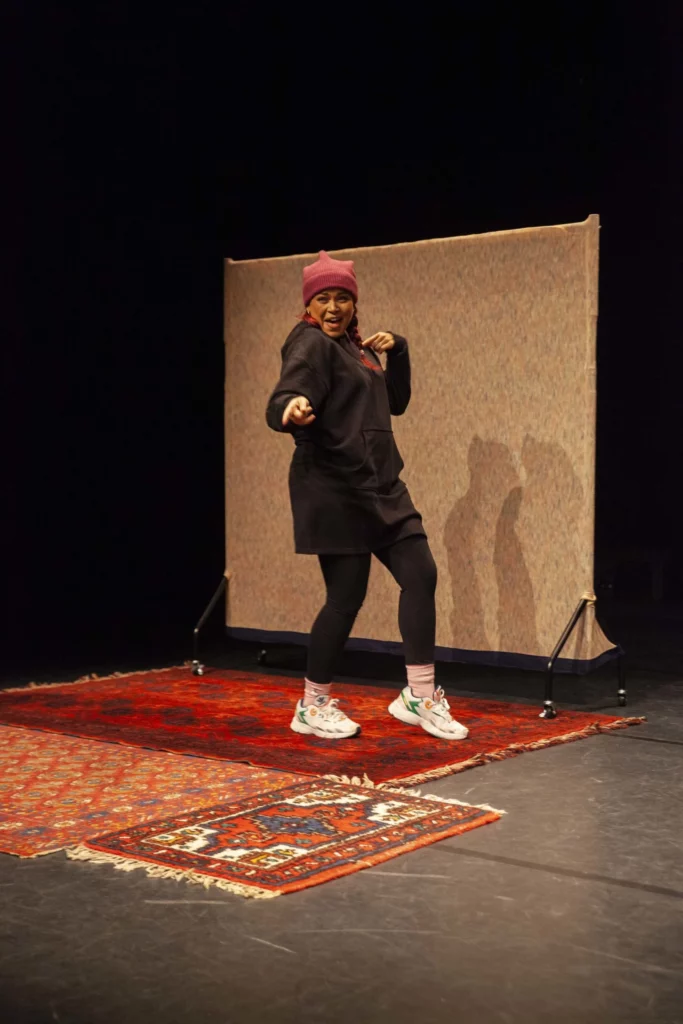
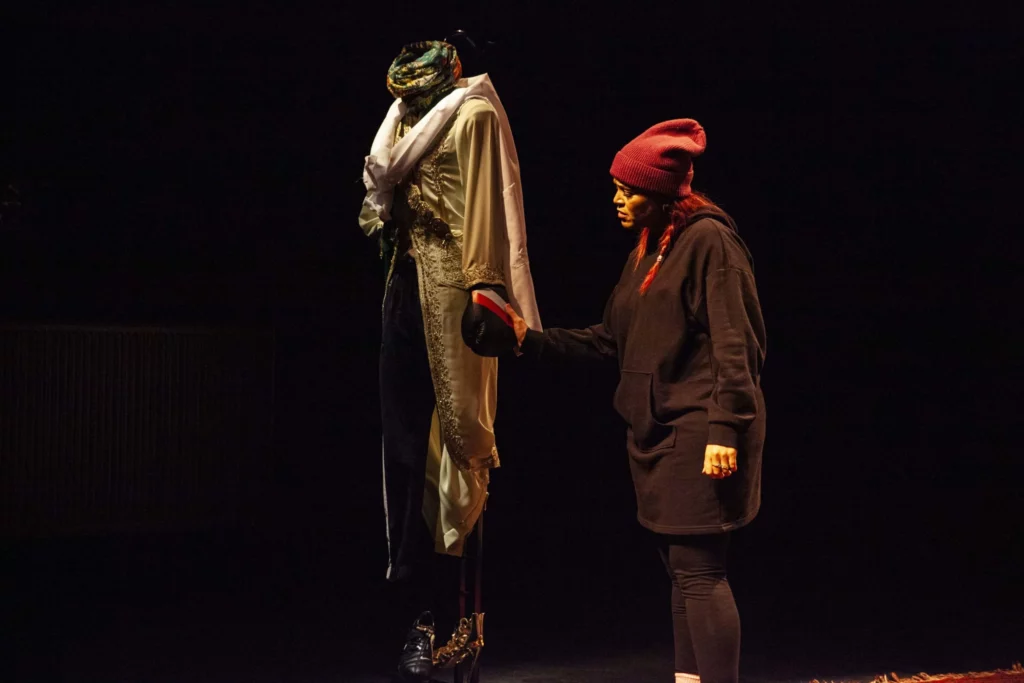
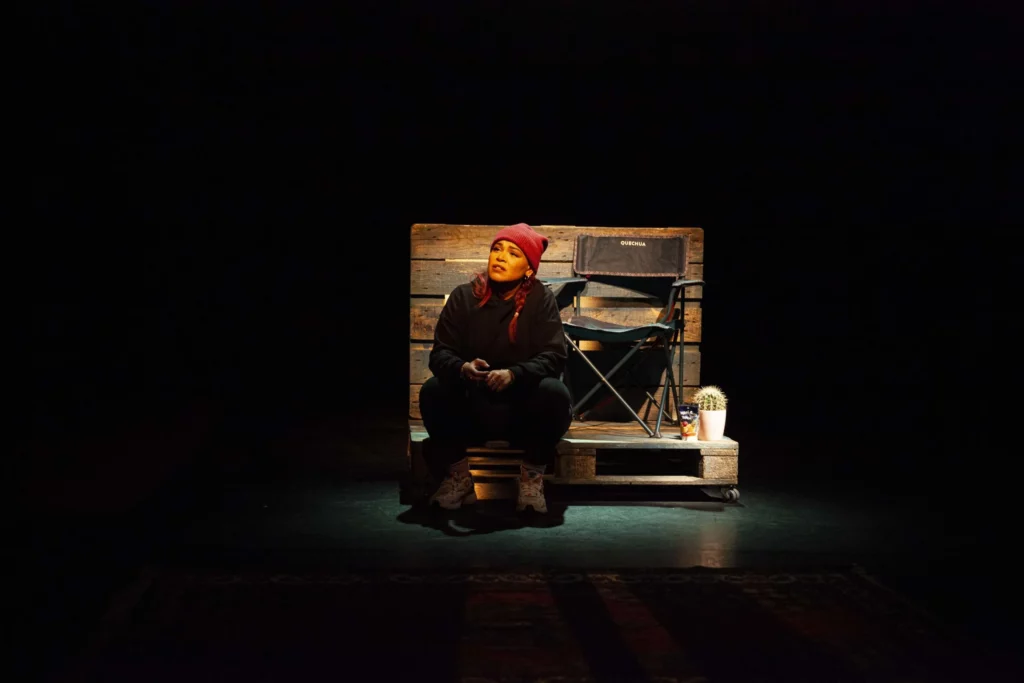
In Yousra Dahry and Mohamed Ouachen’s Kheir Inch’allah, Dahry gives an informal and vulnerable account of her relationship to womanhood at various stages in her life. She sets the tone of the show straight in the beginning, when she remembers how adults in her life view her as a child. Screwing up her face, she draws a large breath and spits out, “meskina!” The public laughs. Well, most of it—I did not know what the word meant. Nor could I recognize, unlike many around me, the caricatures of personalities from Dahry’s life, right down to the barber on her street.
Dahry does explain the word soon after in French, but the show continues to negotiate with the necessity of translation. If something comes up that an anderstalige cannot follow (“meskina!”), she might translate enough in French (“it basically means…”); on the other hand, the translations themselves often require familiarity with Moroccan Arabic, and some parts remain untranslated. That evening, I found myself on a pendulum caught between clarity and not knowing. But this unstable position of the spectator that does not quite know the artist’s world but is also not quite outside of it by the virtue of the encounter too belongs to the dramaturgy of translation.
“There is always a potential that someone in the room cannot quite understand.”
There is always a potential that someone in the room cannot quite understand. Today, that was me; tomorrow, it might be you. It would be arrogant to presume one will always be in the know, but equally absurd to assume one will forever be excluded. We are not always samen-talig, but we are not always anderstalig, either.
Meanwhile, Ouachen told me that Kheir Inch’allah will be programmed at Théâtre National Wallonie-Bruxelles for next season. My mind wandered off to compare the audience at Le Rideau with the audience at Théâtre National, the high dark imposing walls near De Brouckère and the narrow streets in Matonge where I sometimes spend my happy hours. “That’s going to be different, isn’t it?” I asked. “Oh yes,” he said. “We’ll have some unfamiliar faces. It’s going to be interesting.”
Many thanks to Ahilan and Mohamed for their generosity and the conversations.
Brussels, March 2024
KRIJG JE GRAAG ONS PAPIEREN MAGAZINE IN JOUW BRIEVENBUS? NEEM DAN EEN ABONNEMENT.
REGELMATIG ONZE NIEUWSTE ARTIKELS IN JOUW INBOX?
SCHRIJF JE IN OP ONZE NIEUWSBRIEF.
JE LEEST ONZE ARTIKELS GRATIS OMDAT WE GELOVEN IN VRIJE, KWALITATIEVE, INCLUSIEVE KUNSTKRITIEK. ALS WE DAT WILLEN BLIJVEN BIEDEN IN DE TOEKOMST, HEBBEN WE OOK JOUW STEUN NODIG! Steun Etcetera.
essay
07.05.2024
Leestijd 11 — 14 minuten
15.09.2022
—
14.12.2022
Caroline Lee-Jeong does dramaturgy and writes on different occasions. She has a background in literary and theater studies.
Sébastien Hendrickx
Mia Vaerman
essay 07.05.2024
Sébastien Hendrickx
Mia Vaerman