Confessie – Raven Ruëll & Bruno Vanden Broucke
De kunstmarkt maakt de kunstenaar
Klaas Tindemans





Hamel, YouYou Group © Navid Fayaz
Without knowing about each other, several ensembles have formed in Central Europe in recent years that bear striking similarities: groups of people who work experimentally with the voice, were founded by women, function as collectives, and often perform beyond the classical concert stage. Friedemann Dupelius explores the question of whether one can speak of a ‘new vocality’ in this context. If so, does it encompass only technical and compositional aspects of vocal sound, or also social, psychological, and political ones?
It’s June 21, 2023, the longest day of the year, late evening and still some sunlight outside. A dozen members of the Glossa (Γλωσσα) choir sit in front of the Makroscope, a cultural centre in Mülheim an der Ruhr, western Germany. A soccer ball kicked by kids next door lands first among the choir group and then bounces loudly off the wall of the town hall opposite. Beer bottles pop, conversations burble.
Glossa has returned to the city where the choir performed publicly for the first time in September 2020 — and where its founder and director Elisa Kühnl comes from. As part of a residency, the group is working on its ‘archive’ here — with a touch of self-irony: Can you really have an archive after only three years of existence? Even if you can, why would you need it so early on? But perhaps what was ’new’ in 2020 will already be history by 2023. How long is a ‘new vocality’ new?
The residency at Makroscope illustrates what defines Glossa as a group: like in a small ant colony, tasks are distributed (including cooking, washing up, cleaning) and small groups are formed. Anyone who has always wanted to try something new can do so here and experiment with others, perhaps even teaching them something. A sounding pendulum triggers and distorts recordings from the Glossa archive — the disembodied voices morph through the room in regular meter. Other vocal snippets creep into the space of Makroscope’s library like woodworms — emanating from contact speakers onto the surfaces of tables and tubes. On a sunny afternoon, the choir returns on pedal boats to the bridge over the Ruhr, where its first performance took place in 2020 — except that back then, it was the audience who used pedal boats and the choir was on the riverside. Now the archived voices flow over the Ruhr via in-ear monitors into the choir members’ auricles.
At the end of this week, contrary to what one might expect from a choir, there is no concert, but instead many new thoughts about the group’s self-image and ideas for the future. For one day, the temporary laboratory welcomes a visitor from Brussels: Myriam Van Imschoot eats, listens, and talks with the group. She is part of the YouYou Group, founded in Brussels in 2014. When she learned about Glossa in 2021 and met Elisa Kühnl shortly after, they both realised they were not alone in their practices and interests. The YouYou Group also meets regularly, without rehearsing for a concert in the traditional sense. From the beginning, there was the Club Zaghareed, which recently moved from its former artist-run Manchester Space in Molenbeek to the KBR, the Royal Library in the heart of Brussels, where the group is currently in residence to make a book and continue its practice. In an informal setting, YouYou members and interested newcomers come together once a month to eat, drink tea, chat, and devote themselves to the vocal practice triggered by the YouYou sound.
‘In preparation for my first piece YOUYOUYOU, Khadija Lazaar suggested I’d organize a club,’ recalls Myriam about the early days. ‘Although my intention was to shape a piece, I was equally interested in encounter and research. The club format created a convivial space where people felt at ease, close to the joy that the custom represents or triggers.
After a few gatherings, it was clear that everyone wanted to be in the piece, and the focus shifted naturally to rehearsing. But the lesson remained — that conviviality and practice can coexist, and it has stayed at the heart of the group’s philosophy.’
The YouYou, known in Arabic as zaghareed (or in Moroccan Arabic, zaghareet), is the sound that the Belgian group revolves around. Myriam was drawn to it after initially exploring the Alpine tradition of yodelling and then living in Egypt for a while. She developed the idea of creating a performance based solely on YouYous. To this end, she sought out 12 women who were familiar with this type of vocal production (also known as ululation)—or who were open to learning it — and thus the Club Zaghareed began.
Glossa also began with informal meetings—albeit in an academic research context. Unlike Myriam, Elisa’s intention was not to develop a piece, but rather her master’s thesis. As part of an artistic research practice on ‘The Voice as an Instrument of Given Circumstances’ in the ‘Klang & Realität’ (‘Sound & Reality’) programme at the Robert Schumann University of Music in Düsseldorf, she invited friends and fellow students to open voice labs over several months. From the beginning, they were labelled ‘choir rehearsals.’ The constellation was different in each rehearsal — most of the participants are now part of the larger Glossa body. Many of the scores Elisa developed for these rehearsals are now integral to the group’s repertoire and performances.
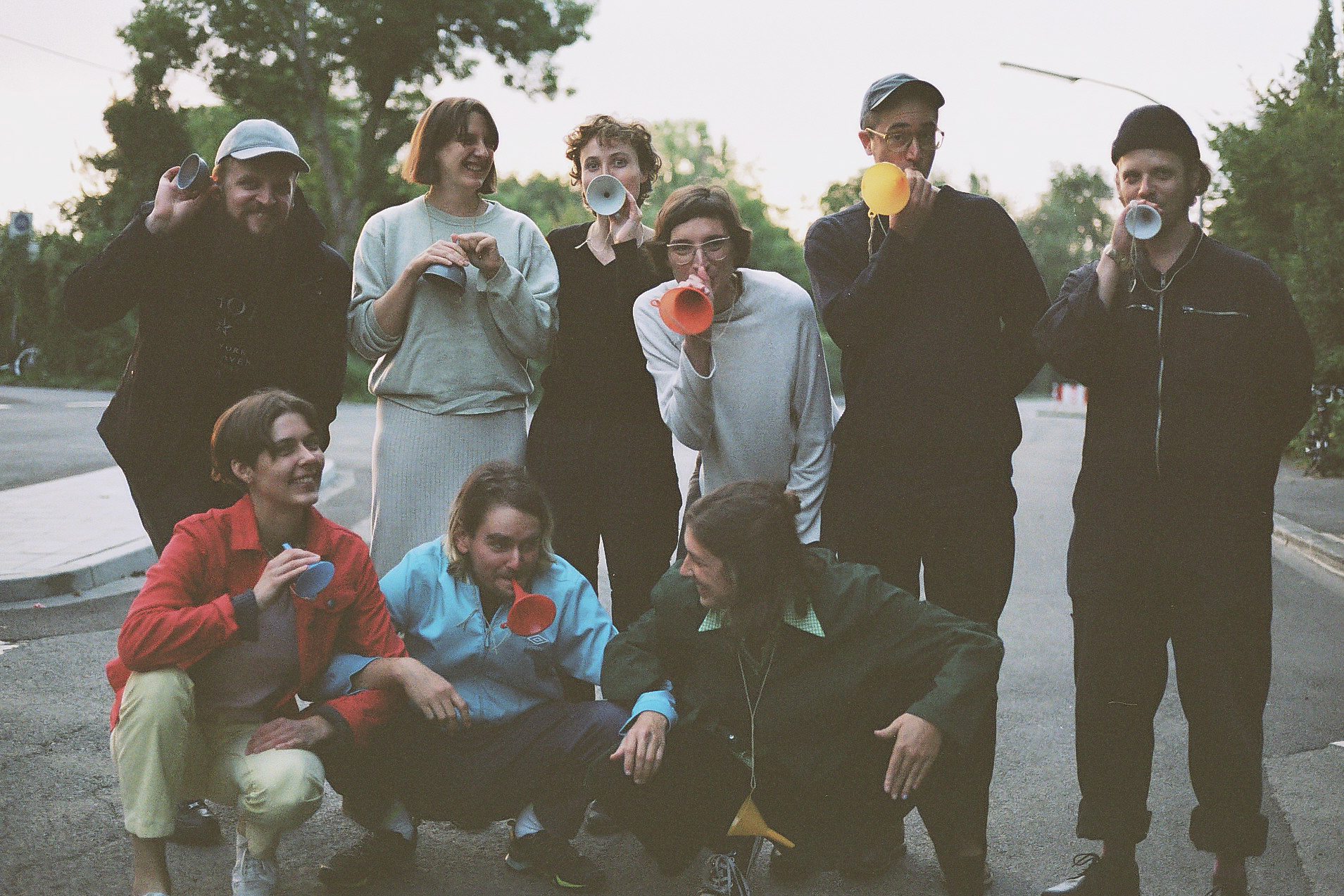
Glossa © Sebastian von der Heide
The close intertwining of informal gatherings and concentrated rehearsals is something both groups have in common, as is their laboratory-like character and process-oriented work on pieces. Both are united by a curiosity for the possibilities of vocal expression and the previously unimagined sonority of their own voices—even and especially when this seems strange, irritating, or embarrassing to others (or even to themselves). Both groups were founded by a woman who incorporates her previous artistic practice into the ensemble but allows the collective to transform and modify it. This feeds into new forms of co-creation. Both groups are similar in size: around 40-50 members are active on a mailing list (Glossa) or a WhatsApp group (YouYou), from which a slightly different constellation comes together for each performance
“Both groups are united by a curiosity for the possibilities of vocal expression and the previously unimagined sonority of their own voices — even and especially when this seems strange, irritating, or embarrassing to others (or even to themselves).”
But there are also differences: the members of Glossa are all around the same age—somewhere in their thirties, or just below or above—while the age range of the YouYou Group extends from 14 to 74. Glossa has grown out of a homogeneous social milieu: many are students and graduates of art schools and/or are involved in other artistic and musical projects. The migration background2 is not as strongly present as in the YouYou Group, where almost all participants share it: one third have family roots in Morocco, others in Algeria, Nigeria, Palestine, Iran, Greece, Italy, or Australia. And since the eponymous sound of the YouYou Group is practiced exclusively by women in its African and Middle Eastern regions of origin, the YouYou Group—unlike Glossa—also consists exclusively of women.
Time flies and yet somehow stands still. The spring awakening of 2021 fluctuates between the feeling of an endless loop and the shy promise of a better future. People with masks gather in front of a window facade in Brussels, as if behind it were the only television broadcasting the latest infection statistics. The air hums; the building seems to be leaking sound to the outside. But above everything, the tram rumbles; in fact, Brussels’ notorious inner-city traffic dominates acoustically—for now. At some point, however, it can no longer be ignored: a YouYou, several YouYous, they emerge incessantly from the building like an audible liquid. Those who step closer experience the strange effect of hearing less but seeing more: two circles of women inside behind the glass, each around a microphone they seem to worship like an artifact. Daffodils and delicate light-green leaves blow in the wind, as does the supermarket bag of a woman strolling by. A powerful ritual takes place here—even in difficult times it assures us: we will continue together.
The YouYou / Zaghareed is a type of vocal tremolo sound. While the vocal cords vibrate at high speed, rapid tongue movements (e.g., trills against the palate or alveolar ridge) and sometimes uvular vibrations contribute to the characteristic modulation of the sound. It is practiced by women in West Asian, North African, and some other African cultures to express joy, and sometimes grief, in ceremonial contexts such as weddings, births, or funerals. It is passed down from generation to generation, although by no means all women in a particular culture practice it. Anissa Rouas from the YouYou Group describes it as follows: ‘I’m sure I heard my first YouYou shortly after I was born. When I was 15 or 16 years old, I wanted to learn it myself, so I practiced with my aunts. It’s a power that you can bless or celebrate something with your voice!’
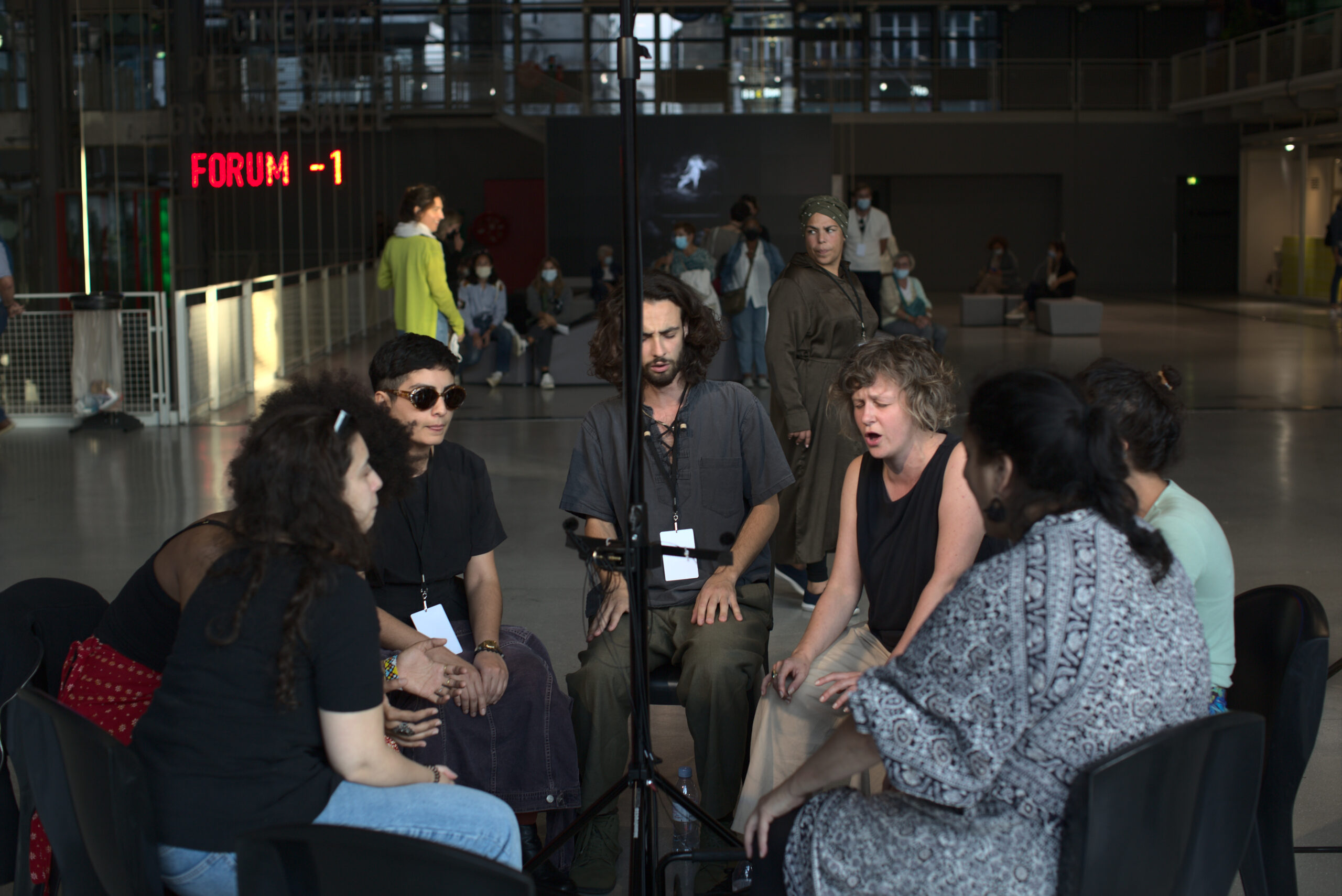
Mars, YouYou Group © Lotte Knaepen
The YouYou is ambiguous in many ways and changes depending on the context—as it does with the shift away from traditional rituals toward artistic performances. ‘When I started with the YouYou group, it felt strange to me to do this outside the context of a ceremony. When I talked about it with my family, they didn’t understand. But now it gives me strength to do it with other people. It’s not the same as in ceremonies. It even sounds different.’ Anissa talks about how she has changed and developed her YouYou through practice with the group. She had to find techniques that allowed her to repeat it more often while exploring new body postures for it. YOUYOUYOU, the first performance developed with the original Club Zaghareed, was groundbreaking in this respect: the basic idea was to prolong the YouYou until it felt like an eternity—an eternity that ultimately lasted ‘only’ eight minutes, but in which the sound never stopped once it began. In addition to developing new vocal and physical techniques, the group found ways to cooperate with each other. Divided into small groups, they could pass the sound to each other. To give the transfer a sense of continuity, they omitted the typical closing gesture.
Over the years, so-called ‘family members’ have developed from the basic sound—no longer true YouYous, but variations and derivatives such as miniaturised cries or vocal techniques that plunge into the lower spectrum of the pitch range. The group’s vocabulary has continually grown through these and other modulations. The performance SEGEN, last staged in September 2025 on a vacant lot in Molenbeek, is based on a six-second YouYou that gradually merges into a compressed, layered sound generated by all throats overlapping each other. According to the makers, the tension in composing and performing with the YouYou lies in treating cultural tradition with respect while still creating something new that breaks new ground both sonically and contextually—a culturally sensitive, transcultural practice. In the process, the original emotional associations of the source sound change meaning, yet something is still carried across from the seed into the new spaces of perception that are opened.
“The YouYou or Zaghareed is practiced by women in West Asian, North African, and some other African cultures to express joy, and sometimes grief, in ceremonial contexts such as weddings, births, or funerals.”
Before founding Glossa, Elisa developed a vocal technique that she performed solo on several occasions3—a kind of scream not unlike the YouYou technique, sounding somewhere between a herd of goats and an analogue ring modulator. After about 20 minutes, her physical (and mental) strength is usually exhausted. Elisa has already tried to teach Glossa this sound—with varying degrees of success—but unlike the YouYou Group, thegroup’s vocal repertoire is not based on this sound. Rather, it focusses on the questions that accompany it: When is my own voice alienating—for me and for others? What associations does a vocal sound trigger when it is decoupled from its original emotion? When is a person (originally: a woman) allowed to raise their voice in public? When do you feel ashamed of the sound of your voice, and how can you deal with that?
In Elisa Kühnl’s and Glossa’s practice, these questions lead to ever-changing experimental arrangements. The central means for this are scores, which are used to structure rehearsals. Some of these later find their way into performances. They can be very simple, such as the ‘standing rule’: each choir member positions themselves in the room according to an individual rule that they do not reveal to anyone else (e.g., ‘always one meter to the left of Elisa’). In Glossa’s latest performance, Die Traube (The Grape), this standing rule determines the initial constellation of the group. This is followed by a score in which everyone sings the beginning of Bach’s chorale ‘Es ist genug’ as slowly as possible, each at their own tempo. A typical Glossa score consists of a sequence of different scores of this kind, usually in written form, sometimes also in graphic form. Elisa tries to keep these scores as simple and memorable as possible, which in turn allows individuals freedom of interpretation.
The compositions of the YouYou Group also emerge from collective practice, but the score usually comes later, toward the end of the process. Pieces build on and expand an ever-growing repertoire of developed sounds, techniques, and embodied memories that are kept alive through ongoing practice, giving a strong sense of shared ownership. Since 2021, Myriam has ceased to be the sole author of the group’s compositions; for each piece, a team of directors—a core team—guides the process, primarily in the sense ofresponsibility and caretaking, rather than for purposes of directorial profiling.4
In February 2021, Kassel, the geographical centre of Germany, is covered in snow. But by afternoon, the melting process starts. Water drips from the roof of the Fridericianum onto the ground, where people are passing by, wondering about the strange voices that emerge through the tilted windows from inside the premises of the Kasseler Kunstverein. A deep, vibrating hum, like that of an oversized male chest in its physicality. A cautious, female-sounding search movement, asking a wordless question. A flock of crows crossing an imaginary winter sky. A frightened passerby adds her own scream to this bestiary of voices.
At Glossa, there have already been attempts to expand authorship: choir member Josephine Stamer played a key role in developing the dramaturgy for a performance in Cologne’s Stadtgarten Park in 2024. The division of authorship went furthest in the CHOLERA project. For this, Glossa collaborated with the artist collective RHO and morphed from a choir first into a light and sound installation at the Kasseler Kunstverein, then into a radio play—without ever having been performed live. A total of ten people were involved in the project in various authorial roles.
Within the YouYou Group, different visions of the social organisation of the group coexist. Arezoo Khazanbeig explains: ‘I’m quite new to the group, as a coordinator. What I can tell is: many women in the group have strong alpha energy—and that’s great. Different variants of leadership can coexist. We have natural leaders, matriarchal leaders, moral leaders, founders, etc. It’s a rather complex mix, with cultural biases too. You won’t get anywhere without the consent of the older members—because that’s shaped by the cultural values many of us share.’
For some, the sound, the music, is the focus of the project; for others, it is the social interaction; for others still, it is the opportunity to immerse themselves in an activity without having to assume responsibility. Over the past five and a half years, there have been several visions of holding a Glossa rehearsal without Elisa—but this has not yet really happened. The workshops and experiments at Makroscope in 2023 came closest to the idea of a leaderless collective. Nevertheless, a certain ‘soft leadership’ can be observed in both collectives, which have created ecosystems that are largely self-developing. Each member contributes their own sounds and individual interpretations of the given scores to the overall sound—inspiring the others and setting in motion sonic and social processes that are then reflected in the performances. There are always spin-offs and side projects, such as when Glossa member Simon Waskow samples individual voices from the choir and uses them for a film soundtrack. And the distribution of tasks at residencies such as Makroscope, or even in a secluded house in the Eifel region, is only possible if everyone sees themselves as an equal and equally responsible part of the collective.
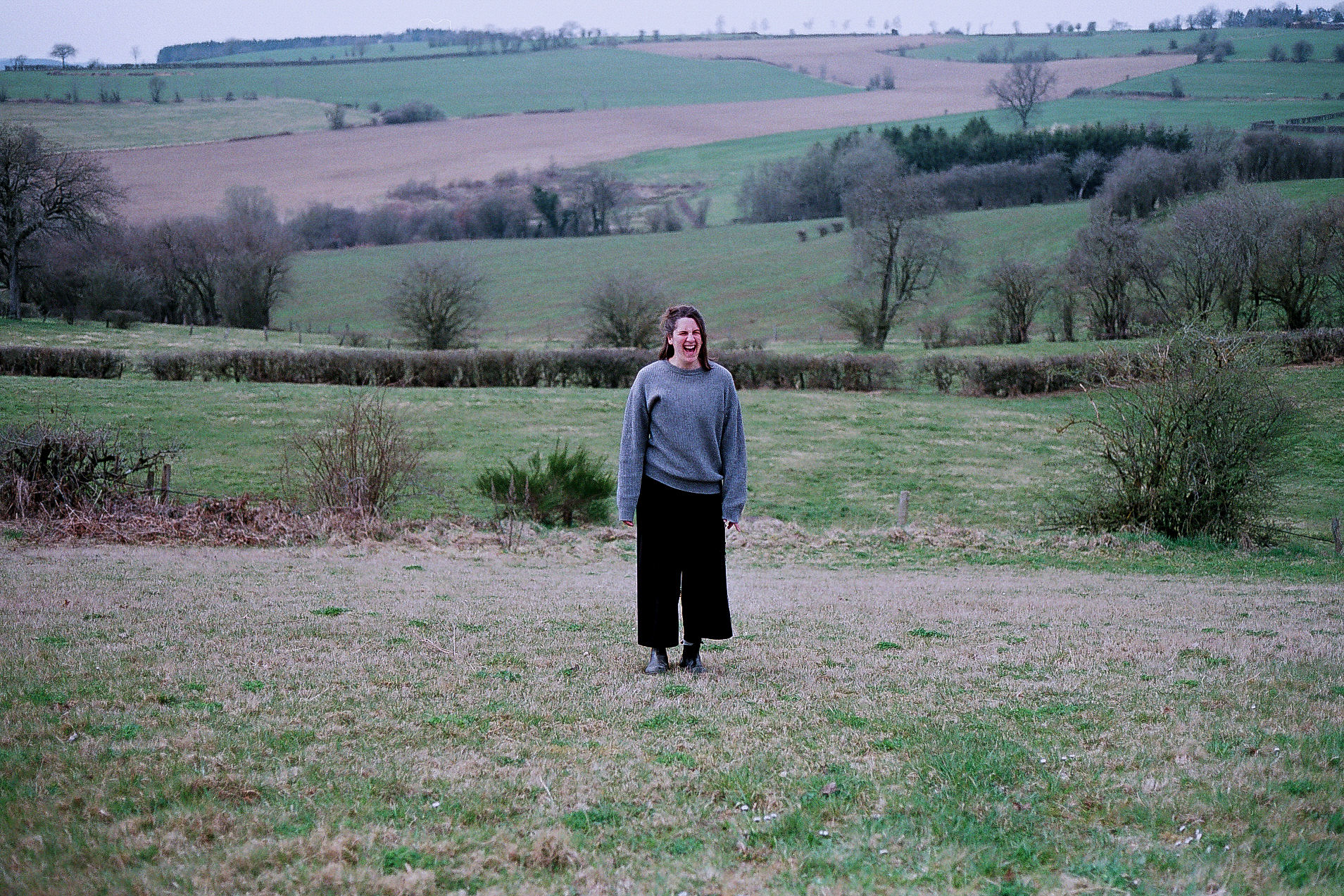
Glossa © Sebastian von der Heide
What could disrupt this ecosystem? A football from next door? At Glossa, probably not—it would be integrated into the group’s play. A new member, perhaps? That too is unlikely, probably because the focus is not on individual artistic ability, so no one needs to fear being displaced on the basis of quality. It would be more disruptive if a new member failed to accept how the ecosystem functions. Perhaps the potential for disruption in both collectives lies more in the encounter between ecosystems — when one meets another, for instance during a performance in public space.
Cell phone alarms interrupt sleep with merciless melodies. Glossa has rarely been sucha silent ensemble as it is this morning before sunrise on a farm in Olfen, on the northern outskirts of the Ruhr area. The choir members warm themselves with cups of tea. They are about to head to the first of four bridges on the Alte Fahrt. In the past, goods for the steel industry were transported here by ship. Today, the former canal is a biotope—andthe stage for an all-day performance by Glossa, for which there is no invited audience. Fourtimes between sunrise and sunset, the choir performs scores in which they connect with old stones, young ducks, and, last but not least, with themselves. The last sound of the day is Elisa’s infamous scream. After dark, it pierces through the bones, much like this morning’s phone alarms, signalling the previously scattered group to reunite one last time.
Alongside creating pieces for institutional houses, both groups share an interest in performing in places ‘that are not covered by Google Maps’5—here a wasteland in Molenbeek, a street in Brussels, or a park in Sofia, Bulgaria (YouYou), there a disused railway line in the Ruhr area, the hollow body of a bridge over the Rhine, or an underpass on the outskirts of the city (Glossa). In many places, an invited audience may be present—in others, no invitation is sent at all, and the performers engage with the people, animals, and other organisms that happen to be there. With Glossa, one sometimes gets the feeling that the group is performing for itself, that it doesn’t need an audience at all—and that’s probably true. Nevertheless, there is this interaction, most clearly when sounds from the environment or lettering from billboards find their way into the performance, or when, at the end, someone from the audience asks when the next rehearsal is and whether they can join in. Or when the YouYou Group blesses an overgrown property with an open future in the middle of Brussels with its ululations, or makes the façade of an art centre bleed acoustically while welcoming spring—for an outdoor audience placed on the other side of the window front.
Going out in public was an intuitive decision for the YouYou Group. For many centuries, public space was the domain of men—and even today, a woman who raises her voice in public may still face many prejudices. YouYou member Fatiha Settouti describes the 2016 terrorist attacks at Brussels Airport and the Maelbeek metro station as a moment of crisis in the history of the group. In the first YouYou print publication6, she recalls: ‘The Belgian population once again points fingers at Moroccans, because the attacks were carried out by Moroccans. So once again we’re singled out, pushed aside, and there’s fear of seeing Moroccans. There were women who were insulted; there were women whose veils were torn off.’
At the same time, the group was preparing their second performance HELfel, a public,20-minute sound choreography in Brussels’ Parc de forest. The members continued as planned, and it felt like a ‘form of resistance.’ Even though it wasn’t discussed in the group in so many words at the time, the Club Zaghareed felt like a haven, and the performance became a way to project another image of public presence—as a positive action.
A YouYou that you unexpectedly stumble upon in a park can, and perhaps should, sometimes be irritating—not in an aggressive sense, but in a way that challenges your own perception of public space, the space shared by all. This is not quite as explicit with Glossa, although the feminist-emancipatory aspect formed the seed of the ensemble through the artistic work of Elisa Kühnl. Glossa is also very much about discovering the foreign within oneself—being disturbed by the sound of one’s own voice at times—entering the zones of shame and enduring them in public. This is easier to do in a collective.
Both representative groups of this ‘new vocality’ find themselves in a field of tension that affirms self-awareness but is not satisfied with mere feel-good practices. It is about relating one’s own voice to others—finding one’s place within an ecosystem, showing consideration for its other inhabitants, and approaching the environment with an empathetic ear.
“It is about relating one’s own voice to others — finding one’s place within an ecosystem, showing consideration for its other inhabitants, and approaching the environment with an empathetic ear.”
It may be somewhat far-fetched to claim a ‘new vocality’ based on two examples. However, in recent years, other ensembles have emerged that share similarities with Glossa and the YouYou Group. The Glitch Choir, founded by dancer and choreographer Deva Schubert in Berlin, also draws on a cultural tradition of the female voice in public ritual—more specifically, that of the professional mourner. In deconstructing Italian lament singing, the ensemble seeks the ‘connection in cacophony.’
In Antwerp and elsewhere, the Quantum Choir—which functions as a ‘nomadic ensemble,’—sets up camp. Its founder, Tomer Damsky, reconstructs the mystical musical practice of Carmelite nuns from 16th-century Spain, with a lineup that changes depending on the location. She describes this as ‘heavy folk,’ where ‘heavy’ refers to the spiritual and existential content of the music, but also to a certain devotion in the vocal expression. ‘Folk’, on the other hand, stands for a popular, non-academic approach to singing.
Asserting a new artistic movement often seems like an exaggerated gesture. This is not a manifesto for ‘new vocality’; rather, it is an attempt to outline a current development. What unites the discussed collectives is their exploratory approach to the sound of the voice, its transfer into the collective, the creation of a unique yet open ecosystem—all practiced against a feminist backdrop and with socio-political curiosity, in places with soft boundaries and an open view.
In 2026, an osmosis between the two groups will take place to continue—on a larger scale—what began when Myriam first visited the Glossa lab. Then the Kinotita project will start, bringing together various artists to further explore and develop ‘new vocality’ in various forms. In addition to Myriam, Anissa, and Elisa, three other vocal artists—Anne-Laure Pigache (Grenoble, France), Jule Flierl, and Doreen Kutzke (Berlin)—are involved in the three-year, three-country project. With an open view of vocal performance, a holistic approach that does not distinguish between trained and amateur vocalists, a feminist stance, and an interest in making art in groups, the participants aim not only to exchange experiences and skills, but also to develop a shared toolbox (for future generations to use),to create performances (the first is scheduled for November 2026 at the opening ceremony of the newly renovated museum Kanal-Centre Pompidou in Brussels), and to reveal and discuss their process through podcasts and publications. We stay tuned.
However, to recognise the subtleties in things, I must first understand their scope. If my own voice is capable of surprising me, then I have probably not yet learned enough about the human voice.
BIBLIOGRAPHY
Hahn, V. (2023). Gedanken über Kollektivität: Making it work. In Noies 05/23. https://noies.nrw/gedanken-ueber- kollektivitaet-making-it-work
Haffou, N. (2025). What’s in a Cry? 97 YouYous!. In YouYou Group, a li’nuage. Newpolyphonies asbl.
Kühnl, E. (2020). Γλωσσα. Die Stimme als Instrument gegebener Umstände. Masterarbeit, Institut für Musik und Medien, Robert Schumann Hochschule Düsseldorf.
Settouti, F. (2025). Fatiha Settouti in conversation with Justine Maxelon and Myriam Van Imschoot. In YouYou Group, a li’nuage. Newpolyphonies asbl.
Video Documentary: https://www.youtube.com/watch?v=DFN33XJKtt0
Conversations between the author and Myriam Van Imschoot, Arezoo Khazanbeig and Anissa Rouas, 06.08.2025 & 17.09.2025 via Zoom
The author’s own membership in and experience with Glossa / Γλωσσα since 2020 Encounters with Myriam (since 2021) and members of the YouYou group (since 2023)
KRIJG JE GRAAG ONS PAPIEREN MAGAZINE IN JOUW BRIEVENBUS? NEEM DAN EEN ABONNEMENT.
REGELMATIG ONZE NIEUWSTE ARTIKELS IN JOUW INBOX?
SCHRIJF JE IN OP ONZE NIEUWSBRIEF.
JE LEEST ONZE ARTIKELS GRATIS OMDAT WE GELOVEN IN VRIJE, KWALITATIEVE, INCLUSIEVE KUNSTKRITIEK. ALS WE DAT WILLEN BLIJVEN BIEDEN IN DE TOEKOMST, HEBBEN WE OOK JOUW STEUN NODIG! Steun Etcetera.
essay
15.12.2025
Leestijd 20 — 23 minuten
15.12.2025
—
14.04.2026

Friedemann Dupelius works with sound and language. He writes radio features and texts on electronic, experimental, and contemporary music and other sound phenomena. He wrote the libretto for Clemens K. Thomas’s opera Dollhouse at Staatsoper Hamburg. Friedemann produces genre-fluid electronic music as Friday Dunard and lends his voice to the Glossa choir. He is co-curator of the SPA music label and the Brückenmusik series in Cologne.

Klaas Tindemans
Mia Vaerman
essay 15.12.2025
Klaas Tindemans
Mia Vaerman