Confessie – Raven Ruëll & Bruno Vanden Broucke
De kunstmarkt maakt de kunstenaar
Klaas Tindemans




© Celine Pourveur
According to Thai filmmaker Apichatpong Weerasethakul, we are trapped in time, in our memories, and in our desire for continuity. In his new installation for the Kunstenfestivaldesarts, a collaboration with his regular artistic partners Rueangrith Suntisuk, Pornpan Arayaveerasid, Akritchalerm Kalayanamitr, and Koichi Shimizu, he makes a sensory plea for forgetting, to experience the world anew with an open mind.
When I walk into the historic Brigitinnen Chapel where the audiovisual installation is located, the light is already there. It settles on the projection screen, gathering itself into shapes and colors I recognize. A woman, a flower, a hand writing. Fragments that may once have formed a story or will do so here, care and love for moments that took place somewhere in someone’s life. The audience gathers in front of the screen much like we do in a movie theater, with the difference that the film is already playing upon entering – something is already unfolding that we did not witness coming into being.
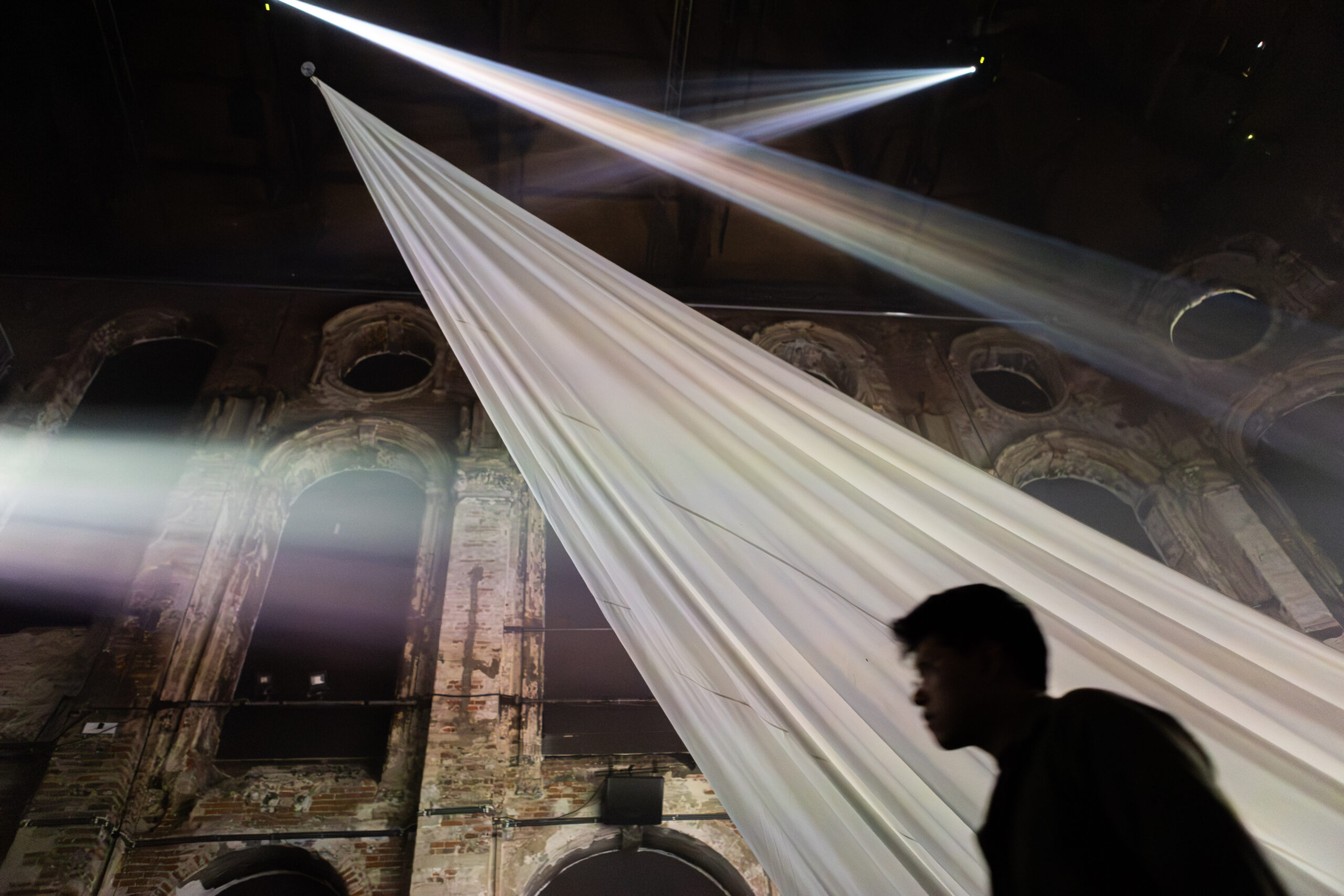
On the floor lies a large, rectangular white cloth, with invisible cables at each corner shooting upward and anchoring to the chapel ceiling. Something is about to happen, but for now my gaze is drawn to the screen hanging in front of me, slightly higher than usual, causing us all to look diagonally upward as if we were searching for constellations. In a fleeting montage, I have little grasp of the images we see, but prompted by this star-gazing posture, my attention is drawn primarily to the fragments that focus on the sky. The sun is hidden behind the clouds, bursts into a spectrum of colors, turns back into a blazing orange orb, and then partially transforms the film image into a white expanse, total overexposure, the pixels saturated. The camera struggles to capture the bright sunlight, shifting unpredictably from neutral exposure to overexposure. Attempts to grasp something that crystallize into white pixels, loss, letting go. Briefly, I am drawn into the detail of what is happening there, of how color and light meet in the film image. The camera brings out something that we cannot see with the naked eye, flashes of color that exist solely because of the overexposure. The sun’s mighty and momentarily dominant presence, only to settle back into the landscape with resignation after the glare. Points of reference: mountains, plants, the earth.
“The camera struggles to capture the bright sunlight, shifting unpredictably from neutral exposure to overexposure. Attempts to grasp something that crystallize into white pixels, loss, letting go.”
The cloth begins to move toward the audience, that steps aside to make way for this ghostly apparition as it moves through the crowd and the space. It comes to a halt right at my feet. I no longer see any people, only the white fabric and, above it, the projection screen on which the words “a conversation with” fade into an image of a white, round, pulsating shape. I finish the sentence – a conversation with the sun. Viewed from my position, all the elements of the performance come together so harmoniously that the whole seems composed for that exact spot in the chapel. For a brief moment, the images seem directed solely at me.
Yet I leave my central position and begin to move. On the screen to my right, following a process similar to the earlier play with the sun, the image of a woman emerges: an eye appears from a white, overexposed area, colors form lines that gradually build up into a face, a gaze that looks at us for a moment and then flashes away. Everything is constantly in the process of becoming, I think, there is no final form. “We change all the time, we are never the same person at any moment”, Weerasethakul said about this in an interview. We swirl in and out of ourselves in spiral-like movements, from different moments in time, from an endless spectrum of shifting and enriching states of mind. In the present, we don’t always see ourselves clearly, thankfully so.
According to Weerasethakul, our relationship with time has something confining about it. “We are trapped by time,” he says, “the problem of humanity is linked to memory, to thought.” We are conditioned by our past, which influences the present and carries over into our future. The problem arises, however, when we try to turn that into a story with our minds and when, in an attempt to complete that story, we use time as a narrative element. Logic takes the lead and the timeline matters: we shape our thoughts around what has happened, attach words to our experiences, and before we know it, our lives are described in a single clear, linear movement of cause and effect. Temporarily, it seems to offer a framework and a sense of security, but that feeling does not last long because the next confrontation with the chaos, discontinuity, and inconsistencies that are an inevitable part of life effortlessly undermines the fragile system. According to the creators of A Flower of Forgetfulness, we would be better off putting that linear fixation on time aside. Memories are a trap; moreover, there are so many of them, and once you allow yourself to think back on past events, you introduce the concept of time into your being, and that is precisely where, according to Weerasethakul, things go wrong. Yet it is difficult to resist, he calls it our addiction to continuity.
“According to Weerasethakul, our relationship with time has something confining about it. We are conditioned by our past, which influences the present and carries over into our future.”
A Flower of Forgetfulness thus proposes forgetting, not by turning away from memories, but by grasping them and, in the same motion, seperating them from the people to whom they once belonged. That disconnection is inherent to the artistic gesture – once a work leaves the artist’s hands and enters the world, it partially detaches itself from the personal history in which it may have originated. What once belonged to a single person then functions as a circulating entity that enters into a dialogue with the bodies and consciousness of the people who engage with the work. A Flower of Forgetfulness, however, adds an extra nuance to this movement by interweaving the memories of five different artists, which they have collected separately in image and sound over the past few years.
While the idea of a stable “self” from which a coherent past could be narrated is already thoroughly questioned throughout Weerasethakul’s work, memories completely lose their function as building blocks of an individual life story in A Flower of Forgetfulness. Through the process of collective creation, the artists manage to free themselves from what Weerasethakul describes as the possibly harmful embedding of time within our being. The porous boundaries between the self and the other become a means of experiencing the world anew and with an open mind, and thus we arrive at the title of the work, borrowed from a story about a flower that, after you have smelled it, has the magical effect of making you forget everything and allowing you to perceive the things around you anew.
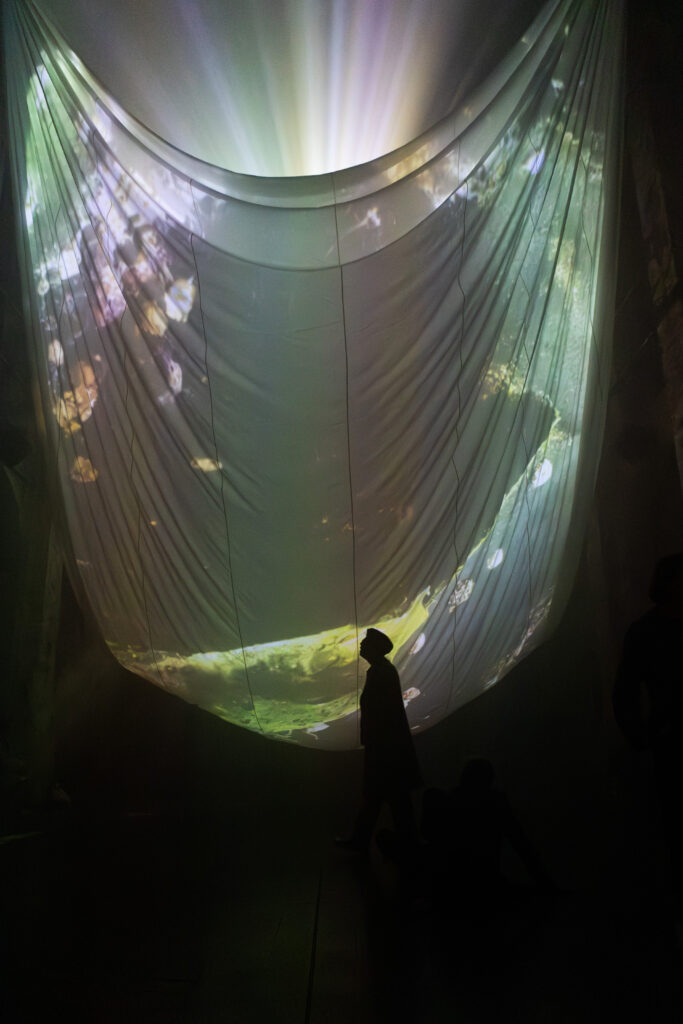
After the perfomance the artists explain how they began with what they call our “vertical ambition”, our desire to ascend, to build our own paradise up there, cut off from the order of the earth, a new home. The audience can physically explore this aspiration by climbing up to the top of the chapel via a scaffold and, in a reversal of the stargazing posture, gaze down into the depths from there. In the film footage, too, we see people acting on the desire to go up, as they climb the mythical Sigiriya Mountain in Sri Lanka and then descend from it. Height as a place of dreams, of ambition. Step by step, their hands on the railing patiently move a little further up and down. That rising and falling is a key motif throughout the entire performance, extended into the soundscape that lays itself over the whole in waving movements and into the spatial experience that constantly plays with the viewer’s perspective. From the position where I now stand, I see how the cloth casts an oval-shaped shadow on one of the screens onto which clouds are projected. The whole suggests an airplane window: viewed from my position, I am no longer looking up at the clouds, but floating above them and looking down from there.
© Celine Pourveur

© Celine Pourveur
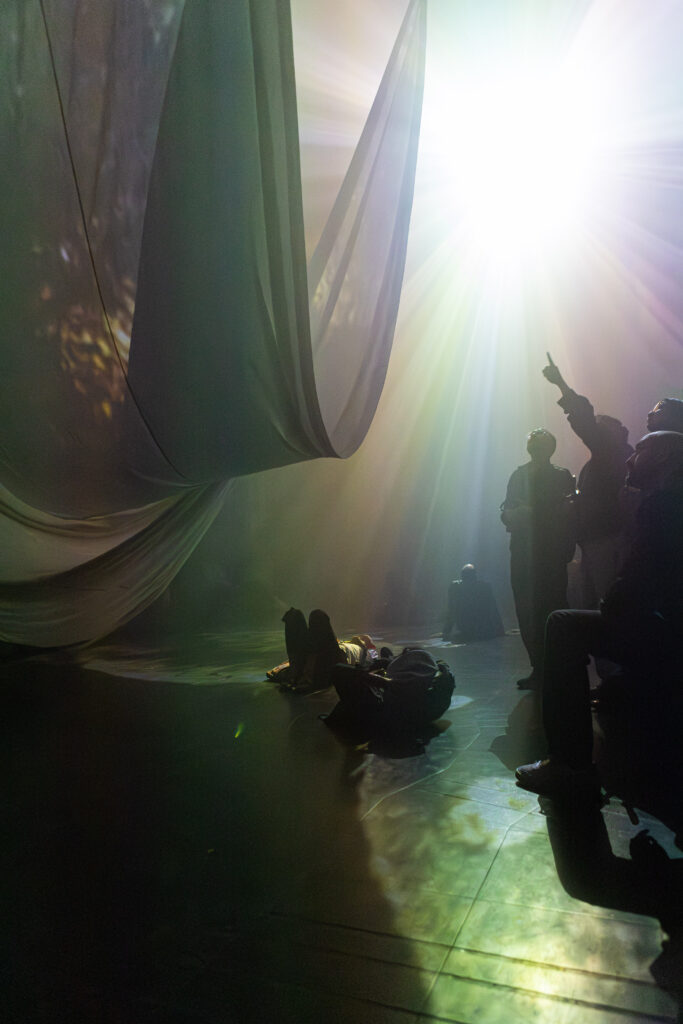
Next to me two people are no longer looking at the projections but at the light source itself. They seem to be staring straight into the projector’s bright light, and I wonder if they’ve had enough of the concrete and mundane world toward which the film images are gradually guiding us, and if, like me, they’re beginning to long again for those moments of dazzling light that marked the beginning of the performance for me. I follow them and notice that gradually the rest of the audience is doing the same. The light moves in colorful lines through the space, and this shift toward abstraction seems to affect the audience’s attention and concentration. A focused gaze that brings us back to what cinema is fundamentally about: light, which – fleeting as it is – is suddenly taken away from us once again. A blackout plunges us into darkness from one moment to the next. Pupils wide open, fully present, receptive to every detail the darkness wishes to reveal.
I look up, daylight squeezes through the cracks in the old building, forming semicircles that stand out against the chapel ceiling above us. By analogy with the earlier looking at the images of the sun, with staring into the sun-like white core of the projector, the sight of these semicircles makes me think of the moon. “The sun has a lot to say, but moonlight is a listening light”, says Marjolijn Van Heemstra in Nachtgids. The moon gives no light of its own, it responds. A relationship is contained within the light of the moon. And although I feel resistance to the worn-out dichotomy between heart and head, body and mind, feeling and thinking, there is something in the transition from light to dark that seems connected to that after all. Up and down, rising and falling, the movement that for the past half hour defined image, sound, and spatial composition is now also palpable in my own body, which breathes, contracts and expands along with all the other bodies in the space.
© Celine Pourveur

© Celine Pourveur
The cloth is now looming closer, and something stubborn stirs within me. I don’t want to move and I imagine what it would be like to be swallowed up by that gigantic cloth – a sense of vanishing, of losing oneself, a longing that has everything to do with forgetting. The approaching white fabric gradually fills my entire field of vision. Yet one last twitch of thought: my mind turns to the words of psychiatrist Jim Van Os, who speaks of the duality of consciousness: we get stuck because we think and feel something and want to say something about it, yet at the same time, on a meta-level, we can also form an opinion about it. In that internal dialogue with ourselves, in the experience of the fact that we are experiencing, he believes the core of psychological suffering lies. Faced with the white cloth right before my eyes, this thought occurs to me. I feel a connection to Weerasethakul’s insights about time, come up against my own limits and don’t quite finish my line of reasoning. “The problem of humanity is linked to thought”, and I realize that I have been doing the same thing here all along, adding that extra layer of reflection on top of the experience, something I would so much like to free myself more from.
No matter how fragmented and intuitive the video images in the first part of the performance were brought together, my mind kept racing, searching for connections. Arriving here, it becomes clear to me: I struggle with the paradox of seeking meaning in something that is exactly trying to elude that. Forgetting, of course, also means letting go of that self-imposed internal timeline that you sometimes think you need to shape your identity. On the other side of the cloth, I hear an opera voice, a sound beacon that sets me in motion, and I manage to free myself from language and thought.
“I don’t want to move and I imagine what it would be like to be swallowed up by that gigantic cloth – a sense of vanishing, of losing oneself, a longing that has everything to do with forgetting.”
Beams of light settle in clearly defined lines within the chapel. Appearing, disappearing, semicircles, lines, crisp drawings of light, smoke forming cloud-like shapes – spatial echoes of the film images projected earlier. Electronic music takes over the soundscape and if I hadn’t been held back by a touch of shyness, I would have been dancing. Around me, I notice a few restrained dance movements, enough to make me feel connected and flow along in the excitement.
An image is projected onto the cloth from above. Abstract patches of color. The whole is drawn up into the air. The projected light seems to take on weight. Matter, a volume of light that looks heavy and depicts the sheer mass of memories, the multitude of things, only to vanish into nothingness once again. An absolute black that is immediately pierced by the next beam of light. I look into the light source, see the white core burst open into a multitude of lines of light that I follow all the way to the projection screen, where the words A Flower of Forgetfulness take shape. In accordance with the light particles that find definition on the screen in the outline of the letters, meaning in the completeness of the word, cadence in the rhythm of the phrasing, I feel the particles in my own body regrouping around a core. The body, the primary matter through which we interact with the world. In the dark, a form of thinking emerged that does not stand in opposition to feeling but flows from it, a permission to be unclear to myself.
KRIJG JE GRAAG ONS PAPIEREN MAGAZINE IN JOUW BRIEVENBUS? NEEM DAN EEN ABONNEMENT.
REGELMATIG ONZE NIEUWSTE ARTIKELS IN JOUW INBOX?
SCHRIJF JE IN OP ONZE NIEUWSBRIEF.
JE LEEST ONZE ARTIKELS GRATIS OMDAT WE GELOVEN IN VRIJE, KWALITATIEVE, INCLUSIEVE KUNSTKRITIEK. ALS WE DAT WILLEN BLIJVEN BIEDEN IN DE TOEKOMST, HEBBEN WE OOK JOUW STEUN NODIG! Steun Etcetera.
recensie
11.06.2026
Leestijd 11 — 14 minuten
15.04.2026
—
07.09.2026

Jana Coorevits’ artistieke praktijk houdt het midden tussen die van een experimentele filmmaker en een beeldend kunstenaar. Een nadruk op lichamelijkheid gaat gepaard met het verkennen van ruimte voor de vrouwelijke ervaring. In een poging om naar buiten te halen wat in en om het lichaam zit, grijpt ze naar trage en intieme weergaven. Stilte steunt de gevoeligheid van dat ritme. Uit de analogie die golft tussen landschappen en mensen vloeien nieuwe betekenisvelden. Na het behalen van een Master Audiovisuele Kusten aan LUCA School of Arts (Brussel) werkte ze als artistiek onderzoeker aan het Koninklijk Conservatorium van Antwerpen. Ze maakt deel uit van Ursula Collectief en momenteel is haar tweede solo tentoonstelling luchtvlak landschap zon, maan te bezichtigen bij Fred & Ferry Gallery (Antwerpen).
Dit artikel maakt deel uit van: Dossier: Kunstenfestivaldesarts 2026
Klaas Tindemans
Mia Vaerman
recensie 11.06.2026
Klaas Tindemans
Mia Vaerman