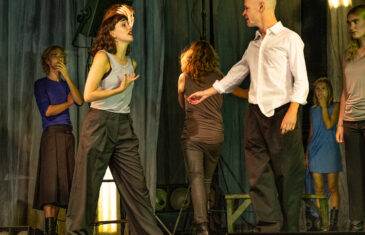
Iphigenia – De Roovers
Geef mij maar het verzet van Klytamnestra
Mia Vaerman





© Samah Hijawi
As a person working on the histories and cosmologies of the foods on our table, I would like to invite you to grab a bag of pistachios (preferably the Iranian variety), and enjoy them while you read this short reflection. In Levantine Arabic, the saying füstoq fādee is used to refer to a person with no substance, or a situation that yields no outcome.
It is hard to write these days, because there seem to be no words that can actually carry the weight of what continues to happen in Palestine. Indeed, I have been contemplating the position of privilege one needs to write. I often say that embedded in the colonial system of power and subjugation is the spatial element of distance. Distance is at the core of academic production, because it calls for a person to be objective, and objectivity requires a person to be removed from the dynamics of life, to take a birds-eye view on the matter. This distance makes it possible to observe, monitor, take notes, draw, discuss, edit and conclude. The seminal Palestinian author Edward Said points us to how this is part of the European colonial attitude towards the world, that: “the decision of the Church Council of Vienna in 1312 to establish a series of chairs in Arabic, Greek, Hebrew, and Syriac at Paris, Oxford, Bologna, Avignon, and Salamanca”, through which a process of establishing a hierarchy amongst people was slowly built.
“If all the books that make the foundational pillars of education around Europe and the USA have contributed to this kind of violence, then we cannot celebrate.”
One of the reasons I came to Belgium ten years ago, is to get distance from the distracting force of conviviality of life in Jordan where I grew up. In Belgium I was able to take a step away from living life, and be able to think, reflect and write and make art. I was always aware that I came to live and work in the place that birthed the colonial systems that we are confronted with today. While I do not want to discredit the contribution the global north has made in cultural, technological and intellectual development, I find myself cynical of the much celebrated European ‘enlightenment’ that marks the beginning of the path towards the so-called ‘civilized’ conditions we are at today. I will not argue that ‘we’ in the global south have our shit together either. But from the perspective of a world order driven by the global north, if we argue that the civilized part of the world has led humanity to where we are today, then this might be a good moment to contemplate the deeper meaning of ‘civilized’. If all the books that make the foundational pillars of education around Europe and the USA have contributed to this kind of violence, differences based on religious beliefs and ethnicities, and ethical bankruptcy, then we cannot celebrate.
“It was beautiful to see the people previously colonized by the Dutch come all the way to teach the ‘civilized’ world how to spell the word G-E-N-O-C-I-D-E.”
I was hopeful throughout the last months, that despite that indescribable retaliation on the Palestinians in Gaza, something good must come out of the darkness. That Israel is destroying itself by showing its true colors. Undoubtedly, in the history of dismantling the legacies of coloniality, it was beautiful to see the people previously colonized by the Dutch, come all the way from the southern tip of the African continent, to teach the ‘civilized’ world how to spell the word G-E-N-O-C-I-D-E. I really want to believe that we are at a pivotal moment in human history and the tables are slowly turning. Yet, I cannot shake off my pessimism since the order came out following the first hearing at the ICJ, because it changed nothing on the ground.
Again, distance comes to my mind: that the systems put in place for peace, justice and democracy (by the same nations who operate with a colonial mindset) are slow. The distance between the hushed courtroom in The Netherlands, and the screaming, death, loss, trauma, airstrikes, bombs, and hopelessness in Gaza are so far removed. Without operating from a genuine sense of urgency, rather than adhering to the formal processes, the time needed for this system to work seems to inflict violence in itself.
As a metaphor for a feeling for many of us have (those who want to see real change from all our governments—to stand up to their word, to spell it out as it is, to take fast and urgent action, to echo the world’s affirmative NO), these old dusty systems, come out like an empty pistachio shells, füstoq fādi—hollow in their democracy and equal rights.
KRIJG JE GRAAG ONS PAPIEREN MAGAZINE IN JOUW BRIEVENBUS? NEEM DAN EEN ABONNEMENT.
REGELMATIG ONZE NIEUWSTE ARTIKELS IN JOUW INBOX?
SCHRIJF JE IN OP ONZE NIEUWSBRIEF.
JE LEEST ONZE ARTIKELS GRATIS OMDAT WE GELOVEN IN VRIJE, KWALITATIEVE, INCLUSIEVE KUNSTKRITIEK. ALS WE DAT WILLEN BLIJVEN BIEDEN IN DE TOEKOMST, HEBBEN WE OOK JOUW STEUN NODIG! Steun Etcetera.
column
01.03.2024
Leestijd 4 — 7 minuten
15.12.2023
—
14.03.2024
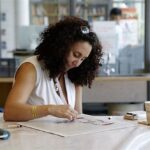
Samah Hijawi is a multi-media artist (a painter, a performer, an astrologer, a story teller, a researcher and an academic, a cook—it’s up to you to decide). Regardless of the form through which she materializes her work, her projects are always deeply rooted in historical narratives which are used to re-imagine our contemporary life outside of the radicalized and polarized discourses that direct our lives today.
Mia Vaerman
Tom Rummens
column 01.03.2024
Mia Vaerman
Tom Rummens