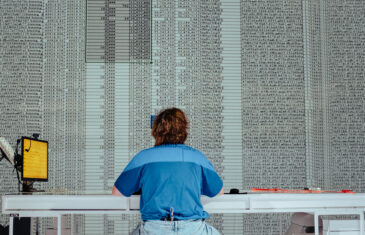
Average Happiness – Dinsdag.org / Bas Vanderschoot
G = (GM – OGM)/t
Pepijn Loobuyck





‘What We Can Do Together’, Monkey Mind © YvdH
Never underestimate the power of the people who inspire us to move. Dancers and choreographers Lukah Katangila, Lisi Estaras and Marc Vanrunxt pay tribute to a mentor, someone who changed their view of dance forever.
‘Which corner of your eye are you looking at? Which colors are stuck in your throat? All those types of voices can change in your sleep. Why are you so worried about yourself? You have to think elsewhere but don’t doubt yourself. Tell me more about your future. What artist do you want to be?’
– Hannah Bekemans
Hannah cries when people have looked at her in stations and shops, or because people walk too fast and she cannot follow them, or because we’ve rushed her while she needs more time to put her shoes on, to close her bag, to drink, or because she urgently needs to write something that came to her mind, probably a poem. I met Hannah Bekemans for the first time in 2016 at Platform-K, while I was giving a workshop. It was my first encounter with dancers with different bodyminds (the term ‘bodymind’ emphasises the interdependence and inseparability of the body and mind). Hannah was in her early 20s back then. Since then, we have developed a creative relationship which continues to the present time. During the several captivating processes that we have shared, and thanks to her generosity and unlimited imagination, I developed the monkey mind approach.
Hannah has a unique way of being and dancing that often goes together, diving into the moment with total conviction and carelessness. Her movements are constantly influenced by stories and feelings and the must, what is impossible to hold back and needs to come out. There is no playing, no fakeness. If there is no urgency, then there is no dance! In her approach to dance, we see a state of celebration and unlimited joy, a hybrid of forms, a patchwork which includes everything and everyone.
At that time, I was developing the idea of the monkey mind: a method for using thoughts and emotions as triggers, rhythm and narrative and creating movement from them. Benefiting from the fluctuations of this chaotic state to make choreography. Somehow, I was looking for answers to fulfill the need of giving content to the movement language, to give an insight into what was going on in the head of the dancers while they executed movements. I wanted it to become more concrete for the dance to tell the story of those bodies and at the same time tell a universal story. I wanted to understand what the bodies were trying to express in the conjunction between abstract and concrete making the dance speak beyond a style or technique.
During those first sessions I would play different kinds of music and set tasks around physical qualities, I would observe and be mesmerised. I remember a clear moment during the process of creating Monkey Mind (2016), when Hannah started to put names to the movements so as to remember the choreography: basketball, count in, flower, sky, hold on… I have learned from her that movements have content not only in the gestures which resemble an object or state of mind but also on the inside, this close relation with the embodied mind, the corporeal and sensory relations of the body to its world, a movement that is full of details and gets decorated and developed in a unique way, the Hannah way. A lot of the material Hannah is interested in has at first glance a mental structure that I will call pre-linguistic or precognitive but that eventually makes conscious and symbolic thought possible, it always reaches a point of understanding for the viewer.
Many times, in the studio, there was no clear demarcation of when things started or finished, a blurred line that also applied to the spatial division between performers and audience. The universe unfolds there to be shared and we are not sure… This uncertainty is uncomfortable and beautiful. It triggers a place of ambiguity that I love in a performance. Everything is allowed, we can be immersed fully in the choreographic path when distraction arrives and we incorporate it into the choreography, so it becomes further from what it should be but closer to humanity. It gives a perspective of live performance, of mastering the moment, even when this moment has been rehearsed and set.
Hannah has a great sense of humour and timing in her doing. This quality is a very important topic to me. Like Hannah, I don’t understand life without humour. Taking yourself too seriously can prevent you from looking at what’s beyond. I love the incongruences that float through the studio in her presence, there is always another way of doing something, the unexpected, the surprise, the fun. She often plays with absurdity and vulnerability, taking references from the world around her. She is able to recognise her condition of ‘being different’ or crip (pointing at herself) and question the gaze of others at her and explain the pain that this causes. Hannah loves food and she is curious about how dishes were made. ‘Lunch time, the best time.’ Sometimes she would write a whole menu of three courses for each member of the cast and give it as a present. So, you come to the studio and you get that at the start of the day and you cannot help but laugh and think: that is so great. In this hectic dark world, someone has had the idea to make a menu for you as a present.
She has the capability of putting herself in the other person’s shoes, mixing their perspective with her own. In some extreme cases she would take the disability of one other dancer — for example someone in a wheelchair — and express that she (also) can’t walk anymore.
Some years ago, Hannah discovered words and the power of writing. Now she says that words come first, before the dance. We arrived almost at the same time at the place where we need to include words in the dance because we need to be clear, maybe flirting with the idea of being understood. Still the words come in a collage form where thoughts are generated and mixed up, always with the pain underneath, with the strength of how difficulties and being the other brought us here, to be ourselves. In an interview Hannah said: ‘When I dance, I mix my feelings with the stage. First, I breathe and do the easy way and then I go further, like in a long tunnel to become more me and I dance easy or difficult to discover more Hannah, to be me. Always me in the future; always me, always the future.’
KRIJG JE GRAAG ONS PAPIEREN MAGAZINE IN JOUW BRIEVENBUS? NEEM DAN EEN ABONNEMENT.
REGELMATIG ONZE NIEUWSTE ARTIKELS IN JOUW INBOX?
SCHRIJF JE IN OP ONZE NIEUWSBRIEF.
JE LEEST ONZE ARTIKELS GRATIS OMDAT WE GELOVEN IN VRIJE, KWALITATIEVE, INCLUSIEVE KUNSTKRITIEK. ALS WE DAT WILLEN BLIJVEN BIEDEN IN DE TOEKOMST, HEBBEN WE OOK JOUW STEUN NODIG! Steun Etcetera.
artikel
25.02.2025
Leestijd 6 — 9 minuten
01.03.2025
—
14.09.2025

Lisi Estaras started dancing in Córdoba, Argentina. In 1997, she joined les ballets C de la B, where she danced and co-created numerous works by Alain Platel and Sidi Larbi Cherkaoui, among others. Later, she also started creating her own work. In 2016, she created the performance Monkey Mind for Platform-K. This project inspired Estaras’ research at AP University of Applied Sciences, on kinesthesia, empathy and mirror neurons.

Pepijn Loobuyck
Lena Meyskens
artikel 25.02.2025
Pepijn Loobuyck
Lena Meyskens