All Day I Dream About Soccer (ADIDAS) – Ahilan Ratnamohan
Kickabout in de black box
Floris Baeke




© Kurt Van der Elst
FC Bergman, a group of mastermind theatre makers, come back with yet another prop-saturated and tech-savvy play. Werken en dagen, similarly to their previous work The Sheep Song is a commentary on society and its workings. Werken en dagen focuses, however, on the community instead of the individual.
‘It would be madness not to ascribe reason to Nature, or to make that reason so far above us that we cannot know it by what is daily in use with us’ , I read in a translation of Hesiod’s Works and Days, a poetic manual about agricultural practices. The work goes through the days and works to be done on these days, hence the name. The phrase contains both a praise for the human being and a necessary humbleness that is contained in recognising Nature’s reason. We’re instructed by Nature, and we’re smart enough to understand her signs, but we’re still dependent on her. Ultimately, we do not control her. A good introduction to what the book, and supposedly the play, is about: working with Nature and being instructed by her.
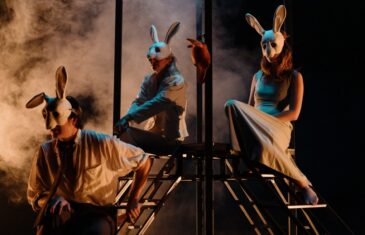
In Werken en dagen, we see a small community (Stef Aerts, Joé Agemans, Maryam Sserwamukoko, Yorrith De Bakker, Marie Vinck, Fumiyo Ikeda, Geert Goossens) ploughing the front of the stage after clumsily fertilising it with a chicken’s egg. The rough, dead earth made out of wooden planks is opened up before sowing the seeds. The community performs a ritual around an erected maypole, the chicken is killed, a necessary offering in hopes of a good harvest. A drum, flute and clarinet, played live on stage by Joachim Badenhorst and Sean Carpio, provide the soundtrack to the works and days that pass, at one point one of the two sings an enchanting song. I’m mesmerised, there are so many dimensions to this community and I’m engaged every time we go deeper into their workings. They do horrible and beautiful acts with equal measure, they’re focused and determined because of an implicit awareness of something greater than themselves.

© Kurt Van der Elst
“It is said that there are three things that one can look at without getting bored: running water, fire and working people. I’d add: a well-coordinated theatre performance.”
At this point I wish the play went on forever. It is said that there are three things that one can look at without getting bored: running water, fire and working people. The scenography of working people is masterful, the fertilized earth produces colourful wooden blocks of harvest, they’re sorted by colour and brought into a barn that a moment ago was erected from a few poles. The harvest is threshed in the see-through barn, the community breaks into a coordinated dance. We see an elephant-cow give birth to a calf after which the creature is skinned. Its wails are played by jazzy saxophone noises, its blood is silken scarfs that float and catch light on the stage. There’s no stench, no pain, no one gets dirty or tired from the work. I guess the fourth thing I’d add to the aforementioned list would be a well-coordinated theatre performance. Humans are easily fooled by beauty and this is the truth I want to believe in, and so I catch myself believing that this is true, this is the past, this is what we’ve lost in our metropolitan way of living. A simple, playful and fruitful way of being with no resistance to what needs to be done for the community to flourish.
Two-thirds of the way in, we see the arrival of the steam machine. It’s glistening, it’s new, everyone is curious. The members of the community undress and climb on it, sit next to it, its dark oil drips on their bodies – it’s sexy. No matter how aesthetic this very historical take on progress of the community is, I become unsettled. Am I seeing an ad for the industrial revolution, or a critique on our enslavement to technology? So far I believe the latter, maybe FC Bergman is still training our eyes to be less susceptible to glitter, naked women next to cars and other cheap tricks? This is another kind of beauty, but I’m less susceptible to it because I’m not equally convinced of its merits.

© Kurt Van der Elst

© Kurt Van der Elst
© Kurt Van der Elst
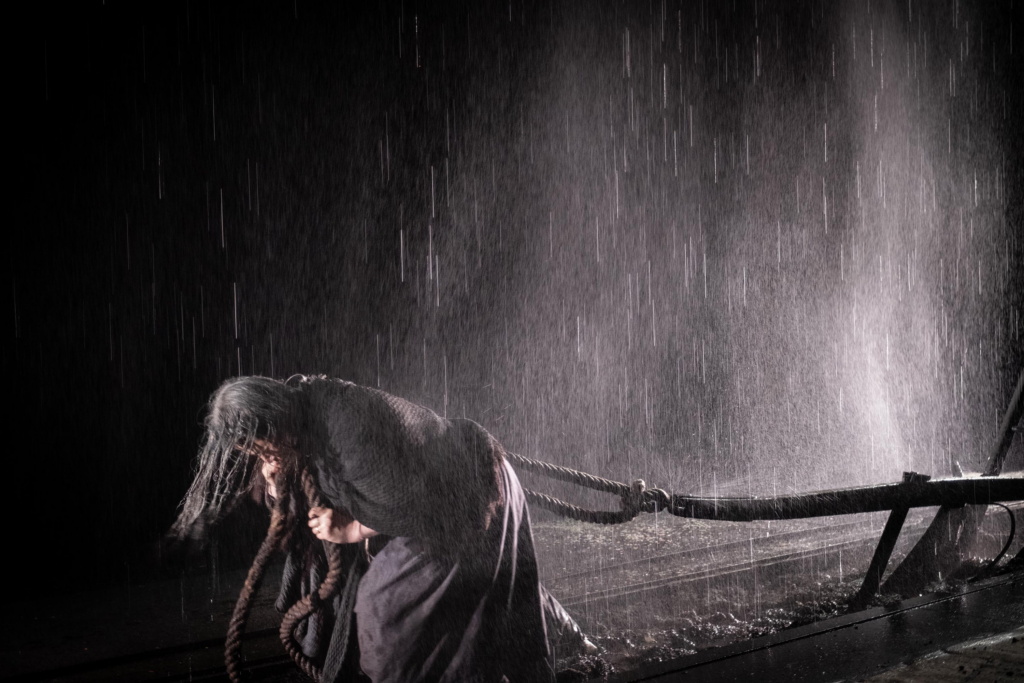
This episode is followed by Fumiyo Ikeda’s struggle to plough the earth. Although mirroring the one in the beginning, this scene couldn’t be more different. Everything is much more real. This time Ikeda works with soft soil instead of wooden planks, but surprisingly she can’t move the plough even when using all her might. She shouts, gets angry, tries to make do with what she’s got but her seeds have turned to dust, her crop is rotten, her food inedible. It’s all painfully real. She gets soaked in the heavy rain pouring down so hard that the audience in the first row need to put their raincoats on their knees. This crushing image speaks so loud. About the anger farmers feel when their hard work is not enough, when the summers are too wet and the winters too warm for there to be good yield, when Nature is out of balance. She’s still sending us signs, she’s crying on us with us, asking for help. I feel like the play takes a very broad stroke, speaking about the anger of a lone female farmer who can’t save the world, calling to arms the communal listening of the earth. But does it?
“First we idealise the past and then we see that the farmers are actually doomed, and all I wonder is: will the farmer ever fit into this society in a way that won’t wash off the earth from her hands?”
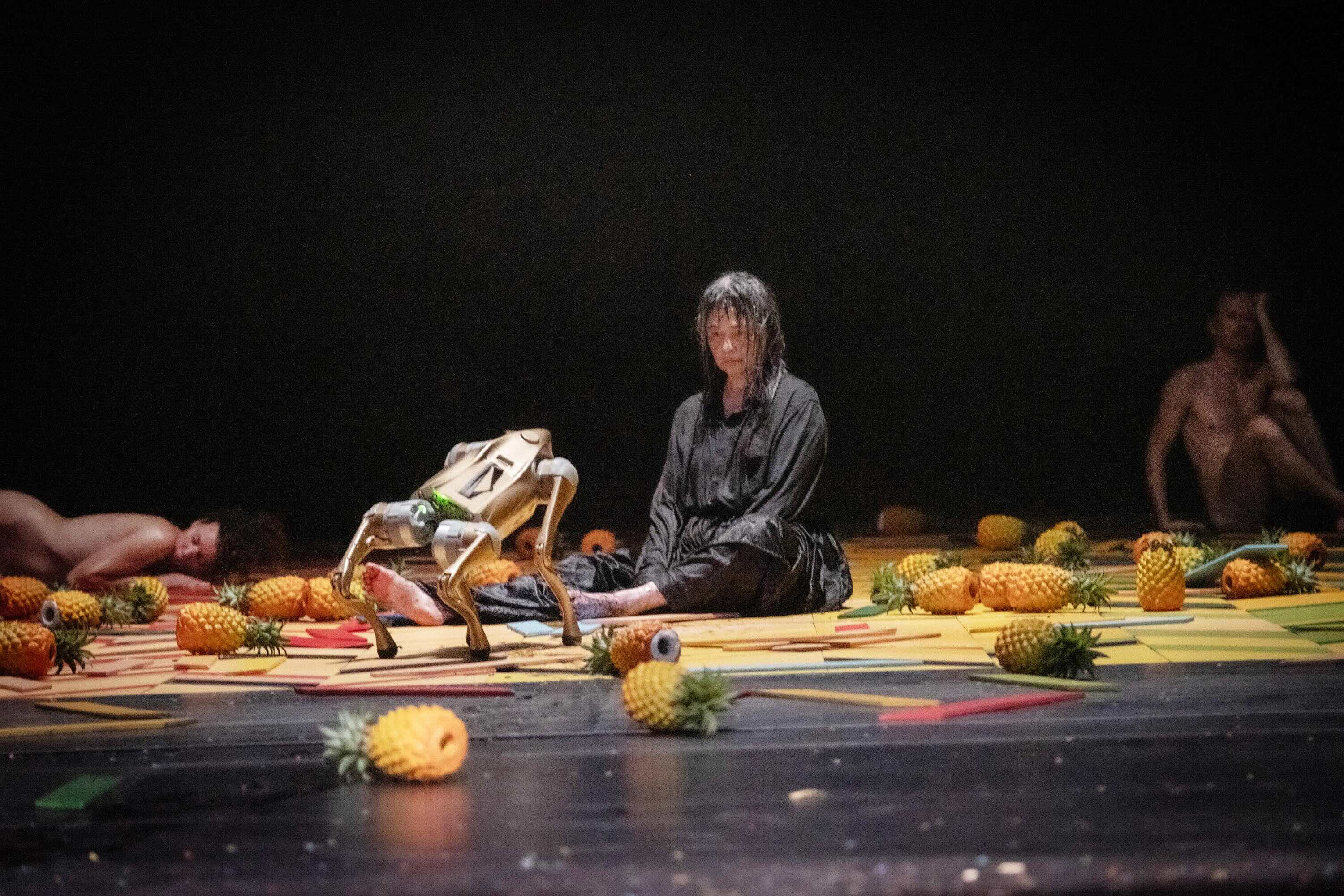
Because then something even more crushing happens. Behind the lonesome farmer we see the steam machine. It’s rising on tidy wooden floors where shiny humans are lying. They’re sparkling as much as the machine, showing off their bodies’ blinding crevices. The farmer steps on the floors, leaving a stain of dirt. She sits down, a robot dog walks up to her. The floor starts popping and produces one pineapple after another. She sits there, covered in dirt, between all these fake unmoving people, between pineapples, that evoke the images of neatly planted palm trees around the amazon – the cancer that eats at the lungs of our planet. But the audience is amused by the popping of the pineapples, they laugh because the dog acts cute, we just saw a lot of life so, of course, we’re humanising this machine.
The machine is dead, only imitating life, and worst of all: made by us, the people who don’t listen to Nature. The play decides to end on this image after what we’ve seen and free us from any wishes to go to a naive, play-dough past or get our hands dirty. First we idealise the past and then we see that the farmers are actually doomed, and all I wonder is: will the farmer ever fit into this society in a way that won’t wash off the earth from her hands? In the end we force people into yet another idealized world – the Silicon Valley pineapple heaven where we shine, doing nothing at all.
KRIJG JE GRAAG ONS PAPIEREN MAGAZINE IN JOUW BRIEVENBUS? NEEM DAN EEN ABONNEMENT.
REGELMATIG ONZE NIEUWSTE ARTIKELS IN JOUW INBOX?
SCHRIJF JE IN OP ONZE NIEUWSBRIEF.
JE LEEST ONZE ARTIKELS GRATIS OMDAT WE GELOVEN IN VRIJE, KWALITATIEVE, INCLUSIEVE KUNSTKRITIEK. ALS WE DAT WILLEN BLIJVEN BIEDEN IN DE TOEKOMST, HEBBEN WE OOK JOUW STEUN NODIG! Steun Etcetera.
recensie
07.10.2024
Leestijd 6 — 9 minuten

Ugnė Noreikė is a Lithuanian writer, musician and artist. She works in spaces of not knowing, vulnerability and extreme feelings. She’s looking for meeting points between sounds and words.
Dit artikel maakt deel uit van: Dossier: het TheaterFestival 2025

Floris Baeke
Klaas Tindemans
recensie 07.10.2024
Floris Baeke
Klaas Tindemans