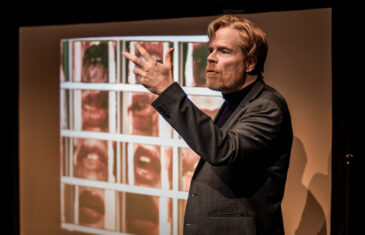
Confessie – Raven Ruëll & Bruno Vanden Broucke
De kunstmarkt maakt de kunstenaar
Klaas Tindemans





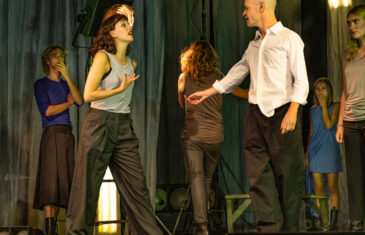
Imagine there was no roof – Sound meditations © David Helbich
David Helbich challenges the often unexamined assumptions surrounding the role of sound in performance, calling for a deeper and more integrated listening culture within the performing arts. Rather than treating sound as a functional or aesthetic afterthought — music as mood, or sound as glue — he invites us to reframe listening as a central, co-creative act that shapes both perception and experience.
Why is music in performances often so naïve? Why do the decisions about sound seem guided merely by taste? And conversely: why is the performative aspect of concerts often so dusty, so outdated?
Is it not a kind of tokenism when, on the one hand, performance in concerts is simply reduced to ‘everything that happens’ or ‘everything on stage,’ while at the same time every preceding discourse and every experience of physicality, seeing, choreography, intention, etc. is left unacknowledged?
Or when, on the other hand, music is simply reduced to a social event and bonding agent, and centuries of research (or years of individual practice) on silence, listening, time, intonation, simultaneity, ensemble culture, and instrument building and mastering play no role?
“Most musicians/composers have never experienced a conceptual dance evening or ritual theatre, and only very few choreographers or theatre makers have endured four and a half hours of Feldman’s string quartets or spent entire afternoons in listening sessions with field recordings.”
Of course, some of this can be explained by working conditions and formats—two or three rehearsals as opposed to two or three months in the studio. But it also stems from a deeper fact: rarely is one truly the other’s audience. There is a lack of lived experience. Most musicians/composers have never experienced a conceptual dance evening or ritual theatre, and only very few choreographers or theatre makers have endured four and a half hours of Feldman’s string quartets or spent entire afternoons in listening sessions with field recordings. To overcome artists’ blind spots regarding the sonic or the performative, it would be far more meaningful for them to have been an audience than merely to have studied.
I believe sound is underestimated—in its versatility and in its uniqueness at the same time. Especially within the visual and performing arts, sound is thought of either as a medium or even as an item. But just as the alignment of media with senses fails (‘to each sense its medium’?), sound cannot be reduced to musical carriers of meaning. Just as music is already more than familiar songs or historical pieces, sound is more than just music. And listening itself, in turn, is more than mere sound identification.
To cultivate a sound perspective within the performing arts requires acknowledging that sound is not only what can be shaped for the ear. It also fundamentally conditions the non-sonic dimensions of a work. In the context of performance, sound is not a technique or an add-on medium; it plays a leading role in the (often unconscious) perception of the audience.

Imagine there was no roof – Sound meditations © David Helbich for Concertgebouw Brugge
It determines spatial orientation—of objects, performers, and the audience body, but also of the space itself, as volume or as furnished, arranged. Or temporal orientation—ofevents, of the relation to duration, in space, in the piece, in one’s own body. Sound is also the only element that can aim at bodily participation, assuming that sound waves actually touch all bodies and can set them into resonance.
Furthermore, listening holds the key to illusionistic forgetfulness—namely, our ability to switch back and forth between stage (or ‘performance’) and audience space. Regardless of the presence or absence of a fourth wall, I, as a spectator, can be among people, in the theatre space, or in the illusion of the performance. On the one hand, that lies within my own power. On the other hand, this attentional control is also in competition with planned or unplanned (sound) events around me. Hearing steps on stage while the voice comes from the loudspeakers can break a fourth wall, while a cough behind us brings the social space of the audience back into consciousness—and thus briefly dissolves the fifth wall, the one between me and the others in the room.
The switches are the ears, for two reasons. First, because their doors are always open and thus, alongside what is focused, they simultaneously embody rhythmic details (like headbanging), anticipate bladder-bursting durations (like how Wagner’s dramaturgy is bathroom-break management), and feel subtle social stress (like the balcony at one’s back). Second, because our brain has appointed discrete bouncers with a selection mandate (the ‘cocktail party effect’), who, like an algorithm, follow our interests and make a preselection of what is allowed in and what is not. We hear everything and nothing. At the same time.
The hearing of the audience is always active: a co-performing listening, much more than other parts of the body. And it reads more than sound—whether it wants to or not. For me, this is the key in every work to understanding what is really happening in the room: how a piece is actually experienced or can be experienced. And therefore a much larger playing field than compressed loudspeaker sounds would suggest.
“When I teach dancers and choreographers, I try to emphasise that a piece is always already sounding, not only once music is glued onto it.”
In this sense, I believe sound is often underestimated when composers, musicians, sound designers, or producers are asked to ‘make the sound’ of a work—because it is rarely understood how far the question, and thus the possible collaboration, actually extends.
An expanded sound perspective can help avoid missed opportunities. For that, time (and space!) must be created in the working process of a piece, just as fundamentally already in the training of choreographers and theatre makers. There, music history is often taught, but rarely sound as such—what sound is and can be, and the insight that music is only one of the many possibilities of bundling sound.
Looking back, I find it astonishing how late we learned something about acoustics in my training as a composer. When I ask participants in workshops and masterclasses what sound is, musicians as well as other students quickly become very poetic. The answers are usually correct, but few have a real idea of what is happening in the air (or in the wood, or in the room, or …). Yet a concept of—or at least a feeling for—the physical side of hearing can open profound poetic depths.
When I teach dancers and choreographers, I therefore try to emphasise that a piece is always already sounding, not only once music is glued onto it. Just as musicians and composers must learn that the body of an instrumentalist does not vanish when the tone fades, and that concert conventions are themselves forms of theatre—and therefore performative decisions.
When techno happened, the real liberation was not the new drugs or the new venues—not even the new scale of the parties. The real liberation was from the song. And more precisely, liberation from the meaning- and identity-giving side of songs.
Gone were the get-on/get-off scenarios of dance floors, where half would go get a drink because this wasn’t their thing, while the other half jumped up in excitement. Instead of three minutes of ‘I know what’s going on,’ we got three hours of ‘we just keep going.’ Quasi-formless, apart from a few drops, which were no interruptions, but more like nudges of the waves.
There was no retreat in that sense—the kick was like thick air in surges, the halls were saturated, it was loud everywhere—instead there was endless space for thinking, looking, and moving. The formal revolution was not stylistic but sonic. The ‘sound’ was no longer one’s own, but the encompassing—the all-encompassing. No droning fourth wall, but a space without front or back: a shared space.
I understand why most keep affixing songs onto their dance and theatre productions. Songs carry instant legibility: in a few seconds we know who they are and where they come from. Their duration is self-explanatory (short!) and surprises are rarely to be expected. They are packages of certainty and therefore so popular in the performing arts—as atmospheric props, so to speak.
Longer musical works, classical music included, also have their advantages. For example, they can serve well as a timeline. In the search for cues, most choreographers actually read music mainly structurally. The dramaturgy in micro- and macro-time can be applied to everything and is relatively easy to analyse.
In this sense, music is a practical solution. It helps organise material. Loaded with historical or cultural identities, it can serve as an atmospheric surface—both above and beneath.

Imagine there was no roof – Sound meditations © David Helbich
Of course, there are many different kinds of music. Just as you can make music with anything, basically anything can be music. That one can really push the definition of music beyond every last boundary has been demonstrated sufficiently by the experiments of the last century—from music as the mere gesture of what is meant as music, to algorithmic generation without listeners.
In our workshop ‘Composer-Performer’, which composer Jennifer Walshe and I developed some years ago for the Darmstadt Summer Course for New Music, the question often came up about commonalities among works conceived from entirely different disciplines and backgrounds. The lowest common denominator, so to speak. ‘The love of sound’ was our answer—with which we countered an objective definition with a subjective one.
“I understand why most keep affixing songs onto their dance and theatre productions. Songs carry instant legibility: in a few seconds we know who they are and where they come from.”
The great thing is that each music works differently and must therefore also be heard differently. This depends on cultural codes but also on playback conditions—technical, spatial, and social. Whether something is played live or comes from loudspeakers alsomakes a musical difference.
What kind of loudspeakers, where they are hanging, whether you hear people playing or electronically produced music, or both, whether the whole space resonates or everything sounds very close, whether it comes from the front or from everywhere, whether someone kisses the microphone or screams, whether the lights are on or off, whether I am alone (as listener) or with 40,000 people, only with experts or with a bunch of kids… And of course, what the music itself does, what happens in it? Can I sing along after two chords, or somehow know exactly what comes next? Can my dancing leg (or nodding head) rely on a pulse?
Music can open an infinite number of listening and experiential spaces for us. It can tell us about its ingredients and strategies and about the people who made the music. It can be very controlled, or it can also give itself over to chance and intuition.
In experimental and ‘new’ music and sound art, listening conventions are often established only through the music itself. The work teaches its own listening. The listening instruction is then the music itself: it clarifies in the course whether a sound belongs to the music or is ‘only’ a by-product of playing (like the scratching of a guitar string). Do I recognise a structure—does something develop or repeat—or do I hear a static situation, a sound carpet, a texture? Do I understand the influence of the musicians, or is the playing cryptic, or from ‘tape’?
Questions such as the extent to which music can explain itself, and how listening habits can be expanded and experimented with, have been intensively explored in the experimental music and sound scene for over a century. Yet this research has had only limited influence on the sonic dimension of theatre and dance. However, it is precisely such openquestions that make music exciting—already from a dramaturgical perspective, since uncertainty creates greater tension.
Much more difficult are readings of the sonic within music. It is not only tones that give music its identity. Structural aspects also sound: the simultaneity of musical processes, the elements of the mix, the temporal characteristic of sound events. And bodies sound—the resonancebodies of the instruments, the loudspeakers, as well as the bodies of the performers. You hear their striking force on the drumhead and their innermost lungs in the flute.
Music also simply competes with material. All touring sound technicians know this: it sounds one way sometimes, another way another time. That depends on the loudspeakers, the height of the room, how and where the audience sits, whether it’s winter or summer (thick sweaters!), etc. We hear movements we do not see, we hear breath, we hear steps, shoes, fabric, we hear the reverb in the room, the movement of sound, our seat neighbors, the street. These are all sonic qualities, sometimes in the music and sometimes as independent elements. The space itself sounds, from the walls to the eardrums.
In theatre, the audience comes, sits down, and takes its time. Or it gives time. Both are somehow true. The time can then be taken and filled. That is the social deal. I believe this is also why the convention in music exists of applauding after each piece—simply to mark the social time period.
Sound theoretically contradicts this agreement; it cannot simply be assigned to time units. Light can change quickly—a slideshow of light spaces, for example, is no problem. That does not work with sound, because sound travels differently through space. And spatial sound has its own time. You need a sound event in order to hear the space, and space needs time.

Imagine there was no roof – Sound meditations © David Helbich for Concertgebouw Brugge
If I just want to hear a reverb, I first need an event, and then the time afterward—and then I have to have heard everything to the end in order to know how large the space is, for example. So, I cannot make a slideshow of sounds, because each space has its own time. As does every sound. Perhaps it would almost work with event-sounds—signals and sounds that appearquickly and object-like and represent their sound source (a shot, a falling glass,…). But it certainly doesn’t work with complex structural sounds and textural sounds, as composer Helmut Lachenmann once called them—that is, sounds that only reveal themselves as a process, that have a dramaturgy (in textural sound, a micro-dramaturgy). Spatial sound is itself a structural sound, and spatial experience a capacity of hearing.
One could say music distinguishes itself by its own intentionality, but it also has to travel through space to reach us. On its way, it becomes sound. There it encounters many things — walls, air, and jackets—and not least the directedness of our listening, which isas versatile as people are. The intentionality of listening (of the audience) is not aimed only at music, not even only at sound.
We hear our own listening. We hear our ears—their individual abilities and peculiarities. We do not only hear sound waves, but also our memories of sound and music, and what we have imagined—our conscious or unconscious inner inventions of sound. In listening, we contribute to sound; we co-listen. We actually hear ourselves in the encounter with spaces and contents. I imagine listening in this sense as an oscillation between inner and outer worlds, where we are not merely exposed to sound but actively shape the listening process. Listening is creative.
Mostly unconsciously—but here we can also intervene playfully. Mentally, but also physically. The simplest example: if we look left or right, we change all sound directions, virtually rotate the space, but also filter frequencies in and out—we shift our sound image, so to speak.
Small tip: turning your head is very interesting with very high tones—sine-tone beeps, for example. There you can actually virtually co-compose in that way. Which is no sacrilege, because acoustically there is no ‘right’ version anyway.
But even the mere shift of concentration is creative and, in this sense, performative. A shift, for example, from the observation of instrumental playing technique to room acoustics, from harmonic progression to intonation, from the search for references and meaning to the current perception of time, from critical listening to trance—can proceed controlled, wild, random, or purposeful—probably all of that back and forth.
In the attempt at simultaneous listening to various parameters and voice progressions hides a kind of koan, an unsolvable riddle, which can nevertheless lead to insight, or simply pleasure. It is self-performative in the intro-active sense. I have adopted this term in distinction from interaction, where the performative moment takes place on the communicative level. Intro-action for me is the individual, internal activation—preferably in play—in any case within the realm of aesthetic experience. Art (and other things) can give it a push, but doesn’t have to, which is why I think it is self-performative in both cases.
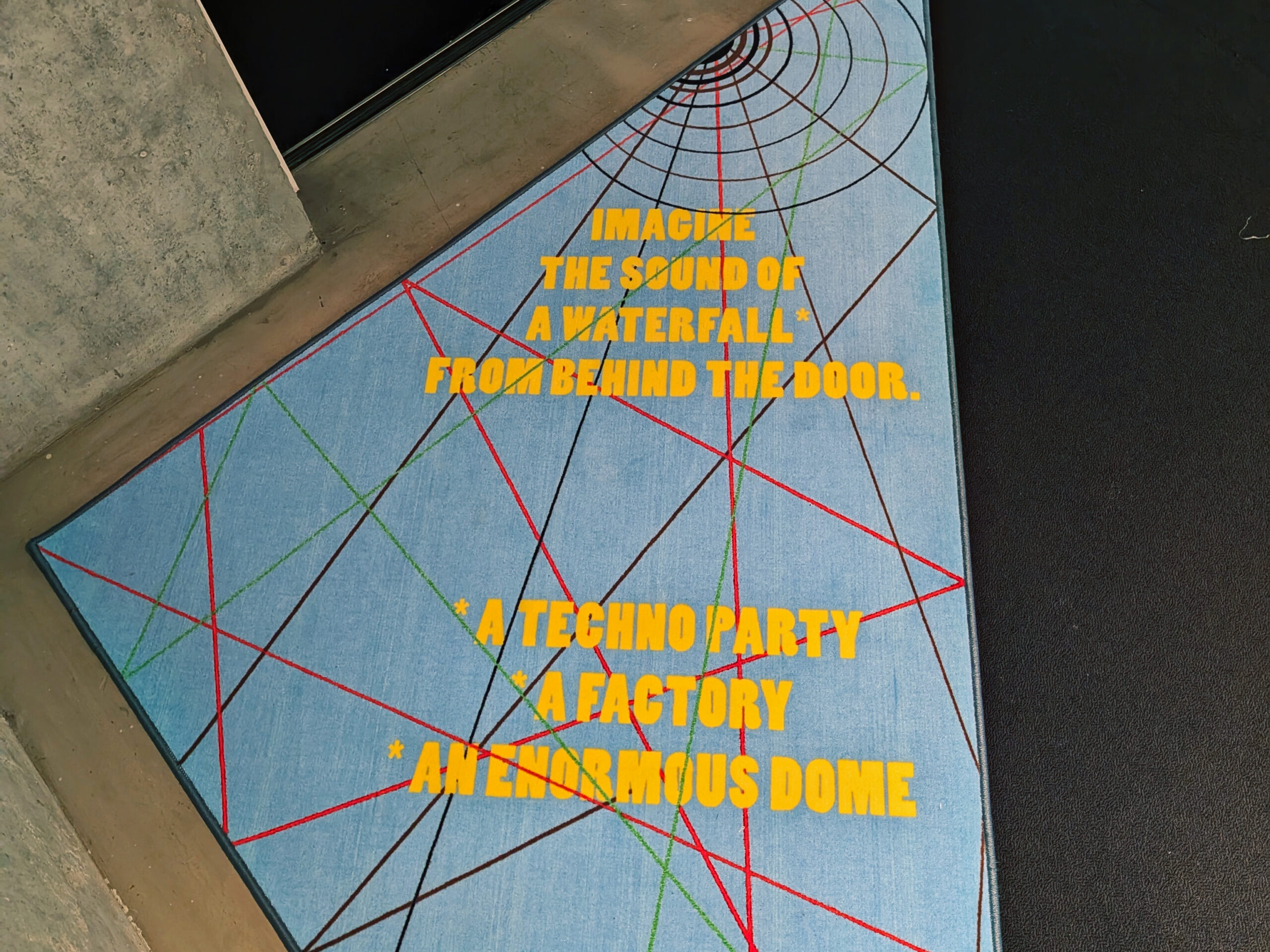
Imagine there was no roof – Sound meditations © David Helbich for Concertgebouw Brugge
Performative listening can, in reverse, lead to performative music: music that is aware of its performative side—that knows the communication of musical and sonic concepts takes place throughout the whole room, in the bodies of the performers just as much as in those of the audience. The individuals in the audience, it must be said. For the performative moment is a relationship that takes place in space, but not necessarily in social space. That, however, can reinforce and carry it—and thus is also one parameter among many.
“An artistic approach that acknowledges how meaning depends on bodily and social experience must also search for a different relationship to the mediation of art. Knowledge does not flow only from art to the audience, but back and forth.”
Music has become more performative in the last 25 years. Not only the conventions of musical practice—the applause, the clothes, the handling of instruments—were suddenly in the spotlight. Through the dissolution of the separation between low- and high-tech, the entire ‘dirt’ of a concert experience was now brought to the surface. The (to this day still dominant) attempts at exclusive listening— the exclusion of ‘non-intended’ elements in music—suddenly appeared absurd, and so conspicuous that they began to stand in the foreground. The effort for cleanliness in musical concepts revealed the impossibility of purity.
That changed a lot. It lifts, for example, the separation of instrumentalists, performers, and composers, who suddenly blur together and thus make careers in various hybrid forms possible—or rather, necessary. In my own teaching practice, I notice a rapid increase in demand for interdisciplinary teaching concepts.
Extending the perspective of an expanded art of listening to the entire field of the performing arts would also mean embracing its inherently experimental character. This would inevitably affect play, text, movement, and more—simply because it would shift the relationship to the audience. An artistic approach that acknowledges how meaning depends on bodily and social experience must also search for a different relationship to the mediation of art. Knowledge does not flow only from art to the audience, but back and forth.
The site of experimentation is therefore less a secluded laboratory and more a public space, where results condition one another. This brings uncertainty into the work—not everything can be predicted—but that very uncertainty can also grant an artistic work a sense of openness.
AH, IF ONLY IT WERE MORE LIKE YOGA, AND LESS LIKE TELEVISION
The vision of an audience-centered perspective does not focus on a particular content of artworks, but on other modes of working and on a different momentum from which art is created. Here the notion of practice becomes central, describing the permanence of work.
Instead of assuming that each piece represents a self-contained concept, experiment, or research field, this perspective speaks of constant rehearsal — an ongoing attempt that continues even between productions.
In this sense, works function as training grounds—training camps for experiences of experience. Every work is a kind of routine, a rehearsal, and thus never stands alone. All participants are involved, and thus the problem of didactics in mediation dissolves: just like in yoga, it is not enough to have once learned the positions. Experience must be practiced anew each time.
This also brings us back to the idea mentioned at the beginning: that the recurring experience of being an audience is precisely what enables artists to engage with the expanded field and to collaborate with others on equal terms. The constant shifting of roles within art— and between art and audience—then becomes the wellspring of expanded creativity.
KRIJG JE GRAAG ONS PAPIEREN MAGAZINE IN JOUW BRIEVENBUS? NEEM DAN EEN ABONNEMENT.
REGELMATIG ONZE NIEUWSTE ARTIKELS IN JOUW INBOX?
SCHRIJF JE IN OP ONZE NIEUWSBRIEF.
JE LEEST ONZE ARTIKELS GRATIS OMDAT WE GELOVEN IN VRIJE, KWALITATIEVE, INCLUSIEVE KUNSTKRITIEK. ALS WE DAT WILLEN BLIJVEN BIEDEN IN DE TOEKOMST, HEBBEN WE OOK JOUW STEUN NODIG! Steun Etcetera.
essay
15.12.2025
Leestijd 16 — 19 minuten
15.12.2025
—
14.04.2026

David Helbich lives and works in Brussels. He studied composition and philosophy in Amsterdam and Freiburg. He works as a sound and performance artist, as a visual and conceptual artist, as well as a photographer, composer, curator, and teacher. He has created experimental works for the stage, for print and online media, and for public space.
Klaas Tindemans
Mia Vaerman
essay 15.12.2025
Klaas Tindemans
Mia Vaerman