Confessie – Raven Ruëll & Bruno Vanden Broucke
De kunstmarkt maakt de kunstenaar
Klaas Tindemans





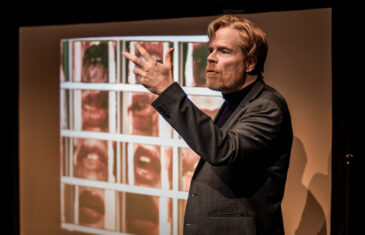
Chambre Son © Jean-Baptiste Veyret-Logerias
What happens when we breathe together? Simon Baetens speaks with singer, dancer, and facilitator Jean-Baptiste Veyret-Logerias about how the voice lives in the body, and how singing together can become a space for trust, curiosity, and transformation. From his early days in school choirs to conducting, dancing, and working with fascia, Veyret-Logerias’s practice is one of radical presence. Over the last 15 years, he has contributed to a vast number of projects and collaborations. What are the recurring threads he sees in each of them? In this interview, he sheds light on concepts and co-variation, amateurism, and on why the most important work is often about not knowing.
Simon Baetens:
Your artistic practice takes on many forms. How would you describe your parcours so far? How did you end up doing all the things you do today?
Jean-Baptiste Veyret-Logerias:
Where to begin? The starting point would be the practice of singing, but more specifically choir singing. It was never my goal to be a soloist. I did sing solos in some choirs that I was a part of, but it was never the point for me. And when you’re a soloist in a choir, you’re never truly alone anyway, because you’re always with a group of people. I never really felt comfortable being seen as a soloist. In any case, I started out as a chorister, as we would call it, in a pop singing group when I was in middle school. And this was really great as a first experience with singing. Around that time, I got asthma, and singing offered a way to work on breathing. And coincidentally, I also started learning the transverse flute around the same time. It just kind of happened intuitively. However, choir singing really was and still is my root practice. I keep coming back to it, and it holds together all the other things.
And how did you start conducting?
A bit later. I started conducting—or as I would say today,being a facilitator—around my early twenties. What’s funny is that through conducting, I ended up dancing. Actually, a friend of mine was part of the choir that I got the chance to conduct on a specific song. It was a women’s choir, and I got quite emotional from the relationship that emerged between the singers and me. And at the end, my friend came to me and said: ‘You know, you should really dance.’ I told her I had no clue what she was talking about. Dance was totally not on my radar.
She said, ‘Okay, I will just take you toa dance show at some point.’ We went to a show maybe two months later. Seeing that performance was like a big slap in the face. Not a bad slap, a good one: it openedme up to a field and practice that I was not aware of.
Do you remember what show it was?
I do. It was Les hommes en colère by Odile Azagury, a piece from 1999. And it blew my mind. I felt, wow, that’s totally what I want to do. There was a lot going on at that moment in my life. Around that time, I was starting to really embrace my homosexuality. In the piece, there were only men on stage, so you can imagine I was projecting a lot in the way I was looking at it. Dance was presenting itself as a way of being with your own body that was totally new to me. All of a sudden, there was so much potential opening up to me.
It’s funny that conducting really led me to dancing. I took my first Feldenkrais workshop one month later, I think. And then I started dancing at the university. Maybe five years later, I studied in Angers, at CNDC. I didn’t do the programme for dancers, but rather the programme for project makers. It was called Essais (‘Attempts’) because it was process-based rather than aiming for finished pieces.
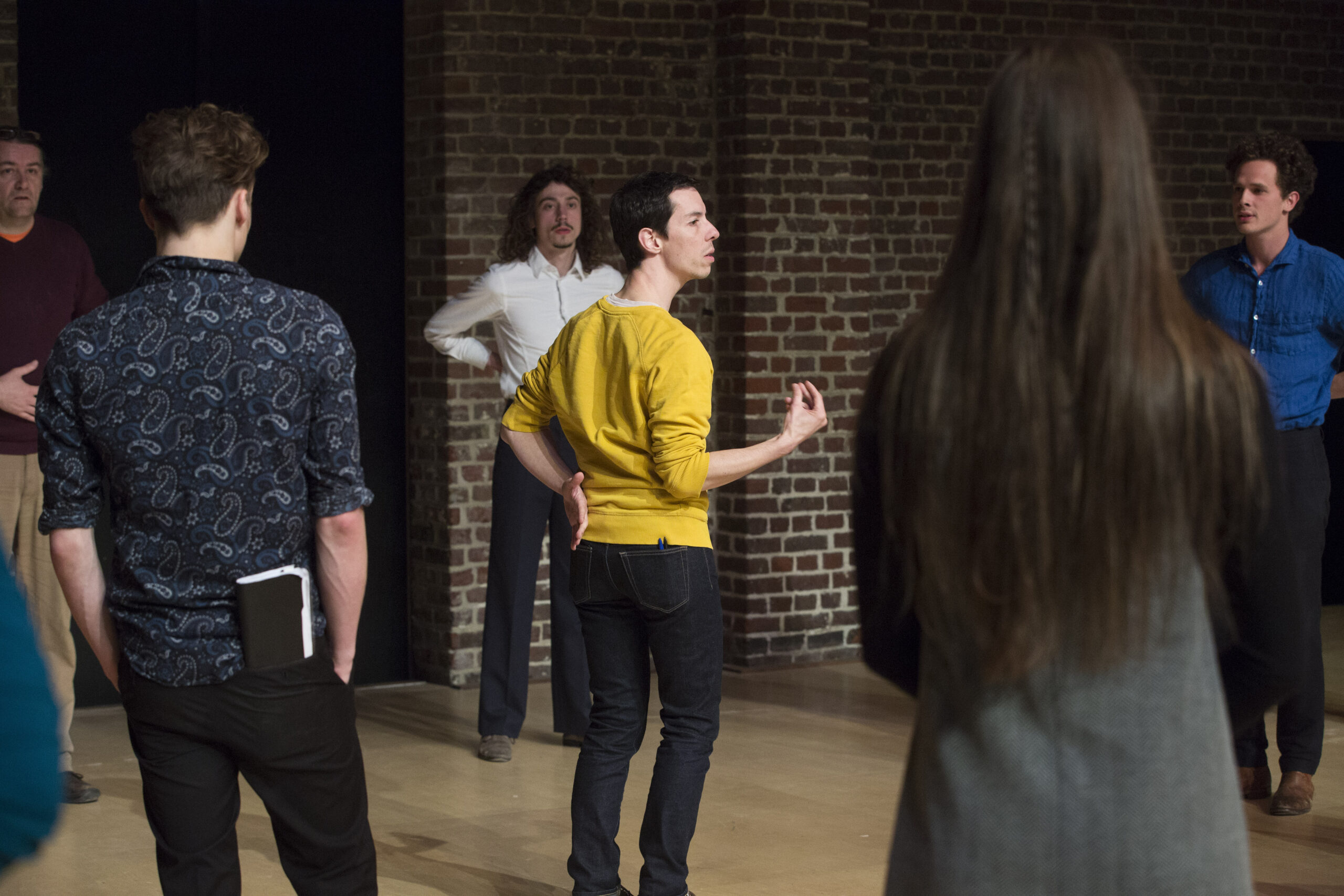
IN KOOR!, Myriam Van Imschoot & Willem de Wolf © Phile Deprez
And then—now that I am tracing everything back—when I was in Angers, I had a bit of a tough period. A lot was happening in my mind and in my life. There was a lot of joy but also a lot of things to look at. A friend of mine then told me about fasciatherapy as something that had helped her a lot. That’s how I first got taken care of with fascia, and then I started training and learning the Danis Bois method.
I guess you could say that somatics really became another anchor point in my life and practice. It all kind of came together, from choir to dance to fascia, through giving rooted body sensations to the practice.
It sounds so organic now that you say it like that, but it’s been a long trajectory.
That’s how life drew me. One thing was always connected to the other. And today, I cannot really disconnect one practice from the other. Everything is very much intertwined. That’s also the way I teach. I transmit a lot; I facilitate a lot for groups singing together. Another thing that keeps finding its way back to me is philosophy. I studied philosophy at the University of Nanterre, and somewhere in my second master’s year everything started to come together. I was analysing social movements in public space, both dance gestures and vocal gestures. That’s what I’m still working on today with my PhD.
It’s amazing how the voice has been the starting point for all of this. Do you remember how you first discovered that the voice is your language? Did someone point you to that? Maybe we can go back to your childhood, even. Were you a kid that was experimenting with their voice?
That is tricky for me to answer. I cannot really trace back any kind of extraordinary fascination for the voice when I was a kid. I do have a lot of memories of me mimicking the vocal music that my parents were listening to. The aria of the Queen of the Night in Mozart’s The Magic Flute, for example. I remember that I would embody the singer’s voice over and over again, and my parents were very amused by that. But even though I really enjoyed doing that, I wouldn’t say I was experimenting with my voice a lot—more that I was sensitive to other people’s voices.
So the fascination started by picking up on things and trying to emulate them and finding fun in that. What age were you when this first began?
About five or six, I would say. But I think something shifted when we moved from the countryside back to the city, to Tours, a few years later. My mother then enrolled me in a music school that followed a special pedagogy which maybe also gives a hint about my entry point into music. It’s called the Martenot method, which is not about learning music theory but rather about learning by playing and experimenting. It was also at that school that I started singing. I remember that I had very specific sensations there, but I cannot really tell you much more than that something was happening that I really liked. I was eight or nine by that point.
And then when I was ten, I went to what we call collège in France, which is where I started practicing choir singing. I was in a choir that was part of the school and led by the music teacher, whom I was really fond of. I really loved my music teachers. It seems like my journey through music and dance is somehow connected to people I trust and like.
“Choir singing has some similarities with contact improvisation. Because, in a way, you are in contact with each other without touching each other.”
The school choir was your first real experience with singing in a social setting, something that has since become very central in your work. Can you tell us about some of the different ways in which singing brings people together that you have observed throughout your parcours?
One thing that is somehow very basic but that I keep coming back to is that singing has to do with vibrations of the body. This is very exposing for some people. Somehow, I observe time and time again that people are drawn to their own voice—it triggers something in them that dance movement does not. Which doesn’t mean that dance movement is not engaging; it’s just another kind of trigger. But in singing, there is this vibration and also the shared vibration, because you can feel the vibration of other people’s bodies: you can be impacted by the voices of others when you’re close enough to them. So singing is actually very physical, which links it to dance and to movement: voice is a gesture as much as dance is one. It’s a funny thing to say maybe, but to me, choir singing has some similarities with contact improvisation. Because, in a way, you are in contact with each other without touching each other. And because you are depending on each other. I don’t like the term ‘codependency’ though, because I don’t trust it so much.
Why not?
Codependency has so much to do with biology and ecology, which I don’t think is the right paradigm to analyse what I see happening in music or dance. I would rather speak about co-adaptation and co-variation. This idea of co-variation is super enjoyable to me, because you’re always moving with others, reacting to what others are producing. In a way, you’re always with the others. You can never just indulge yourself and be with yourself. This is also never the case when you’re singing in a choir. You’re always in touch and in a relationship—a strong relationship—which is happening on many levels. The level of vibration, the level of kinesthesia, the level of kinesthetic empathy that Hubert Godard speaks about, but also an emotional level, which can come from the vibration, but also from this connection to others. Feeling yourself in connection with others can really draw strong emotions in you.
I remember when you were guiding us in the piece IN KOOR! by Myriam Van Imschoot and Willem de Wolf, where I and maybe twenty other actors played a practicing choir, that I would sometimes get very emotional during rehearsals. Not necessarily from the music or its content, but rather from the physical sensations, from using my body in ways I rarely do otherwise.
Exactly. The breath also plays a huge role in this, I guess, and thus so does the diaphragm, which is in a way the connection between your torso and your lumbars, with your psoas and the posterior muscle chain. You could say that through the diaphragm, you’re anchoring yourself in the ground, meaning that breathing has to do with being able to root yourself—or not, depending on how you breathe. It’s not surprising then that this can be emotional, destabilising, or re-stabilising to practice.
Another hypothesis that I have is that singing has a lot to do with lengthening your breath. Usually in speaking we don’t do that, unless you want to speak for a very long time or say a very long sentence. You don’t even think of your breathing when speaking, except maybe in emotional situations. In singing, we are purposely extending the breath. And I think the joy also comes from there. That in a way, you’re experimenting with—and stretching —your own capacity to breathe in and out. Breathing out is about howmuch breath you draw to the world, and not from the world. Which I think is something quite significant, this gesture of putting a certain awareness and effort towards this movement outwards. Especially when you hear others doing the same towards the world and thus also towards you. Then it’s all about sharing this movement out and in, the sound gets back to your ears and is drawn out and back to the ears again. This reinforcement of your own gesture and that of others can be very nourishing.
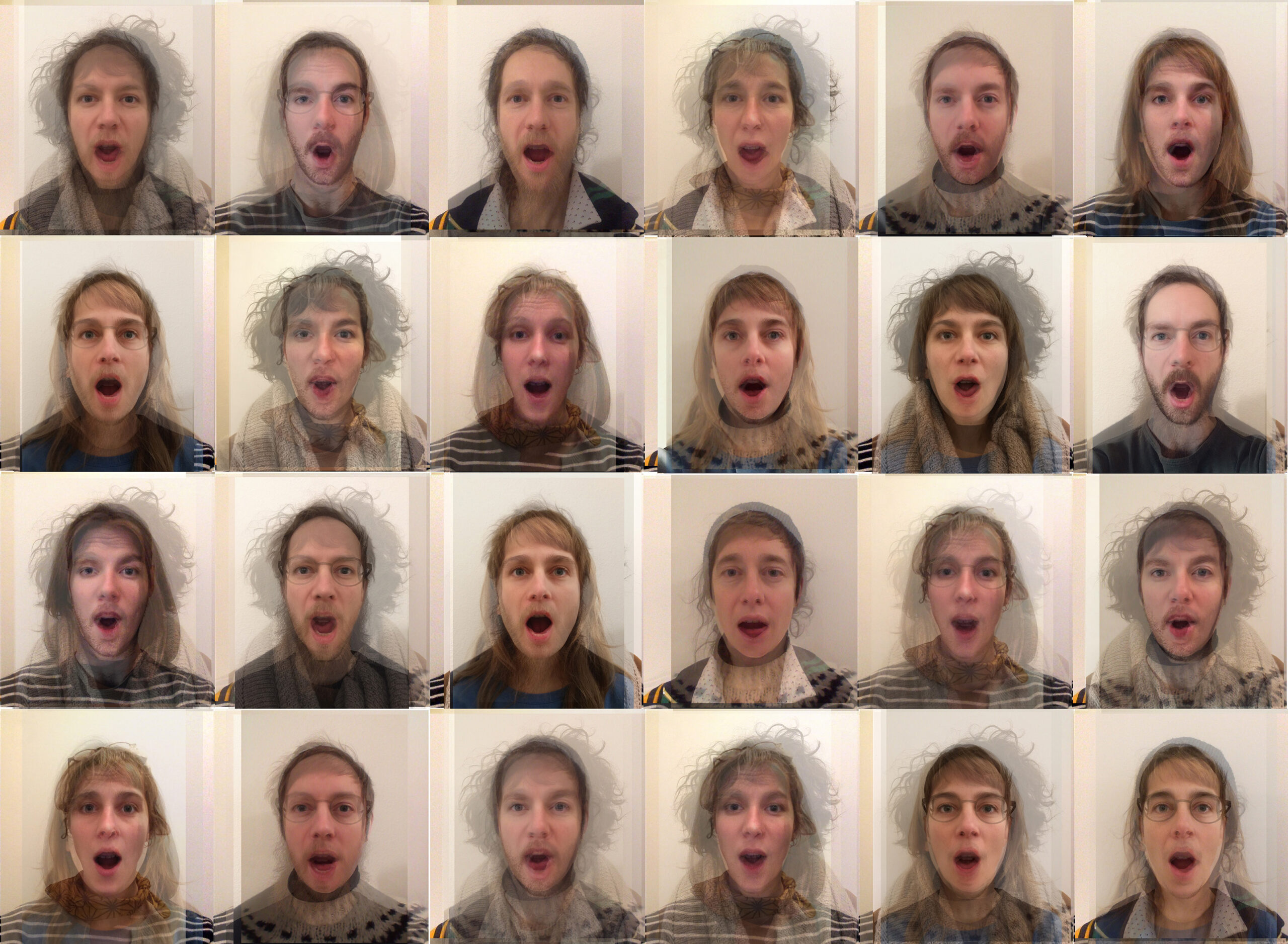
Plurissons, Jean-Baptiste Veyret-Logerias © Jean-Baptiste Veyret-Logerias
It has to do with generosity as well: to me, when it comes to choir singing, if you’re not here to share with the others, then the sound will suffer. But the practice can also draw people to start sharing with others. I can feel a big distinction between choirs in the way they sound. There is a certain way of sounding which is ‘warm’ and another which is ‘cold’. In some professional choirs, you hear the skill level, but it’s very cold. You hear the music, but not the relations within the group. Or rather, you hear professional but not close relations in the sound. And I’m very interested in this sensation you somehow get through listening of how the group is working and sharing together.
That closeness or intimacy can be revealed. Choir singing should be about this to me. If not that, then what? I feel the same way about orchestras. That’s why I like some orchestra conductors and others less, because some lack the ability to bring people together. Which I think is needed—especially nowadays.
How do you train that ability of bringing people together? That can’t be something you’re either just capable of or not.
You have to reinforce the group and the relations within the group. This is always an aim. You can never achieve it, in a way. But it’s essentially what I’m looking for. It has to do with trust, I think—trust and relying on the others. It’s the same as contact improvisation, once again. You have to see who has those specific skills that the others can rely on. This distribution of skills within the group is always moving; it never stays the same. And it’s not that you can rely on this person specifically for this specific skill always. It’s constantly changing, depending on where people are in their own learning process. Some people will be quicker with the music, but less quick with relations toward others; for others it’s the exact opposite. Learning to sense and nurture this is a set of very tiny skills that are super important in a group. Because when it works, it can really make connection happen.
“One of the first things that I try to reinforce in people is trust. Especially when working with amateur choirs, which is what interests me the most. I really consider myself an amateur, and I feel my practice, whatever it is, is an amateur practice.”
So one of the first things that I try to reinforce in people is trust. Especially when working with amateur choirs, which is what interests me the most. I really consider myself an amateur, and I feel my practice, whatever it is, is an amateur practice. Most amateur singers, especially people who have not sung much, usually feel that they cannot sing, or that they sing out of tune, that they have no clue what to do. I believe that we already know everything we need to sense to be able to sing, but you have to make people see and believe it. So the trust has to be built from very basic practices, namely listening: what am I producing? How am I producing it? And also listening to others: what is this person doing? How am I affected by this? Do I like it? If I don’t like it, then why? Even if I dislike it, can I find something in it that I could be interested in, that I could feed with my own sound? You need to move beyond judgment.
What do you like to do? Be silly. Play with it. Don’t be clever with it. Don’t try to invent something new. Play with the others. It doesn’t matter—just do something. Then it starts to be interesting because judgment is pushed out. This is not easy, because we are judgmental beings. But suspending this judgment and creating the conditions for it to be as suspended as possible—that is one of my goals.
It’s really interesting to me that you said that you see yourself as an amateur, because at the same time, everything you’re describing requires an enormous amount of skill and a sort of hyper-awareness of allthese little things and dynamics that are going on in a group.
I’m not an amateur economically. I’m not an amateur in terms of the status that I have in the dance field and the music field. But I feel like an amateur when I’m entering a studio and I’m starting to practice. I do have experience, and I have developed skills from these experiences. But still, I feel like an amateur. Why? Because somehow in the social perception of professionals, you always feel like they are in the know.
I don’t feel like I’m in the know. I don’t know shit about music. I don’t know shit about singing. I’m searching. In many ways, I feel like some amateur musicians have developed skills on a technical level that I have totally not developed. What I’m trying to say is that by putting myself in this category of the amateur, I’m trying to keep myself interested, intrigued, and alert. Being a ‘professional’, I’m not sure that it actually brings anything to the practice in the studio. Yes, I have tools, but my main point is to keep being an amateur.
“I’m not an amateur economically. I’m not an amateur in terms of the status that I have in the dance field and the music field. But I feel like an amateur when I’m entering a studio and I’m starting to practice.”
Letting go of a certain pursuit of perfection.
Exactly. Every day I try to tell myself: work with what is there. If my voice is only breath today, it’s only breath. It’s fine. Maybe we can make something out of it. Some days it’s annoying; it’s frustrating. Yes. How can we still make something out of it? So maybe being an amateur is just one way to get back to the sensation of things.
To stay curious.
Yes. To remain active in what I’m doing and to not stick with what I know. We all have skills and habits that we repeat, which is fine, it’s good to have anchor points. But I think you also need to reinvent those anchor points. I can get very bored with habits, because they put me in a certain perception of myself. That’s something that I started questioning through dancing. Dancing has this capacity to draw us toward certain inner sensations that are hardly reachable and require a lot of attention and curiosity.
Why do you think people ask you to join a project? What do you bring to a collaborative practice?
In preparation for this interview, I tried to make a list of projects that I was part of in the last 10-15 years. I realised that all the people that I worked with somehow have a connection to dance. So, the people who call me always have a certain dance practice. My guess is that that’s where we meet—that’s the bridge—because we share a common imagination, common skills, and an awareness of how the body is engaged in making a gesture happen.
I work a lot with choreographers who call me to facilitate the transmission of songs to their groups. I think that also has to do with a certain sensitivity to movement that I have, and the idea I believe in that singing is all about movement. When I facilitate singing in people, I draw attention to movement,—the movement of breath first of all, and how it emerges and how one can shape it. From there, you can start building.
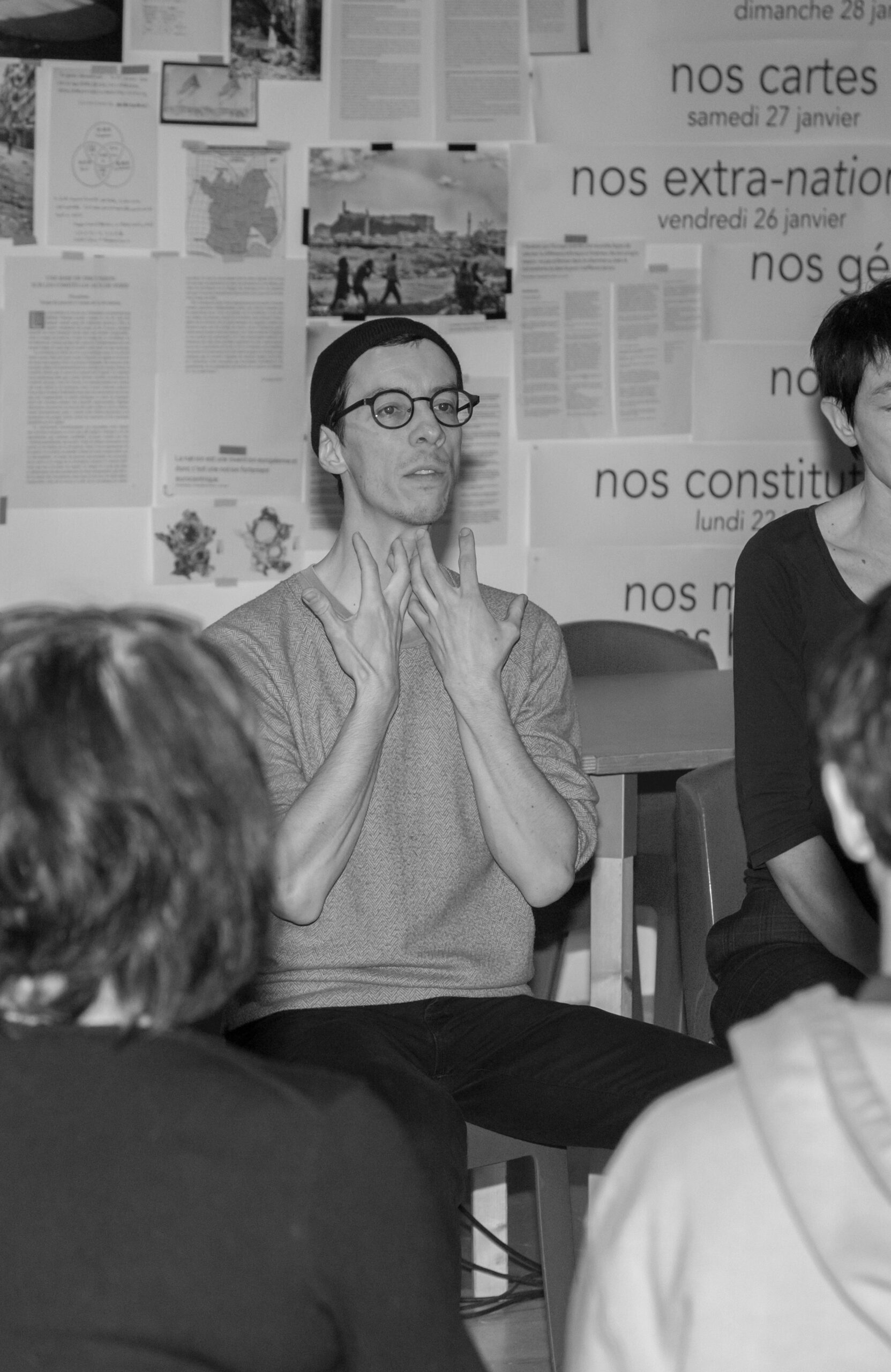
Plurissons, Jean-Baptiste Veyret-Logerias © Hervé Veronèse
By starting from these tiny sensations, you can discover another type of singing than the one that I was taught, which is more purely ‘technical’: I took a lot of classes where the body was seen. as an instrument, was instrumentalised to reach a certain quality of sound, as if the body would be just a vehicle for the voice. I don’t want to work in this way. I want to work from the awareness of the body, and how the gesture is shaped into it. I try to always approach the vocal gesture as a movement inside yourself which draws you outside yourself.
“I want to work from the awareness of the body, and how the gesture is shaped into it. I try to always approach the vocal gesture as a movement inside yourself which draws you outside yourself.”
Do you notice a lot of differences in how dancers approach singing as compared to people who aren’t used to working with the body in the same way?
Yes, because of the imagination that it requires, I guess. Dancers have a strong capacity to enhance their sensation with a certain imagination. They trigger certain ways of perceiving an inner feeling or movement, and stay there. That’s where they work from. Some musicians, I feel, have the tendency to work from outside of their body, as if the voice can only be this immaterial being floating in the air, as if the body can only be the vehicle, as if the voice can’t be first and foremost bodily, carnal. I also see this in people who have never sung before.
Usually, they think that they have to push their voice out to make it exist in the world. Whereas the more you amplify your voice inside, the more you’re the conveyor of your own voice outwards. It’s not outside of you, it’s in you, because that’s the only way you can draw it out. This is a strong paradigm shift for some people, because it draws them back to the sensation of their own body and how it gets involved in the vocal gesture. This can sometimes be very confronting.
Are dancers more used to going there?
Dancers train for a double awareness: ‘I’m there with you, but I’m never out of myself. And it’s not because I’m there with you that I need to be out of myself, and out of my weight.’ Moreover, dancers tend to have a very strong practice of sharing in the studio. They ask each other things like ‘How do you do this move?’ ‘What do you go through?’ ‘What is your imagination of this movement?’
This doesn’t happen between singers?
In my experience it rarely does. Rehearsals for professional musicians and singers are usually like this: you come knowing the score and your voice already warm, you work on the score, you leave. So, there is hardly any sharing of practices. I don’t want to make any distortion here though: for many practitioners singing and dancing come together and are linked.
Maybe this linked to the idea of talent as well? There is such a perception that there are people who can sing and people who can’t sing, and also that your voice is very personal to you. That inherently leads to a less social way of working with it. We have so much vocabulary to describe one’s voice, words like range, timbre, colour… As far as I know, in dance, we don’t use so many words to describe someone’s body as something that you can develop and train, but that is somehow personal to you.
Absolutely, this idea of vocal ‘identity’ is very present still. I’m very cautious with this term of identity, which I feel is very dangerous in a way. I think singularity is more accurate.
The singularity of the body is the same because we don’t have the same tonicity. We don’t have the same posture. We don’t have the same length of bones. We don’t have the same length of muscles. We didn’t train the same. So, we don’t have the same cultures and nature didn’t give us the same things. It’s not that it’s either natural or cultural. It’s both, always. And voice is exactly the same. If I sound like this today, if my vocal ‘identity’ is this one, it has to do with a certain culture. It has to do, yes, with the length of my vocal cords, which give me a certain height, with the length of my pharynx and the larynx and the shape of my mouth and everything. Yes, this all gives me a certain range. But that doesn’t say anything about how the quality of the sounds I can produce, and how I can play with my voice and reach a multiplicity of sounds. You can’t have an essentialist approach of the voice.
“We hear a lot: ‘You have a talent. You have this very specific timbre that you have to be cautious with. You have to nourish it.’ Fuck that. The idea of vocal identity, meaning fixity, bores me.”
We hear a lot: ‘You have a talent. You have this very specific timbre that you have to be cautious with. You have to nourish it.’ Fuck that. You have so many voices inside you. The idea of vocal identity, meaning fixity, bores me. Unless identity is something to be constantly reinvented. It’s true that when you call me on the phone, I will know that it’s Simon from your voice. That’s the way your voice sounds by habit (and not ‘naturally’). But you could, for fun or for any reason, be sounding differently. And then I would be like, ‘whoa, whoa, who’s speaking?’ That’s exactly what I was trying to say before, this thing of being playful with it. Because then you can start to explore. That’s also another pedagogical tool, actually, to draw people to discover their own voice. The ways in which we can make our voice sound are highly performative. So very moving and very plastic, always changing. It has nothing to do with the fixed ‘identity’ that we usually associate with it. I think that’s what I try to encourage in myself and others, to stay curious about where our voices can take us.
KRIJG JE GRAAG ONS PAPIEREN MAGAZINE IN JOUW BRIEVENBUS? NEEM DAN EEN ABONNEMENT.
REGELMATIG ONZE NIEUWSTE ARTIKELS IN JOUW INBOX?
SCHRIJF JE IN OP ONZE NIEUWSBRIEF.
JE LEEST ONZE ARTIKELS GRATIS OMDAT WE GELOVEN IN VRIJE, KWALITATIEVE, INCLUSIEVE KUNSTKRITIEK. ALS WE DAT WILLEN BLIJVEN BIEDEN IN DE TOEKOMST, HEBBEN WE OOK JOUW STEUN NODIG! Steun Etcetera.
interview
15.12.2025
Leestijd 21 — 24 minuten
15.12.2025
—
14.04.2026

Simon Baetens is co-editor in chief of Etcetera. He works as a theatre maker, dramaturg, and performer. He has collaborated with Lisa Vereertbrugghen, Thomas Verstraeten, Micha Goldberg & Rosie Sommers, Pablo Lilienfeld & Federico Vladimir, among others. In 2024, he created the performance I’m Not Done.

Klaas Tindemans
Mia Vaerman
interview 15.12.2025
Klaas Tindemans
Mia Vaerman