Iphigenia – De Roovers
Geef mij maar het verzet van Klytamnestra
Mia Vaerman




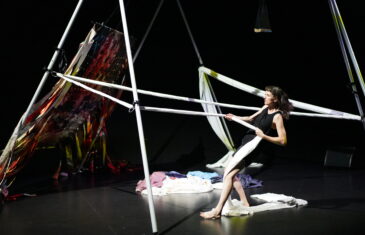
Shadow Text, Chloe Chignell & Amina Szecsödy © Miles Fischler
Can a dance piece read a text rather than reproduce it in stage form, as in the classic sense of adaptation? The performance Shadow Text by Chloe Chignell and Amina Szecsödy seeks to bring feminist philosopher and writer Monique Wittig’s novel Les Guérillères to the stage. Wittig’s novel, from 1969, — now considered part of the feminist and lesbian canon Feminist critic Mary McCarthy for example, called the book ’the only work of beauty to come out of the Women’s Lib.’1 The novel is a cyclical narrative, in which collective life is continuously destroyed and rebuilt. Wittig’s book is structured as a triptych and in this sense resembles epic more than the conventional novel. Wittig’s novel may be perfect for the stage, as it is concerned with citation, cyclic movement, non-linear time, and the materiality of the body.
Monique Wittig wrote in 1980 ‘that there is no “feminine writing” and that ‘one makes a mistake in using and giving currency to this expression.’ Throughout her literary and theoretical work, Wittig insists on this point, that ‘woman’ is a mythical formation, which only has meaning in relation to man. Lesbians, Wittig famously claimed, are not women because they don’t sleep with men: their ‘sexed’ position is not defined by its relation to ‘man’ as ‘woman’ inevitably is. In her novel Les Guérillères (1969), Wittig advances her claim in literary form, imagining a world in which the concept of ‘man’ has never even existed. The novel describes a world in which there are no men, but there are no women either, it is a utopia inhabited by ‘not-women.’ Wittig was a separatist but not essentialist, as her politics of disidentification testifies. Only through separatist politics can the ‘lesbian’ start to define her own language, to create a language that is not defined by being the ‘other’ of men.
Shadow Text ‘reads’ Les Guérillères in multiple ways. Firstly, Chignell and Szecsödy reproduce scenes from the novel on stage but rewrite them. In a language close to Wittig’s, the text, written by the performers, is projected askew on the wall. It describes women gathering around a campfire for example, while the performers mimick gathering around the fire. This might give the impression we are reading Wittig’s text, but by not having Wittig’s own words on stage, Shadow Text intends to create a new, Wittigian, text. The piece is composed of three short stories dispersed across projected text, sound installation, and movement material. The question of the performativity of both language and reading echoes Wittig’s insistence on the materiality of language itself. This is not simply adaptation but the invention of a language that belongs to the work, one that acknowledges the pre-existing language it departs from and continues.
Another way in which Shadow Text reads Les Guérillères is by making us look at the book as object. The audience members each receive a copy of the Feminaries, a mysterious book mentioned in Wittig’s novel but its content is not explicated, but it is in the hands of Chignell and Szecsödy. The copies of the book, with its new content, point to Shadow Text’s infidelity to Wittig’s novel. Rather, what we are dealing with is a proliferation of books and readers, a ‘more’ as a refusal of the single, authoritative text. A way of reading Chignell and Szecsödy describe as ‘exploding’ the novel on the stage.
The guerrilla of women announces itself first through a subtle militaristic march. The two dancers on stage sound like a crowd. In this way, the first absence of speech—the mere sound of marching—becomes a guerrilla tactic announcing the more than two, or the multitude of women. This is a gesture they will repeat throughout, pointing at language by not speaking, and this opening sound invokes the collective force of Wittig’s guerrilla.
Shadow Text can be understood described as a choreographic translation of Wittig’s book, or as a contemporary annotation to Les Guérillères. It adds to the novel, rather than restaging it in dance. In an earlier version, Shadow Text was an immersive work in which spectators could move around the dancers and vice versa. On stage, the work attempts to preserve a participatory dimension both by letting us read and watch at the same time, but also by handing us the book as an object—transforming us into the readers of the Feminaries in Wittig’s novel.
Shadow Text works with iconography: the two bodies become one in a statuesque pose, one climbing onto the other, arms extended, in an almost angelic elevation, that other androgynous figure. Imagine a marble monument—head held proudly, without a smile, with a sharp, precise look that here specifically belongs to the lesbian, neither man nor woman. It is precisely the epic, world-making ambition of Wittig’s that Shadow Text translates into bodily iconography. The lesbian as mythic figure, who is now no longer lacking her own iconography, is Wittig’s intervention. The creation of a ‘lesbian’ language, with its necessarily speculated and fabulated history, in the absence of recorded history.
“Shadow Text asks how dance can represent the lesbian, defined by Wittig precisely as not-woman.”
A recurring stereotype about lesbian sexuality is the idealization or eroticization of ‘sameness’: woman looking at woman, and thus at herself and its connotations of equality, symmetry, and mirroring. Shadow Text deliberately constructs asymmetry as a response to this idea, especially in its manner of the two dancers embracing. Their embraces refuse the symmetry often projected onto lesbian erotics; instead they emphasize imbalance and resistance, an erotics of asymmetry. In doing so, it shows a lesbian erotics grounded not in sameness but in asymmetry, and also in repetition. Shadow Text thus asks how dance can represent the lesbian, defined by Wittig precisely as not-woman.
In a recent essay on Wittig’s afterlives, feminist theorist Sophie Lewis identifies a distinctly guerrilla politics in contemporary queer movements made possible by Wittig’s intervention, as the lesbian ‘conjures something quite other than intrafemale eroticism: not a form of desire but a strategy toward an abolitionist end.’ Lesbian politics, here, is grounded in collective disidentification with gender as a political category rather than an identity to be affirmed—as a lesbian politics grounded in the identification with ‘woman’ would. There is a negativity at play in Wittig’s feminist politics as a politics of estrangement through describing the body. The body becomes a mode of speaking, a body that can cite itself through repetitive gestures. In Shadow Text, quite literally, when the performers eat and digest language in the form of roses and spit them out. Language becomes body and body becomes language.
Representing lesbian erotics without reinscribing sexual difference—man versus woman—is a challenging and exciting task, as both Wittig’s work and Shadow Text demonstrate. These works are necessarily speculative. What seems to be missing in Shadow Text though, is the ways in which in Les Guérillères the body, and the collective as a body becomes a site of abjection too, as identity and and the self get more and more displaced. In the novel, the ‘not-women’ lesbians invade each other’s bodies. Shadow Text seems to be a more clean restaging of Wittig’s separatist utopia but it convinces as a continuation of Wittig’s project, speculating on what forms of embodiment and collectivity become possible once ‘woman’ ceases to be the central category. Shadow Text insists on the transformation of the body and the self through language. Woman doesn’t exist, but the lesbian does.

Shadow Text, Chloe Chignell & Amina Szecsödy © Miles Fischler

Shadow Text, Chloe Chignell & Amina Szecsödy © Miles Fischler
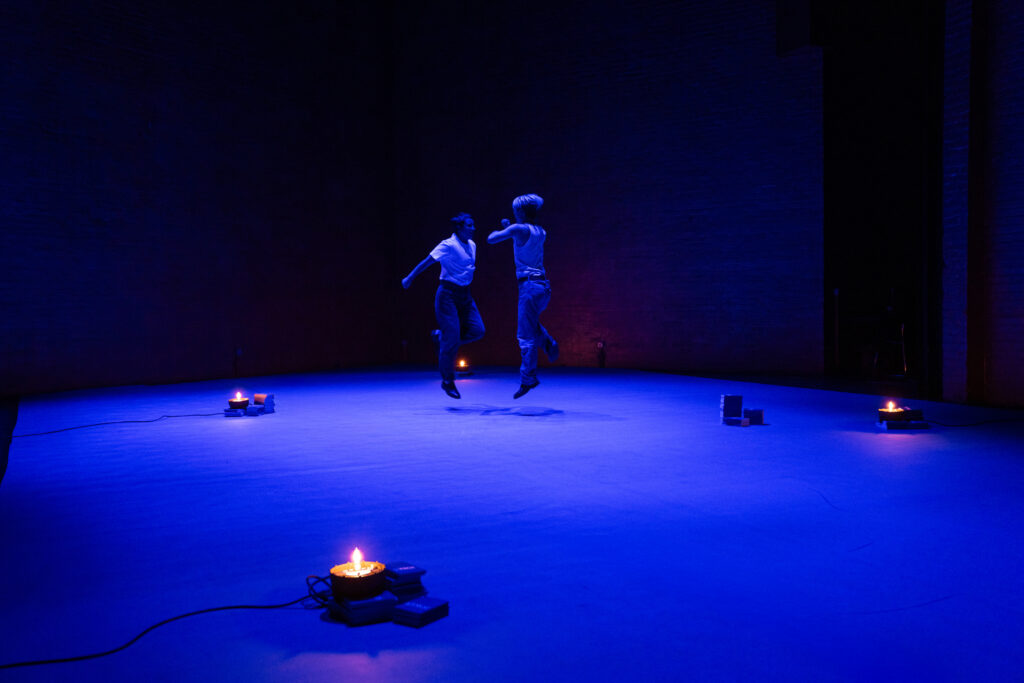
Shadow Text, Chloe Chignell & Amina Szecsödy © Miles Fischler
KRIJG JE GRAAG ONS PAPIEREN MAGAZINE IN JOUW BRIEVENBUS? NEEM DAN EEN ABONNEMENT.
REGELMATIG ONZE NIEUWSTE ARTIKELS IN JOUW INBOX?
SCHRIJF JE IN OP ONZE NIEUWSBRIEF.
JE LEEST ONZE ARTIKELS GRATIS OMDAT WE GELOVEN IN VRIJE, KWALITATIEVE, INCLUSIEVE KUNSTKRITIEK. ALS WE DAT WILLEN BLIJVEN BIEDEN IN DE TOEKOMST, HEBBEN WE OOK JOUW STEUN NODIG! Steun Etcetera.
essay
12.12.2025
Leestijd 6 — 9 minuten
15.09.2025
—
14.12.2025

Mia Vaerman
Tom Rummens
essay 12.12.2025
Mia Vaerman
Tom Rummens