Maak kennis met Michael Disanka, onze columnist in Congo!
Nieuwe reeks: Outside Eyes
Michael Disanka


© Giuseppe Follachio
As AI technologies are increasingly integrated into the performing arts, the question of what we want to make art with becomes central in Arkadi Zaides’ documentary choreography. In The Cloud, visual and auditory material shapes an artificial reality that is critically re-embodied through the body. Misha Demoustier’s improvised movements respond to AI-generated data in ways grounded in his own subjectivity. How can the aftermath of the Chernobyl explosion and the work of the liquidators be (re)interpreted through both AI-generated material and the performer’s embodiment?
The Cloud (2024) is a performance by choreographer Arkadi Zaides, created in collaboration with performer Misha Demoustier, AI developer and composer Axel Chemla-Romeu-Santos, cinematographer Artur Castro Freire and dramaturg Igor Dobricic. In this work, Zaides constructs an artistic dialogue between two types of invisible clouds: the radioactive cloud that spread in the aftermath of the Chernobyl nuclear disaster in 1986 and the virtual cloud of artificial intelligence as a site of data storage. Born in 1979 in Gomel, Belarus (then part of the USSR), only a few kilometres from the Chernobyl reactor, Zaides grew up under the shadow of nuclear threat. Nearly four decades later, The Cloud re-embodies political and personal narratives through Zaides’ autobiographical connection to Chernobyl, exploring the complex interplay of ‘human and non-human agency, biography and history, the factual and the fictional’ (“The Cloud” n.d.).
In April 2025, I saw The Cloud at GC De Kriekelaar in Brussels. I was particularly captivated by Misha Demoustier’s embodied (re)interpretation of AI-generated documentary material. Having previously written about his sister Zoë Demoustier’s choreographic work and her strategies of reinterpreting ‘Flemish Wave’ archival material, I was keen to understand how Misha Demoustier engages with documentary material in Zaides’ work. My curiosity was further heightened by the fact that he joined the creation process only during its final two weeks, at the end of an eight-year research project. To gain deeper insight into the work’s documentary strategies and his experience as a performer, I conducted an in-depth interview with Misha Demoustier in May 2025.
The dramaturgical structure of The Cloud can be understood as twofold: it begins with a textual and visual introduction of documentary material by Arkadi Zaides and gradually transitions into an embodied exploration of video footage and AI-generated audio by Misha Demoustier.
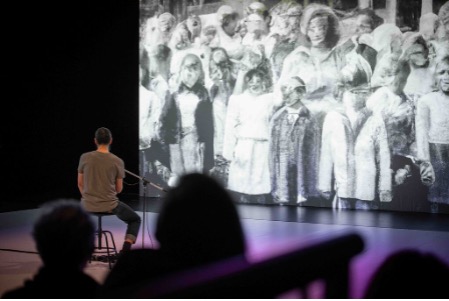
Zaides opens the performance by welcoming the audience and introducing the sources he will use throughout the ‘experiment’, as he calls it. These include his own notes, selected documents and materials produced by a custom-made AI system. Seated on a stool at the centre of the stage, he reads his notes from an iPad into a microphone, while two screens behind him display almost real-time transcriptions generated by a speech recognition program. The choreographer maps his personal history in relation to broader historical events. For example, he recalls May 1st, International Worker’s Day, when a city parade took place, yet he spent the day undergoing a medical examination rather than participating in the festivities. This memory unfolds alongside the accumulation of text and images on the screens, forming a visual composition reminiscent of a spider’s web or a collage, with photographs interconnected by straight lines. The diagrams grow increasingly complex: the material duplicates, mutates and spreads rapidly, evolving into an expansive virtual archive. This network mirrors the contemporary understanding of archives, which now extend beyond physical spaces to include digital collections accessible through various technologies.
“Both AI-generated and non-AI documentary materials can be factually unreliable, thereby blurring the line between fact and interpretation, if such a distinction can be made. This raises the question of whether all documentary material is inherently subjective.”
Seated behind a desk at the side of the stage, Axel Chemla-Romeu-Santos oversees the AI development and soundscape, enabling the non-human actor, artificial intelligence, to generate material. The audience’s perception constantly shifts as the visual collage alternates between zooming in to reveal details and zooming out to offer a sense of the bigger picture. Upon closer inspection of the images, particularly the class photograph showing Zaides and his childhood friend Genaldi, the artificial nature of these visual representations becomes evident. These images are not real but rather visualize a constructed or false reality. However, both AI-generated and non-AI documentary materials can be factually unreliable, thereby blurring the line between fact and interpretation, if such a distinction can be made. This raises the question of whether all documentary material is inherently subjective.
Although filmmaker Meg McLagan’s observation in ‘Introduction: Making Human Rights Claims Public’ is not specifically about The Cloud, she argues that photographs and moving images in general cannot always be trusted (2006, 192). They are not ‘transparent mirrors of reality’ and therefore require interpretation and critical contextualization (ibid., 192). For Zaides, such critical engagement with documentary material is situated in the body, a medium ‘through which documents are encountered, re-inscribed and transformed’ (2025, n.p.). In his recent lecture ‘Notes on Documentary Choreography’ at the symposium Towards Documentary Choreography Encounter #2 at Beursschouwburg in 2025, Zaides elaborates on the intersection of embodied and documentary practices, a concept he calls ‘documentary choreography’. He further clarifies the central role of the body in relation to new media within his artistic research:
Documentary choreography necessarily grapples with new technologies and new media. Choreography, grounded in the physical body, enters into critical dialogue with these technologies, offering a site where disembodied data can be re-materialized and interrogated through embodied practice. (Zaides 2025, n.p.)
The re-materialization of data through the body can also be seen as a process of re-subjectivization by the performer. In the second part of The Cloud, Misha Demoustier enters to perform a solo which offers an embodied (re)interpretation of the (AI-generated) documentary material he perceives and experiences in that moment. His subjective engagement will be explored in more detail later in the text.
At the first edition of the symposium Towards Documentary Choreography Encounter #1 at Beursschouwburg in 2023, Arkadi Zaides invited several artists and scholars to collectively reflect on the concept of documentary choreography (“Towards Documentary Choreography Encounter #1” 2023). Together, they explored how such artistic practices ‘not only challenge the boundaries of contemporary dance and documentary theatre but also engage critically with social and political issues’ (ibid.). This situates Zaides’ use of the term documentary choreography within the tradition of documentary theatre, which is part of a broader category known as ‘theatre of the real’.
In her book Theatre of the Real, drama scholar Carol Martin explains that this category includes not only documentary theatre, but also other forms such as ‘reality-based theatre’, ‘theatre of witness’ and ‘autobiographical theatre’ (2013, 5). According to Martin, these forms ‘recycle reality’ by drawing on personal, social, political and/or historical contexts (ibid., 5). She further notes that contemporary society is shaped by a growing critical awareness of how ‘the real is presented across media and genres’ (2013, 5). Martin links this shift to the exposure of images through social media, which often include artificial content or misleading information such as fake news, a concern similarly reflected in performances such as The Cloud. Within Zaides’ artistic oeuvre, Martin’s question is pertinent: ‘In what ways is performance embodied kinesthetic historiography, and what end does this serve?’ (ibid., 11).
© Giuseppe Follachio

© Giuseppe Follachio
© Giuseppe Follachio
In her earlier article ‘Bodies of Evidence’, Martin observes that the rise of documentary theatre coincides with a period marked by ‘international crises of war, religion, government, truth, and information’ (2006, 14). The nuclear disaster at Chernobyl and the years-long ongoing conflict between Israel and Palestine are just two among many examples. Within such international contexts, Martin argues that documentary theatre allows for a critical examination of complex issues by laying bare the reliability and shortcomings of its sources (ibid., 9). She identifies ‘technology, text and body’ as the key components of this form of theatre, pointing to technology as ‘the primary factor in the transmission of knowledge’ (ibid., 9). This knowledge travels both digitally and within the structure of The Cloud, where diverse perspectives are shared with the audience. The nature of this content also changes, as social media allows the circulation of raw, unfiltered material that might otherwise not be presented by official news channels.
“In The Cloud, much of the creative work, editing and presentation, is performed by the artificial intelligence itself, rather than residing with the performer, or even the artist.”
Having grown up with his father, war journalist Daniel Demoustier, Misha Demoustier was exposed to this type of footage from an early age (D’Haenens 2025). Today, he notes, the rapid transmission of visual material seems accessible to everyone (ibid.). He emphasizes that he has always approached this material through an emotional lens, in contrast to his father’s more objective stance (ibid.). As a performer in The Cloud, Misha engages with the documentary material subjectively, shaped by his own personal history. This aligns with Carol Martin’s observation that ‘the actors on documentary stages perform both as themselves and as the actual personages they represent’ (2006, 10). Furthermore, according to Martin, the creative act within documentary theatre lies in the ‘selection, editing, organisation and presentation’ of material (ibid., 9). Paradoxically, in The Cloud, much of this creative work, editing and presentation, is performed by the artificial intelligence itself, rather than residing with the performer, or even the artist.
My friend, liquidator, why are you not afraid of the fire that burns the earth? … You and I, my friend, we are the liquidators, the ones who have to go near the fire and try to stop it with our bodies. … Do you see, my friend, do you see what you see? … Do you hear, my friend, do you hear what you hear? … Do you feel, my friend, do you feel what you feel? … Do you know, my friend, do you know what you know? … Do you love, my friend, do you love what you love? (Excerpts from Arkadi Zaides’ The Cloud at GC De Kriekelaar, April 2025)
At the start of the second part of The Cloud, the audience hears these excerpts while Misha Demoustier enters the stage. The audio is delivered through a small speaker attached to the performer’s body. However, when technical issues arise, the text is played through the theatre’s sound system (D’Haenens 2025). Demoustier identified three aspects of the monologue that guided his research and shaped his embodied (re)interpretation: (1) the purpose for which the text was generated using AI, (2) his personal relation to its themes, and (3) the strategies he employs to physically embody the words as he hears them.
He explains that the AI system, drawing the body of information presented in the first part of The Cloud, was tasked to articulate the text from three perspectives: Zaides’ friend Genaldi from their hometown of Gomel, the angel figure and the liquidators. Before initiating the process, Zaides engaged in dialogues with the AI system concerning the performance’s themes. During the creation process, the system consistently produced a new version of the text for each rehearsal (D’Haenens 2025). Having listened to several versions, the team eventually preferred the version now used in the piece, at which point no further text was generated (ibid.). In addition to generating text, the AI produces sound waves whose exact outcome cannot be fully predicted, adding an element of uncertainty and challenge (ibid.). During rehearsals, a visual prompt was entered on the screen, which then triggered sound generation via the AI system (ibid.). In the performance, however, this prompt is hidden from the audience, removing a layer of transparency regarding the sound’s origin (ibid.).
One of the voices that can be traced back within the text is that of Genaldi, Zaides’ childhood friend from Gomel, near the Ukrainian border. Zaides left Belarus in 1990, during the Soviet era, but returned in 2016 with the intention of reconnecting with Genaldi. One of his initial aims was to document this reunion on film, yet the plan was disrupted by the COVID-19 pandemic in 2019. By sharing this context, Zaides introduces the personal and documentary foundation of the research that led to the creation of The Cloud. Although Demoustier only received what he refers to as ‘abstract information’ regarding their friendship, he constructed his own narrative around it. To embody this theme, he imagined the emotional bond between the two friends and accessed a sense of empathy by projecting his own feelings of connection towards Genaldi, envisioning him as a friend far away (D’Haenens 2025).
The second perspective is that of the angel looking back. During the first part of The Cloud, Paul Klee’s painting Angelus Novus appears within a virtual collage of text and images. Walter Benjamin is mentioned, as he famously described the figure as ‘the angel of history’ in his 1940 essay ‘On the Concept of History’. Demoustier embodies this idea of the angel by walking backwards across the stage, making expansive arm gestures and silently miming the monologue. He imagines being pulled backwards, translating this sensation physically into movement (D’Haenens 2025). A subtle tension arises from the lack of synchrony between the artificial voice and his mouth movements: rather than aligning, they enter a dynamic relationship, attempting to connect across a perceived gap in which his embodiment creates a link to the present.
“This essay offers one possible reading of The Cloud as a work that reflects on the ongoing transformation of documentary strategies and embodied practices. Yet as Misha Demoustier suggests, we are also confronted with an ethical question: ‘What do we want to make art with?’”
In addition to the audio, a video is displayed on one of the screens, offering a visual representation of the physical labour of the Chernobyl liquidators. The task of removing radioactive material from a rooftop was assigned to the workers. The footage, not Ai-generated, documents workers being assembled, instructed, sent into the ‘forbidden zone’, rewarded upon return and finally collapsing in exhaustion as they silently process the aftermath. The third voice is that of the liquidator. As the audience observes the bodies of the liquidators displayed on the screen positioned behind the performer, a strong emphasis is placed on the body, both Demoustier’s and the group of men. The irreplaceability of the body becomes clear: when artificial robots broke down under the effects of radioactivity, humans had to take their place (D’Haenens 2025). The liquidators were therefore referred to as ‘bio-robots’, living bodies that carried out the work but later faced severe illness or death (ibid.). On stage, Demoustier improvises movements that embody the affect and aftermath of the explosion. He describes a tension between not wanting to improvise and having to do so, likening his situation to that of the liquidators, who were asked to perform tasks without proper training (ibid.). While improvising, he enters a state he calls ‘functioning on autopilot’, a mode he associates with a survival instinct (ibid.).

© Giuseppe Follachio

© Giuseppe Follachio

© Giuseppe Follachio
During his solo, Demoustier uses anchor points that correspond to shifts in the video. For instance, when the liquidators exit the rooftop, Demoustier moves towards the edge of the stage, and when they are called back, he re-enters the stage as if responding to the same orders. He notes that he misses these cues about 90 percent of the time, yet this ‘failure’ is deliberately embraced as part of The Cloud’s artistic research (ibid.). The focus, as in much documentary theatre, is on the process rather than resolution, revealing how meaning is formed through the interpretation of both actors and spectators. At one moment in the video, as the environment sounds and the voices of the men play, it seems as if Demoustier is being addressed personally: one liquidator asks another if he has an elastic, to which the reply is: ‘Misha, Misha, Misha has it’, responding to the performer’s first name.
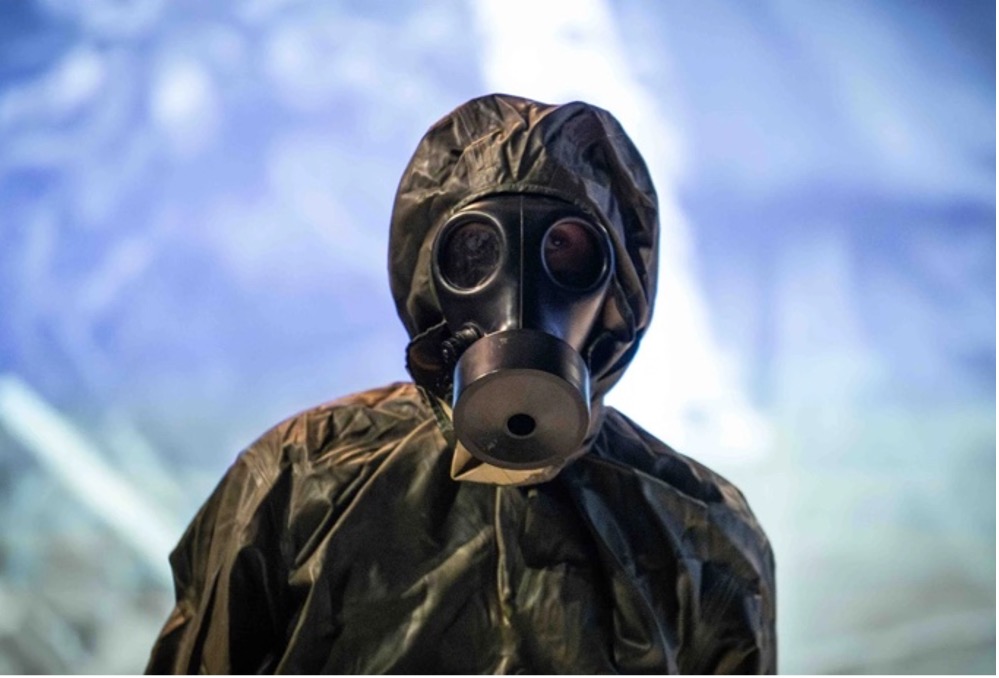
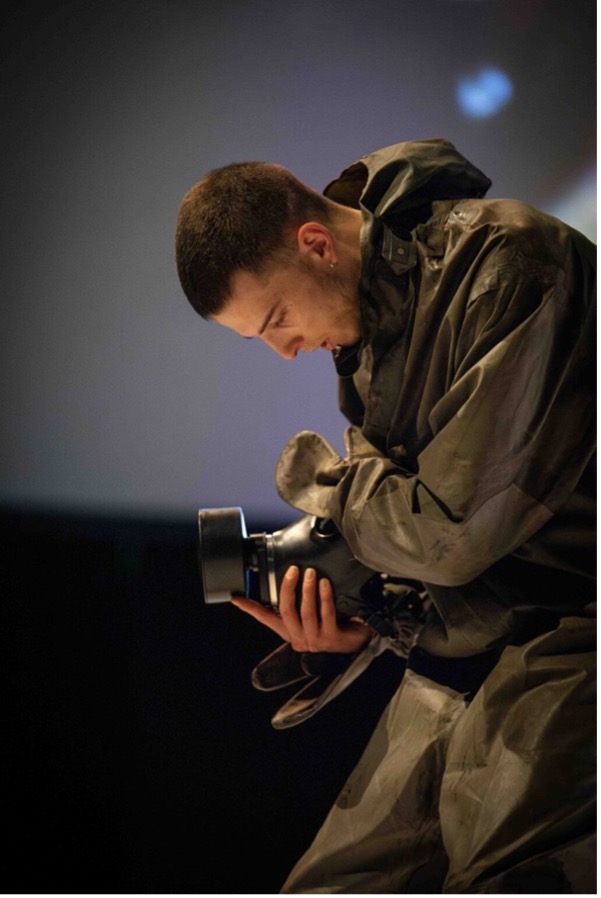
A heightened sense of reality is created through the suits and masks purchased on eBay and worn by Demoustier and Zaides at the end of the performance. During his solo, Demoustier initially holds the mask in his hand. Later, when he puts it on, a certain level of anonymity is established. His face disappears behind the fabric, visually merging with the male figures in the video behind him. Wearing the mask thus becomes a gesture of dehumanization. Demoustier experiences the costume as physically uncomfortable, a sensation intensified by heat and reminiscent of the liquidators’ experience. The mask itself also evokes a sense of threat when Zaides expressed his concerns about the potential radioactivity in the clothes. In doing so, he brings a sense of realness into the theatre space. A reality that allows for individual reinterpretation. Ultimately, Zaides invites not only the audience but also the performer he collaborates with to form associations and dissociations that resonate with both his and Demoustier’s personal histories.
As Martin anticipated in 2006, documentary theatre continues to ‘morph’. How might future practices of documentary choreography continue to evolve in response to emerging technologies and shifting political landscapes? In The Cloud, giving agency to artificial intelligence not only transforms the production of documentary material but also redefines how performers and audiences relate to it. This essay offers one possible reading of The Cloud as a work that reflects on the ongoing transformation of documentary strategies and embodied practices. Yet as Misha Demoustier suggests, we are also confronted with an ethical question: ‘What do we want to make art with?’ (D’Haenens 2025). As AI technologies become increasingly integrated into the performing arts, this question will remain open and central to any critical engagement with future practices of documentary choreography.
References
D’Haenens, H. (2025). Interview with Misha Demoustier at Brussels on 31 May.
Martin, C. (2006). Bodies of Evidence. The Drama Review, 50(3), 8–15.
Martin, C. (2013). Theatre of the Real: An Overview. In Theatre of the Real (pp. 1–21). Palgrave Macmillan.
McLagan, M. (2006). Introduction: Making Human Rights Claims Public. American Anthropologist, 108(1), 191–195.
The Cloud. (n.d.). Arkadi Zaides. Retrieved June 8, 2025, from https://arkadizaides.com/the-cloud
Towards Documentary Choreography. (n.d.). Arkadi Zaides. https://arkadizaides.com/towards-documentary-choreography
Towards Documentary Choreography Encounter #1. (2023). Beursschouwburg. Retrieved June 8, 2025, from https://beursschouwburg.be/nl/events/towards-documentary-choreography/
Zaides, A. (2025). Notes on Documentary Choreography. Towards Documentary Choreography – Encounter #2: Attending to Bodies, Brussel, Beursschouwburg, Belgium. https://www.beursschouwburg.be/en/events/towards-documentary-choreography-encounter-2/
KRIJG JE GRAAG ONS PAPIEREN MAGAZINE IN JOUW BRIEVENBUS? NEEM DAN EEN ABONNEMENT.
REGELMATIG ONZE NIEUWSTE ARTIKELS IN JOUW INBOX?
SCHRIJF JE IN OP ONZE NIEUWSBRIEF.
JE LEEST ONZE ARTIKELS GRATIS OMDAT WE GELOVEN IN VRIJE, KWALITATIEVE, INCLUSIEVE KUNSTKRITIEK. ALS WE DAT WILLEN BLIJVEN BIEDEN IN DE TOEKOMST, HEBBEN WE OOK JOUW STEUN NODIG! Steun Etcetera.
essay
18.09.2025
Leestijd 14 — 17 minuten
15.09.2025
—
14.12.2025

Helen D’Haenens is a dancer, choreographer and researcher who studied at the Amsterdam University of the Arts and graduated from P.A.R.T.S.: School for contemporary dance in Brussels. She obtained her master’s degree in Theatre and Film Studies at the University of Antwerp, where she specialised in dance studies. Helen works at Letterenhuis on the research project ‘Archive in dialogue: The legacy of Jeanne Brabants and the need for oral history’.
Michael Disanka

Michael Disanka
essay 18.09.2025
Michael Disanka
Michael Disanka