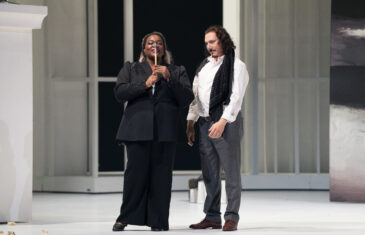
Tosca – Jordan De Souza & Rafael R. Villalobos/De Munt
Een erotisch afleidingsmanoeuvre of Pasolini als rookgordijn
Lena Meyskens




© Yann Leguay
What is the power of sound? How can it transform a theatre space into a world where the auditory takes on a life of its own? Fourteen artists share brief, inspiring statements on the role and significance of sound in contemporary performing arts.
LISTEN TO THE SOUNDCLOUD PLAYLIST WITH WORKS FROM THE CONTRIBUTORS TO ‘NOTES ON SOUND’.
Wat is de kracht van klank? Hoe kan het een theaterruimte laten transformeren tot een wereld waarin het auditieve een autonoom bestaan leidt? Veertien kunstenaars delen korte, inspirerende statements over de rol en het belang van geluid in de hedendaagse podiumkunsten.
Klank = muziek = performer.
Een onzichtbare speler die altijd aanwezig is. Zelfs in stilte.
Ik maak geen strikt onderscheid tussen klank en muziek. Of beter: ik hoor muziek in klank.
In de context van de podiumkunsten is het vaak een onderschatte speler: mensen merken haar meestal pas op wanneer er iets fout loopt — het geluid dat wegvalt, een microfoon die feedbackt, een valse noot. Toch beïnvloedt ze sterk onze perceptie, zonder dat we ons daarvan bewust zijn. Ze prikkelt de aandacht onderhuids en opent andere manieren van kijken.
Muziek maken voor theater, dans of performance is niet hetzelfde als een album maken: wat op scène gebeurt zie ik als een extra stem in de muziek die je de nodige ruimte geeft.
Samenwerken met dansers, theatermakers of performers begint voor mij zonder direct over klank of muziek te spreken. Ik luister, stel vragen, verzamel indrukken en beelden, en probeer tijdens de repetities dingen uit. Zo voel je meteen wat werkt.
Klank en muziek zijn voor mij het onderbewuste van een voorstelling. Zelf kan ik vaak moeilijk verwoorden waarom ik bepaalde beslissingen neem. Het moet vooral juist aanvoelen. Het thema dat je als maker naar voren schuift, is ook niet noodzakelijk wat het publiek er uiteindelijk in leest. In dat verschil tussen intentie en beleving leeft volgens mij de muziek.
I like situations best where it is not entirely clear what is intended as part of the performance and what is not, especially in terms of sound. Performances, installations, and hybrid forms that create a framework in which the incidental and the intentional, the random and the coordinated coexist in such a way that I, as an audience member, can only experience the event as a whole, are among the most intense aesthetic experiences that I seek again and again — including in my own pieces.
Especially in some of the music theatre pieces I have developed in collaboration with director and documentary filmmaker Daniel Kötter we have tried to create such environments. In several pieces, people on stage did mundane things: sawing, hammering, drilling, cooking, but also speaking, playing an instrument, singing, etc.
The attitude of the performers remained the same whether they were building something or playing their instrument. It was always inward-looking, focussed on the work itself and absorbed in the activity. The sounds that came out — accidentally or on purpose — became exaggerated in an aesthetic way, by amplifying, looping, or relating them to each other by rhythmic or melodic values. While the activities ‘made sense’ in terms of the topic of the piece, the overall soundscape created its own musical logic. For example, in Land (Stadt Fluss), the sounds of a trumpet player playing to himself could be heard as a duo with the rhythmically pulsating sound of carrots being cut, or the person’s footsteps in LIEBE became the basic beat of an increasingly intense love song.
Nevertheless, there is a big difference depending on whether the pieces are performed within a musical or theatrical context. The situation is determined not only by the ambiguous actions but also by the expectations of the audience. If these expectations are rejected (‘nothing’ is happening, ‘there is no “real” music’), a situation can arise in which sounds can be “read” in relation to their source (‘I hear someone cooking,’ ‘I hear someone playing the trumpet’) as well as heard musically (a duo for knife and trumpet). In this openness, everything that happens becomes meaningful — even the slamming of a door by a disappointed spectator.
Hoe ik makers uitdaag om over klank na te denken
Als sounddesigner en componist vertrek ik altijd vanuit één vraag: kan klank de verbeelding stimuleren en een ruimte oproepen die het geheel van interacties tussen alle geluiden in een omgeving voelbaar maakt? Een ecosysteem waarin actie, beeld, licht en subject samensmelten. Waar het decor sober blijft, krijgt klank de ruimte om het toneel te vullen — niet als versiering, maar als ademend weefsel dat de verbeelding van de toeschouwer in beweging zet. Voor mij is luisteren nooit vanzelfsprekend — ik onderzoek voortdurend de positie van de luisteraar. Activeren we echt het luisteren, of ontstaat er eerder een gevoel, een sfeer die de toeschouwer meevoert?
Techniek en samenwerking
Wanneer ik een voorstelling mee op tournee begeleid, vertrek ik vanuit de set-up die tijdens het creatieproces is ontstaan. Toch vraagt elke ruimte om aanpassingen: oppervlaktes, afmetingen en akoestiek hebben hun eigen grenzen. Dat zie ik niet als beperking, maar als een kans om te spelen met wat de ruimte teruggeeft. Ik ga daarbij altijd in gesprek met de technici ter plaatse — hun kennis is vaak onmisbaar. Zo voelt het touren niet als een louter technische opdracht, maar als een gezamenlijke zoektocht.
Op papier bestaan er altijd theoretische oplossingen, maar de realiteit van klank is grillig. Geluid beweegt, weerkaatst en gedraagt zich soms onverwacht. Pas in de ruimte zelf laat het zich echt horen. Precies daar ligt voor mij de kern van mijn vak: samen afstemmen, meebewegen en telkens opnieuw ontdekken hoe klank een voorstelling kan dragen.
Klank is voor mij nooit alleen een technisch middel, maar een uitnodiging tot verbeelding — een manier om werelden hoorbaar te maken die anders onzichtbaar zouden blijven.
A Few Aphorisms on Music Dramaturgy
1. Not ‘for’ but ‘with’ the performing arts. I prefer to keep the principle of ‘applied arts’ at a reasonable distance because it lacks the essential element: thinking in proximity.
2. We still have a long way to go, but musical and sound dramaturgy deserves wider recognition. Some of my colleagues see it as nothing more than a form of DJing — which is as absurd as confusing commerce with economics.
3. Independent ideas do not contradict common thinking.
4. The material is not identical to music or sound. This inequality is productive, but it has no effect without an adequate working methodology.
5. The paradigmatic dimension has a conceptual advantage over the thematic one. This also explains why history — in all its manifestations — remains relevant in my work.
6. History and theory are transcendentals: dramaturgy is their dialectic.
7. The greatest achievement is the next one.
8. Whenever a task can be considered to have achieved its goal, it is because decisions have been made beyond the availability of choice. It is also here where theory and practice intersect.
9. I assume I don’t see performance work in the same way performers do: I remain convinced that their listening is in no way comparable to mine, which is transhistorical and memorial.
10. I am not always convinced by what we define as ‘work.’ This is undoubtedly because
I do not idealise the production/reproduction dichotomy. In this sense, I see no problem with dramaturgy remaining a behind-the-scenes affair. But then in the sense of Don José Nieto Velázquez in Las Meninas: the éminence grise.
11. Editing is definitely a constant requirement in my way of working. But in doing so, I am only perpetuating what modernity has been mediating for at least two centuries.
12. ‘The Open Artwork’ was almost a style. ‘Works in Openness,’ on the other hand, allow for ‘analytical creativity.’ This is clearly the approach I endorse.
13. I am still waiting to be able to grasp what was intended through what is represented.
Sound in theatre goes far beyond atmosphere. It can be scenography, actor, or story in itself. Performance expands how we listen, opening us to dimensions usually overlooked. I often think of ‘space care’: a tending to the fragile, shifting space that emerges through the gathering of people, beings, and things. Theatre can offer listening as a form of care — an invitation to step beyond passive reception into active reaching.
Through sound, we sense connections between bodies, materials, and actions. Relations are revealed in how one element interferes, resonates, or resists another. Sound as material in performance can help us notice what often passes unheard, reminding us that what lies beyond the obvious is always present and accessible when we give it our attention.
Listening also involves a choice: how much do we reach towards what we hear? To listen is not only to receive, but to decide. In theatre, cues for listening can guide us safely into unfamiliar realms, attracting our attention and curiosity. They remind us that sound is never mere background, but relation, action, and presence.
For many years my main instrument has been the voice, as it is for many performers. Voice connects us both concretely, through language, and abstractly, as vibration and resonance. It can be ‘just’ sound or music. A shift between the two can happen in an instant, and that shift can transform everything. With a single sound, certainty may be unsettled. When the ear contradicts the eye, assumptions fracture and imagination begins to root and spread.
In this way, sound in performance is not accessory but generative: it forms worlds, unsettles certainties, and calls us into attentive relation with what is present — and with what might yet emerge.
MODULATION: Corporifying Othernesses from Here to Now
Modulation is one of my decolonial composition concepts — creative precedents that I teach and activate through my work. All of these concepts relate to performativity, simply because the only music that interests me is the music of transformation.
When the somatisation of the sacred exceeds verbal expression of myths, a corporeal logic emerges. This can be evinced through modulation. Here, modulation does not mean tonal shifts, but the adoption of body and aesthetic presence as a means of accessing and corporifying a new reality. The leap between normalised human perception and this connective state characterises modulation, where a meeting with othernesses can occur. This meeting is only possible without imposing non-corporeal logics — such as Western rationale —and from this frictional artifice creative potency can emerge.
Examples of modulation of consciousness appear in trance states, such as Afro-Brazilian channelling of guides, deities, and ancestors. In Yoruba cosmology, the body is permeable to both historical world and mythical cosmos, malleable enough to erode the self and ritualistically display its resonant movement between potential and actual. This modulation of self into others is a substitution: there for here, you for me, it for I. In haptically modulating into othernesses, a body subverts coloniality and calls for transformation.
Unlike the Western psyche, binarily divided into conscious/unconscious, this opening modulates existence into multiple contacts with aesthetically nourishing, opaque sources. Origin and death symbolically meet through the expressive displacement of bodies, unfolding extraordinary relations and mediating individual and collective conflicts.
What about a moment of listening to wisdom beyond a pornographically informed reality? ‘The bed of a river does not decipher the water; it receives the water from the river,’ says Brazilian Indigenous thinker Ailton Krenak. Modulation is received, not decoded. A body — permeable and malleable — embraces both ancestral and future consistencies like a riverbed holding flowing waters, weaving collectivity and challenging objective notions of self. Politically, the struggle to modulate states of presence toward enchantment becomes a radical deviation from the commodification of life, organisation, and bodies. It asks us what else is possible beyond a utilitarian notion of existence — a refusal to let time be owned by measure, an invocation of enchantment as an irresolutional praxis.
One of the hardest things I find when making music for dance is figuring out the right sound level — the volume that inhabits the living space without overwhelming or destroying the dance.
In 2008, I worked as an assistant to the American composer Morton Subotnick on the revival of Anna Halprin’s Parades and Changes, for which he had originally composed the music in 1965.
After an initial meeting at his home in New York in the spring — where Morton gave me the material to be played during the piece — we all gathered in Armentières with the full team to bring together dance, light, and music.
While I was mixing the different tracks, Morton would give me his directions. He let me operate the interface I had designed and conveyed everything to me verbally while watching the dancers on stage. The idea was that, once the premiere was over, he would return to New York and I would take full responsibility for the soundtrack on my own.
To adjust the volume of the music during the performance, Morton once told me something along the lines of: ‘If you feel like the dancers look too small, it means the music is too loud.’
This advice may sound a little strange, but I can honestly say that I’ve used it ever since, whenever doubt takes hold of me.
Rethinking Sound and Music in Theatre
On my journey of exploring the role of sound and music in theatre, it has become clear that to unlock their potential in this context, we must rethink concepts, practices, and processes.
First, we must reconsider our understanding of sound and music. When reduced to fixed functions — illustration, support, or ornamentation — their dramaturgical and scenographic powers remain not only underused but also hidden. The space in between what is usually thought of as sound and what is considered music is a fertile and unruly terrain of possibilities, where this invisible force can shift from creating a subtle atmosphere to forming a dynamic scenography, and further transform into an active co-actor alongside performers.
To achieve this approach, the creative process itself needs to be changed, which means a re-evaluation of sound design and musical composition practices. To unlock its full potential, work with sound and music must be integrated into the overall conceptual and dramaturgical process from the very beginning. This demands collaboration that is open, non-hierarchical, and non-linear. Composers, sound designers, directors, actors, scenographers, and technicians must all be part of a process of shared and reciprocal experimentation. This includes technical aspects as well — such as the design of the loudspeaker setup, mixing, and programming — which must be considered essential artistic elements. Emerging new audio technologies like immersive sound, spatialisation, and virtual acoustics intensify the need for new collaborative models and invite new modes of creation.
In this fluid ecology, sound gains new dramaturgical agency. It resists fixed definitions and calls for a re-examination of its roles as music, scenography, co-actor, and structural force. This continuous shifting enables a more expansive understanding of sonic practice in theatre — one where disciplinary boundaries dissolve and sound asserts itself as both autonomous and intermedial.
A theatre is a luxury playground — a black box and a blank space/time frame simultaneously; an empty page, but very well equipped. Sound-wise, it’s definitely a place for experimentation. The field of possibilities in this context is huge, and to have the time and even a team to try things, to give space to doubts, to succeed as much as to fail, is an absolute privilege.
When you come from the DIY music and sound sphere, as I do, and you look backstage at the quantity and quality of material available, it’s like being in wonderland. And I believe that crossing the methods of alternative culture with more institutional practices opens up new approaches and gives a wider perspective on both means and meanings.
I have worked across very different fields and projects — from contemporary and conceptual art to experimental and electronic music, radio art, curation, composition for films, and performances. I have tried never to get stuck in one of those fields, always moving and playing around with different approaches, trying to cross and overlay references and inspirations, blurring the boundaries. One field nourishes another, creating interdependence. Meanwhile, another provides the solid foundation on which fragile balances are built.
Being autonomous with the techniques is also something that can drive creativity and makes it possible not to draw too sharp a line between the technical part and the scenography, or between the performer and the technician — and vice versa.
I remember being in residency in a theatre, and a technician getting upset at us because we were pulling cables and making weird shapes with them. He told us, ‘Stop it! You have to use the material for what it was meant to do!’
Well… my starting postulate in experimenting may be the exact opposite of that. Bending things and giving objects and techniques the time and space for their sense to come out of their form. What is a cable? What is the symbolism of wiring? And if a cable breaks — then what becomes the meaning of a broken cable?
Omdat ik niet als muzikant ben opgeleid, verhoud ik me tot muziek als een hele of halve barbaar, als een outsider. Ik verzamel stemmen, drones, machinelawaai, walvisgeluid, liftmuziek, installeer wat ik maar aan gratis software kan vinden en gooi alles zonder respect voor de oorsprong door elkaar.
Ik spreek vaak makkelijker de taal van een regisseur of beeldend kunstenaar dan die van een muzikant of technicus. Dat leidt soms tot misverstanden, maar ook tot experiment. Soms heb ik in mijn hoofd een geluid dat ik niet kan maken. Dat frustreert, maar het dwingt me om te hakken met het gereedschap dat ik wél heb: echo’s, filters, samples die ik bewerk tot ze onherkenbaar zijn. In de mislukking en het ‘verkeerd’ gebruiken van technieken vind ik vaak de mooiste parels.
Ik zie mijn werk altijd als performance. Of ik nu een set draai, eigen muziek speel of samenwerk met een regisseur of danser: zelfs als je thuis naar een album van mij luistert, zie ik de betekenis van mijn werk ontstaan in de ruimte tussen jou als luisteraar en mij als performer. Wat klank in die ruimte doet, verschilt. Soms is klank de onuitgesproken en onuitspreekbare rouw in het verhaal dat een acteur neerzet over het verlies van een geliefde, soms is klank het onderhuids kloppen van een hartslag terwijl een danser een façade van stilstand is, soms creëert klank een onpeilbare diepte achter een plat beeld, soms is klank een stilte om de gedachten van het publiek te dragen. Het is voor mij altijd: een taal die je niet machtig hoeft te zijn.
My music and sound practice in a theatrical context is almost entirely within a 20+ year artistic collaboration with my performance group Object Collection, and most of all with my main creative partner, writer/director Kara Feely. This working situation has evolved over time but has always been based on the foundational idea of putting experimental musical and theatrical practices on equal footing at all times and in all stages of our productions.
As a composer, I have long been drawn to theatre as the most perfectly collaborative art form. What this means for me in a practical sense is working with a sonic and formal structure that is necessarily filled with gaps: holes and spaces in the composition where potentially contradictory, if not wholly unrelated, material can exist. Musically, this is a recognisable part of several progressive aesthetic lineages, though it remains an outlier in how composers normally think.
In spite of being committed to living in these gaps, I have to constantly remind myself to simply leave things out: to sketch a gesture while leaving large portions of the stage-canvas blank. I find this way of working exciting, and the resulting pieces endlessly surprising. This sometimes chaotic collision of independent, tightly constructed material is now the dominant feature of Object Collection’s works. Since I am frequently performing in some fashion onstage in our shows, I often don’t get to see the fully finished piece until I watch the video after we have closed the show. I have come to prefer this methodology. I have little interest in some auteur-level control over all facets of our pieces.
During some of his concerts in the early 2000s, Prince would go out into his audience and ask individuals whether it was better to lead or to follow. Those who said it was better to lead would be ignored. The first person who said it was better to follow would be brought up for a seat on the side of Prince’s stage. Better to do away with leaders.
I develop music performances in public spaces, working in very diverse locations. It might be a forest, a city centre, a residential area, or a garden. The pieces I create are site-specific: they deal with the history and the current situation of the respective locations themselves, are produced on-site, and are also performed there.
During the creation phase, I often conduct listening and observation sessions together with the performers and musicians involved, trying to understand the place as a microcosm with its own dynamics of everyday life. Depending on the artists’ experience in working with sound, it is sometimes necessary to sensitise them to recognise a theatrical potential in sound itself, and to understand that a narrative does not necessarily require a permanent performative action, but can also be told purely through sound.
I also make field recordings, which are later integrated into the piece as snapshots of past presents. When it comes to the sound of a place, I’m interested in two aspects: first, the already existing sound characteristics, which are determined by everyday activities and thus do not originally pursue a musical intention. These can be incorporated into the piece like a readymade, as the soundscape of the everyday.
Second, I look for objects that can be transformed into musical instruments through consciously musical playing — for example, metal fence bars of different pitches that can be played with mallets or a double bass bow, or the surface of a rough house wall on which abstract rhythmic patterns can be amplified with a microphone.
During the shows, the performers lead the audience on a route through various locations where such sound objects can be found. Their sounds can be produced either through performative actions or through deliberately exhibited music-making. Through the interweaving of these sound layers, different states of the past and present of a place come together to form an auditory narrative — a sonic theatre.
Music, it is said in German, is a Zeitkunst — a ‘time art.’ The phrase is easily spoken, yet its meaning is far from simple. Is music merely a time-based art, one that unfolds in time — or is it the art of time itself, the art of shaping time and its lived experience?
This question is especially compelling when we turn to the listener and to listening. The temporal dimension of music — the experience of time through music — feels mysteriously distinct from its sounding experience, from the musical parameters and the entire cultured apparatus of knowledge that Western art music has often considered essential for artistic appreciation. Unlike musical syntax, semantics, or aesthetics, the experience of time in music requires no privileged access through knowledge. It manifests in the situated listener, whose entire bio-psycho-social being receives — and gives — the gift of time through listening.
Music’s being-in-time carries an intrinsic resistance to acceleration, compression, and short-circuiting. Listening to three seconds of a piece cannot grant access to its being or its experience. In this sense, Zeitkunst may suggest that if its temporal foundation is compromised, the experience collapses — it ceases to exist. As banal as it may sound, music both needs and demands time — and in turn, bestows the gift of it. In an age of social acceleration, the economization of attention, and the maximization of sensory consumption, this quality becomes an act of quiet disobedience against the chrononormativity that structures our system. Music and listener are time-bound, interdependent. The insistent temporality of music and the devotion of listening are, I believe, what we need most today.
Perhaps the true gift of music as a time-bound art is to remind us that acceleration, compression, and the short-circuiting of lived experience come at a heavy cost — a cost whose currency we are only beginning to understand.
I like the sound of a quiet theatre.
The sound of anticipation, concentration. The sound of surprise, even concern.
A sound that’s charged, and far from empty. Or quiet.
When used deliberately, it’s loud. A disturbance that breaks fourth walls.
Louder than a scream, a cymbal crash. The sound of a quiet theatre.
When the speakers are still on, but they’ve stopped playing.
A quiet that is often short-lived.
Inevitably someone coughs, or moves uncomfortably.
Preprogrammed to fill the void, we voice the quiet with sound.
When hearing becomes listening.
When affect becomes effect, charged with affect.
I like the sound of a quiet theatre so much that I create my soundtracks around it.
With every new score, I ask myself: when is the theatre quiet? When do I stop sending my soundtrack to the speakers?
In this absence, in this moment of alienation, we become aware of ourselves as participants, spectators, and listeners.
We become active, in charge.
Charged, like the sound of a quiet theatre.
Je werkt soms voor andere makers, waarbij je de muziek voor hun projecten maakt, en soms maak je eigen werk, waar je beslissingen over de performance en het geluid en de muziek zelf in handen hebt. Wat gebeurt in de switch van de ene rol naar de andere? Hoe communiceer je je ideeën in processen met anderen? Hoe wordt er gesproken over klank en de rol/betekenis van muziek/klank?
De overgang tussen het componeren voor anderen en het maken van eigen werk is eigenlijk heel organisch geworden. Wanneer ik muziek maak voor andere makers, fungeer ik vaak als een soort klankarcheoloog. Ik graaf naar wat hun werk sonisch nodig heeft, welke frequenties en texturen hun verhaal kunnen ondersteunen. We communiceren vaak met referenties, niet alleen muzikale, maar ook tekstuele of visuele om een wereld te delen. Het is een proces van luisteren en vertalen.
In mijn eigen werk heb ik de luxe om over klank, ruimte en dramaturgie tegelijkertijd na te denken. Daar wordt de compositie een soort architectuur. De compositie wordt in zichzelf een scenografie waarin verhalen een plaats vinden, zoals in mijn recent werk A Short History of Decay, waar ik een instrument bouwde in de vorm van een preekstoel die zowel altaar als partituur is.
Je maakt voorstellingen waar je sterk geproduceerde elektronische muziek met akoestische instrumenten tegelijkertijd laat klinken. Dat zijn twee klankvelden met verschillende benodigdheden, qua ruimte en luisterhouding. Speelt dit een rol, of hoe ga je hiermee om? Wat zijn je ervaringen?
Deze spanning tussen elektronische en akoestische werelden staat eigenlijk centraal in mijn werk. Wat mij interesseert is niet zozeer het integreren van deze klankvelden, maar juist het contrasteren ervan: hoe iets fragiels en levends kan worden geplaatst naast iets overweldigends.
In mijn laatste werk The Fugue State beginnen de composities elektronisch en ontwikkelen ze zich geleidelijk tot zachte melodieën, live gespeeld door muzikanten. Het gaat niet om volume of kracht, maar om hoe deze klank kwaliteiten elkaar ondermijnen. Het gaat om een klanktransformatie die de luisterervaring begeleidt. Ik gebruik — door middel van performance — de ruimte vaak als een extrapolatie van mijn composities. Het is hier dat beweging, architectuur en klank samenkomen, ik noem dit ‘psychoakoestische choreografie’. Mijn fascinatie hiervoor is de middeleeuwse kerkarchitectuur en hoe hier ritueel, klank en echo in verband worden gebracht.
Het interesseert me om voor mijn publiek complexe luisterhoudingen te ontwikkelen. De spanning tussen livemuziek, elektronica, tekst en beweging creëert een soort sonisch labyrint waar verschillende betekenissen kunnen ontstaan.
Fragment uit een conversatie met David Helbich, juli 2025.
KRIJG JE GRAAG ONS PAPIEREN MAGAZINE IN JOUW BRIEVENBUS? NEEM DAN EEN ABONNEMENT.
REGELMATIG ONZE NIEUWSTE ARTIKELS IN JOUW INBOX?
SCHRIJF JE IN OP ONZE NIEUWSBRIEF.
JE LEEST ONZE ARTIKELS GRATIS OMDAT WE GELOVEN IN VRIJE, KWALITATIEVE, INCLUSIEVE KUNSTKRITIEK. ALS WE DAT WILLEN BLIJVEN BIEDEN IN DE TOEKOMST, HEBBEN WE OOK JOUW STEUN NODIG! Steun Etcetera.
kunstenaarsbijdrage
15.12.2025
Leestijd 22 — 25 minuten
15.12.2025
—
14.04.2026








Lieven Dousselaere is componist en geluidskunstenaar. Naast het uitbrengen van muziek met zijn bands Tape Tum en Synthômas componeert hij muziek voor film, theater, installatiekunst en hedendaagse dans.
Hannes Seidl works as a composer of instrumental and electronic concert music and — often in collaboration with other artists — on music theatre, installations, and other cross-genre formats.
Sounddesigner en componist Anne van de Star onderzoekt hoe klank een ecosysteem kan vormen waarin luisteren een actieve ervaring wordt.
Alain Franco studied music at the conservatories of Brussels, Liège, and Antwerp. He was the permanent conductor of the Champ d’Action ensemble (1989–1993). His sincere interest in contemporary music and art, as a pianist and conductor, has led him to collaborate with eminent ensembles and musicians all over the world.
Mareike Dobewall is a director, scenographer, musician, and composer. Her work is not bound to a genre but rather crosses the boundaries of genres and includes various art forms.
Marcela Lucatelli is hailed as one of the most innovative vocalists and composers of her generation. Born in Brazil and based in Denmark, she has earned international recognition for her highly original, sensuous, and politically charged performance works.
Sébastien Roux imagines listening situations using algorithms, games, movement, spatialization and diagrams. His work takes a variety of forms: guided listening sessions with loudspeakers, concerts with projected graphic scores, sound installations and site-specific performances.
Kent Olofsson is a composer with an extensive artistic output of over 200 works that span a broad range of genres, ensemble types, and contexts — including music for orchestra, chamber music, electroacoustic music, music theatre, rock music, music for baroque instruments, and works for dance performances and installations.
At the border between sound art and music, Yann Leguay develops a paradoxical way of thinking about technological evolution. He has been active internationally in the experimental scene since 2007.
Marijn Ottenhof is beeldend kunstenaar, componist en dj. In haar videowerken, livesets, radioshows en clubsets is dystopie de overheersende sfeer.
Travis Just is a composer and performer best known for his work with the experimental performance group Object Collection. His practice integrates composition, text, and performance into a hybrid form of experimental theatre.
As a composer, Julia Mihály works at the intersection of new music, performance, and music theatre. She develops multi-layered compositions combining sound, video, and performative elements, often in conjunction with electronic media.
Berno Odo Polzer is a researcher, curator, and dramaturg with a background in experimental music, sound-related art, and performance. His practice combines interdisciplinary research and theory with artistic, curatorial, and dramaturgical approaches to create communal spaces of listening and (un)learning.
Peter Lenaerts is a sound artist, composer, and sound designer. He has created the soundtrack for over 50 dance and performance works by artists including Mette Ingvartsen, Salva Sanchis, Andros Zins-Browne, Eszter Salamon, Wayson Poon, and Rhiannon Newton.
De experimentele composities van Billy Bultheel combineren hedendaagse muziek met middeleeuwse en renaissancepolyfonie. Zo ontstaan locatiegebonden uitvoeringen waarin muzikanten dynamisch interageren met architectuur, beeldhouwkunst en speciaal vervaardigde instrumenten.
Lena Meyskens

Meg Stuart
kunstenaarsbijdrage 15.12.2025
Lena Meyskens
Meg Stuart