Iphigenia – De Roovers
Geef mij maar het verzet van Klytamnestra
Mia Vaerman




© Michiel Devijver
Tiago Rodrigues’ No Yogurt for the Dead is a tender and intimate play about memory, loss, and the spaces in between. Inspired by his father’s final days in a hospital, Rodrigues creates a story that feels both personal and universal. The stage design shifts between a realistic hospital room and a dreamlike landscape, making the audience feel like they are moving through time and memory. Despite the heavy themes, the play balances sadness with humor, making it both emotional and engaging. Small moments — like a missing black pen or a spoonful of yogurt — become powerful symbols of resistance and acceptance. In the end, the play stays with you, making you reflect on life, loss, and the connections we leave behind.
Rogério Rodrigues is a respected journalist and activist who has spent his life writing reports for newspapers in Portugal. His career is marked by resistance and exile—forced to leave the country as an anti-fascist. As cited in the text, he always resides in-between places and with a fight. One day, after years of relentless work, Rogério falls ill. Realizing the end is near, he admits himself to the hospital, knowing these are his final days in the world. Yet, even in his weakest moments, his journalistic spirit burns bright. He asks his son, Tiago Rodrigues, to bring him a black pen rather than a blue pen, determined to write his last report.
The notebook arrives, but the black pen never does. In his hospital bed, Rogério writes as best he can. When he passes away, Tiago opens the notebook and finds a line: “The dead don’t eat yogurt.” A sentence laced with irony and mystery, it becomes a haunting fragment of his father’s voice. Moved by this phrase, director Tiago Rodrigues embarks on a journey to uncover its meaning at The No Yogurt for the Dead invited by NTGent to take part in the series of Histoire(s) du Théâtre.
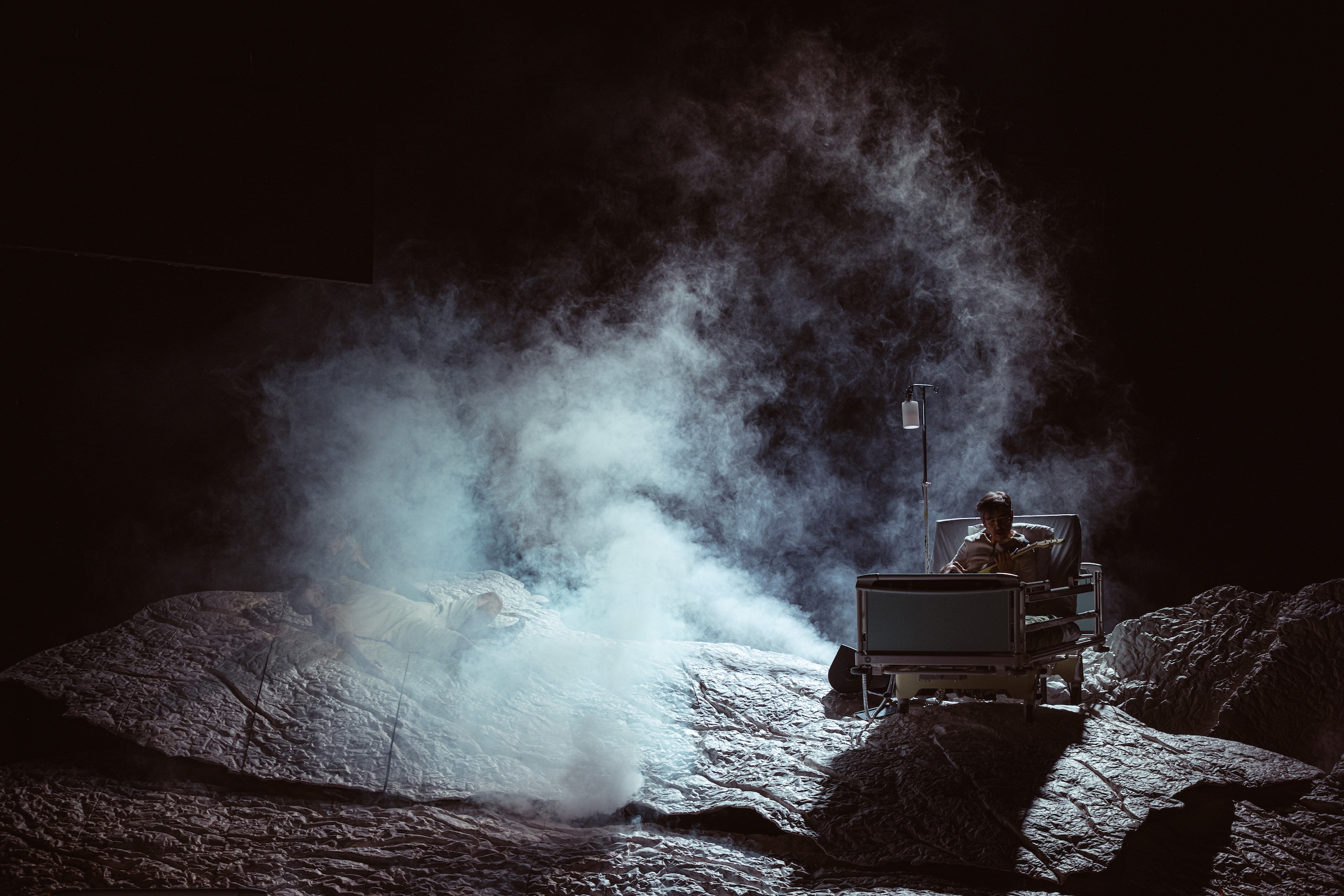
As the audience takes their seats, the stage is already lit. On the front left, a sickbed rests, with a corner behind it holding a clothes stand and a small table. To the right, a towering white, textured structure resembling a mountain dominates the stage. At its peak lies another hospital bed, and in front of it stands a serum hanger. The stage design creates a dreamlike atmosphere—contrasting the sterile realism of a hospital room with the isolated, metaphorical image of a distant place. A nurse in a green uniform, played by Lisah Adeaga, moves around, tidying and preparing the space. She steps forward and addresses the audience in Dutch, explaining that ‘the writer of this play’, Tiago Rodrigues, opens his father’s notebook. Inside, he finds only a few lines, brief scribbles resembling the abstract drawings of a toddler. From these fragments, Rodrigues sets out to imagine the unwritten pages of his father’s final report.
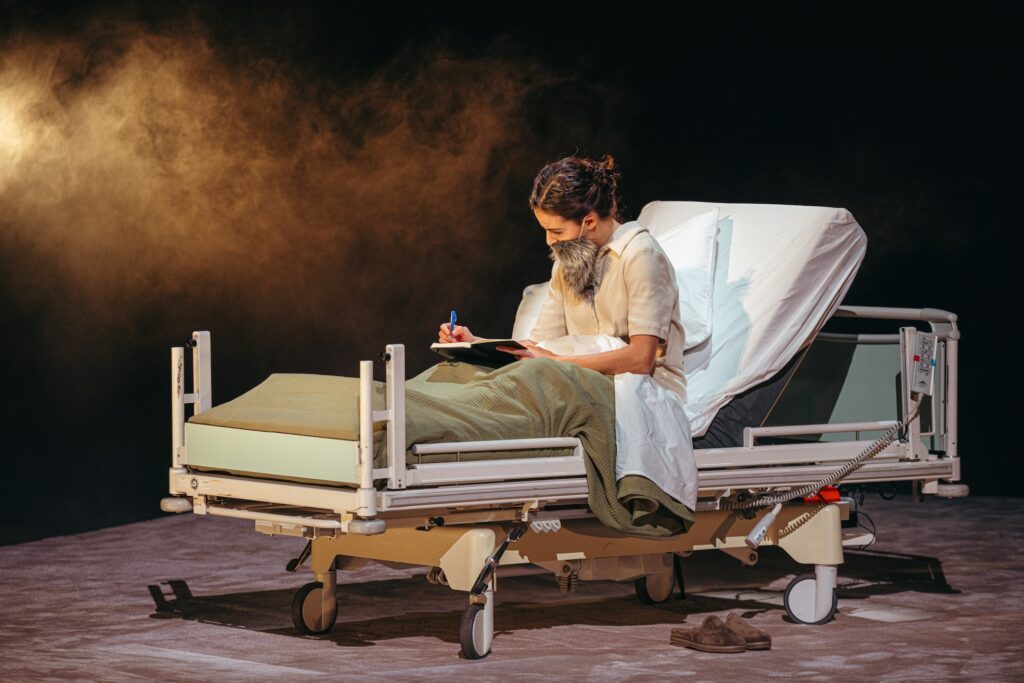
The performance unfolds as Rogério Rodrigues, feeling gravely ill and aware that these may be his final days, arrives at the Amadora-Sintra Hospital in Portugal. The nurse underlines: “I am in his last report”. The date is marked as three months before Christmas, in the autumn. In this prologue, two more performers come on stage and the nurse as narrator hands them two fake beards. Each character is given a nickname based on their appearance or defining traits: Rodrigues, the son, is called ‘Shortbeard,’ while his father is known as ‘Longbeard.’ Manuela Azevedo and Beatriz Brás seamlessly embody multiple roles, shifting between those characters besides of mother and various figures. The beards serve as a theatrical device for switching characters, enabling the two performers to fluidly shift roles. Meanwhile, the nurse, who plays a significant role as both a character and a narrator, is called the ‘Worst Nurse in the World.’ Throughout the show, the performers maintain a playful energy that carefully balances the heavy themes with moments of humor. This balance keeps the audience engaged while reinforcing the dreamlike quality.
“No Yogurt for the Dead transcends the personal, reaching a profound and universal depth, as if a man, in his solitude, is grappling with something much larger than himself.”
As the stage lights dim, the scene shifts: Rodrigues visits his father’s hospital room. Their conversation hesitates between past and present, distance and warmth. They speak of a gift exchanged two years ago, their words carrying both affection and restraint, like a song played in a minor key. On the bed on top of a mountain-like structure, musician Helder Gonçalves remains a constant presence, guiding the performance with his guitar. The sounds he creates are not just music but breath, wind and memory—sometimes rasping like an old man’s exhale, sometimes fado or a song by Jacques Brel.
Through the interplay of sound, atmosphere and acting, the stage becomes a fluid, ever-shifting landscape, inviting the audience into a world where meanings are never fixed. The scenography works seamlessly, enhancing these transformations and allowing the space to breathe with the performance. The mountain itself seems to transform, its texture dissolving and reforming—at times as soft as a pile of yogurt, at others as creased and timeworn as the wrinkled skin of an aging body. These evocative shifts create perfect, playful triggers for imagination, allowing us to immerse ourselves smoothly in a space that transcends the literal. Layered over this dreamlike terrain are Rogério’s observations of the hospital, where memory, perception and identity blur into something elusive and uncertain.
Rogério tries to stand. Each shaky step from the bed toward the mountain reveals fragments of his past. With each step, he returns to the exile he endured as a young journalist under Portugal’s fascist regime. He relives the crossing of the border between Portugal and Spain, the fear and determination etched into every moment as he fled to France. Rogério’s struggle blurs the line between his past and present, between his once fierce independence and his growing vulnerability. Rogério reflects on his own transformation: once a strong-willed journalist, he now finds himself confined to a bed, dependent on others. He notices the details: how he can no longer challenge the nurses, how even resisting the so-called ‘Worst Nurse in the World’ is beyond his strength. The man who once stood firm against everything now relies on others to move, eat or simply exist. Rogério’s thoughts linger on the indignities of his new life. He hates yogurt, yet he is forced to eat it now. There is no room for rebellion, no ability to say no. The hospital, at first a place of care, slowly reveals itself as a space where identity fades, where patients exist in a kind of in-between state—no longer fully in control, yet not entirely gone.
© Michiel Devijver
© Michiel Devijver
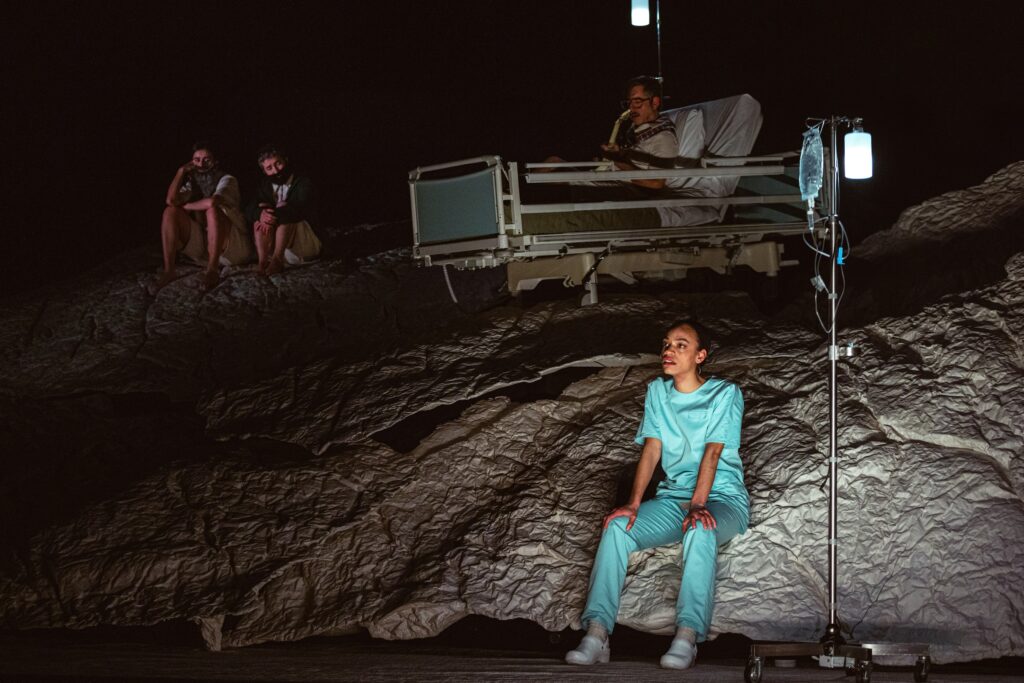
© Michiel Devijver
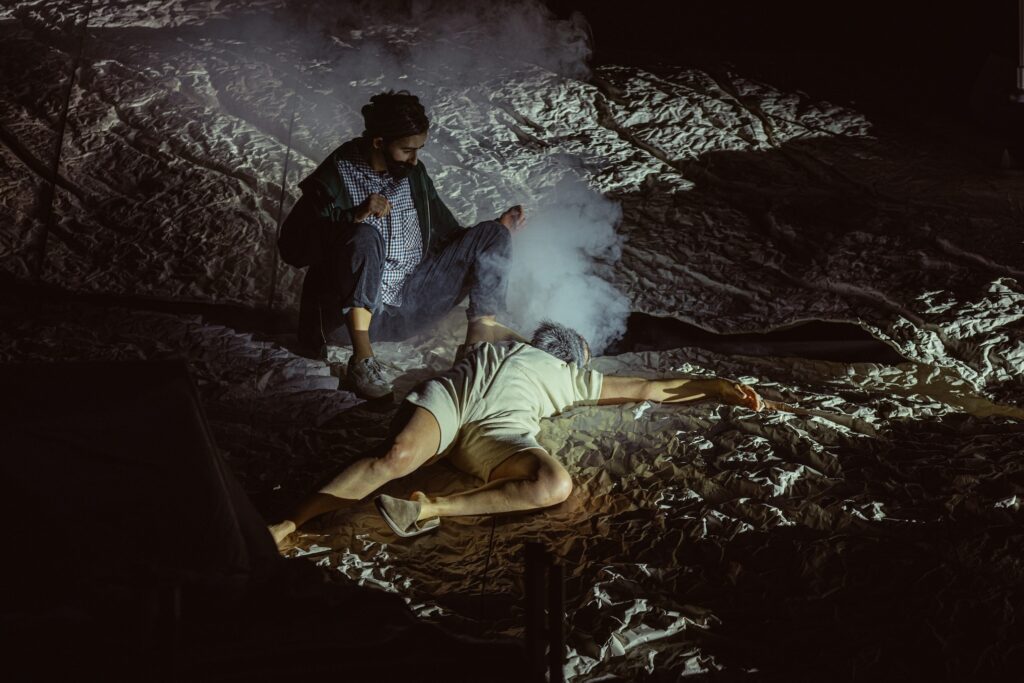
Rogério’s alienation reflects both his own detachment from the world and the way the performance unfolds. His repeated deaths, with smoke rising around him, create surreal yet tender moments that pause the story, emphasizing his fragile existence. Rodrigues, maintaining a quiet emotional distance, embodies the struggle of witnessing loss without sentimentality, making his portrayal deeply affecting. His restraint allows the audience to connect precisely because of the distance— his alienation mirrors a universal disconnection, drawing viewers into the story in an unexpectedly intimate way. The performance transcends the personal, reaching a profound and universal depth, as if a man, in his solitude, is grappling with something much larger than himself. Through its careful balance of detachment and raw emotion, the piece lingers beyond the stage, creating a rare and lasting connection with those who watch it.
As the play moves toward its final moments, Rogério moves slowly across the stage, connected to his IV drip. The light above him flickers with each step, reflecting the fragility of his journey. The staging is simple yet powerful, offering a clear representation of death that lingers after the scene ends. The sharp reality of watching his entire journey unfolds in front of you. What begins as a personal story gradually broadens, balancing heavy themes with nuanced performances. The play goes beyond its individual narrative, leaving the audience with lingering reflections on the complex relationships between father and son, patient and nurse, and the spaces between life and death. It’s a piece that stays with you, urging you to think about the delicate balance between life, care and loss.
KRIJG JE GRAAG ONS PAPIEREN MAGAZINE IN JOUW BRIEVENBUS? NEEM DAN EEN ABONNEMENT.
REGELMATIG ONZE NIEUWSTE ARTIKELS IN JOUW INBOX?
SCHRIJF JE IN OP ONZE NIEUWSBRIEF.
JE LEEST ONZE ARTIKELS GRATIS OMDAT WE GELOVEN IN VRIJE, KWALITATIEVE, INCLUSIEVE KUNSTKRITIEK. ALS WE DAT WILLEN BLIJVEN BIEDEN IN DE TOEKOMST, HEBBEN WE OOK JOUW STEUN NODIG! Steun Etcetera.
recensie
03.02.2025
Leestijd 7 — 10 minuten
15.12.2024
—
28.02.2025

Furkan Ak is a theatre maker who graduated from RITCS (Brussels) and Yeditepe University (Istanbul). Through practice as research (PaR), Ak mainly focuses on transnational theatre, migration and hauntological dramaturgies in his works.
Dit artikel maakt deel uit van: Dossier: Theater Aan Zee 2025
Dossier: het TheaterFestival 2025

Mia Vaerman
Tom Rummens
recensie 03.02.2025
Mia Vaerman
Tom Rummens