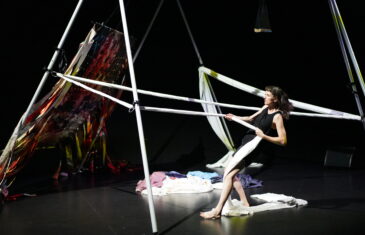
Lullabye – Anneleen Keppens
Wie zorgt er voor wie zorgt?
Tom Rummens




© Samah Hijawi
I end a call with my mother in November last year, I had finally caught hold of her for a recipe I was trying to get for a few weeks now. The first time I called, she was ranting with wild anger and deep sadness at Israel’s unspeakable violence that had started in southern Lebanon in late September. I realised that it was not the right time to to talk about recipes. The next time I called, I got both my parents on the phone, and she was recovering from a much deeper state of depression after the assassination of the Secretary General of Hezbollah, Hassan Nasrallah in Lebanon. Me and my father were trying to distract her by striking a conversation about the variety of tomatoes I had successfully grown on my terrace in Brussels that summer. But that didn’t go down very well with her. She snapped at us both and said it was not time to talk about tomatoes—and she was right.
I was surprised myself to be moved by Hassan Nasrallah’s assassination. I cried as I watched his dead body (intact) being lifted from the gaping hole the 80 tonne bomb had raped open in the residential neighbourhood of Addhiyeh in Beirut, Lebanon. In the devastation I understood that he was the last remaining political figure who stood unwavering against Israeli Occupation. His loss would now open the playing field for Israel to exert its power unchecked in the region. Indeed, in the months following his assassination, the political landscape of the eastern mediterranean has changed so dramatically. The Shia’s power in the region has been brought down, and a new order is falling in place. Aside from his political clout, Hassan Nasrallah was also known for his eloquent and inspiring speeches that combined politics with a touch of humour. I was confused and frustrated by my emotions, especially that in this desolate political landscape the only group left for me to identify with is a political group based on religious ideologies. Ten or fifteen years ago, none of my family and friends from the Arab world would have positioned ourselves with Hezbollah. Personally I was always inspired by Hassan Nasrallah’s speeches, but never coerced to support the party. It is not that I have any issue with spiritual sects (of any religion)—as long as it operates in the realm of spirituality. It is the realisation that the male dominant position that is embodied in political parties like Hezbollah, or New Flemish Alliance (N-VA) in Belgium, or Trumps’ Presidency for that matter, will continue a hierarchal model of power and political rule that compromises a feminist perspective to non-violence, equality and justice.
“I was confused and frustrated by my emotions, especially that in this desolate political landscape the only group left for me to identify with is a political group based on religious ideologies.”
After the death of Hassan Nasrallah, a documentary was released based on interviews with his son and (surprisingly, but strategically interesting) his daughter. The film focused on Hassan Nasrallah as a father, and his path to leadership in Hezbollah. I make an online search for information about Nasrallah’s wife, who doesn’t appear in the film. I only find a name and a date of birth, no other information about her, and certainly no image, which I find disturbing. I don’t need her to be all over the internet, but the absence leaves a haunting feeling. Should we still celebrate him for his stance with the rights of the oppressed in Palestine, regardless? I don’t have the answer. In this world where a televised genocide is the new norm, world politics is now unmasked as a charade that is not interested in ‘the people’. This is something the Palestinians and other colonised people have always known. And now, in this barren political landscape, people are pushed to make alliances with right-wing groups who are re-imposing the male hierarchy.
Anyhow, finally in mid November I managed to catch my mother in a better mood. She was back on track with her life-long work; helping displaced Palestinians living in refugee camps in Jordan. Alongside other women (the men are mostly in managerial positions) in the community organisation of ‘Eebal, small funds are collected to help with basic living issues like school fees, medicine, and fixing the ‘homes’ to a slightly more liveable condition. Adding an extra room to tiny shacks, building a proper toilet, tiling a sand floor, or adding a roof to an outdoor kitchen. My mother is a bit of a ring leader. She is respected by her peers, and her Facebook followers attentively read her critical reflections (and occasional rants). Every once in a while, Facebook’s algorithm will pick up a word it deems ‘suspicious’, and freezes her account, which drives her crazy.
Throughout my research on food, and the movement of food-making practices over time and across geographies, my mother has been a constant reference. At first she urged me to stay away from the kitchen, under the pretence that it was tiring and time consuming. She knew that after a long day in the the kitchen, you come out smelling of onions and garlic, your legs are very tired, and you have lost your sense of humour altogether. I also knew that kitchen work symbolically stood in the way of her (choice) in not making her own money. Over the years, I slowly shifted her perspective to look at women’s cooking practices as one that is central to life—to nutrition, to nurture, to the ephemeral exchange of love and care, to social and environmental lineages. Moreover, a woman’s cooking carries intangible knowledge that is hard to document. This knowledge has been passed through generations in a learning-by-doing process, which is archived mostly in the body’s memory; in the smells, sounds, tastes and hand movements. And it is very quickly disappearing with food habits changing, work consuming most of our time as well as our measure of productivity. Moreover, the internet has become a main resource for food recipes.
“A woman’s cooking carries intangible knowledge that is hard to document. This knowledge has been passed through generations in a learning-by-doing process, which is archived mostly in the body’s memory; in the smells, sounds, tastes and hand movements.”
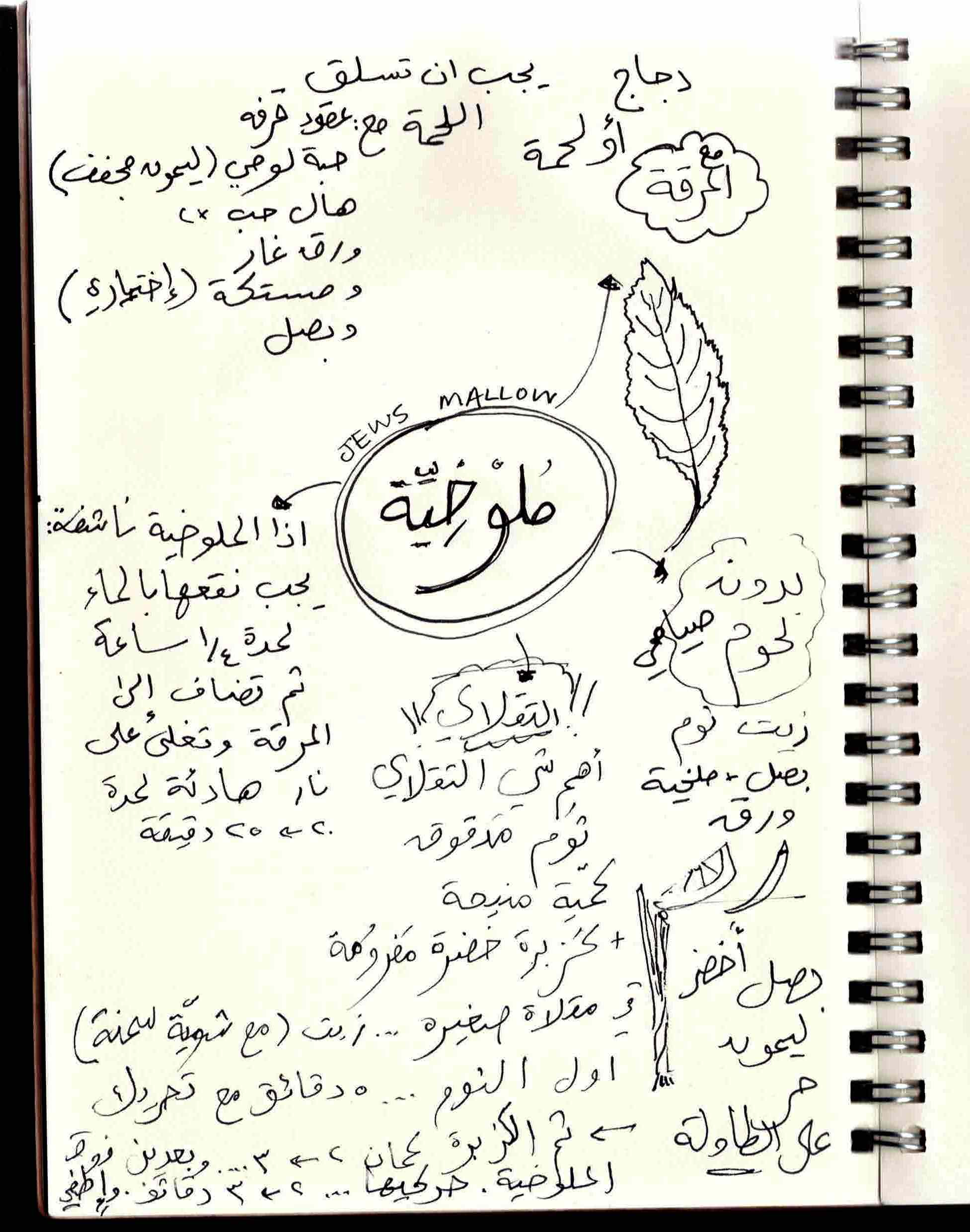
This time I was calling my mother for recipe of Mulukhiyeh (Jews mallow), a dish that strikes emotional cords for most people who grew up with it — often followed by a discussion on the preferred variation: whole-leaf or minced; cooked in a beef or chicken stock, or in olive oil. Fundamentally, there is nothing sexy about Mulukhiyeh. It is basically a dark green leaf that is in season at the end of summer, cooked into thick soup served on rice. It has an earthy flavour, and a slimy texture. So if you don’t grow up with it, it is a bit of a hard sell. The magic lies in the small details: the tiqlay (a coriander and garlic fry up, added in the last minutes of cooking), a squeeze of lemon and green onion as garnish. These lift the whole flavour from mundanity, to a nuanced level of yummm. Half way through our call, my notes are barely legible as I try to follow her instructions that jump from one part of the preparation process to another, and back again. Holding onto my frustration, I try to figure out why is it that taking down a recipe from my mother (which is seemingly a straight forward and simple process) is not working. And it quickly dawns on me that actually, my hand is following the wrong choreography.
When I prepared for the call, I pulled out my notebook of recipes, opened a new page, and wrote the title: Mulukheiyeh, at the top. Standing with attention my pen is ready to dance down the page with a list: ingredients, process, and final tips and tricks. My failure to follow my mother’s instructions in this verti-linear movement, confronted me with the realisation that this score-for-a-recipe didn’t work because it follows the logic of a masculine, capitalist world of cooking. But if we look at a recipe from ‘mama’ as one that carries inheritance of feminine tentacular worlds, of mental and physical process intertwined and overlapping, perhaps we would approach the task of taking down a recipe differently. For example, I could have started in the middle of the page, and that would have allowed me the freedom to jump to the information for each element of the recipe in a circular form. Or I could have taken the movements of a body in the kitchen, like a dance, as a score for writing the description and different phases of preparation.
Let’s paint an image of the two worlds; the chef world, and the ‘mama’ world of cooking. While it’s true that these worlds are not entirely gendered (as some papas are the ones who do most of the cooking); nevertheless, they operate within the power dynamics of a gendered capitalist world. The rise of the star (mostly male) chef over the last 20 years has changed the aesthetics of cooking. Starting with the ‘front-cover’ image of the famous chef; a man stands confidently in a clean apron, beefy arms crossed, in front of the camera with a warm smile. In the videos or TV series, the chef’s kitchen is organised, and he moves around the kitchen with ease, chopping fast (with a big knife) as he explains the science and chemistry behind his recipe—carefully blending together depth and simplicity. The careful movements relay the message that they approach their ‘art’ with a dedicated passion, paying close attention to small details—crouching over a dish with utmost care to add a sprinkle of parsley with expert fingers. In the meantime, they chat with you making it look fun; and most importantly: it doesn’t look like it takes much time. And if the chef’s followers would like more depth, the large hardcover book of full colour photographs, will give people more information on how his grandmothers’ food tickled his tastebuds and moved him so deeply, he just had to share it with the world. Rarely is the grandmother, or any other woman for that matter, sharing the page or the TV space. The capitalist urban food industry has influenced our impressions of making food, as much as it has influenced our idea of a recipe, and ultimately of what it means to cook. Ottolenghi, the much loved chef of Europe, is even more problematic. Not only are women absent from his book, but his rise to fame came on the backs of the colonised in Palestine.
Mama’s kitchen on the other hand, is not always a relaxed fun place. If I think of the vibes as my mother prepares a dinner for guests… she is generally not in the mood to be disturbed as she goes through a mental list of the timing, process, herbs and spices, of the different dishes on the menu. She, like other women, look like “Shiva goddesses with a hundred hands who are both clever and thrifty…requiring a multiple memory of witness gestures, of consistency…[and] a subtle intelligence full of nuances and strokes of genius, a light and lively intelligence that can be perceived without exhibiting itself.” And there needs to be someone to help actually, because cooking for many people requires a helping hand. As we were growing up (and could be coerced more easily), my mother would ask us to help peel, stir, stuff, or prepare a salad. Admittedly, we were always reluctant to be dragged into the chore, but these were the moments when information would actually slip into our minds and bodies of how a particular dish was prepared, and later how that preparation produced a particular flavour.
Meanwhile, the time and labour intensive processes of learning-by-doing in the kitchen alongside ‘mama’, or of calling to ask about the recipe (in a conversation that is likely to be complemented with anecdotes and stories on the side) are dying off. Calling for a recipe is a very intimate act. It creates personal bonds, and it plays tribute to a person’s knowledge. Meanwhile, once consumed, the cooked recipe carries an even less tangible thing: an energy, a quantum movement between people, time, memory, anecdotes, laughter, and secrets that no media can transmit. As we buckle down for a crazy world, that is promising AI-generated madness sooner than we can wrap our heads around; I invite you to find a relative’s hand written cook book and remake something. Alternatively, and as a way to celebrate that your family and friends have not been violently taken away by war, call them for a recipe, write their name down next to it, and remake it with love and attention and gratitude.
KRIJG JE GRAAG ONS PAPIEREN MAGAZINE IN JOUW BRIEVENBUS? NEEM DAN EEN ABONNEMENT.
REGELMATIG ONZE NIEUWSTE ARTIKELS IN JOUW INBOX?
SCHRIJF JE IN OP ONZE NIEUWSBRIEF.
JE LEEST ONZE ARTIKELS GRATIS OMDAT WE GELOVEN IN VRIJE, KWALITATIEVE, INCLUSIEVE KUNSTKRITIEK. ALS WE DAT WILLEN BLIJVEN BIEDEN IN DE TOEKOMST, HEBBEN WE OOK JOUW STEUN NODIG! Steun Etcetera.
column
31.03.2025
Leestijd 10 — 13 minuten
01.03.2025
—
14.09.2025
Samah Hijawi is a multi-media artist (a painter, a performer, an astrologer, a story teller, a researcher and an academic, a cook—it’s up to you to decide). Regardless of the form through which she materializes her work, her projects are always deeply rooted in historical narratives which are used to re-imagine our contemporary life outside of the radicalized and polarized discourses that direct our lives today.
Tom Rummens
Floris Baeke
column 31.03.2025
Tom Rummens
Floris Baeke