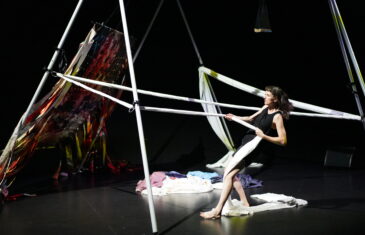
Lullabye – Anneleen Keppens
Wie zorgt er voor wie zorgt?
Tom Rummens





Infinite Dances, Michiel Vandevelde © Tom Herbots
For too long, the transmission of dance has relied either on the rules of a particular style or on the authorship of a choreographer. Michiel Vandevelde believes there’s got to be another way. How can artistic practices be passed on without reinforcing power structures? How do we transmit dance as such? And in what form does it make sense to think about a dance archive? In the dance ritual Infinite Dances, initiated by Vandevelde, the thesis is clear: the transmission and survival of dance will either be social, or not at all.
In recent discussions about how to pass on an embodied art form like dance, two strategies have often been considered. The first involves materialising dance in an archive, for example through video recordings, texts and drawings. The second strategy consists of restaging specific choreographies as ‘re-enactments’ or ‘repertoire’. Both approaches treat dance as something that can be frozen in time. Sure, passing a dance onto another body always generates variations, but the overall authority of the choreography and the choreographer largely remains untouched. As a result, dance becomes a static asset — something that is preserved and conserved.
“The discussion about dance heritage is not just about the dance itself, but also about preserving a name, an identity and, ultimately, a position of power.”
Since the 20th century, the value of the archive has been closely linked to the importance of the author. The claim is that contemporary dance doesn’t have a single encoded form but that there is, rather, a variety of individual and personal styles. This may well be true when viewed from within a historical trend. However, with some distance — and in parallel with centuries-old narratives — contemporary (Western) dance also becomes a ‘style’ that no longer needs to be tied to an individual. Yet, given the proximity to the historical moment, the discussion about dance heritage is not only about the dance itself, but also about preserving a name, an identity and, ultimately, a position of power. In these approaches, the archive serves not only as a tool to preserve dance but also as a means to consolidate influence and status.
How can dance be passed on in other ways? What kinds of archival practices can be developed that break away from power structures? Practices that focus not on the person behind the choreography, but on the dance itself? How can the essence of dance — its style, dynamics, characteristics — be handed down in a lively way?
Before we can talk about transmission, we must define a perspective on art. Each era has its own forms of art appreciation, value attribution and experience. In her latest book, Disordered Attention: How We Look at Art and Performance Today, art theorist Claire Bishop describes a shift in spectatorship influenced by smartphones, social media and the internet.
In the art world, and particularly in the performing arts, smartphones are often met with disapproval. Before a performance, you tend to hear all kinds of prohibitions — no phones, no pictures and the like. However, Bishop argues that such announcements are rooted in late 19th and 20th-century notions of dedicated, unfiltered attention to art. Rather than viewing digital technology negatively, Bishop is more interested in the potential of a shifting spectatorship.
Back in the 18th century and before, audiences freely commented on what was happening on stage. The theatre’s parterre was filled with people laughing and drinking, while on the balconies, the city’s elite put themselves on display or retreated to back rooms to engage in activities that had very little to do with watching the performance. Many plays were written with the challenge of capturing the audience’s attention in mind. However, from the late 19th century onward, with the rise of modernism, a new form of art emerged: one that demanded focus and attention in order to be understood. This notion remains dominant to this day.
And yet, as Bishop points out, the way we pay attention today is shifting back to a more pre-modern form. Through the lens of our smartphones, we are already documenting art while we’re watching it. This change is also tied to the shift towards lengthy art formats, where attention is no longer demanded from a single perspective or within a single attention span. Think about the many ‘durational performances’ taking place in both museums and theatres — performances where you’re free to come and go as you please, and which, above all, don’t insist on having your full attention. Instead, the viewer decides whether or not to stay engaged. During such performances, it’s common to chat with your neighbour or to document and share the experience through photos and videos.
Infinite Dances, Michiel Vandevelde © Tom Herbots
Infinite Dances, Michiel Vandevelde © Tom Herbots
While the late 19th and 20th centuries prioritised the artistic, and artists were valued for their ‘brilliant’ ideas, the balance between the social and the artistic experience of art is perhaps slowly being redressed in the 21st century. This inevitably impacts the approach to archiving as well. Art is now continuously and decentrally archived by visitors who take pictures and potentially share them via private and public online channels. At the same time, a new social (attention) space is emerging, where art (often unconsciously) becomes a mediator of social relationships. There’s a renewed appreciation for the social sphere where art is not above it, but exists within it.
“There’s a renewed appreciation for the social sphere where art is not above it, but exists within it.”
This more balanced relationship between the social and the artistic sphere also holds the potential for a new approach to the notion of ‘the archive’. In a sense, the seed for this balance was already planted in the 20th century by the mother of postmodern Western dance: Anna Halprin.
Anna Halprin may not be as well-known as some of her contemporaries, but her influence extends far wider and deeper than that of the choreographers who are often considered the defining figures of the second half of the 20th century, such as Trisha Brown, Simone Forti, Steve Paxton, Meredith Monk and Yvonne Rainer. Although Halprin created over a hundred performances, some of which became iconic, her true significance lies not so much in these specific works as in her ability to intertwine the artistic and the social.
Halprin’s artistic journey can be roughly divided into two phases. In the first, she focused on an in-depth exploration of movement and dance itself. The second phase, which began after she was diagnosed with colon cancer, was marked by her use of movement methodologies to provide care and establish connections between people.
In her first phase, Halprin created and organised numerous performances and workshops, showing many, including the choreographers mentioned above, that dance can be much more than a fixed, coded language. She revealed dance as a practice of freedom and endless possibilities. Dance didn’t have to be confined to traditional concepts or fixed forms; everyday actions could become dance, too. Thus Halprin opened the door to a much broader and more inclusive understanding of what dance can be.
In the second phase of her life, she increasingly worked with people who practiced dance in their spare time, particularly those who had experienced illness. After all, Halprin firmly believed in the healing power of dance. On her famous dance deck in California, she worked with diverse groups of people, including HIV patients, cancer patients, elderly people in wheelchairs and people with disabilities. She continued to do so until her death in 2021, at the age of 100.
A major dance ritual initiated by Halprin in 1980, Planetary Dance, has had a direct influence on my thinking about the notions of archive and legacy. This ritual continues to be performed annually to this day. It lasts an entire day and has a permanent base in San Francisco, though over time it has also been performed in various locations worldwide. Once a year, people of all ages and physical abilities come together to perform this dance dedicated to healing, in the broadest sense of the word. It could mean healing the earth, healing a relationship with a loved one, healing an illness or healing peace. Planetary Dance consists of several dance rituals, and depending on the location, some or all of them are performed. One element is always included, though: the so-called ‘earth run’, a simple ritual in which participants walk and run in concentric circles.
“The idea behind Infinite Dances has always been that the ritual doesn’t rely on a leading figure to survive. In my view, such a ‘guru aspect’ always creates an unhealthy power dynamic.”
Planetary Dance is not primarily focused on artistic concerns such as ‘a dance archive’ or ‘an artistic legacy’. Instead, it invites reflection on how physical practices can be shared over the years. It’s a powerful example of an initiative rooted in artistic thought, fostering specific and enduring knowledge-sharing (maybe unconsciously for most participants) of the practices Halprin cultivated and shaped throughout her artistic life. It’s also a form of transmission in which a community takes responsibility, allowing the dance to exist independently of the choreographer’s presence or personality. Most participants don’t take part because they want to preserve an artistic legacy. They join because the dance itself adds meaning to their lives. In this way, Planetary Dance is not just a dance, but also a testament to how a shared practice can connect people.
Faced with the cycle of life and death in my own life, and with the fleeting nature of the performances one creates as an artist, I began to reflect on alternative approaches to knowledge-sharing, transmission and legacy. Halprin was an important source of inspiration in this respect.
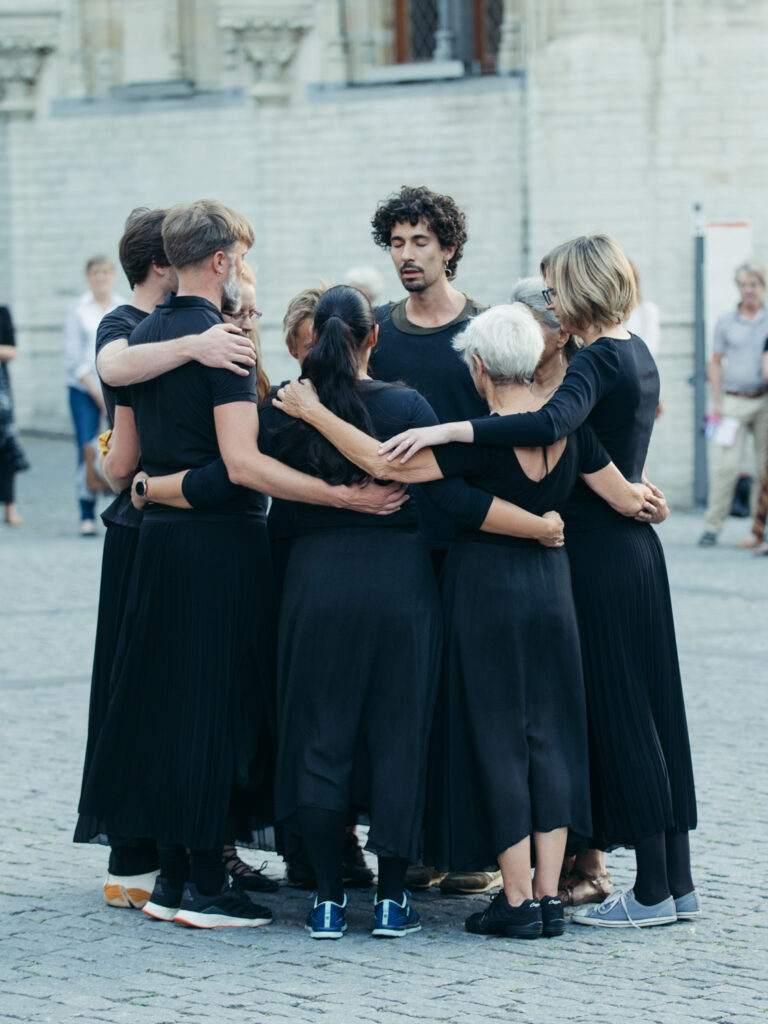
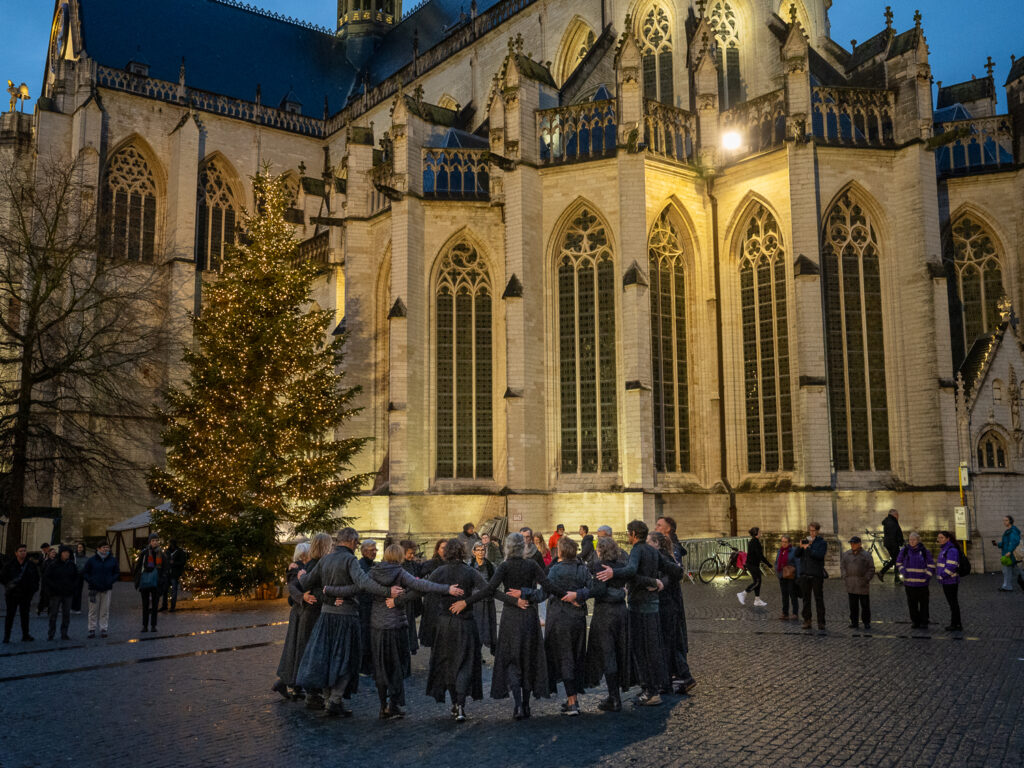
In 2022, I created Infinite Dances, a dance ritual that began in June of that year and has since been performed at sunset on the last Monday of each month by a group of volunteer dancers from Leuven and the surrounding area. It’s a dance of mourning. The key question: how can we say goodbye to a loved one in a physical way? The dance material originates from my choreography Dances of Death, which was performed in theatres between 2020 and 2023 by seven dancers and a singer. The material for Dances of Death was developed in collaboration with the dancers and is based on three dance videos I inherited from my mother after she passed away in 2019.
In her youth, my mother dreamed of becoming a dancer, taking classes at a dance school in Kortrijk with Heiko Kolt. This Russian-Estonian choreographer ended up in West Flanders during World War II. After the war, he quickly became a local celebrity thanks to his acclaimed choreographic style. He combined influences from ballet, modern dance and (Eastern) European traditional dances — a common practice at the time which can, for instance, also be seen in the work of German choreographer and dance theatre pioneer Kurt Jooss.
In the three 8 mm videos I inherited, my mother dances both solo and in a group, performing a choreography taught by Kolt. Various dance styles shine through in her movements, though it’s hard to pinpoint which tradition each movement belongs to. Together with the dancers from Dances of Death, we distilled about twenty movements from these videos, which we then reworked into a smooth and repetitive circular choreography. Centuries of dance evolution unfold: the gestures in Dances of Death carry history; the dance material connects past and present. This choreography was later adapted and simplified into Infinite Dances.

Infinite Dances, Michiel Vandevelde © Tom Herbots

Infinite Dances, Michiel Vandevelde © Tom Herbots
The Leuven cultural centre 30CC played a pivotal role, launching an open call for participants. Before June 2022, around twenty people learned the dance movements in about five workshops. Over the past two years, the group gradually grew to about thirty dancers. The dance, which takes place every month at the Grote Markt in Leuven, can be performed by just one person, though an average of ten dancers participate each month. Halfway through the month, 30CC hosts a rehearsal. New dancers are introduced to the movements by more experienced participants. Returning dancers can refine their movements or join to connect with others.
The idea behind Infinite Dances has always been that the ritual doesn’t rely on a leading figure to survive. The work isn’t defined by the choreographer’s importance, personality or oeuvre. In my view, such a ‘guru aspect’ always creates an unhealthy power dynamic, which I want to avoid. I conceptualised and initiated Infinite Dances, but am otherwise absent. The dance survives thanks to a community that takes responsibility for keeping the initiative alive and passing it on to new participants. Its preservation stems from and depends on the participants’ intrinsic motivation. What if, one day, the dance ritual is no longer considered meaningful? Then it will disappear.
This form of transmission also holds the potential for evolving into new movements or even an entirely new choreography. It’s inevitable — to be encouraged, even — that participants adapt the dance to reflect new insights, needs or preferences. After all, the social aspect is what keeps an archive alive and meaningful. Imagine that Infinite Dances actually survives and is still performed twenty, fifty or even a hundred years from now: what will it look like? What will motivate people to dance it? Which time periods, aesthetic preferences or socio-political dynamics will shape it?
In March 2025, I created a new dance ritual in Bruges, commissioned by KAAP and Concertgebouw Brugge, titled Transitional Dance. This dance revolves around celebrating life’s transitions. Think of major changes such as birth, the cycle of the seasons, the transition from a student’s life to a professional one or physical changes, but also smaller moments, like new routines, social interactions or resolutions.
“Imagine that Infinite Dances actually survives and is still performed twenty, fifty or even a hundred years from now: what will it look like?”
The dance material for Transitional Dances came from the performance Le Sacre du Printemps, which I created at Theater Neumarkt in Zurich in 2023. The choreography consists primarily of hand gestures with political, spiritual or social meanings; the second part of the choreography is based on hip movements, which are historically associated with birth and new life. I reworked and simplified this material into a repetitive choreography to be performed in Bruges by a new community of dancers.
In this view, every new dance ritual is at the same time a living dance archive. The plan is to expand it over the years, always based on choreographies originally created for theatrical contexts. Besides other, more traditional archiving methods — Flanders lacks a material dance archive! — I strongly believe that physically connecting dance archives with a social purpose is the most meaningful way to approach an intangible dance archive.
Translation: Lies Xhonneux
KRIJG JE GRAAG ONS PAPIEREN MAGAZINE IN JOUW BRIEVENBUS? NEEM DAN EEN ABONNEMENT.
REGELMATIG ONZE NIEUWSTE ARTIKELS IN JOUW INBOX?
SCHRIJF JE IN OP ONZE NIEUWSBRIEF.
JE LEEST ONZE ARTIKELS GRATIS OMDAT WE GELOVEN IN VRIJE, KWALITATIEVE, INCLUSIEVE KUNSTKRITIEK. ALS WE DAT WILLEN BLIJVEN BIEDEN IN DE TOEKOMST, HEBBEN WE OOK JOUW STEUN NODIG! Steun Etcetera.
essay
18.03.2025
Leestijd 12 — 15 minuten
01.03.2025
—
14.09.2025
Tom Rummens
Floris Baeke
essay 18.03.2025
Tom Rummens
Floris Baeke