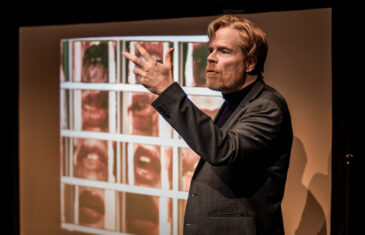
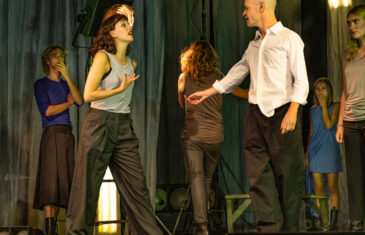
Confessie – Raven Ruëll & Bruno Vanden Broucke
De kunstmarkt maakt de kunstenaar
Klaas Tindemans





© Shirin Rabi
How do you write about a ritual that you have no personal connection with, in which the role of the spectator is limited to watching and not participating? Ugnė Noreikė reflects on these questions, after seeing Firestarter, a collective fire ritual that opened the new theatre season of NTGent.
As far back as we have any records of human life on earth, rituals have been an integral part of our existence. They’ve punctuated our lifetimes, marking special occasions, changes, rites of passage. If compared to our history it’s bizarre to think that now we live in a secular society with barely any rituals present. Unless connected to strict religious practices, most celebrations have been claimed by capitalism. They’re highly focused on material goods, incentivizing us to mark the occasion through consumerism.
Rituals, however, have always been connected to consuming, but in a very different often literal way. The process requires something to be shed, lost, something needs to transform, change shape. Another important aspect of this consumption is its relation to time: we spend time going through the metamorphosis, either through slowly chewing the host, burning incense, changing to different clothes for a prayer or embarking on a long journey, staying at a monastery or an ashram. It’s no wonder that rituals have been pushed out of society that prioritizes efficiency, where time is money and money is everything.
To bring attention to our need for rituals, NTGent opened its season this year with a fire ceremony. Anyone who wanted to participate could just register for free. The ritual started on the stairs of the NTGent theater on the evening of 27th September. We were greeted by a group of 18 children, all dressed in white. They extended their greetings to human and non-human life forms, different social groups, sexualities, religions and so on. After singing a song and asking the fire to walk with them, they took their peculiar walking sticks standing close by the stage. We obediently followed them to Coyendanspark around ten minutes away from the theatre. There they formed a gateway asking each one of us “What is burning in you?”. I didn’t answer, I was too shy to disturb the silence in which the eerie melodies of musicians we met on the walk were resonating.
We gathered around a big sculpture made out of metal frames and hay. I and many others were sitting way too close, as it was so crowded. Even before the sculpture was lit I knew we’ll have to move, the fire was going to grow too big. This reminded me of a metal festival in Lithuania I used to go to, called Kilkim Žaibu. Every year a bunch of volunteers would build sculptures to be burned at the end of the four-day festival. All dirty and smelling of sweat we would gather on the closing night of the festival to say goodbye. So when this sculpture in the middle of Coyendanspark was lit and the children were dancing around, my mind went there, to another ritual in my home country. I wondered if the children felt as connected and elevated as I did back then. But why didn’t I feel the same connectedness here?
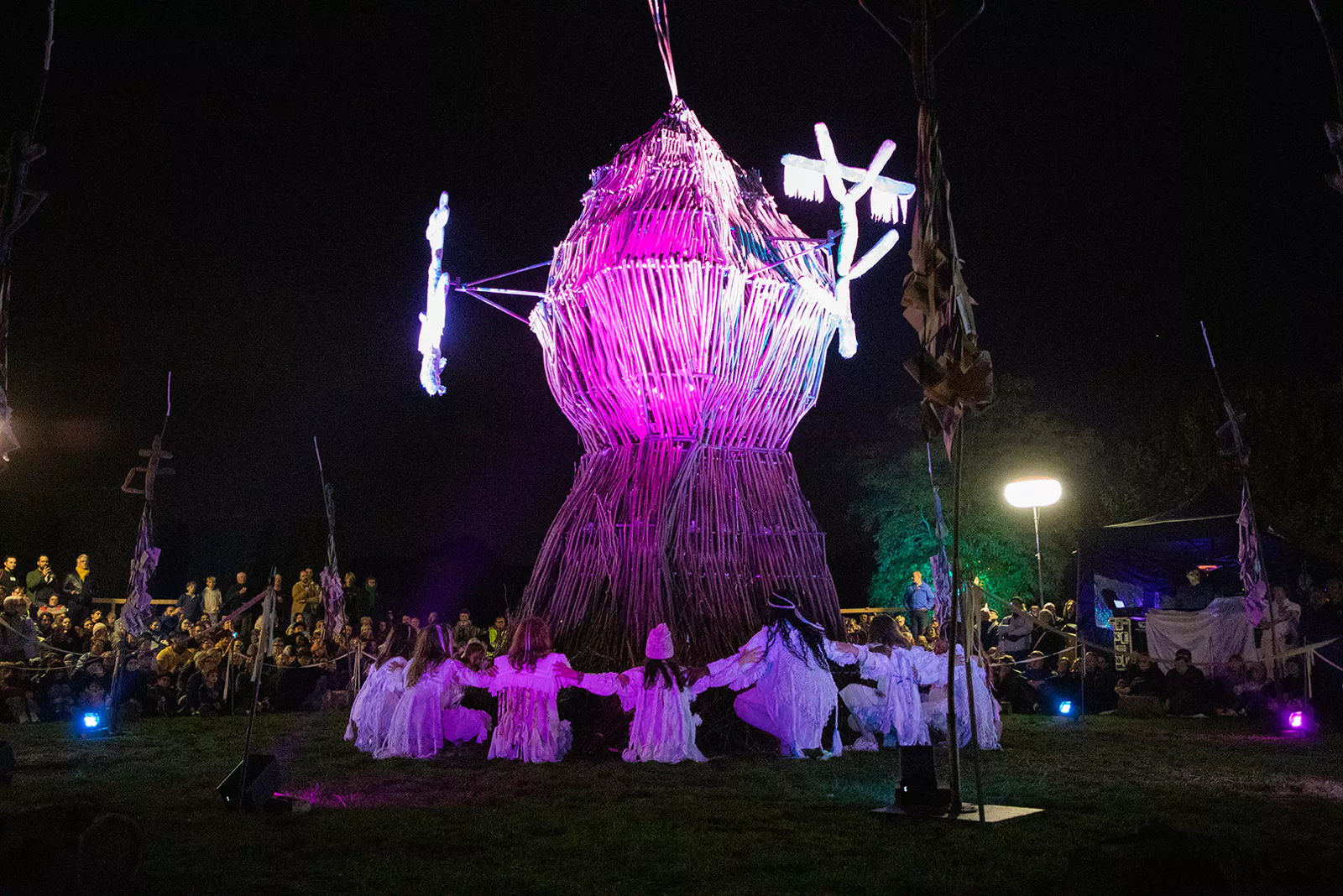
© Shirin Rabi
Just before Firestarter I interviewed the makers – NTGent’s artistic director Barbara Raes and Dutch theatre maker Alexandra Broeder. I found out what a long process it was to gather these 18 children around the fire. They all went through a metamorphosis in order to be able to stand here together, before us. I found out why during the ritual they were holding circular objects and putting them in the fire, what was hanging on their sticks that they were carrying and later burning as well. I read the booklet with information about this evening and many other private evenings that this project ignited, I was well-informed. But after gathering all this knowledge, when the sculpture was burning, I was wondering: how should I write about this? Part of me felt that without a personal relationship to the ritual, without a four-day festival to precede this evening and preparing for it, I’m not a part of it all.
For Raes and Broeder preparing for this night and working with the children was not about going after their artistic pursuits but rather a matter of urgency. Even though this generation is very young, they – according to the artists – have already been facing many challenges in their lives: they’re the first ones to grow up in a completely digitalized world and a big part of their developing years have been marked by the corona pandemic. Their life has been dominated by technology, but that’s not the only way to live and to relate to one another. We, pre-screeners, know it and yet constantly forget about it. Realising that you’re a part of the whole of human history and that this screen age is but a negligible period of time is the first step to connectedness. It puts attention to the fact that time is necessary for kinship. We’re preceded by our ancestors that knew nothing about relating without touch, smell, or physical proximity to one another. These are still the most powerful experiences we can have. Technology or not, the kids deserve to partake in this knowledge as well.
Therefore, this evening wasn’t a performance or an art piece per se but an evening of digesting what they’ve learned and transitioning to a new state. You could see that they have been trained in the process to control their attention – fearlessly holding eye contact while we were passing in between them. They were focused and determined while dancing around the fire. They were there to mark a rite of passage, to show what culture they’ve built. Most of the spectators didn’t pre-meditate their presence here months in advance. Someone even called the fire brigade because the flames were so high, a practical approach to something we don’t fully understand. All I could do is rest in a respectful position of the observer and reap what they’ve sown. At the end, when the kids wandered through the audience handing out little bags with seeds, it felt like they were extending an invitation to create something of our own. To remember our connection to the ancestors. Could we try to observe time differently? What does it mean to precede one evening with a long communal process?
“On the night of Firestarter many spectators came to see a ritual, not to participate in one.”
I cannot possibly review the months that the children spent together. Anyway, there’s a documentary being made to cover the whole process. However, while interviewing them I heard them talk about possibilities, feeling bigger, enabled, sensing magic. Thus, it feels like Raes and Broeder’s project was a success. But it also very clearly shows that as a spectator, without the time spent together, without intimate contact with one another today, we can’t simply join hands and experience a ritual. On the night of Firestarter many spectators came to see a ritual, not to participate in one. Even though they were invited to think about their burning questions and children even broke the fourth wall and interacted with us, all we could hope for is to be inspired to do the same as them.
The consequence of performing such an intimate experience is that the audience can only witness but never really partake in the emotional range of it all. In a way it feels removed and put up, even though it’s extremely true and real. Most rituals are performed in insider groups where even though not everyone is participating, everyone knows how this relates to their lives. I hoped that I’d be a part of community who doesn’t need to question what I’m seeing, I’d known the weight and the meaning of each object and movement. One could ask what was the role of the spectators at all, why did we need to be there? I have two thoughts about it. Maybe we were there to make the experience of children more real by seeing them. Or maybe the children were showing us how rich our society could be if we ritualised our being in the world a bit more.

© Shirin Rabi
KRIJG JE GRAAG ONS PAPIEREN MAGAZINE IN JOUW BRIEVENBUS? NEEM DAN EEN ABONNEMENT.
REGELMATIG ONZE NIEUWSTE ARTIKELS IN JOUW INBOX?
SCHRIJF JE IN OP ONZE NIEUWSBRIEF.
JE LEEST ONZE ARTIKELS GRATIS OMDAT WE GELOVEN IN VRIJE, KWALITATIEVE, INCLUSIEVE KUNSTKRITIEK. ALS WE DAT WILLEN BLIJVEN BIEDEN IN DE TOEKOMST, HEBBEN WE OOK JOUW STEUN NODIG! Steun Etcetera.
recensie
27.10.2025
Leestijd 7 — 10 minuten
15.09.2025
—
14.12.2025

Ugnė Noreikė is a Lithuanian writer, musician and artist. She works in spaces of not knowing, vulnerability and extreme feelings. She’s looking for meeting points between sounds and words.
Klaas Tindemans
Mia Vaerman
recensie 27.10.2025
Klaas Tindemans
Mia Vaerman