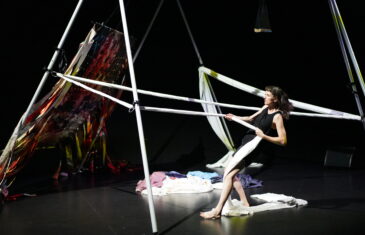
Lullabye – Anneleen Keppens
Wie zorgt er voor wie zorgt?
Tom Rummens




© Charles Phillips
Performance maker Sophia Rodriguez and longtime artistic collaborator Vivi Focquet share a common interest in ‘anatomical theatre’. Inspired by the spectacle of historical operating theatres and ancient as well as contemporary healing practices, they are at the starting point of a research project. From that precious place, this text came into being as the result of a two-way interview.
Sophia Rodriguez Our research into anatomical theatre started from a contradiction. While I wanted to stay at home, study biodecoding2 and listen to my organs, you connected this desire to the historical space of the anatomical theatre.3 Through this architecture and the spectacle of presenting a body for an audience, you brought the outside in. How did that happen for you?
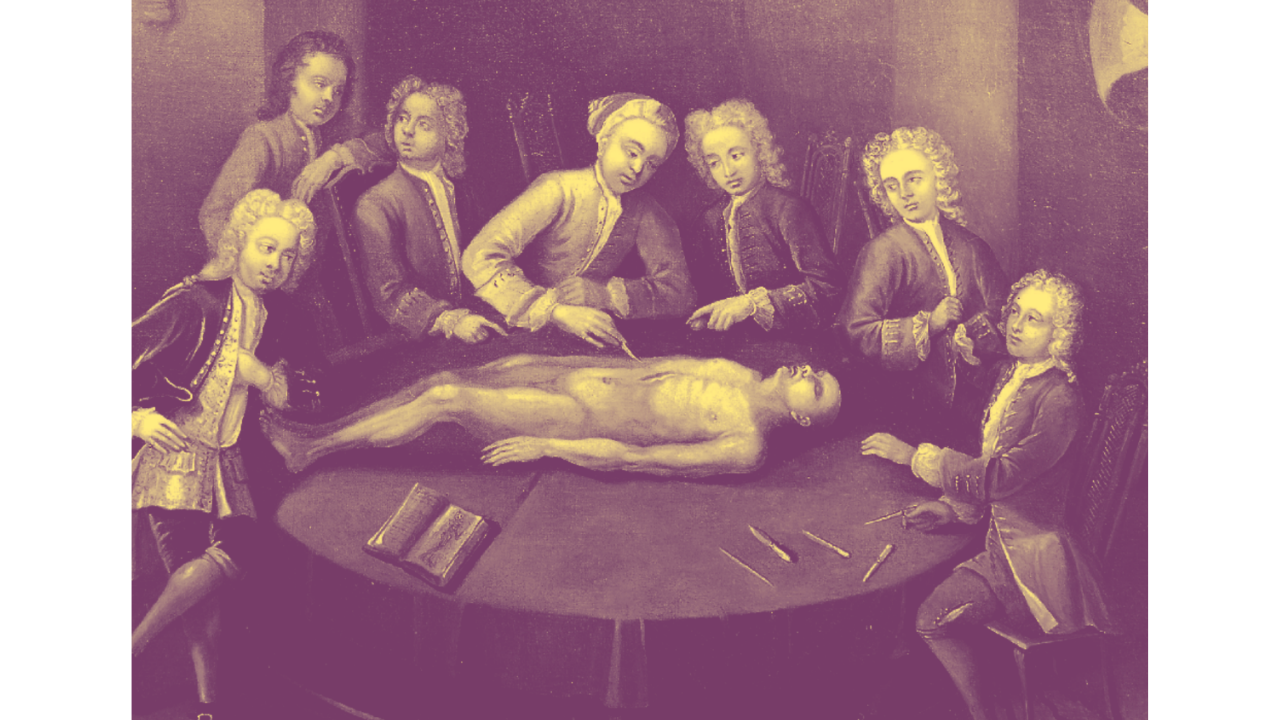
Vivi Focquet The anatomical theatre came to me in the first place because the building of KASK School of Arts in Ghent has one. Although we haven’t yet had the chance to work there, the idea of that space became important. In a lot of ways, the anatomical theatre was born out of a culture of death. It arises in the epoch of modernity—colonial times—when the discovery of the body paralleled the so-called ‘discovery’ of the ‘New World’. For me, it represents the disenchantment of the world. Through that space, science makes the world into its object. So what does it mean to be alive in that space today and to feel what we are feeling?
SR Our initial desire was to turn the anatomical theatre inside out, to put life and imagination back into that space of death by assuming the anatomical position of dissection, imagining that we are dead and observing what remains of us. What if we leave the scalpel aside and imagine a meditative dissection practice?
It’s a feminist gesture in that sense, too: not to search for truth in death and exterior objectivity, but to trust myself and my body. We can travel and see beyond the anatomy, by staying very close to it.
“What if we leave the scalpel aside and imagine a meditative dissection practice? It’s a feminist gesture in that sense, too: not to search for truth in death and exterior objectivity, but to trust myself and my body.”
— Sophia Rodriguez
VF Since we have only just begun, our anatomical theatre practice mostly exists in our respective heads. But in the few days we spent together in the studio —and the questions, videos and experiences we continuously share—it has become clear that the tension between inside and outside is active throughout it. This porous divide operates on a concrete level—what’s inside and outside of the skin—but also on a symbolic level: the private and the public, the emotional and the rational.

© Marla Morella
SR In and out. During our studio days, we enter a performative mode and leave it again. Laying down on our backs, like
the body in the middle of the anatomical theatre. In that position, we mentally dissect ourselves or each other. This meditation practice takes different forms. Sometimes we talk to ourselves while dissecting; sometimes we talk to each other in more of a doctor-patient relationship, sometimes we remain silent.
VF We imagine our inner organs, not just as blobs of matter, but as living elements connected to our feelings, to our environment. We think our organs are sending us messages and the anatomical theatre offers us the time and spaceto decipher them and pass them on.
SR While dissecting, I stumble on personal memories and thoughts, like my chest remembering a touch or the stress of a new
subsidy application having settled in my neck. In this perspective, dissection isn’t simply about the objective understanding of the internal organisation of the individual, but a thick practice of seeing the connections between memories, emotions, social relations and the body.
VF In a way, we try to use the modernist (mental) architecture of the anatomical theatre for practices that predate it. We
are researching ancient healing practices that came before anatomical theatre and that were sidelined by science, which dominated and centralised all knowledge by discrediting all other ways of knowing and healing.
SR Pachita, for example—a healer from Mexico working in the sixties and seventies—operated on bodies without using medical equipment. She said she was guided by the spirits of the Aztecs. Critics called her ‘a performative and psychological phenomenon’ because they couldn’t believe people were actually getting better. But maybe that’s an accurate description of her work. Maybe we could be a bit like her.
In South America, there is a term for these kinds of healers: curanderos. They practice a mix of Indigenous, African and Western or Catholic knowledge. I’m inspired by this ancient knowledge and interested in what happens when it enters the space of the anatomical theatre. Curanderos use imagination, words and practices of oration as methods of operating and dissecting a body. For example, you might be asked to imagine that a jaguar is eating your liver. Through this exercise your liver releases or heals from a specific problem.
“We think our organs are sending us messages and the anatomical theatre offers us the time and space to decipher them and pass them on.”
— Vivi Foquet
VF This makes me think of the opening scene of your previous creation FRICTION(2023), where you sing: ‘Operate me, take
them out, all the words—they are heavy walls. I got them from the past.’ How is this new practice connected to the rest of your work?
SR Most of my work starts from observing the body and how it moves. I try to notice frictions or internal conflicts. This comes from the core idea of biodecoding: an internal conflict that can’t be resolved expresses itself as a (painful or harmful) bodily sensation. In this way, I manage to bring together the body and movement with intimate personal histories. It doesn’t end there though. Cultural and political traumas and conflicts also manifest themselves in our bodies. Addressing them from that perspective gives us a unique starting point to discuss and understand what’s happening around us.
VF I feel like you are reacting to a presupposition that dealing with therapy results in a self-involved way of making theatre.
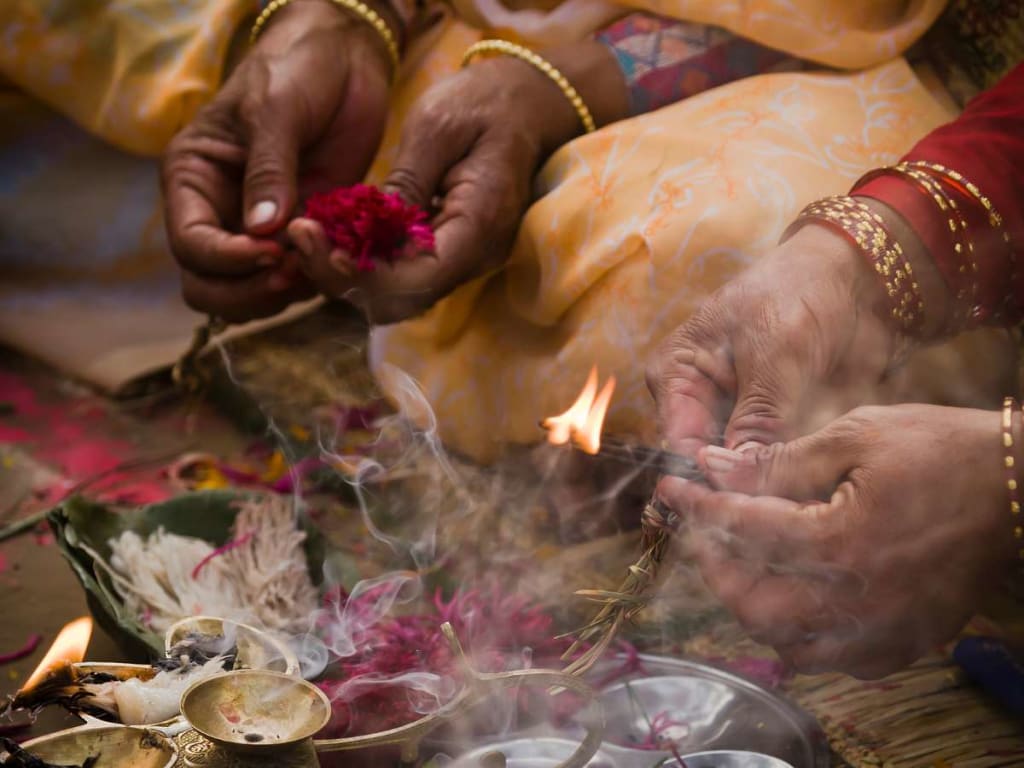
SR It’s true that a possible risk of working with healing practices as motors for performance could be that it becomes self-contained and individualistic. But I have experienced myself that asking yourself these questions and taking the time to sit with them in an embodied way actually does the opposite. I feel that I open up for my ancestors, but also everyone I’m in relation with. More concretely, sharing this intimate connection with an audience feels so powerful.
You know about fascia, right? The tissue that connects everything in the body? Fascia therapists speak of the waves of the tissue. Releasing the fascia means opening up toward the outside. What if this fascia doesn’t stop at our skin, but continues as a kind of social tissue? Could anatomical theatre be a way of massaging the social fabric?
“My sense of survival is strongly anchored in my experience of growing up in Venezuela, where the absence of basic state protection produces a constant sense of alarm.”
— Sophia Rodriguez
VF The historical anatomical theatre, as I understand it, is a space where the dead body serves as an excavation site for definitive and objective truth. The body is sterilized, stable and alone. But if I look at the etch above, I also feel like it was a
place full of life. How do you feel death is present in our anatomical theatre?

Ostentation, Sophia Rodriguez © Arnaud Beelen
SR In this question, the relationship between death and intimacy is essential to me. The intimacy with death in the space, and the intimacy generated by a dead body. How close can we feel to the sense of absence, to the fear of losing someone or something or being alone. These are very intimate feelings that arise when we relate to death. While I was previously occupied with the topic of survival, body. How close can we feel to the sense of absence, to the fear of losing someone or something or being alone. These are very intimate feelings that arise when we relate to death. While I was previously occupied with the topic of survival, I’m drawn to continuing this research because of the move towards a different question: how to discover a peaceful way of being with death. Aging as a person and a maker, I ask myself how I can sustain an intimate relationship with death.
VF Maybe part of the intimacy of the anatomical theatre is the proximity to death?
SR There is another strong association I have. It has to do with the position of the exposed body. The Swiss-American
psychiatrist Elisabeth Kübler-Ross writes about out-of-body experiences in which people rise above themselves and look down at their bodies not unlike the perspective of the audience in an anatomical theatre.
In another common near-death experience, people see a loved one who allows them to let go of life. This is just to say that transmission is happening and that even the most personal experiences, like dying, are always related to the ones around us. It’s an intimate space where you have to let go of something, where you understand and become conscious of the steps you took in your life. Being close to death can be a moment to speak the truth or ask for forgiveness. And when you let go, you can go on. Anatomical theatre can be that space too. ‘Death is not the elephant in the room. Death is the room and we are the elephants. The working definition for death is truth,’ says comedian and poet Alok.

VF What does that mean in the studio?
SR I remember very clearly when we started to try our dissection practice in the studio—which meant, in a way, entering a state close to death. I felt so good. In my practice, I always think of meditation or observation as something that is very alive and very active. But to do the opposite, and be present for yourself as a dead body and surrender completely and imagine that everything could disappear, that was a new sensation.
VF This seems paradoxical again. We started by speaking about healing practices, and now we’re speaking about death. How do dying and the resistance to it coexist in the same space?
SR They are two sides of the same coin. In the face of death, we need to think about survival. My sense of survival is strongly anchored in my experience of growing up in Venezuela, where the absence of basic state protection produces a constant sense of alarm. Even now, in a relatively safe environment, the body remembers that state. In the theatrical space I learn to understand and reclaim these embodied memories. It’s interesting to me how death and the struggle to survive co-exist in our anatomical theatre. It can be a place to imagine something else, to work with re-presentation, re-production, role switching.
VF Like in Ostentation (2020), when you pitch down your voice and perform a scenario of a man trying to take you into
his car, reversing the scene of abuse you experienced?
SR Exactly. In a state of survival, my body is blocked and disconnected. Traumatic scenes replay in your mind again and
again. You become their playing field, and your present becomes their prey. The theatre offers me a way out by performing
a different role. By representing the one who hurt you, you empathize with the pain and misery of the other, and from that
place, it is easier to heal and empower yourself. Memory is not a fixed point in the past. When you can reverse this pattern on the stage, you gain space by letting go of the fear of what hurt you. We can use imagination to re-write the past in a performance, so it does not become a future. Like an operation of the self, rearranging some insides.
At least as wonderful to experience is how the audience becomes an expanded self. In this case, can we still speak of representation? This expanded self as a healing tool is actually a mechanism you, Vivi, use in the first performative proposition that emerged from anatomical theatre.
“I’m interested in how therapy and healing can be a collective experience rather than a hyper individualised one.”
— Vivi Focquet
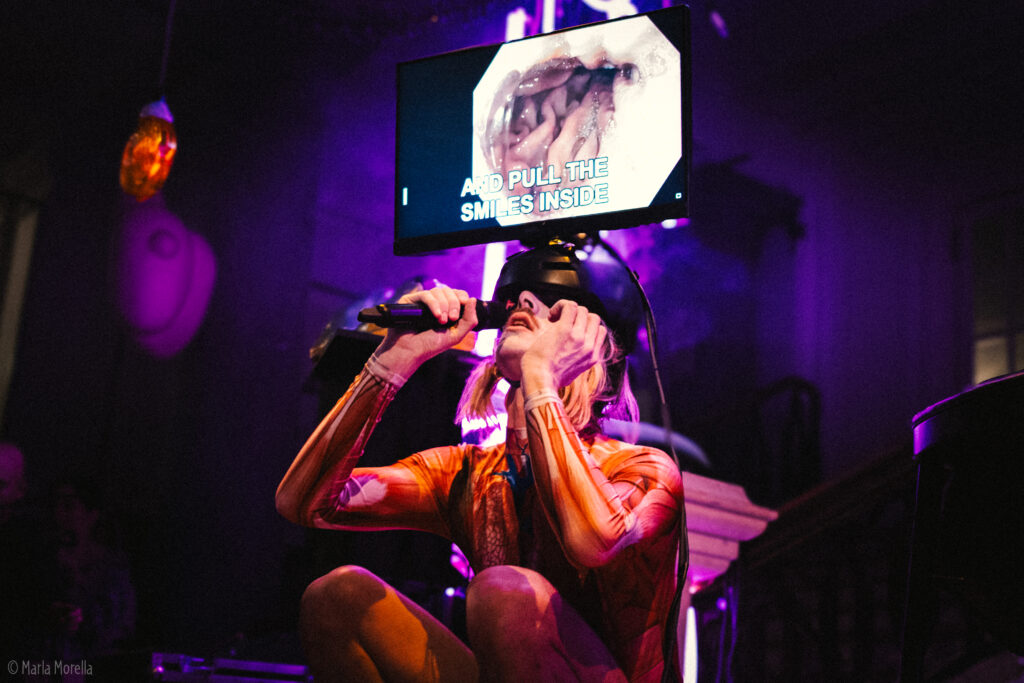
VF In the solo that I made out of some of these thoughts for the Brussels performance cabaret Anal Pompidou, I perform a character named ‘Doctor’. It’s a character that’s both the dissector and the dissected body, both dead and alive. In one scene, Doctor interacts directly with the audience in a sort of collective acupuncture session. First, an audience member identifies a
point on their body where they are hurting. On the spot, I interpret what that pain means symbolically. A blocked neck could indicate that a shift in perspective is necessary or a hurting knee might tell you to stop running away from something. After that, the audience touches the same spot on their body with one hand and on their neighbour’s with the other. That way a ‘chain of pain’ is created. After the collective shout of an improvised spell, the chain is broken and the person is ‘healed’.
Each time I perform this, however tongue-in-cheek, I feel something ‘real’ does surprisingly appear for me and the person
hurting. I’m interested in how therapy and healing can be a collective experience rather than a hyper individualised one.
VF What is the organ you want to speak from right now?
SR Right now, I really feel my pussy. When I imagined your question, a small river appeared. I would need to speak from my pussy feelings.

VF What are they telling you?
SR I try to listen to the first impulse that comes when you ask the question. The precise feeling/image that came to me
when you asked me the question was an electrical feeling and right after I saw myself being born from my own vagina with my tongue sticking out.
VF You just gave birth to yourself, in this moment?
SR Exactly. Anyhow, this period is Scorpio’s new moon, so it makes sense to be in a movement of rebirth.
VF Wow, what a moment to be born (again)?
SR Well, there are a lot of things to fix in these troubled times. Maybe we need to enter through a new portal to understand
ourselves and others? That’s also the potentiality of the theatre, we can pass through that portal together again and again and we can ask ourselves: what will die and what will stay alive?
KRIJG JE GRAAG ONS PAPIEREN MAGAZINE IN JOUW BRIEVENBUS? NEEM DAN EEN ABONNEMENT.
REGELMATIG ONZE NIEUWSTE ARTIKELS IN JOUW INBOX?
SCHRIJF JE IN OP ONZE NIEUWSBRIEF.
JE LEEST ONZE ARTIKELS GRATIS OMDAT WE GELOVEN IN VRIJE, KWALITATIEVE, INCLUSIEVE KUNSTKRITIEK. ALS WE DAT WILLEN BLIJVEN BIEDEN IN DE TOEKOMST, HEBBEN WE OOK JOUW STEUN NODIG! Steun Etcetera.
gesprek
15.04.2026
Leestijd 12 — 15 minuten
15.04.2026
—
07.09.2026


Vivi Focquet studied Theatre Studies at Ghent University. Since then, he has worked as an organiser, performer, and writer. He is currently a member of Kunstenplatform PLAN B and Gouvernement. Together with longtime collaborator Marie Umuhoza, he produced the concert performance Holy (2026) by Martha Canga Antonio and is building a new night club in Brussels.
Sophia Rodriguez is an actress, dancer and choreographer. She studied circus, dance and theatre in Venezuela, in Cuba and in Switzerland. She worked together with Micha Goldberg, Simon Van Schuylenbergh and Benjamin Abel Meirhaeghe. In her own work Sophia uses physical performance, voice and improvisation as building blocks for energetic and feminist propositions.
Tom Rummens
Floris Baeke
gesprek 15.04.2026
Tom Rummens
Floris Baeke