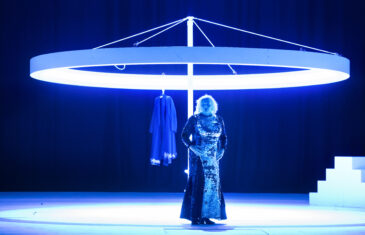
De Materie – Phia Ménard/Opera Ballet Vlaanderen/Bas Wiegers
Een schurend vooruitgangsdenken
Sébastien Hendrickx





‘The Making of Justice’, Sarah Vanhee, filmstills
Prisoners, we know them from TV series, true-crime podcasts and newspaper reports. But in the theatre performance De gevangenis (The prison) by Lara Staal and in the films The Making of Justice by Sarah Vanhee and Reas by Lola Arias, (former) prisoners themselves get to have their say. Can fiction offer a way out of their harsh reality? And can the imagination help us to break through entrenched paradigms about law and justice? Natalie Gielen seeks some answers.
‘I shifted my work from journalism language to art and literature (…): to take the readers into the camp. To live with us.’ (Behrouz Boochani)1
Doors closing with a thud, footsteps echoing in corridors, voices resonating in bare rooms, basketballs bouncing mutely in a courtyard: this is the soundtrack I associate with prison life. What I see in my mind’s eye are bars, metal, concrete, blind walls, damp patches, locks, uniforms. Clichés of a reality that to many of us is something abstract and unfamiliar, prisons generally being far from our city centres or behind high walls we walk by hastily.
And the people who live in prison? Whether held in punishment for a crime (whether committed or not, depending on the legal system – or lack thereof – which they are subject to), while they await a verdict or due to a lack of space in a psychiatric institution, they are condemned to a life outside society, which does not even allow them to have a voice.
More than ten years ago, as part of an exhibition project, I repeatedly visited the prison of Mechelen, where men are held who have generally not yet been convicted. I met guards, prisoners and management staff.2 I observed the usual clichés: lack of space, staff shortages, a language full of cryptic jargon and abbreviations that reduced people to ‘movements’ in corridors, to ‘the walk’ in a courtyard, to ‘inside’ and ‘outside’. Within the strict prison regime, it was a challenge to make time and space for the art projects I was helping to support then. I was only able to have a few short conversations with the prisoners, which means that I didn’t really get to know them. What I did see was that, while prison life ticked off all the clichés, the prisoners seemed simply … human.
Can art – and therefore fiction and the imagination – help to narrow the gap between the reality ‘inside’, within prisons, and ‘outside’? Can artistic strategies counteract the dehumanization of people in prison? Can we avoid portraying them as cardboard characters or monsters, without minimizing the serious crimes that some have committed? Can artistic strategies bring us closer to restorative and dialogical systems in which there is room for justice and mutual responsibility? Can we use our imagination to cast a critical gaze on our justice systems and detention centres, on the places where we lock people up, people who are excluded from taking part in our society? Can our imagination enable us to look ‘inward’ and ‘outward’, from ‘outside’ to ‘inside’ and from ‘inside’ to ‘outside’? Can artistic processes have a liberating effect on those who are imprisoned and can they broaden the minds of those who are ‘free’? I explore these questions through a play and two films about and with (former) prisoners.
“Sarah Vanhee regularly reminds her fellow scriptwriters that the film script is fictional and that they are free to speak and think as they wish. Yet reality stands in the way.”
‘I’d start the film with a scene from the childhood of our perpetrator’, says a woman’s voice. On screen, we see images that have been deliberately blurred: details of a clean, quiet room with framed paintings hanging on the walls and a circle of chairs. Camerawoman Fairuz Ghammam zooms in on hands, a chin, a knee in jeans, legs, notebooks … We only see details of the people in the space. It looks like a room for group therapy, but it turns out to be a writer’s room in the prison of Leuven Centraal. Those present – artist Sarah Vanhee herself, together with a supervisor and seven long-term prisoners – discuss the film script in progress for the film Justice. Occasionally, the men read excerpts from the script, which appear in yellow letters across the screen, such as: ‘Tom is 17, commits minor offences.’
The script is fictional in two respects. On the one hand, we see and hear the imagination of Vanhee and her seven co-authors at work. On the other, it is unclear whether Justice will ever actually be made. The Making of Justice is therefore a documentary prison film about the development of the fictional prison film Justice.
The men brainstorm a number of relatively innocent offences that the main character could commit as a teenager. In doing so, they use what philosopher Paul Ricoeur calls their ‘reproductive imagination’ (where memories are reproduced) and their productive imagination (where new ideas are produced).3 For example, someone suggests that the main character Tom was bullied as a child, just like he himself was: clearly a case of reproductive imagination. Another imagines Tom urinating through the open window of a police car. ‘That’s a wild dream of yours, man’, one of the men chuckles, causing the group to burst out laughing: productive imagination and prison humour.

The Making of Justice, Sarah Vanhee, film still
The film script of Justice is a vehicle for stimulating the imagination. Thanks to the script, various events and themes from the prisoners’ reality rise to the surface. How does it feel to commit a murder? Does the law have anything in common with justice? How do you deal with victims and their loved ones? What does the future look like once a sentence has been served? Literary critic Charlotte Remarque talks about ‘fiction as a way out through the dense undergrowth of immutabilities’ (De Groene Amsterdammer, 2025, p. 69).4 The fictional film script serves here as a way out of both the harsh reality and the clichéd perception in which the prisoners are trapped.
Vanhee regularly reminds her fellow scriptwriters that the film script is fictional and that they are free to speak and think as they wish. Yet reality stands in the way. In an exchange with prisoners in the literary magazine De Gids, writer Christine Otten talks about the (internalized) pressure that prisoners experience: ‘That makes it difficult to be completely honest on paper. A fictional story can be interpreted as “real”. It remains a prison’ (De Gids, 2022, p. 7). The men’s reactions in The Making of Justice also show that they fear their fictional script will be perceived as reflecting their real beliefs: ‘And then now to say, in a film, even if it’s fiction, “Oh well, he can be released immediately”, that’s like saying that I think that murder isn’t that bad in fact. And I can’t accept that, sorry.’ The scriptwriters navigate between fantasizing about alternative realities, remaining truthful (‘So, you know, you don’t need to make up stories unnecessarily’) and a concern for control over the way prisoners are portrayed – both at the level of the film script Justice and in the editing of The Making of Justice.
Fiction and reality interpenetrate: reality feeds the script based on the memories of the men in prison, their imagination feeds fictional scenes, and at the same time, The Making of Justice allows viewers to adjust their image of prisoners. That is why film is an interesting medium. In the screening of the blurred images, you can see metaphors that we as visitors might not notice. For example, when the camera fades out by zooming in on the black T-shirt of one of the men, his body acts as a kind of vanishing point.
The blurred images adhere to the rule according to which prisoners must not be recognizable on screen. They visualize a zone in which there is room for different forms of imagination. These offer both prisoners and viewers possible new perspectives – a way out of entrenched ideas, failed visions of the future and stranded social debates.
While The Making of Justice ends with the familiar sound of doors slamming shut and footsteps echoing in corridors as the soundtrack to the credits, in Reas by Lola Arias they can be heard during the opening credits. A mugshot is taken of a young woman in a purple T-shirt with a blonde ponytail. Yoseline was sentenced to four years and six months in jail for smuggling drugs. An off-screen voice puts factual questions to her about her time in prison, before asking: ‘What would you like to be?’ Yoseline laughs: ‘A millionaire.’
Like the rest of the fourteen-member cast of Reas, Yoseline was incarcerated in the Ezeiza prison of Buenos Aires. The actors here have names – contrary to The Making of Justice, where we only hear voices. They play themselves, but also take on other roles that contrast or resonate with their own experiences: those of guards, fellow inmates, visitors or lawyers.
These contrasts in terms of both form and content are typical of the docufiction Reas: realistic-looking re-enactments of prison life merge seamlessly with speculative conversations on fantasies about a utopian future and everyday scenes such as visits, inspections or phone calls are sung and danced to the rhythm of infectious music. Like The Making of Justice, Reas engages in a game with fact and the imagination, while steering a middle course between exuberant musical and documentary re-enactment. The result is a series of beautiful images, with many symbolic contrasts (light/dark, inside/outside) and tightly framed and choreographed scenes. Because of the way they are lined up, a group of intimidating guards look like a group of music-video dancers, and a row of prisoners waiting during a long and painful break-up conversation on the phone start dancing in sync to a pop song.
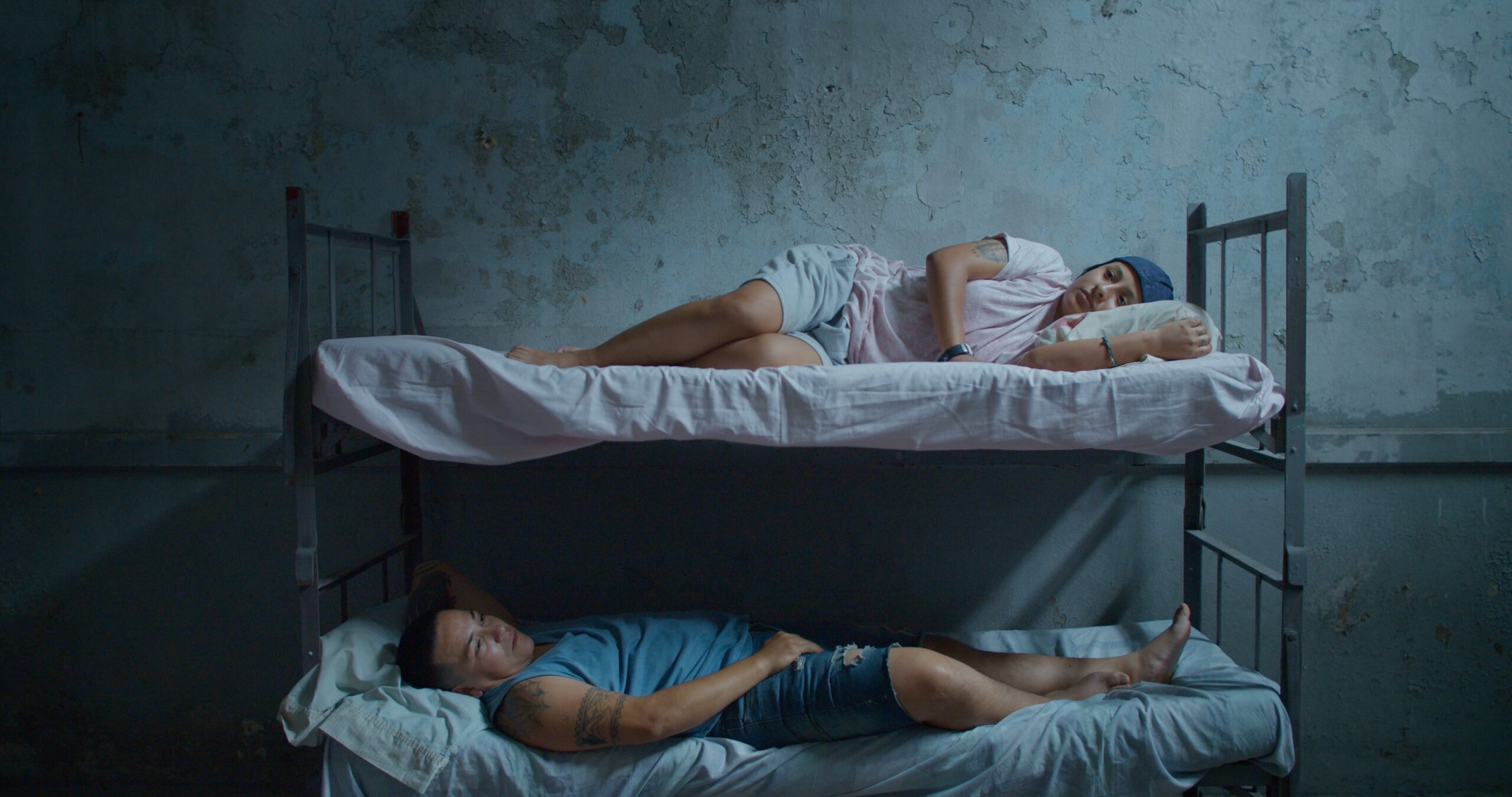
Reas, Lola Arias, film still
You could say that these fictionalized musical scenes aestheticize and romanticize the world of the prisoners. After all, as Lola Arias explains in the director’s notes on her website, the musical is a genre that originally depicted marginalized worlds in a stylized way, with trained dancers and singers. In Reas, however, the dancers and singers are amateurs portraying their own experiences. It is true that the dialogues have been written out – such as a meta-scene in which someone bursts out laughing during a conversation about violence because she has forgotten her lines and so takes out the script – but they are based on the actors’ time in prison. What’s more, the film was shot in a former prison where people were once tortured.
“You could say that these fictionalized musical scenes aestheticize and romanticize the world of the prisoners. In Reas, however, the dancers and singers are amateurs portraying their own experiences.”
In De Gids, a prisoner named A. and author Christine Otten also discuss in their correspondence how difficult it is to make your (real) voice heard in prison. This is in part due to a lack of privacy, but also to a culture of ‘strong language and strong stories’ (De Gids, 2022, p. 6). There is a lot of non-verbal communication, too. This issue is addressed in Reas during a beautiful, subdued scene in which trans woman and femme queen Noe teaches her fellow prisoners to vogue in a bare cell. ‘The hand performance tells a story with your hands’, Noe explains. ‘Now tell me your story.’ I see hands waving, flapping, pushing away, circling, diving and fluttering.
The vogue scene illustrates the resilience and strength of the community that makes up the film’s cast. The cis and trans women were all held in the Ezeiza prison, which is unique in that it has a wing for trans people. Alongside the reproductive imagination of dystopian prison scenes full of violence and oppression, the actors present utopian counter-images that demonstrate caring friendship, humour and solidarity. Hollywood films have made us familiar with male prisoners who support each other through thick and thin; Reas shows a transfeminist alternative. As such, the actors appropriate the stories about their former reality. They embody, articulate, dance and sing a different representation of the prison world. As I watched Reas, I was reminded of the semi-documentary film Cesare deve morire by Paolo and Vittorio Taviani, in which prisoners rehearse Shakespeare’s Julius Caesar. The actors recognize the violence in the drama. The parallels with Shakespeare’s fictional tragedy confirm their reality, while the fictional musical scenes in Reas help precisely to transcend and transform the actors’ reality.
You could say that Reas is nothing more than escapism: from a prison (past) to a parallel musical universe. However, the transformative power of the film manifests itself fully during the final scene. In an epilogue, we suddenly see the actors sitting on a sunny beach in their swimsuits, with cocktails, a small inflatable pool, white sand and palm trees. This setting is entirely consistent with the actors’ fantasies about the future. As the camera rises and zooms out for a bird’s-eye view, we discover that the beach has indeed become reality: a ‘prison beach’ of sorts has been staged in the middle of the grey courtyard.
This beach is much more than just escapism. It shows how the imagination can create new realities and invites us, the viewers, to also use our imagination as a transformative force. As the camera rises higher and higher, we see that the beach is located within the vast prison site, which in turn is in the middle of the city, in the middle of society. As the camera zooms out and as the prison and the city grow smaller and smaller, the louder the question echoes in my head: how can we take a different approach to justice?
In the performance De gevangenis (The Prison) by Lara Staal and NTGent, former prisoners also question the (Belgian) justice system. On stage are Freddie Konings, Adam Rambouk, Bahadir Kanmaz and Laurens Aneca as Kevin Laforce. Like in Reas, they analyse the system from their own embodied experience and stage prison life. They do so live, however, on an actual stage. In De gevangenis, Lara Staal and the actors create an artistic framework in five chapters that explore their experiences of imprisonment: a preliminary examination of how prisoners are perceived by so-called experts and in films and TV series; an interrogation during which the actors question each other about their experiences; a lesson on the history of imprisonment; a chapter in which the prison regime is staged by the actors; and finally an epilogue about life after their release.
“De gevangenis is at its strongest when staged anecdotes contribute to criticism of the system and when the tension between fiction and reality is brought to a head – the theatre auditorium is the perfect place for this.”
While the voices of the men in The Making of Justice sounded clear and close by, they came from within the prison, they were ‘inside’ – where both their bodies and their surroundings were inevitably shrouded in a certain flou artistique. In Reas, the actors were visible and audible, their bodies were ‘outside’. They were free to sing and dance, but they were still at a certain distance: on a screen and in a (former) prison. The actors in De gevangenis seemingly distance themselves physically from their time ‘inside’ by standing live on a stage in a theatre auditorium. In stark contrast to the interviews with experts screened at the beginning of the performance, here the actors speak as experts by experience and determine what the audience sees and hears in the theatre itself.
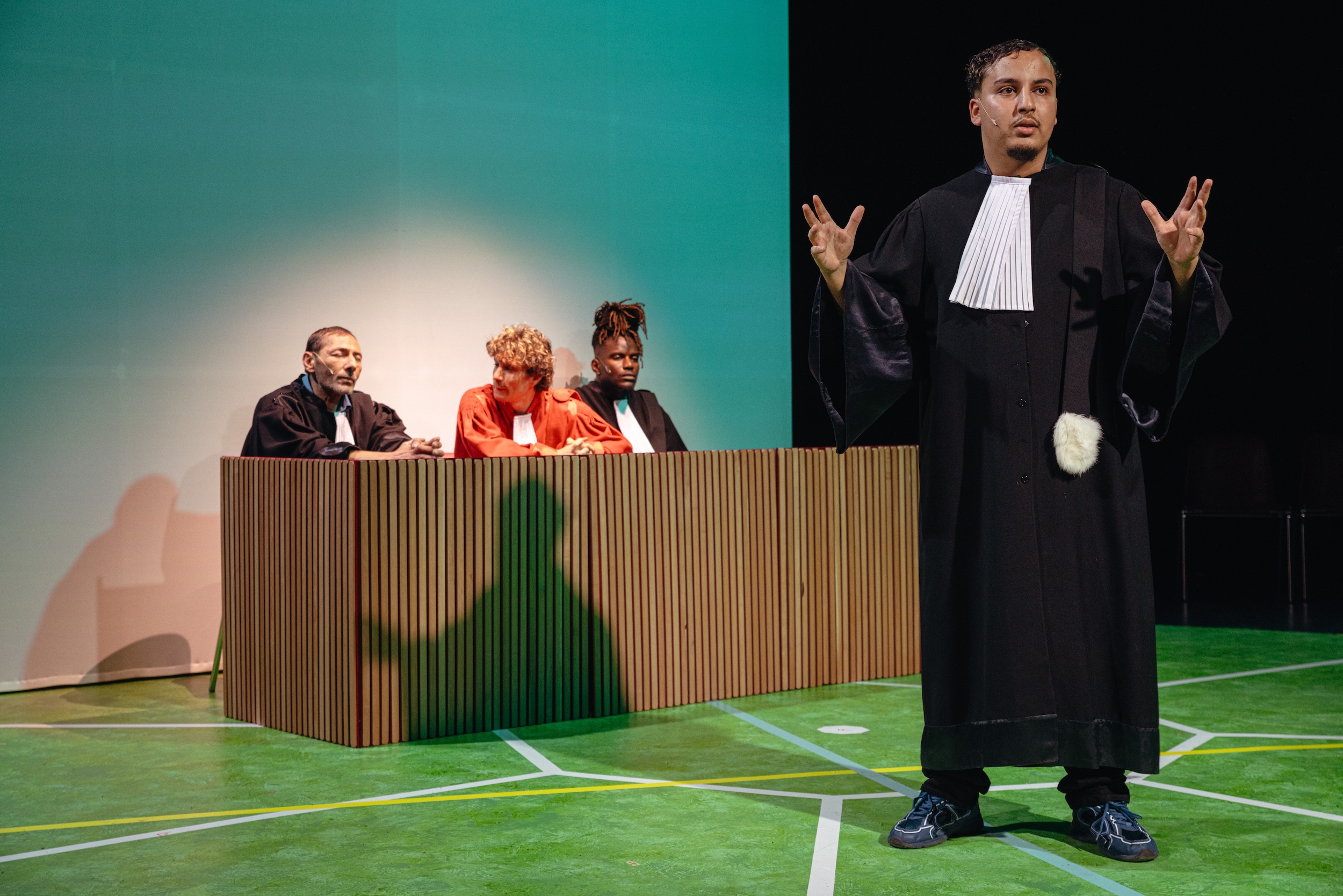
De gevangenis, Lara Staal © Michiel Devijver
Together with Staal, the actors create an artistic framework and a scenario. By working on stage with live camera images that they themselves direct and screens behind which they can disappear, the actors regain control. They literally determine the perspective. The scenography underlines this by working with projection, cameras and movable walls. The fictional setting not only shows a new position that the former prisoners can take, it reproduces and reinforces it thanks to the theatre’s bag of tricks: lighting, scenography, dramaturgy, acting techniques, role reversals, and so on. ‘Here in the theatre, we can be in control’, says Freddie Konings. ‘Here in the theatre, we can take the system apart and examine it from all angles.’
Of course, that live presence in a theatre is not only a way of exercising control, it also allows the actors to interact live with the audience. In an interview with Wouter Hillaert (De Standaard, 2025), Bahadir Kanmaz says: ‘The power of theatre is that you can address people directly.’ This entails a certain vulnerability, but the fictional context of a performance helps in this regard. As in Reas, the actors take on different roles – guards, ‘top dog’ or ‘newbie’, lawyer, fellow prisoner, psychosocial worker in a suit with a laptop – and stage their experiences as characters who resemble them. During the performance, a quote from Judith Hermann’s novel We Would Have Told Each Other Everything comes to mind. Hermann describes how she let her psychotherapist read a short story she had written. His reaction has stayed with me: ‘What untiringly detailed work, altering and distorting everything so skilfully that in the end nothing is correct any more, yet everything is true.’ (2025). The former prisoners stand on stage as actors and as experts by experience, but not (quite) as themselves. They give their experiences an artistic twist. Their discomfort, at the beginning of the performance, at standing in front of an audience is hopefully no longer genuine after a while, but acted according to the script.
De gevangenis is at its strongest when staged anecdotes contribute to criticism of the system and when the tension between fiction and reality is brought to a head – the theatre auditorium is the perfect place for this. A good example is a re-enactment of the prison visit. As in Reas, we see chairs set up for family and friends, but they remain empty on stage and the actors address imaginary visitors. This makes the experience of loneliness and isolation more palpable. A scene at the beginning of the performance is strikingly simple, with the actors standing in front of a screen showing images of the prison. In the theatre, you can both be free and at the same time still be (mentally) locked up. Fiction and lived experience, imagination and live reality can merge on stage, giving the impression that the actors’ bodies are in those grey corridors.
In a theatre performance, different perspectives can coexist, roles can be reversed and a broken system can be analysed from the perspective of embodied experience. And yet the harsh reality of prison is never far away. This becomes painfully clear when it appears that one of the actors ended up back behind bars during rehearsals. The role of Kevin Laforce is therefore played by Laurens Aneca. He embodies Laforce’s experiences and ends the performance with a letter from him, in which Laforce writes that reality feels hopeless. Within the prison walls, Laforce misses theatre’s power of imagination. That clash between fiction and reality makes the invitation to us, the audience, painfully necessary: can we imagine an alternative to this failed system instead of merely watching from our theatre seats?
Fiction is therefore not merely a genre; it can be used as a strategy. In The Making of Justice, it serves both to evoke one’s own reality and to imagine other realities. In Reas, it serves as an emancipatory tool to imagine other roles and perspectives and to physically embody one’s own experience. And in De gevangenis, it serves as a framework within which control, agency, processing and a public appeal for social reflection suddenly do become part of reality. As an artistic strategy, fiction offers more than a way out of our compelling – and, for prisoners, oppressive – reality. It creates spaces of imagination both for experts by experience in the prison world and for viewers to rethink their own perspectives and reframe reality.
Even within a fictionalized framework, there is room for real people with their own experiences, voices and names; people with bodies, people who are generally made invisible and inaudible in our society. This is where fiction’s greatest power lies in The Making of Justice, Reas and De gevangenis. By placing experts by experience of the harsh reality of prison at the centre and giving them agency, Vanhee, Arias and Staal move beyond the suspension of disbelief. They invite us to reflect on the judicial system and the role of prisons in our society. They invite us to suspend our disinterest.
The Making of Justice will be screened on November 7, 2025 at Het Bos. You can find the touring dates of De gevangenis here.
Translation: Patrick Lennon
Arias, L. (januari 2024). Director’s notes.
Hermann, J. (2025). We Would Have Told Each Other Everything. Trans. Katy Derbyshire. Granta.
Hillaert, W. (15 maart 2025). Ex-gedetineerde Bahadir Kanmaz acteert bij NTGent: ‘Je kijkt in je cel uit naar het licht aan het eind van de tunnel, maar dat blijkt dan te veel licht ineens’. De Standaard. https://www.standaard.be/media-en-cultuur/ex-gedetineerde-bahadir-kanmaz-acteert-bij-ntgent-je-kijkt-in-je-cel-uit-naar-het-licht-aan-het-eind-van-de-tunnel-maar-dat-blijkt-dan-te-veel-licht-ineens/48663761.html
Otten, C. & A. Taal in de gevangenis. De Gids, 2022,2.
Remarque, C. (13 februari 2025). Schrijver, en dus verdacht. De Groene Amsterdammer.
Stoakes, E. (18 januari 2020). Hope Is a Complicated Concept: An Interview with Behrouz Boochani. Los Angeles Review of Books. https://lareviewofbooks.org/article/hope-is-a-complicated-concept-an-interview-with-behrouz-boochani/
Verheyen, L. (12 september 2019). Waarom ons denken fictie nodig heeft. rekto:verso. https://www.rektoverso.be/artikel/waarom-ons-denken-fictie-nodig-heeft
KRIJG JE GRAAG ONS PAPIEREN MAGAZINE IN JOUW BRIEVENBUS? NEEM DAN EEN ABONNEMENT.
REGELMATIG ONZE NIEUWSTE ARTIKELS IN JOUW INBOX?
SCHRIJF JE IN OP ONZE NIEUWSBRIEF.
JE LEEST ONZE ARTIKELS GRATIS OMDAT WE GELOVEN IN VRIJE, KWALITATIEVE, INCLUSIEVE KUNSTKRITIEK. ALS WE DAT WILLEN BLIJVEN BIEDEN IN DE TOEKOMST, HEBBEN WE OOK JOUW STEUN NODIG! Steun Etcetera.
essay
18.09.2025
Leestijd 17 — 20 minuten
15.09.2025
—
14.12.2025

Natalie Gielen is a member of the editorial staff at Etcetera. She also works as a freelance author, editor and outside-eye in the arts. She is co-founder of the writer’s collective Letterveld.
Sébastien Hendrickx
Mia Vaerman
essay 18.09.2025
Sébastien Hendrickx
Mia Vaerman