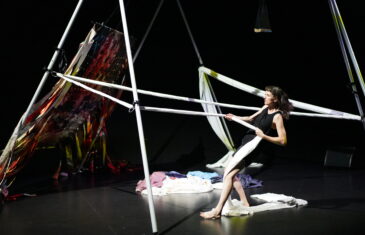
Lullabye – Anneleen Keppens
Wie zorgt er voor wie zorgt?
Tom Rummens





© Lore Stessel
How can dance be passed on from one generation to the next? What are the differences that occur when you execute a movement originating from a different body? Choreographer Zoë Demoustier reflects on her practice as a potential site for physical archiving.
As a child I used to play a game of whispers.
We would form a circle or sometimes a line.
One child would start and imagine a sentence.
Something mysterious, something joyful or just funny.
This child would whisper the phrase in the ear of its neighbor.
That child would listen very carefully and pass it on to the next child in line.
And this would continue for a while.
There was no doubt that the sentence would slowly change along the way.
With every child, every ear and every mouth it would transform.
Until eventually, the last child in line would have the honor to say the words out loud.
Most of the time this moment was followed by laughter or total hilarity.
Because even though we more or less knew what would happen, every time we played the game we were overwhelmed by the unexpected outcome.
And the most beautiful part of it is that somewhere, somehow, we would always recognise the origin of it, even though it was just an echo.
This summer, many years later, I played the game again.
But this time I asked a group of children to imagine a phrase, not in words, but in movement.
We had to adjust the rules because the intimacy of whispering disappears when showing a set of movements.
So, we invented a new set of rules with closing the eyes and turning around to hide the movement for the others who were waiting for their turn.
And eventually, the game worked just as well.
Like in the original game, the movements slowly changed.
Observing from the side, I enjoyed watching the children play and felt privileged to witness where and how the changes were made along the way.
Sometimes, by accidently confusing right with left or by skipping the ending, being too impatient to wait and already tapping their neighbour’s back to show their own version of the phrase.
Sometimes I could witness something else in the sincere attempt of passing on the movement phrase.
They added their own imagination.
Or should I call it fantasy, personality, interpretation?
In that way they became the new owner of the material.
After finishing the game, I told them about the so-called Flemish Wave
About the impact a young group of artists had on the (dance)landscape in Belgium (and beyond).
How they pushed the boundaries of dance and movement and pushed Belgian dance across land borders, changing everything.
I explained how what they did is still tangible today.
How one wave creates a new wave and a new wave.
How old and big waves were once touched by other waves.
How the ripples made by the water touch others.
I remember the flying bricks, caught just in time.
I remember that sitting on a chair never felt the same after seeing these women dance on them
I remember being eleven years old, sitting next to my mother in the theatre, almost feeling the drops of water splashing from a dancer who jumped off a rock that looked like the moon. It made me want to dance, spin around and let my hair grow long.
The ripple touched me.
I was born in May 1995.
The same year Alain Platel was rehearsing La Tristeza Complice.
Half a year before Antilichaam by Marc Vanrunxt premiered.
One week after Rosas danst Rosas was performed at Archa Theatre in Prague.
For the past three years, I’ve been working as a performer and chore ographer under the wings of Ultima Vez, where I created one solowork Unfolding an Archive, a group piece What Remains and this year I will create a new group piece, Hear The Silence.
Being part of this company gave me the opportunity to work on different levels with a large team and for the big stages.
We have toured, seen many places and met many people.
But it also made me realise that I’ve grown up, I still see little Zoë sitting in the theatre with her dreams.
They haven’t disappeared, they have only changed over time.
There’s this thing about growing up. As a grownup you look at your parents and realise something has changed.
You see the complexity of life, the cracks, the influence of time.
Maybe that’s the hardest part of it: people that once were your heroes become human beings. They become conversation partners, maybe friends or colleagues, or loved ones. You experience similar doubts, pains and desires, differences between you. You realise that someday it will be your turn to relate to a younger generation.
One day you yourself will be ‘the fallen hero’.
I explore this generational theme in my most recent piece What Remains.
When we started the process, the performers were between 5 and 75 years old. Today, they too have grown up and grown older.
The performance is about loss and grief. It focuses on the moment in life when you start to question what will be left, and what you’ll pass on.
Something concrete: a ring of your mother, for instance. Or the recipe for an apple cake. The color of your eyes. Or more abstract: a movement, a way of running, singing. A way of looking at the world.
During rehearsals I was touched by the friendship developing between the performers, all of different ages. The older ones coached the younger, and the younger taught the older. Roles shifted and transformed. Both literally and figuratively speaking everyone could carry the other.
Thus, life becomes a circle. We receive and pass on, for others to receive.
Working in Ultima Vez, being so close to the repertoire that once felt so far away, I started questioning how me and my peers feel about this repertoire, the techniques, the ideas and the images we grew up with. What do we carry within us, what do we pass along, and what is
changed along the way? What do we want to change?
© Lore Stessel
As a teacher in art schools, working with young adults, I often notice a strong rejection of repertoire. Probably the perspective on it, too, moves in waves.
The strong urge to do things differently, to create something new, to be bold and sometimes destructive, intrigues me. When comparing it to growing up, I think this critical mindset of forming your own character, the phase of resistance like the teenager — is one we should embrace. It is both essential for their own development as for
the artistic world in general. It confronts us, it opens up our eyes.
However, we should not forget the past. We shouldn’t hide from it.
We need to learn from it and work with it.
And most importantly, work together.
Last year I got a research position at the Conservatory of Antwerp, titled ‘The Flemish Wave Revisited: towards an intergenerational dialogue with dance heritage’. This research will result in a dance performance — The Wave — set to premiere in the winter of 2026.
In The Wave I want to confront a new generation of performers with the legacy of the emerging dance artists from the eighties and nineties.
On stage there will be a mix of children, youngsters, young professionals of diverse profiles in terms of age, education, ability and background together with dancers that were once part of the repertoire pieces we’ll get inspired by.
My research will focus on this intergenerational encounter, and how the existing material can be enriched and changed by the addition of today’s dancers. I want to explore the transmission of movement vocabulary, and how this can be transformed by the dancers’ own gaze, personality, bodies and background.
Just like a game of whispers.
This research will raise many questions.
Which material will I choose to work from?
Which choreographers are forgotten.
What kind of dancers do I want to work with?
How close should I stay to the original?
How can we create something new without losing the essence, the core?
What would that core be? What is it we want to pass on, what becomes a part of our archive?
In my work, I often explore the idea of the body as an archive.
In the solo Unfolding an Archive, I approached this quite literally re-embodying the video footage from my father’s archive of war images.
And in What Remains, I worked with older and younger bodies, archives that change over time and through life. At home, I have a room full of cardboard boxes, filled with material of projects I’ve done, photos of people I met, traces and remnants of travels and tours. I try to hold my memories close, turning them into relatable objects, not losing them.
I try to contain the past. Some people might call this hoarding. For me it’s a way of remembering.
It’s also from this love of memories, of archiving and collecting that I am fascinated with what happens today. By the shift we are in.
And how we will deal with this legacy that lies before us, and more that will follow.
How do we capture dance if it is as ‘elusive’ as water
If it is already gone just after we saw it.
Many methods and attempts of archiving, preserving and passing on dance already exist — body-to-body, movement scores, drawings and videos. However, we should not forget the spectator, especially when we look into collective memory. People were sitting in the theatre. They were there, they were watching.
How did they experience the play?
What do they remember?
Recently I started collecting memories from spectators of dance pieces that were created before my birth in 1995. Pieces I ‘missed’.
Doing so, I’m building a new archive. A history of reception. From those interviews, I created detailed dance scripts to pass on to performers of different ages.
It’s beautiful to see how they interpreted these scenarios of movement. How they made images out of descriptions, like an ‘ekphrasis’, but with extra layers — movement, image, memory, language, image, movement. This indirect approach of the repertory material, through the highly personal gaze of each spectator and performer, will be one of the research methods for The Wave.
A circle through time. A game of whispers that, hopefully, will end up with all our voices raised.
***
To finish this letter, I will bring you back to a few weeks ago, with the group of children in the studio.
I organised an encounter for them with Bérèngere Bodin, one of the dancers who worked with Alain Platel for many years.
She taught them a phrase of Tauberbach.
They had a lot of fun.
Afterwards, I asked them to describe the movements to me, for you, for those who don’t know it.
As if to explain to a blind person.
I invite you to close your eyes and listen
What would you see?
Would you see the dance?
Would you be able to dance it yourself?
Do you feel the ripple?
What disappears from the original and what remains?
This text was originally presented at the symposium ‘Choreographic Legacies’ on 17 September 2024.
KRIJG JE GRAAG ONS PAPIEREN MAGAZINE IN JOUW BRIEVENBUS? NEEM DAN EEN ABONNEMENT.
REGELMATIG ONZE NIEUWSTE ARTIKELS IN JOUW INBOX?
SCHRIJF JE IN OP ONZE NIEUWSBRIEF.
JE LEEST ONZE ARTIKELS GRATIS OMDAT WE GELOVEN IN VRIJE, KWALITATIEVE, INCLUSIEVE KUNSTKRITIEK. ALS WE DAT WILLEN BLIJVEN BIEDEN IN DE TOEKOMST, HEBBEN WE OOK JOUW STEUN NODIG! Steun Etcetera.
kunstenaarsbijdrage
25.02.2025
Leestijd 9 — 12 minuten
01.03.2025
—
14.09.2025

Zoë Demoustier is a Brussels-based choreographer and performer with a background in Mime corporel, contemporary dance and cultural studies. The body serves as her starting point for visual representations, linking movement to current and engaged issues to create choreographic work. In recent years, she created Unfolding an Archive, Beating Choir/Choeur Battant (BRONKS BE & Le Carrousel CA), Nesting (fABULEUS) and What Remains (Ultima Vez), which was selected for Het TheaterFestival 2023 and received international recognition.
Tom Rummens
Floris Baeke
kunstenaarsbijdrage 25.02.2025
Tom Rummens
Floris Baeke