Iphigenia – De Roovers
Geef mij maar het verzet van Klytamnestra
Mia Vaerman




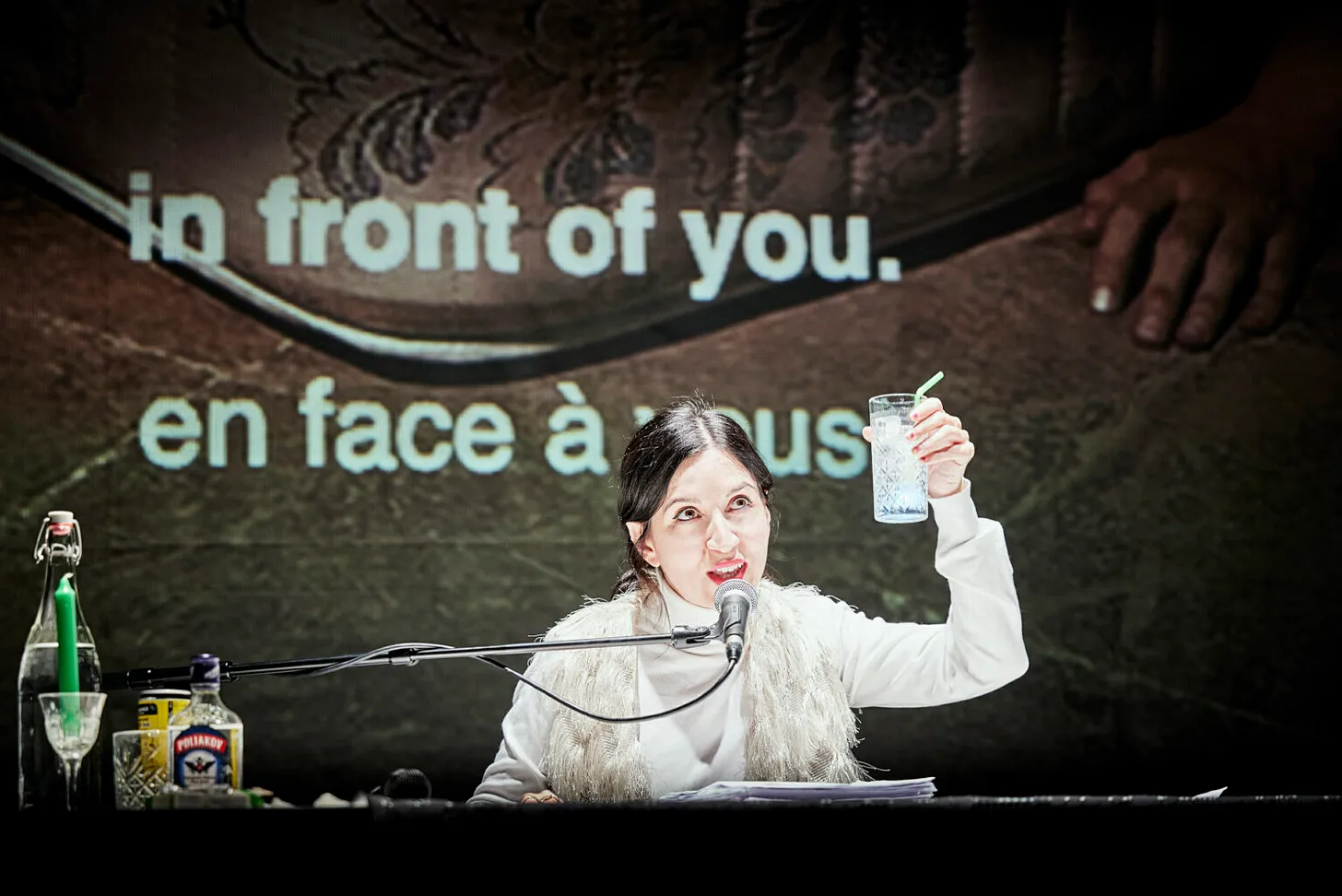
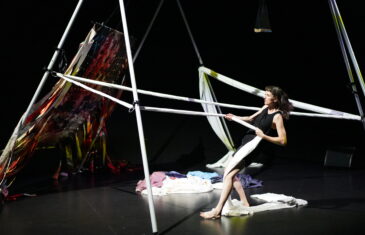
Carolina Bianchi in ‘The Bride and the Goodnight Cinderella’. © Christophe Raynaud de Lage
In Artists’ Entrance, we ask artists about their life and work. Today: writer, director and performer Carolina Bianchi. With her São Paulo-based collective CARA DE CAVALO, Bianchi has most recently created The Bride and the Goodnight Cinderella (2023) and The Brotherhood (2025).
What was your first encounter with the performing arts?
When I was a child, maybe around 6 years old, in the city I was born in, Porto Alegre (in the south of Brazil). My mother took me to an incredible marionette show about ghosts. I was completely crazy, it was so delicate, eerie, and melancholic in a way. I will never forget. And I saw it many times.
When you were a child, what did you want to be when you grew up?
A nun.
When did you know that you wanted to work in the performing arts?
I don’t really remember the moment when I made the decision to work with art, because I don’t think it ever really happened, you know? The beginning of my art history wasn’t extraordinary, or magnificent, or prodigious, or even self-aware. I don’t remember a moment when I realised: ‘I want to be an artist, I want to be that.’ Perhaps because artistic expression was at the core of how I perceived things, in the way I interacted with the world, I don’t know.
It’s not easy to describe this feeling because it may sound like something ‘destined’ and that’s not really the case. I was a child who used artistic languages because my imagination was what made me live, to be able to understand that I was alive, transforming this into my way of communicating with the world. At that time, I didn’t see myself as an ‘artist,’ but rather experiencing writing, drawing, or creating stories as something I understood as part of my existence.
I don’t come from a family with money. But my parents loved books and music. And they encouraged me to keep my interest in any artistic expression alive. My relationship with art did not begin in an intellectual way, but as an act of hunger, of extreme curiosity, I would say: of desperation for life.
“My relationship with art did not begin in an intellectual way, but as an act of hunger, of extreme curiosity, I would say: of desperation for life.”
Which performance has kept you awake recently?
I saw the poet Laura Vazquez reading her poems in Marseille recently and I was really touched by her writing, and her extreme commitment with the words.
Which performance is unforgettable?
Os sertões and Cacilda! at Teatro Oficina, directed by José Celso Martinez; Que haré yo con esa espada? by Angélica Liddell; Romeo Castellucci’s On the Concept of the Face, Regarding the Son of God; Hamlet by The Wooster Group; Grace Passô’s performance in Vaga Carne; and the concerts of the Brazilian singers Maria Bethânia and Ney Matogrosso.
What is your favorite place to be?
My house, and with my love, my cat and my books. And in the theatre, rehearsing with my team. And swimming in the sea.
Where would you like to show your work?
In my country, Brazil.
Who taught you the most in your life?
My best friend Carolina Mendonça, my mother Adriana, my grandmother Isolda, Sarah Kane, Clarice Lispector, Audre Lorde, Roberto Bolaño, Louise Gluck, Elsa Dorlin, Caetano Veloso, Marguerite Duras, Antonin Artaud, the Brazilian director José Celso Martinez Correa, the people I have worked with and those I continue to work with over the years.
What does your workplace or atelier look like?
I don’t have an atelier. I work in my house, or in hotels on tour. A computer in the middle of an obscene piles of books, and things written on a wall like in a police crime investigation.
What do you to relax?
I swim.
Or I watch very stupid harmless TV series.
What music do you have on repeat at the moment?
‘Lonely Day’, by System of a Down.
Do you have a ritual before you go on stage?
Dance some songs in the stage with my friends and check my texts and microphone, check with all the team if everything is okay, and ready.
What is the best thing about your job?
I don’t see what I do as a job. Not at all. I would say the best part of this life now is to be able to create together with people that I love and admire. And in the last years, I would add: to have the privilege to travel, to many countries and different theatres presenting my shows.
Do you have a daily practice?
Reading.
Do your parents like your work?
My parents haven’t seen my work for a long time now, because they live in Brazil and I haven’t presented my shows there in years, unfortunately. I think my mother used to like my work yes, sometimes she considered them too sad, and some images hard to watch. As for my father, I don’t know. He didn’t see much of what I did.
“I think theatre only has impact, when artists do not do what they do to create the impact.”
Does theatre have an impact?
Yes, but it is an unpredictable impact. I think the impact only exists when artists do not do what they do to create the impact. ‘Representing’ the impact, or treating it as a kind of ‘goal’ as an artist, is, in my opinion, completely pathetic. I think the real impact that theatre can have comes from a mystery, and yes, sometimes it can transform feelings and ideas in a profound way.
Often, the impact theatre has had on me has been less in a political sense of ‘well-being’, and more in making me realise new possibilities with the language of theatre itself, new possibilities for expression. And on very rare occasions, theatre can make me see something, a glimpse of a nightmare, something I cannot find the words for, something that carries me away. And when this happens, I am sure I’ve moved to a different place inside of me.
With whom would you like to collaborate one day? Are there certain artists you feel related to and why?
I would love to collaborate with a heavy metal band, or a big orchestra.
I feel related to a lot of people, artists dead and alive, especially writers. I feel deeply related with the poet Emily Dickinson. When I read her poems for the first time some years ago I was deeply disturbed by the erotic strength, the violence of the words and the form, the way it creates an enigma about her, because her biography is impossible to determine, and what we have is only this amount of poems discovered after her death.
Who would you like to see collaborate on a piece?
Samuel Beckett, Diamanda Galás and Trajal Harrell.
Have you ever had a special encounter with an audience member?
Yes. I remember being in Avignon in 2023, on the last day of the A noiva e o boa noite Cinderela [The Bride and the Goodnight Cinderella; red], a very young girl approached me at the entrance of the theatre, when I was arriving, saying it was the third day in a row she was coming to see the show, because it changed her life and her perception about what theatre is, or what theatre can do. And that this time, she brought ten friends with her and her mother and grandmother.
“Sometimes I read good reviews about my shows, but the writing only touches a first layer of the show, seeing my work as something that desires scandal. Then I can get a bit bored.”
Do you care about reviews?
Yes and no. Sometimes I read good reviews about my shows, but the writing only touches a first layer of the show, projecting a kind of agenda on my work that is really not there, or talking about biographical things that are not in the show, or seeing my work as something that desires scandal. Then I can get a bit bored.
What is the most recent note you made?
It was my touring schedule for the next three weeks. I shared it with my boyfriend so he can try to come to see me at some point. 🙂
What’s a question you’d love to answer, but that no one has ever asked you in an interview?
Questions about writing and literature.
If you would get the chance to start again and choose a new career, what would you do?
This question is impossible to me.
Do you think the theatre will survive in the future?
Yes.
Theatre is something that lives from death. It resurrects all the time.
KRIJG JE GRAAG ONS PAPIEREN MAGAZINE IN JOUW BRIEVENBUS? NEEM DAN EEN ABONNEMENT.
REGELMATIG ONZE NIEUWSTE ARTIKELS IN JOUW INBOX?
SCHRIJF JE IN OP ONZE NIEUWSBRIEF.
JE LEEST ONZE ARTIKELS GRATIS OMDAT WE GELOVEN IN VRIJE, KWALITATIEVE, INCLUSIEVE KUNSTKRITIEK. ALS WE DAT WILLEN BLIJVEN BIEDEN IN DE TOEKOMST, HEBBEN WE OOK JOUW STEUN NODIG! Steun Etcetera.
interview
20.10.2025
Leestijd 7 — 10 minuten
15.09.2025
—
14.12.2025
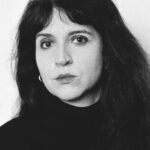
Carolina Bianchi is a writer, theatre director, and performer born in Porto Alegre-Brazil, and currently based in Europe. Her work emerges from a perspective of crisis, creating bold confabulations about sexual violence and the history of art. Her staging blends diverse references from literature and painting, centering on violence through text and bodies that incarnates sensorial and performative gestures.
She is the director of the São Paulo-based collective CARA DE CAVALO, with whom has most recently created Trilogia Cadela Força, chapter I: The Bride and the Goodnight Cinderella that premiered in Festival D’Avignon in 2023, Chapter II: the Brotherhood premiered at Kunstenfestivaldesarts in 2025. Her previous shows include O Tremor Magnífico (The Magnificent Tremor, 2020), LOBO (Wolf, 2018), and Mata-me de Prazer (Kill Me of Pleasure, 2016).
She was awarded the Silver Lion of Biennale di Danza di Venezia in 2025.
Dit artikel maakt deel uit van: Artiesteningang

Mia Vaerman
Tom Rummens
interview 20.10.2025
Mia Vaerman
Tom Rummens